The Picture of Dorian Gray Themes & Symbolism
When Oscar Wilde published The Picture of Dorian Gray in book form in 1891, he inserted a famous Preface consisting of twenty-four sharp aphorisms, including the provocative dictum: “There is no such thing as a moral or an immoral book. Books are well written, or badly written. That is all.”
Yet, despite Wilde’s public defense of pure aesthetic detachment, the narrative itself unfolds as one of the most rigorously moralistic tragedies in English literature. Behind its glittering epigrams and opulent descriptions of orchids, tapestries, and jewels, the novel dramatizes the terrifying psychological cost of severing sensory gratification from human ethics.
While our primary The Picture of Dorian Gray Study Guide outlines the plot, major characters, and historical background, this companion analysis explores the foundational themes and symbolic structures that animate Wilde’s masterpiece.
Fast Facts: Masterwork Thematic Profile
| Critical Dimension | Thematic Function in Dorian Gray |
|---|---|
| Central Motif | The Portrait: An unyielding visual record of moral guilt, conscience, and spiritual decay. |
| Philosophical Conflict | Aesthetic Hedonism vs. Ethical Conscience: Walter Pater’s doctrine taken to its extreme. |
| Psychological Structure | The Faustian Bargain: Trading the eternal soul for eternal bodily youth and beauty. |
| Societal Critique | Victorian Double Lives: The stark gulf between Mayfair drawing rooms and East End vice. |
| Literary Catalyst | The Poisonous Yellow Book: Decadent literature as an engine of psychological corruption. |
| Companion Analysis | Dorian Gray Study Guide • Dracula Themes |
1. Aestheticism and the Hedonistic Fallacy
The central philosophical engine of The Picture of Dorian Gray is the late-nineteenth-century Aesthetic Movement, which arose in rebellion against Victorian utilitarianism, industrial ugliness, and rigid evangelical moralism. Drawing inspiration from Walter Pater’s Studies in the History of the Renaissance (1873), aesthetic thinkers argued that art should exist solely for the cultivation of beauty—l’art pour l’art (art for art’s sake).
In the novel, this philosophy is articulated by Lord Henry Wotton, who advocates for a “New Hedonism”:
“A new Hedonism—that is what our century wants. You might be its visible symbol. With your personality there is nothing you could not do. The world belongs to you for a season.”
The Fatal Flaw of Lord Henry’s Doctrine
Lord Henry preaches that human beings should yield to every temptation, treating life itself as a work of art and sensations as the supreme currency of existence. However, the novel exposes a catastrophic distinction:
- Lord Henry’s Detached Spectatorship: Lord Henry is a salon philosopher who experiments with dangerous ideas from the comfort of plush armchairs. He never risks his own social standing or physical safety; he observes life through ironic detachment.
- Dorian Gray’s Destructive Literalism: Dorian takes Lord Henry’s theoretical doctrines and translates them into physical reality. Because Dorian’s body is magically insulated from aging and disease, he abandons all moral constraints, consuming human lives as disposable sensory experiences.
When Dorian callously abandons the young actress Sibyl Vane after her acting falters, he justifies his cruelty by viewing her suicide through an aesthetic lens, murmuring: “It seems to me to be simply like a wonderful ending to a wonderful play. It has all the terrible beauty of a Greek tragedy.” Wilde demonstrates that when human compassion is subordinated entirely to artistic form, the result is monstrous inhumanity.
This critique of intellectual detachment leading to moral destruction echoes Rodion Raskolnikov’s rationalist hubris in Crime and Punishment Themes & Symbolism.
2. The Triad of Influence: Artist, Critic, and Canvas
Wilde famously confessed in a personal letter: “Basil Hallward is what I think I am; Lord Henry what the world thinks me; and Dorian what I would like to be—in other ages, perhaps.”
The novel constructs a dynamic psychological and allegorical triangle among its three central male figures:
The Destruction of the Creator
The dynamic reaches its horrifying climax in Chapter 13. When Basil arrives to plead with Dorian to repent of his whispered vices, Dorian leads him to the locked attic and reveals the hideous, decomposing canvas.
Confronted with the visual evidence of Dorian’s blackened soul, Basil falls to his knees and urges Christian repentance: “Pray, Dorian, pray! What is it that one was taught to say in one’s boyhood? ‘Lead us not into temptation. Forgive us our sins. Wash away our iniquities.’ Let us say that together.”
Instead of inspiring redemption, the sight of his own degradation fills Dorian with an uncontrollable rage against the man who painted it. Dorian seizes a hunting knife and drives it repeatedly into Basil’s neck, severing the jugular vein. In killing Basil, Dorian murders his own conscience, his moral anchor, and the only figure who genuinely loved him rather than his reflection.
3. The Portrait as Conscience and the Double
In classical gothic literature, the supernatural “double” (doppelgänger) typically manifests as an identical physical twin, such as the monster in Mary Shelley’s Frankenstein or the alternate persona in Stevenson’s Dracula and Jekyll and Hyde. In The Picture of Dorian Gray, however, Wilde invents a brilliantly original variation: the double is an inanimate object that breathes and rots on canvas.
The Metaphysics of the Attic Schoolroom
When Dorian realizes that the portrait is altering, he does not keep it in his lavish library or drawing room. Instead, he locks it inside the old schoolroom at the very top of his house—a room filled with the relics of his childhood:
| Physical Detail | Literal Reality | Symbolic Meaning |
|---|---|---|
| Attic Location | Top floor, locked behind heavy bolt and iron bars. | The Freud-precursor subconscious: repression of forbidden guilt away from social gaze. |
| Childhood Setting | Room of his boyhood lessons, toys, and dead mother’s tapestry. | The sacred purity of youth permanently defiled by adult depravity. |
| Satin Pall Shroud | Covered in a gold-embroidered Venetian damask funeral shroud. | Hiding spiritual necrosis under the glittering fabric of luxury and aesthetic elegance. |
| Blood Stains on Hands | Crimson dew welling up on the painted fingers after Basil’s murder. | The inescapable biblical mark of Cain; physical matter bearing witness to sin. |
The portrait functions as an unbribable metaphysical mirror. While Victorian high society is easily duped by Dorian’s flawless, unlined porcelain face, the portrait cannot be seduced by charm or wealth. It registers the objective spiritual consequence of every lie, betrayal, and murder.
4. The Five Stages of Dorian’s Moral Dissolution
Dorian’s corruption is neither instantaneous nor accidental; it unfolds through five distinct psychological and spiritual stages:
5. The “Yellow Book” and Decadent Sensibility
In Chapter 10, Lord Henry sends Dorian a novel bound in yellow paper—a notorious contemporary packaging used for scandalous French literature. Although Wilde never names the book, at his 1895 criminal trial he admitted that he had in mind Joris-Karl Huysmans’ 1884 novel À rebours (Against Nature).
À rebours follows the eccentric, neurotic aristocrat Jean des Esseintes, who retreats from modern industrial society into an artificial hermitage where he experiments with perfumes, bizarre lighting, and exotic gems, culminating in encrusting a live tortoise’s shell with jewels until the creature suffocates under the weight of artifice.
The Book as Psychological Blueprint
For Dorian, this novel is not mere entertainment; it becomes a psychological bible:
- The Elimination of Nature: The Decadent movement privileged the artificial over the natural. Dorian seeks to construct an artificial life where biological consequences, aging, and natural moral laws are suspended.
- The Poison of Influence: Dorian buys nine copies of the book, having them bound in different luxurious colored bindings to match his changing moods. It dictates his lifestyle for eighteen years, proving Lord Henry’s opening warning: “There is no such thing as a good influence, Mr. Gray. All influence is immoral—immoral from the scientific point of view. Because to influence a person is to give him one’s own soul.”
6. Victorian Hypocrisy and Double Lives
Published only four years before Oscar Wilde’s own catastrophic arrest and imprisonment for “gross indecency” under the Criminal Law Amendment Act, The Picture of Dorian Gray provides a scathing indictment of late-Victorian moral hypocrisy.
The novel is structured around an absolute spatial and social dichotomy between two Londons:
| Spatial Realm | Characteristics & Atmosphere | Character Dynamics |
|---|---|---|
| Mayfair & Belgravia | Gilded drawing rooms, white-tie dinners, operatic evenings, and fragrant conservatories. | Outward respectability, high-stakes matchmaking, polished aristocratic conversation. |
| East End & Whitechapel | Sordid docks, foggy alleys, rat-infested opium dens, and dim taverns. | Physical degradation, anonymous debauchery, drug addiction, and violent crime. |
Victorian society, as Wilde portrays it, did not genuinely care about personal virtue; it cared exclusively about decorum and appearances. Because Dorian possesses radiant golden hair, blue eyes, and aristocratic manners, Society continually dismisses the rumors of his midnight depravities:
“Society, civilized society at least, is never very ready to believe anything to the detriment of those who are both rich and fascinating… Manners are more important than morals.”
Dorian uses his youthful beauty as a passport that allows him to commit atrocities in the East End slums while remaining the toast of Mayfair dinner tables, exposing an empire whose moral piety was entirely superficial.
This duality mirrors the double consciousness explored in Stoker’s Dracula Themes & Symbolism and Charlotte Brontë’s Jane Eyre Themes & Symbolism.
Recommended Critical Edition
To experience Oscar Wilde’s masterwork in its most authentic, gorgeously typeset form, we recommend the definitive digital release from DodaBooks:
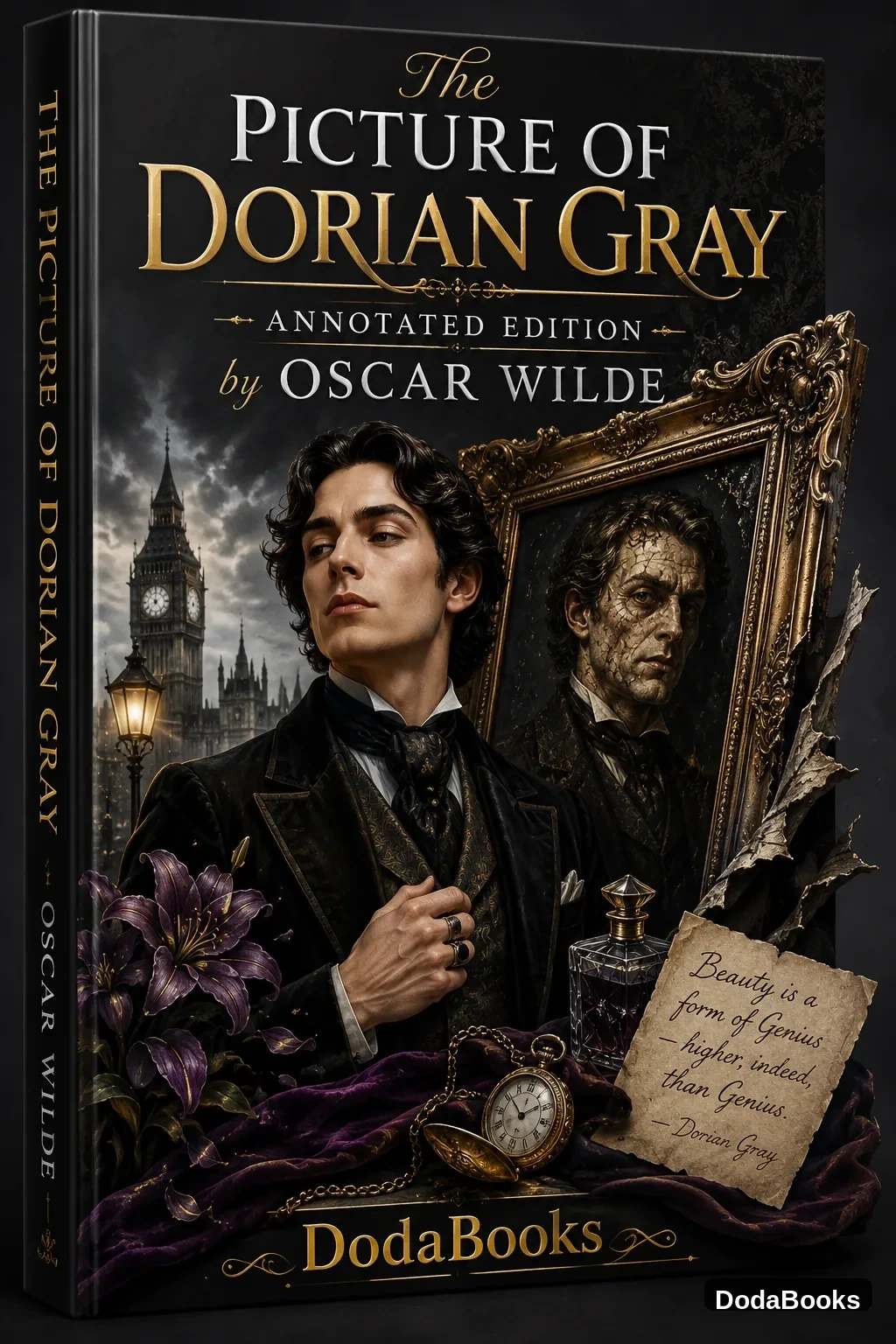
The Picture of Dorian Gray (Annotated Edition)
Discover Oscar Wilde’s immortal gothic tragedy with extensive scholarly commentary. Featuring full historical notes on Victorian Aestheticism, the Decadent movement, the 1891 Preface, and the scandalous censorship history of the original 1890 magazine text.
- Complete, authoritative 1891 revised text including Wilde's 24 Preface aphorisms
- Comprehensive annotations unpacking Huysmans' Yellow Book, Pater, and Hellenic art
- Stunning custom 3D typography and digital formatting optimized for all e-readers
- Instant EPUB download compatible with Kindle, Apple Books, and Android
Frequently Asked Questions
Why does Dorian Gray die when he stabs the portrait?
In the novel’s climactic scene, Dorian attempts to destroy the canvas because it is the sole surviving piece of evidence of his crimes and a tormenting reminder of his blackened conscience. However, because his soul and life force were magically transferred into the painting during his original Faustian wish, the portrait is his true metaphysical self. Slicing the canvas is spiritually equivalent to driving the knife into his own heart, instantly restoring the painted likeness to its original youth while transferring decades of putrefaction and murder onto Dorian’s dying corpse.
What does Sibyl Vane represent in the symbolic economy of the novel?
Sibyl Vane represents uncorrupted artistic genius and innocent, transcendent love. When she truly falls in love with Dorian, the artificial illusions of Shakespeare’s stage lose their meaning for her, leading to her clumsy performance as Juliet. Dorian’s immediate, brutal rejection of her exposes his inability to love a real human being; he loves only artifice, illusion, and his own projected vanity.
How does the theme of art vs. nature resolve in the ending of the novel?
The novel concludes with the triumph of art over mortal vanity. When the servants discover Dorian’s withered, knife-pierced body on the floor, the portrait hanging upon the wall has been miraculously restored to its pristine, radiant beauty as Basil Hallward originally painted it. Wilde suggests that while individual human beings are corrupted and destroyed by their selfish vices, true art survives untouched, eternal and incorruptible.
Explore Related Literature Masterworks
Continue your exploration of classic world literature and Victorian masterworks with our companion analyses:
- The Picture of Dorian Gray Study Guide: Our complete companion guide with chapter breakdowns, character profiles, and critical reception.
- Dracula Themes & Symbolism: Explore Bram Stoker’s gothic exploration of blood contagion, reverse colonization, and Victorian anxiety.
- Crime and Punishment Themes & Symbolism: Discover Dostoevsky’s exploration of rationalism, guilt, and the torment of moral transgressors.
- Frankenstein Themes & Symbolism: Dive into Mary Shelley’s study of scientific overreaching, parental neglect, and social isolation.