Dr. Jekyll and Mr. Hyde Study Guide: Summary & Themes
When Robert Louis Stevenson published Strange Case of Dr Jekyll and Mr Hyde in London in January 1886, it was an immediate sensation, selling forty thousand copies in its first six months and being quoted from church pulpits across Britain. What initially appeared to be a sensational Victorian mystery novella swiftly crystallized into one of the most enduring psychological allegories of Western civilization.
Behind its fog-shrouded streets, locked laboratory doors, and horrifying chemical transformations lies an acute dissection of late-Victorian culture: the stifling hypocrisy of social respectability, the terrifying implications of Darwinian evolutionary regression, and the early recognition of what Sigmund Freud would later formalize as the conflict between the civilized Superego and the untamed Id.
Fast Facts: Masterwork Overview
| Category | Detail |
|---|---|
| Author | Robert Louis Stevenson (1850–1894) |
| First Publication | January 5, 1886 (Longmans, Green & Co., London) |
| Literary Genre | Urban Gothic / Psychological Horror / Mystery Novella / Science Fiction |
| Setting | Late-Victorian London (Mayfair, Cavendish Square, and the foggy slums of Soho) |
| Narrative Form | Polyphonic epistolary mystery: third-person legal investigation, deathbed testimony, and personal confession |
| Central Conflict | The moral and intellectual hubris of Dr. Henry Jekyll vs. the unchecked atavistic malevolence of Edward Hyde |
| Climax | The breaking down of the laboratory door (Chapter 8), followed by Dr. Lanyon’s and Dr. Jekyll’s posthumous confessions |
| Key Motifs | Chemical potions, the locked cabinet, fog and gaslight, walking sticks, double doorways, handwritten wills |
1. Historical & Scientific Context
To understand Stevenson’s masterpiece, one must situate it within the intellectual seismic shifts of the late nineteenth century. The novella emerged during a period of acute crisis in Victorian religious faith, philosophical materialism, and scientific optimism.
The Double Life of Edinburgh and London
Although set in London, Stevenson grew up in Edinburgh, a city physically and socially divided into two starkly different worlds:
- The Rational New Town: Characterized by wide, neoclassical boulevards, orderly Georgian architecture, and wealthy Protestant professionals.
- The Sordid Old Town: A labyrinth of medieval tenements, narrow closes (wynds), illicit drinking dens, and rampant prostitution.
Stevenson was deeply influenced by the real-life historical figure of Deacon William Brodie (1741–1788), a respected Edinburgh town councillor and master cabinetmaker by day who led a secret gang of armed burglars by night before being executed on the gallows. Stevenson co-wrote a play about Brodie in 1880, and this historical double life served as the psychological seed for Jekyll and Hyde.
Darwinian Atavism and Criminal Anthropology
Published twenty-seven years after Charles Darwin’s On the Origin of Species (1859), Dr Jekyll and Mr Hyde reflects widespread cultural dread that if humans evolved upward from primitive primates, they could also degenerate backward down the evolutionary ladder.
This concept was formalized by Italian criminologist Cesare Lombroso, whose 1876 treatise L’Uomo Delinquente (Criminal Man) argued that habitual criminals were biological “throwbacks” (atavisms) who possessed identifiable physical traits: elongated arms, prominent jaws, asymmetrical skulls, and an inability to feel moral empathy. Stevenson deliberately encodes these Lombrosian traits into Edward Hyde, whom onlookers describe not through specific physical deformities, but as radiating an aura of prehistoric, ape-like malice:
“Mr. Hyde was pale and dwarfish, he gave an impression of deformity without any nameable malformation, he had a displeasing smile, he had borne himself to the lawyer with a sort of murderous mixture of timidity and boldness… God bless me, the man seems hardly human! Something troglodytic, shall we say?”
This anxiety of biological atavism connects Stevenson’s novella directly to Bram Stoker’s Dracula Themes & Symbolism and Mary Shelley’s Frankenstein Study Guide.
2. Urban Gothic Topography: The Architecture of the Soul
In Dr. Jekyll and Mr. Hyde, Victorian London is not merely a passive backdrop; it is an active architectural allegory of the human psyche. Stevenson constructs a spatial binary that mirrors the moral split of his protagonist:
The Door as Moral Boundary
The novella opens not with Dr. Jekyll, but with Mr. Utterson and his cousin Enfield walking past a mysterious, blistered door in Chapter 1 (“Story of the Door”). The door has no knocker, no bell, and is defaced by tramps and mischievous children.
This door is physically connected to the back of Jekyll’s mansion—once the surgical amphitheatre of a celebrated anatomist. By having Jekyll enter through the polished front door and Hyde emerge through the decaying back door, Stevenson dramatizes how easily late-Victorian gentlemen could compartmentalize their personalities, walking out of respectable social circles straight into degraded vice without detection.
This spatial hypocrisy directly anticipates the Mayfair drawing rooms and East End opium dens of Oscar Wilde’s The Picture of Dorian Gray Study Guide.
3. The Metamorphosis: Jekyll’s Descent into Addiction
One of the most radical aspects of Stevenson’s narrative is its depiction of chemical dependency. Rather than invoking medieval demonology or black magic, Jekyll isolates his alter ego through chemical psychopharmacology: a mixture of volatile white crystalline salts and a blood-red tincture.
Jekyll’s relationship with Hyde follows the precise clinical progression of substance addiction:
The Paradox of the Impure Salt
In Chapter 10 (“Henry Jekyll’s Full Statement of the Case”), Stevenson introduces a tragic scientific irony: the potion worked initially not because of Jekyll’s pharmacological brilliance, but because of an unknown impurity in the original batch of commercial salt he purchased from the wholesale chemist.
When Jekyll orders fresh supplies to synthesize an antidote, the new salts are chemically pure and prove completely ineffective. This detail transforms the story from a simple cautionary tale about dangerous science into a metaphysical tragedy: Jekyll did not discover a fundamental law of nature; he stumbled into an accidental, irreversible chemical trap. Evil was easily summoned, but virtue could not be restored by formula.
4. Narrative Architecture: Polyphony and the Legal Mystery
Unlike modern film adaptations which reveal Jekyll and Hyde’s identity in the opening scene, Stevenson structured his original text as a forensic detective mystery.
The story is told through three distinct narrative layers:
| Narrative Section | Perspective & Tone | Epistemological Function |
|---|---|---|
| Chapters 1–8 | Third-person limited through Mr. Gabriel John Utterson, a dry, pragmatic Victorian lawyer. | Represents conservative, empirical Victorian society trying to explain irrational horror using legal logic and blackmail theories. |
| Chapter 9 | First-person epistolary confession by Dr. Hastie Lanyon, a traditional materialist physician. | The psychological destruction of orthodox Victorian science: Lanyon witnesses Hyde drink the potion and dies of sheer existential shock. |
| Chapter 10 | First-person posthumous testament by Dr. Henry Jekyll. | The internal subjective truth: the tragic autobiography of an intellectual who destroyed himself through moral compartmentalization. |
Why Stevenson Chose Utterson as Detective
Mr. Utterson is the ultimate personification of Victorian bachelor professionalism: undemonstrative, loyal, silent, and obsessed with avoiding social scandal. When he suspects that Mr. Hyde is blackmailing Dr. Jekyll, Utterson does not contact the police; he seeks to protect his friend’s reputation at all costs.
Stevenson uses Utterson’s intellectual blindness to critique Victorian society. Utterson is so committed to rational explanations that he cannot conceive of the metaphysical truth staring him in the face. Even when he discovers Hyde’s body dressed in Jekyll’s clothes inside the locked laboratory, Utterson still assumes Jekyll has been murdered and his body hidden away.
This critique of narrow rationalism failing before existential psychological truth mirrors Porfiry Petrovich’s interrogation of Raskolnikov in Crime and Punishment Study Guide.
5. Major Themes & Critical Interpretations
1. The Duality of Human Nature
In his confession, Jekyll makes his most famous philosophical pronouncement:
“With every day, and from both sides of my intelligence, the moral and the intellectual, I thus drew steadily nearer to that truth, by whose partial discovery I have been doomed to such a dreadful shipwreck: that man is not truly one, but truly two.”
Jekyll’s fatal mistake was believing that by separating his two natures, both could flourish independently. Instead, he discovers that while Hyde is pure, unadulterated evil, Jekyll remains a compromised mixture of good and evil. Hyde possesses the intoxicating energy of the animalistic Id, whereas Jekyll is trapped in self-deceptive guilt.
2. Silence, Repression, and Social Complicity
Throughout the novel, the gentlemen of London enter into a tacit pact of silence to preserve decorum:
- In Chapter 1, after witnessing Hyde trample a child, Enfield and the crowd force Hyde to pay £100 rather than publicly expose the respected gentleman whose signature is on the check.
- When Enfield and Utterson pass the sinister door, Enfield declares his golden rule: “I am ashamed of my long tongue. Let us make a bargain never to refer to this again.”
- Utterson locks Dr. Lanyon’s revelatory letter inside his private safe, refusing to open it until Jekyll is dead.
Stevenson suggests that Victorian society itself created Edward Hyde: by demanding total public perfection and punishing natural human flaws with social ostracism, society forced men to hide their vices in the shadows, where they festered into monstrous pathologies.
Recommended Critical Edition
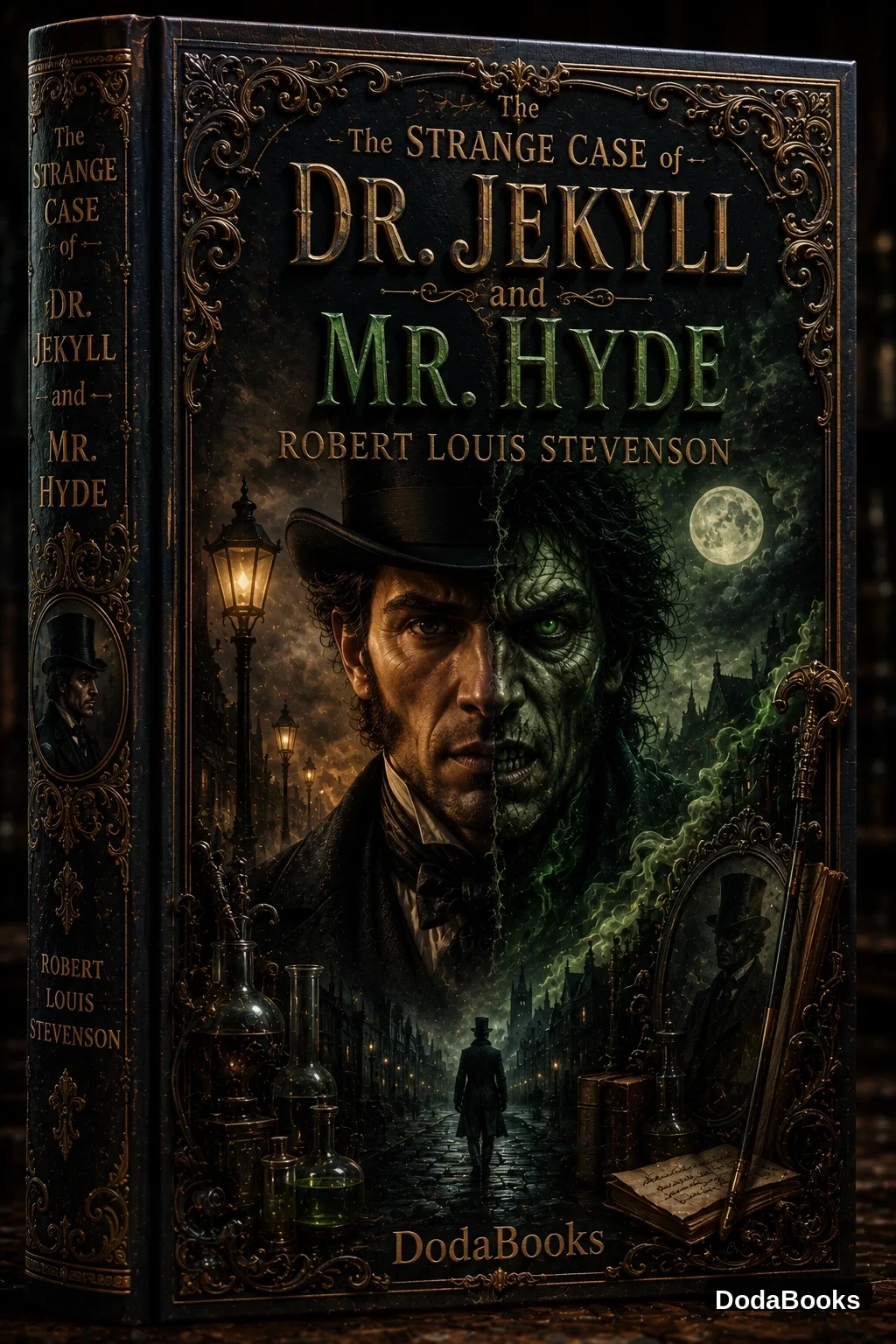
For scholars, collectors, and readers seeking the definitive reading experience with historical annotations, Victorian medical context, and Edinburgh architectural notes, we recommend the unabridged edition from DodaBooks:
The Strange Case of Dr. Jekyll and Mr. Hyde
Experience Robert Louis Stevenson’s timeless psychological masterpiece in an authoritative digital edition. Featuring extensive historical annotations covering Victorian psychopharmacology, Edinburgh's dual architecture, Deacon Brodie's trial, and Lombrosian criminology.
- Complete, authoritative 1886 unabridged text with original chapter divisions
- Scholarly annotations explaining Victorian medical science and urban topography
- Exquisite custom 3D typography and digital formatting optimized for all screens
- Instant EPUB download compatible with Kindle, Apple Books, and Android
Frequently Asked Questions
Why does Dr. Lanyon die after witnessing Hyde’s transformation into Jekyll?
Dr. Hastie Lanyon represents rigid, orthodox Victorian scientific materialism. Throughout his career, he dismissed Jekyll’s research as “unscientific balderdash.” When he physically witnesses Hyde drink the potion and transform into Dr. Jekyll, his entire intellectual worldview is shattered. The horror of discovering that the supernatural exists and that human nature is fundamentally divided induces profound psychological shock, causing his physical health to collapse within weeks.
Why is Edward Hyde physically smaller and younger than Dr. Jekyll?
Dr. Jekyll explains in his final confession that Edward Hyde represents the evil side of his nature, which had been less developed and less exercised throughout his life due to his constant efforts to maintain social respectability. Because Jekyll’s malevolent impulses had been repressed for decades, Hyde was smaller, lighter, and more youthful. However, as Jekyll indulged his alter ego more frequently, Hyde grew in stature and strength, eventually overpowering Jekyll completely.
What is the significance of Sir Danvers Carew’s murder?
The brutal murder of Sir Danvers Carew in Chapter 4 marks the point of no return for Dr. Jekyll. Carew is an innocent, white-haired Member of Parliament who represents the pinnacle of Victorian political and social order. Hyde beats him to death with a heavy cane without the slightest provocation or motive. This atrocity proves that Hyde is not merely a vehicle for harmless private pleasures; he is a sadistic monster who takes joy in destroying civilization itself.
Explore Related Literature Masterworks
Continue your exploration of classic world literature and gothic masterpieces with our companion analyses:
- The Picture of Dorian Gray Study Guide: Dive into Oscar Wilde’s companion tragedy of aestheticism, double lives, and the rotting portrait of the soul.
- Frankenstein Study Guide: Summary, Characters & Analysis: Explore Mary Shelley’s landmark study of scientific hubris, creator responsibility, and biological experimentation.
- Dracula Themes & Symbolism: Analysis of Key Motifs: Examine Bram Stoker’s exploration of blood contagion, reverse colonization, and Victorian imperial anxieties.
- Crime and Punishment Study Guide: Summary & Analysis: Discover Dostoevsky’s psychological autopsy of transgression, rationalism, and moral resurrection.