Dr. Jekyll and Mr. Hyde Characters: Jekyll & Hyde
Robert Louis Stevenson’s 1886 masterpiece Strange Case of Dr Jekyll and Mr Hyde is universally renowned as the quintessential narrative of the divided self. Yet reducing Stevenson’s characters to a cartoonish polarity between saintly doctor and monstrous goblin obscures the profound psychological subtlety of his characterizations. Stevenson constructs a tight ensemble of late-Victorian gentlemen whose friendships, professional rivalries, and shared social hypocrisies form the crucible in which Dr. Jekyll’s fatal experiment takes place.
Every major figure in the novella—from the repressed, forensic lawyer Gabriel Utterson to the dogmatic materialist Dr. Hastie Lanyon—functions as an ideological and psychological foil. Together, they dramatize the profound moral tensions of late-nineteenth-century London: the conflict between empirical materialism and transcendental mysticism, between outward Victorian respectability and the dark, unlegislated impulses of the animal subconscious.
While our Dr. Jekyll and Mr. Hyde Study Guide traces the novella’s plot progression and Dr. Jekyll and Mr. Hyde Themes & Symbolism examines its philosophical motifs, this character analysis provides an exhaustive deconstruction of Stevenson’s key personalities.
Character Roster & Structural Foils Matrix
Stevenson arranges his cast with architectural precision, balancing the volatile duality of Jekyll and Hyde against the austere, rationalist observers of Victorian legal and medical institutions:
| Character | Social / Professional Role | Core Motivation | Fatal Flaw / Vulnerability | Ultimate Fate |
|---|---|---|---|---|
| Dr. Henry Jekyll | Prestigious MD, DCL, LLD, FRS; Philanthropist | Scientific transcendence, moral compartmentalization | Faustian pride; addiction to illicit freedom without consequence | Commits suicide via cyanide behind his locked cabinet door |
| Edward Hyde | Jekyll’s chemical alter-ego; Savage predator | Pure instinctual pleasure, destruction, self-preservation | Total lack of empathy; escalating sadism and animalistic fury | Dies dressed in Jekyll’s oversized clothes in the laboratory |
| Gabriel John Utterson | Senior Chancery Lawyer; Jekyll’s executor | Duty, loyalty, preserving gentlemanly reputation | Extreme reticence; emotional repression; resistance to intuition | Solves the mystery through posthumous documents |
| Dr. Hastie Lanyon | Eminent Cavendish Square physician | Empirical materialism, orthodox scientific dogma | Intellectual rigidity; intolerance of transcendental inquiry | Dies of psychic and physical shock after witnessing the transformation |
| Mr. Poole | Jekyll’s loyal domestic butler of twenty years | Protecting his master; household order | Bound by servant hierarchy until fear forces him to act | Breaks down the laboratory door alongside Utterson |
| Richard Enfield | Man about town; Utterson’s distant cousin | Social entertainment, maintaining decorum | Cynical detachment; refusal to ask probing questions | Retires from the investigation into the mysterious door |
| Sir Danvers Carew | Member of Parliament; Victorian aristocrat | Benevolent public service; aristocratic dignity | Physical fragility; defenseless against atavistic violence | Bludgeoned to death in the street by Hyde’s heavy cane |
1. Dr. Henry Jekyll: Faustian Hubris and Chemical Addiction
Dr. Henry Jekyll is not an innocent man who falls prey to an external demonic infection. He is an ambitious, fifty-year-old physician of immense wealth, distinguished lineage, and intellectual brilliance who harbors a lifelong psychological rift:
“I was born to a large fortune, endowed besides with excellent parts, inclined by nature to industry, fond of the respect of the wise and good among my fellow-men, and thus, as might have been supposed, with every guarantee of an honourable and distinguished future. And indeed the worst of my faults was a certain impatient gaiety of disposition… which I found it hard to reconcile with my imperious desire to carry my head high, and wear a more than commonly grave countenance before the public.”
The Psychology of Addiction
Jekyll’s relationship with Hyde operates precisely according to the clinical dynamics of addiction:
- The Euphoric Honeymoon: The first time Jekyll swallows the potion, he experiences excruciating physical pain followed by an exhilarating sensation of lightness, youth, and unrestrained sensory freedom: “I felt younger, lighter, happier in body; within I was conscious of a heady recklessness, a current of disordered sensual images running like a millrace in my fancy, a solution of the bonds of obligation.”
- The Rationalization of Immunity: Jekyll convinces himself that he has solved the fundamental problem of human suffering. If he wants to indulge his dark appetites, he can simply step into Hyde’s skin; when finished, he can drink the potion, return to his study as Dr. Jekyll, and sit before the hearth as a blameless, smiling gentleman: “Jekyll had more than a father’s interest; Hyde had more than a son’s indifference.”
- Tolerance and Escalation: Over months of indulgence, Hyde demands greater stimulation. What began as petty nocturnal debaucheries escalates into random cruelty—trampling a young girl in the street, breaking a shopkeeper’s window, and eventually the frenzied bludgeoning of Sir Danvers Carew.
- Physical and Mental Dependence: The turning point occurs when Jekyll goes to sleep in his Cavendish Square bedroom as the doctor and awakens in the morning with the small, hairy, dusky hand of Edward Hyde resting upon the counterpane. He has transformed without the potion. The chemical is no longer needed to unleash Hyde; rather, massive doses are required merely to keep Hyde at bay. When his supply of the impure chemical salt is exhausted, Jekyll faces total psychic extinction.
2. Edward Hyde: The Primal Id and Evolutionary Throwback
Edward Hyde is the most terrifying figure in nineteenth-century urban Gothic literature because his monstrosity is entirely human yet entirely devoid of humanity. While Frankenstein’s monster in Frankenstein Characters Analysis is articulate, educated, and desperate for human fellowship, Edward Hyde feels nothing toward other human beings except contempt, disgust, and predatory lust.
The Visceral Impact of Hyde’s Appearance
Stevenson never provides an exhaustive, anatomical description of Hyde’s facial features. Instead, he describes the visceral, somatic revulsion Hyde provokes in everyone who beholds him:
- Mr. Enfield: “He is not easy to describe. There is something wrong with his appearance; something displeasing, something downright detestable. I never saw a man I so disliked, and yet I scarce know why. He must be deformed somewhere; he gives a strong feeling of deformity, although I couldn’t specify the point.”
- Gabriel Utterson: “God bless me, the man seems hardly human! Something troglodytic, shall we say?… Or can it be the old story of Dr. Fell, or Is it the mere radiance of a foul soul that thus transpires through, and transfigures, its clay continent?”
- The Instinctive Nausea: Even the doctor summoned to treat the trampled girl—described by Enfield as a cold, unemotional Scotsman—turns “sick and white with the desire to kill him.” This universal revulsion stems from the fact that Hyde represents the pure, concentrated signature of Satan within the human animal—a sight our civilized instincts recognize with biological dread.
Hyde’s Malicious Vandalism
In the novella’s final chapters, Hyde’s behavior shifts from indulgence to frantic, spiteful warfare against Jekyll himself:
- Hyde resents Jekyll’s attempts to suppress him and retaliates by tormenting the doctor’s psyche.
- He burns Jekyll’s letters, slashes the portrait of Jekyll’s father, and scribbles “startling blasphemies” in the margins of Jekyll’s favorite Christian theological treatises.
- Yet, despite his hatred of Jekyll, Hyde clings frantically to Jekyll’s body as his only sanctuary from the gallows, illustrating the symbiotic parasite trapped within a crumbling host.
3. Gabriel John Utterson: The Reticent Victorian Investigator
Gabriel John Utterson is the narrative lens of the entire novella. Stevenson introduces him on the opening page with one of the most famous character portraits in English prose:
“Mr. Utterson the lawyer was a man of a rugged countenance that was never lighted by a smile; cold, scanty and embarrassed in discourse; backward in sentiment; lean, long, dusty, dreary and yet somehow lovable… He was austere with himself; drank gin when he was alone, to mortify a taste for vintages; and though he enjoyed the theatre, had not crossed the doors of one for twenty years.”
Utterson as the Embodiment of Repression
Utterson’s tragic limitation is his absolute immersion in the Victorian code of non-interference. When confronted with evidence of monstrous abnormalities, Utterson stubbornly seeks conventional, mundane explanations:
- The Blackmail Hypothesis: Believing that Hyde is blackmailing Jekyll over some youthful sexual indiscretion or financial crime, Utterson attempts to rescue Jekyll from a criminal parasite.
- The Suppression of Evidence: When Utterson receives Jekyll’s confession and Lanyon’s sealed narrative, his primary instinct is to lock them inside his private iron safe, keeping the scandal buried beneath legal seals.
- The Mirror of Jekyll: Utterson represents what Jekyll might have been had he possessed the discipline to endure Victorian repression. While Utterson “mortifies” his desires through self-denial, Jekyll attempts to chemically cheat his desires, producing catastrophe.
4. Dr. Hastie Lanyon: The Orthodox Scientific Rationalist
Dr. Hastie Lanyon of Cavendish Square represents the pinnacle of orthodox, respectable Victorian medical authority:
- The Split in Science: Lanyon and Jekyll were lifelong friends and medical colleagues who fell out over theoretical doctrine. Lanyon dismissed Jekyll’s inquiries into the spiritual constitution of matter as “fanciful,” writing them off as “scientific balderdash.”
- The Encounter with the Impossible: When Jekyll, trapped in Hyde’s body in a hotel in Soho, sends an urgent letter commanding Lanyon to fetch the chemical powders from his laboratory cabinet, Lanyon complies out of professional loyalty.
- The Demonstration of Doom: In Lanyon’s private consulting room, Hyde offers the doctor a choice: let him depart with the mixture, or remain and witness a discovery that would “open up to you a new province of knowledge and new avenues to fame and power.” Lanyon’s scientific curiosity overcomes his revulsion:
“He put the glass to his lips and drank at one gulp. A cry followed; he reeled, staggered, clutched at the table and held on, staring with injected eyes, gasping with open mouth; and as I looked there came, I thought, a change—he seemed to swell—his face became suddenly black and the features seemed to melt and alter—and the next moment, I had sprung to my feet and leaped back against the wall, my arms raised to shield me from that prodigy, my mind submerged in terror.”
- The Epistemological Death: The sight of Hyde transforming into Jekyll does not merely frighten Lanyon; it obliterates his entire framework of reality. His dogmatic empiricism cannot survive the proof that matter and spirit can be manipulated through chemical alchemy. Lanyon takes to his bed and dies of neurological shock within weeks.
5. Secondary Characters & Catalytic Agents
Stevenson’s supporting cast grounds the novella’s supernatural horror in the tangible social realities of Victorian London:
Mr. Poole: The Boundary-Breaking Butler
Poole is Jekyll’s loyal domestic servant of twenty years. Bound by the rigid hierarchies of Victorian domestic servitude, Poole remains silent for weeks as his master locks himself in the laboratory cabinet. When Poole hears strange weeping from behind the door and sees a masked, dwarfish creature rummaging through the chemical supplies, his human devotion overcomes servant etiquette:
- He walks across London in the howling night to seek Utterson’s help.
- Armed with an axe, Poole assists Utterson in battering through the four-inch red baize door of the cabinet, symbolizing the collapse of domestic order in the face of psychological horror.
Richard Enfield: The Cynical Observer
Enfield is Utterson’s distant cousin and walking companion. Described as a fashionable “man about town,” Enfield is the first to encounter Hyde:
- Enfield witnesses Hyde trampling the child at 3:00 AM, yet his primary concern is avoiding a public scene.
- He uses the threat of social disgrace to extract a hundred pounds from Hyde, demonstrating how the Victorian elite prioritized financial settlements and reputation management over genuine moral accountability.
Sir Danvers Carew: The Sacrificial Aristocrat
Sir Danvers Carew is an elderly Member of Parliament whose murder elevates Hyde from a sordid street thug to a fugitive of national consequence:
- Carew’s white hair, gentle demeanor, and polite inquiry about directions make his butchery particularly heinous.
- His death signifies the assault of raw, atavistic savagery upon the highest institutions of British civilized governance.
Comparative Foil Matrix: Psychological Dynamics
Stevenson crafts pairs of foils whose contrasts expose the novel’s thematic core:
| Primary Character | Foil Character | Thematic Contrast |
|---|---|---|
| Dr. Henry Jekyll | Edward Hyde | The divided, guilty Social Ego vs. the uninhibited, remorseless Primal Id. |
| Dr. Henry Jekyll | Gabriel Utterson | The man who cheats moral repression through chemicals vs. the man who endures repression through discipline. |
| Dr. Henry Jekyll | Dr. Hastie Lanyon | The mystical, transcendental pioneer vs. the rigid, dogmatic empirical materialist. |
| Gabriel Utterson | Richard Enfield | The dutiful investigator who cannot look away vs. the cynical dandy who refuses to ask questions. |
| Edward Hyde | Sir Danvers Carew | The savage, atavistic animal vs. the frail, polite symbol of Victorian aristocratic order. |
Recommended Critical Edition
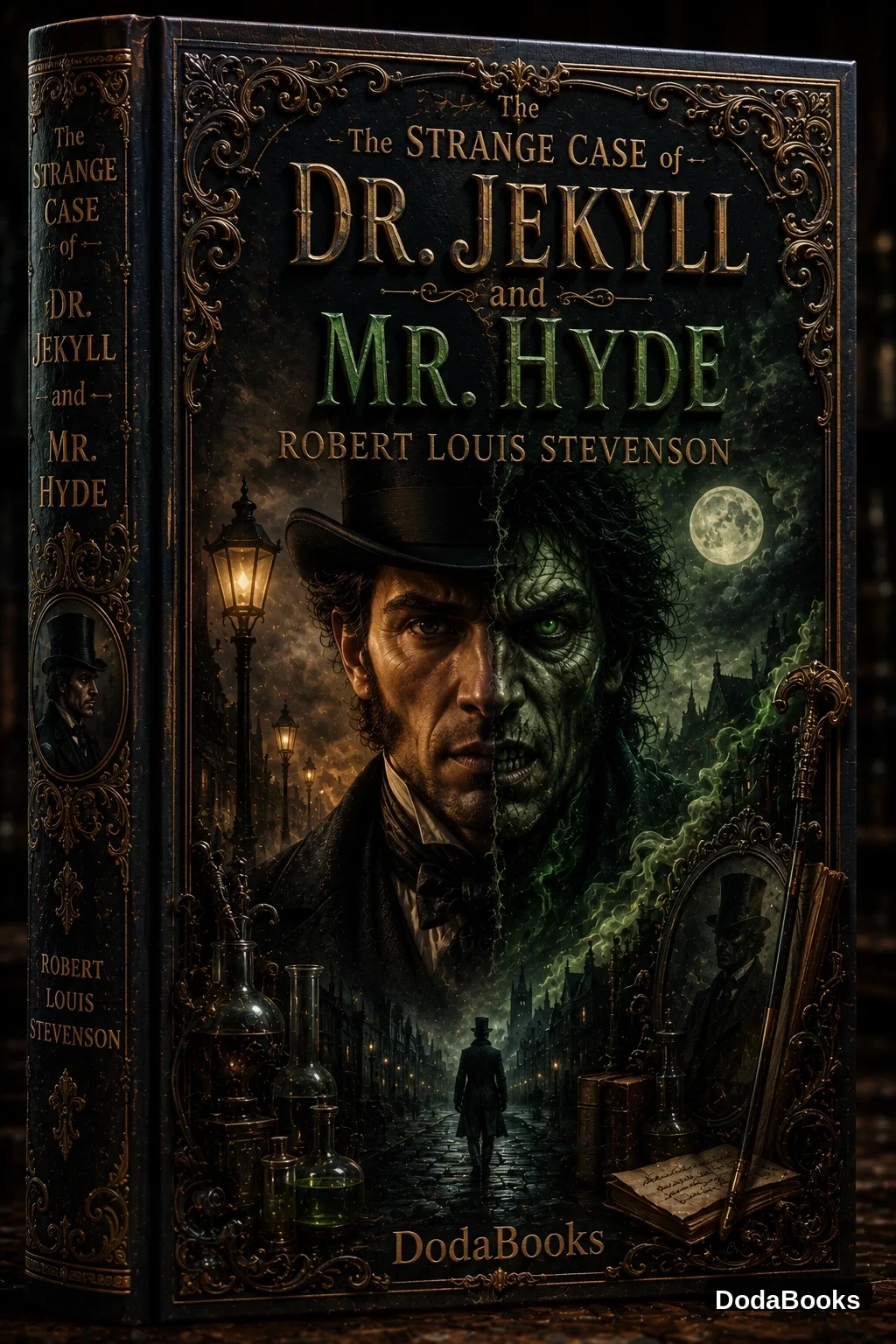
For university students, literature professors, and serious readers seeking the definitive unabridged text with extensive character breakdowns, psychological glossaries, and historical essays, we recommend the unabridged edition from DodaBooks:
Frequently Asked Questions
Does Dr. Jekyll feel remorse for the crimes committed by Edward Hyde?
Dr. Jekyll experiences acute, agonizing remorse initially, but his remorse is profoundly self-serving. Whenever Hyde commits a crime, Jekyll is terrified not for the victims, but for his own social reputation and the prospect of the gallows. He attempts to soothe his conscience by opening his purse to charitable causes and redoubling his Christian philanthropy. However, because he continually preserves Hyde’s wardrobe, money, and lodgings in Soho, his moral repentance remains fundamentally insincere until involuntary transformations strip away his power of choice.
Why is Gabriel Utterson so reluctant to report Dr. Jekyll to the police?
Gabriel Utterson is bound by the nineteenth-century gentlemanly ethos of class solidarity and privacy. In Victorian society, exposing a fellow gentleman of high standing to criminal investigation or public scandal was considered an unforgivable social betrayal. Utterson assumes that Jekyll is being blackmailed by Hyde over some youthful indiscretion and believes that as Jekyll’s lawyer and friend, his sacred duty is to resolve the matter privately and protect Jekyll’s family honor from public degradation.
What is the significance of the final clothes Edward Hyde is found wearing?
When Poole and Utterson break into the laboratory cabinet following Hyde’s suicide, they find Hyde’s dead body dressed in Dr. Jekyll’s expensive clothes, which are far too large for Hyde’s dwarfish, stunted frame: “The body was dressed in clothes far too large for him, clothes of the doctor’s bigness.” This striking image visually demonstrates the grotesque incongruity of their relationship: the primitive, atavistic animal attempting to clothe itself in the tailored dignity of Victorian civilization, exposing the failure of culture to conceal biological beastliness.
Related Masterwork Guides & Deconstructions
Continue your exploration of classic world literature, Gothic horror, and psychological character arcs with our companion guides:
- Dr. Jekyll and Mr. Hyde Study Guide: Full Analysis: The foundational comprehensive study guide to Stevenson’s novella.
- Dr. Jekyll and Mr. Hyde Themes: Victorian Dualism: Deconstruct the chemical potion, urban gothic geography, and evolutionary atavism.
- Frankenstein Characters Analysis: Victor & Creature: Analyze Mary Shelley’s hubristic creator, the articulate Creature, and their deadly psychological warfare.
- The Picture of Dorian Gray Study Guide: Aestheticism & Decay: Examine Oscar Wilde’s portrait of Victorian double lives, hedonism, and spiritual decay.
- Dracula Characters Analysis: Van Helsing & Foils: Explore Bram Stoker’s occult predator, the Crew of Light, and Victorian sexual anxieties.