Frankenstein Characters: Analysis of Victor & Monster
When nineteen-year-old Mary Wollstonecraft Shelley published Frankenstein; or, The Modern Prometheus in 1818, she created a foundational psychological myth of modern industrial civilization. Departing from traditional eighteenth-century gothic specters, Shelley relocated terror within the human psyche, investigating the ethical responsibilities of scientific creation, the destructive nature of intellectual obsession, and the social etiology of violence.
At the core of the tragedy is the symbiotic, mirrored relationship between Victor Frankenstein—the ambitious Genevan scientist blinded by Promethean hubris—and his unnamed Creature—an eight-foot-tall sentient being whose innate benevolence curdles into homicidal fury upon experiencing universal human abandonment. Framing their cataclysmic pursuit across the globe is Captain Robert Walton, whose polar voyage serves as both the narrative lens and the moral double of Victor’s ambition.
While our companion Frankenstein Study Guide and Frankenstein Themes & Symbolism explore historical Vitalism debates and the Prometheus myth, this comprehensive study provides an academic character analysis of Shelley’s cast, examining their psychological dynamics, philosophical archetypes, and tragic arcs.
Master Character Roster & Archetypal Matrix
| Character | Societal Role | Archetype | Core Conflict & Tragic Flaw |
|---|---|---|---|
| Victor Frankenstein | Genevan natural philosopher | The Modern Prometheus / Negligent Creator | Hubristic desire to conquer mortality vs. narcissistic terror and abandonment. |
| The Creature | Reanimated biological creation | The Fallen Angel / The Abjected Double | Innate benevolence and desire for fellowship vs. monstrous alienation and vengeance. |
| Captain Robert Walton | Arctic explorer & epistolary narrator | The Framing Double / Romantic Explorer | Obsessive ambition for polar glory vs. moral responsibility toward his crew. |
| Elizabeth Lavenza | Victor’s adopted sister and bride | The Domestic Angel / Decorative Sacrifice | Selfless maternal devotion vs. absolute vulnerability to patriarchal neglect. |
| Henry Clerval | Genevan humanist scholar | The Romantic Foil / Humanist Counterweight | Wholesome poetic fellowship vs. collateral destruction by Victor’s shadow. |
| Justine Moritz | Loyal Frankenstein family servant | The Innocent Martyr / Institutional Victim | Catholic spiritual purity vs. legal perjury and judicial execution. |
| The De Lacey Family | Exiled French aristocrats in Germany | The Pastoral Ideal / Social Blindness | Domestic virtue and high culture vs. instinctual visual prejudice. |
1. Victor Frankenstein: The Narcissistic Pathology of Creation
Victor Frankenstein is neither a cartoonish mad scientist nor an evil sadist; he is a brilliant, upper-class Genevan scholar whose tragedy stems from narcissistic Promethean overreaching:
The Genesis of Obsession
Raised in idyllic Genevan domesticity, Victor is indulged by adoring parents who treat him as a cherished idol. This privileged upbringing nurtures an inflated sense of cosmic entitlement:
- The Allure of Ancient Alchemy: As a boy, Victor immerses himself in the mystical writings of Cornelius Agrippa, Paracelsus, and Albertus Magnus, yearning not merely for empirical science, but for god-like power: the elixir of life and the philosopher’s stone.
- The Trauma of Maternal Mortality: When his mother Caroline Beaufort dies of scarlet fever, Victor’s psyche suffers an existential rupture. His scientific ambition transforms into a desperate, subconscious compulsion to conquer mortality itself—to defeat death and rob the grave of its victims.
- The Eroticization of the Charnel House: At the University of Ingolstadt, under the encouragement of Professor Waldman, Victor isolates himself completely from human society. He spends two years in solitary confinement, raiding ossuaries, dissecting rotting corpses, and torturing living animals to extract the secret of life.
Victor’s fundamental sin is not that he created life, but that he abandoned the life he created. By fleeing his newborn creation without food, guidance, or emotional shelter, Victor initiates the catastrophic cycle of reciprocal vengeance.
2. The Creature: The Noble Savage’s Descent into Monsterhood
The Creature is Mary Shelley’s most profound philosophical triumph: a sentient, eight-foot-tall being whose interior consciousness embodies John Locke’s tabula rasa and Jean-Jacques Rousseau’s theory of the “noble savage”:
The Education of the Senses and the Mind
Through the Creature’s six-chapter central confession in the icy caves of Montanvert, Shelley provides an astonishing first-person account of sensory awakening:
- The State of Nature: Waking alone in the forest of Ingolstadt, the Creature possesses no language, conceptual thought, or malice. He experiences light, dark, hunger, and cold as raw sensory data, weeping with natural joy at the songs of forest birds.
- The Acquired Language: Hiding in the hovel adjoining the De Lacey cottage, the Creature observes human domestic affection through a chink in the wallboard. He teaches himself to speak and read by listening to Felix instruct the Turkish Arabian exile Safie.
- The Found Library: Discovering a leather portmanteau containing three monumental books, the Creature acquires profound intellectual sophistication:
- Plutarch’s Lives: Teaches him civic virtue, politics, and the history of human empires.
- The Sorrows of Young Werther: Teaches him delicate emotional empathy, romantic melancholia, and existential sorrow.
- Paradise Lost: Teaches him theology, cosmic order, and his own horrifying status as an abandoned Adam turned into a vengeful Satan.
The Double: The Master-Slave Inversion
As the novel accelerates, Victor and the Creature undergo an absolute Hegelian master-slave dialectical inversion:
- At the outset, Victor is the sovereign creator and the Creature is his helpless biological byproduct.
- In Chapter 20, the Creature confronts Victor in the Orkneys: “You are my creator, but I am your master;—obey!”
- Victor’s refusal to grant the Creature sympathy transforms the Creature into an omnipresent shadow that systematically slaughters Victor’s loved ones: his brother William, his friend Clerval, and his bride Elizabeth.
- By the novel’s conclusion on the arctic ice sheet, Victor has become identical to the Creature: a feral, isolated wraith consumed by homicidal mania, stripped of family, nation, and humanity.
3. Captain Robert Walton: The Framing Mirror of Ambition
Captain Robert Walton is the essential third vertex of the novel’s psychological triangle:
Walton as Victor’s Surrogate
Writing letters to his sister Margaret Saville in England from the ice-choked waters of the Arctic Ocean, Walton mirrors Victor’s exact psychological profile:
- Intoxication with Glory: Walton is willing to sacrifice his fortune, his health, and the lives of his crew to achieve immortal fame: “I would sacrifice my fortune, my existence, my every hope, to the furtherance of my enterprise. One man’s life or death were but a small price to pay for the acquirement of the knowledge which I sought.”
- The Longing for a Soulmate: In his second letter, Walton laments his bitter loneliness: “I have no friend, Margaret: when I am glowing with the enthusiasm of success, there will be none to participate in my joy; if I am assailed by disappointment, no one will endeavour to sustain me in dejection.”
- When Victor is pulled half-frozen from the drifting ice floe, Walton recognizes him as the noble brother his soul craved.
4. Elizabeth Lavenza and Justine Moritz: The Sacrificial Women
Mary Shelley—daughter of the pioneering feminist philosopher Mary Wollstonecraft (author of A Vindication of the Rights of Woman)—uses the female characters in Frankenstein to offer an incisive critique of the passive, decorative role assigned to women in patriarchal society:
Elizabeth Lavenza: The Idealized Object
Introduced into the Frankenstein household as an adopted Italian orphan, Elizabeth is literally presented to young Victor as a gift:
- Victor recalls: “I, with childish seriousness, interpreted her promise literally, and looked upon Elizabeth as mine—mine to protect, love, and cherish… a possession of my own.”
- Elizabeth embodies the Victorian “Angel in the House”: beautiful, selfless, gentle, and utterly confined to the domestic sphere. She waits patiently for years while Victor vanishes into Ingolstadt, sending anxious letters of tender devotion.
- Her murder on their wedding night in Evian is the direct consequence of Victor’s solipsism. Victor searches the corridors of the inn with pistols drawn, convinced the Creature intends to assassinate him, while leaving Elizabeth defenseless in the bridal suite. Her strangulation exposes the fatal blindness of male egocentrism.
Justine Moritz: The Martyr of Institutional Cruelty
Justine Moritz serves as the innocent scapegoat who exposes the moral bankruptcy of both religious and civil justice in Geneva:
- Framed by the Creature, who slips William’s miniature portrait into her pocket, Justine is arrested for murder.
- During her trial, Victor sits in the courtroom paralyzed by cowardice, refusing to reveal the Creature’s existence because the public would dismiss him as a lunatic.
- Justine’s Catholic confessor threatens her with excommunication and hellfire until she falsely confesses to a crime she did not commit. Her execution on the scaffold demonstrates that respectable society murders the innocent through legal bureaucracy with the same brutality that the Creature murders through physical force.
5. Henry Clerval: The Humanist Counterweight
Henry Clerval represents the wholesome, integrated humanist ideal that Victor abandons in his monomaniacal quest for scientific power:
Clerval studies poetry, medieval romances, and Oriental languages (Persian, Arabic, and Sanskrit). When Victor collapses into a brain fever following the creation of the monster, Clerval nurses him back to health with tender devotion. Clerval represents the balance between intellect and emotion—a life lived in harmonious communion with literature, nature, and fellow human beings.
When the Creature strangles Clerval in Ireland, Victor’s last link to moral sanity is severed. Clerval’s death signifies the destruction of humanism by unbridled, unethical technological overreach.
6. The De Lacey Family: The Tragedy of Visual Prejudice
The French exile family dwelling in the German forest—blind father De Lacey, his son Felix, daughter Agatha, and Turkish bride Safie—represents the highest ideal of domestic virtue and European culture:
- The Sanctuary of Sound: Inside the cottage, the blind father judges reality through sound and speech. When the Creature enters alone, the old man welcomes him with warmth and dignity, recognizing his articulate eloquence and gentle heart: “I am blind and cannot judge of your countenance, but there is something in your words which persuades me that you are sincere.”
- The Horror of Sight: The instant Felix and Agatha enter, visual prejudice destroys compassion. Felix attacks the Creature with a walking stick, terrified by his grotesque visage, while Agatha faints in horror.
- The Lesson of Rejection: This rejection shatters the Creature’s faith in human goodness. If the most refined, loving family in Europe responds to his deformity with violence, then all humanity is his enemy. That night, the Creature burns the cottage to the ground in a blazing dance of rage, severing his last tie to civil peace.
Recommended Critical Edition
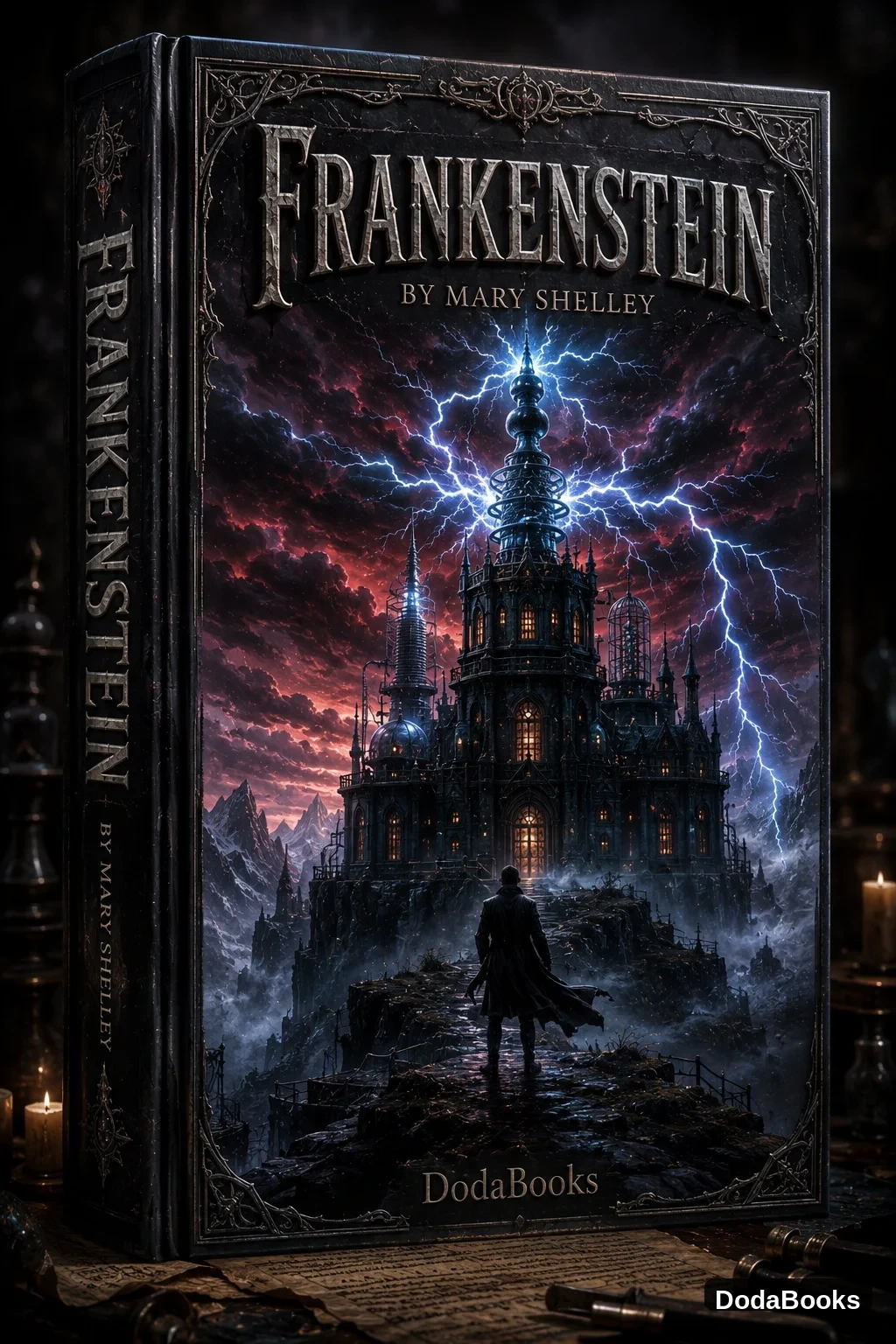
For literature teachers, university students, and scholars seeking the authoritative 1818 text with exhaustive character profiles, historical annotations on the Vitalism debate, and feminist criticism, we recommend the definitive edition from DodaBooks:
Frankenstein: Fully Annotated 1818 Text
Discover Mary Shelley’s immortal classic in a magnificent scholarly presentation. Featuring the complete unabridged 1818 text, exhaustive character profiles, historical footnotes on nineteenth-century galvanism and vitalism debates, and feminist critical essays.
- Complete, authoritative unabridged 1818 novel text
- Comprehensive character analyses comparing Victor, Walton, and the Creature
- Exquisite custom 3D typography and digital formatting optimized for modern e-readers
- Instant EPUB download compatible with Kindle, Apple Books, and Kobo
Frequently Asked Questions
Why does the Creature never receive a proper name throughout the novel?
The Creature’s namelessness is one of Shelley’s most profound symbolic choices. In biblical tradition, naming is the fundamental act of parental recognition, love, and social incorporation (as when Adam names the animals and God names man). By denying the Creature a name, Victor refuses him a legitimate identity, family lineage, and place in human society. Referred to only as “monster,” “fiend,” “daemon,” “wretch,” and “the creature,” his lack of a name symbolizes his absolute social disenfranchisement and existential abandonment.
How does the 1818 original text differ from Mary Shelley’s 1831 revision regarding Victor’s character?
In the original 1818 text, Victor is depicted with greater psychological complexity, active moral agency, and culpable culpability for his scientific choices. In her 1831 revision—written after the tragic deaths of her husband Percy Bysshe Shelley and three of her children—Mary Shelley significantly altered the narrative tone. In 1831, Victor is portrayed as a passive victim of an unavoidable cosmic destiny and deterministic fate, downplaying his personal hubristic responsibility to make the novel more acceptable to conservative Victorian readers.
What are the Creature’s final intentions at the conclusion of the novel?
In the closing scene in Walton’s cabin, the Creature stands weeping over Victor’s corpse, confessing his agony and remorse: “Blasted as thou wert, my agony was still superior to thine; for the bitter sting of remorse will not cease to rankle in my wounds until death shall close them for ever.” The Creature announces his intention to journey to the furthest northern reaches of the arctic ice, build a funeral pyre, and burn his body to ashes so that no future scientist can discover his remains and replicate the cursed experiment.
Explore Related Literature Masterworks
Continue your exploration of classic world literature and psychological character arcs with our companion analyses:
- Frankenstein Study Guide: Summary, Characters & Analysis: The foundational comprehensive study guide to Mary Shelley’s Romantic masterpiece.
- Frankenstein Themes & Symbolism: Analysis of Key Motifs: Deconstruct the Modern Prometheus myth, vitalism, fire, and the arctic ice.
- Dracula Study Guide: Summary, Characters & Themes: Explore Bram Stoker’s foundational Victorian vampire thriller of infection, tracking, and gothic terror.
- Hamlet Study Guide: Tragedy, Characters & Themes: Examine Shakespeare’s supreme tragedy of revenge ethics, philosophical skepticism, and psychological doubles.