The Great Gatsby Study Guide: Summary, Characters & Analysis
F. Scott Fitzgerald once observed that “the test of a first-rate intelligence is the ability to hold two opposed ideas in the mind at the same time, and still retain the ability to function.” In The Great Gatsby (1925), that double consciousness belongs to the narrator, Nick Carraway: a Yale-educated Midwestern bond salesman simultaneously enchanted and repelled by the inexhaustible variety and moral emptiness of high society during the summer of 1922.
Beneath the lyrical prose, glittering jazz orchestras, and clinking champagne glasses, Fitzgerald constructed an unsparing autopsy of the American Dream in the aftermath of the First World War. The novel investigates how unconstrained consumer capitalism, hereditary class snobbery, and criminal underworld syndicates intersected to transform America’s founding ideals into a hollow spectacle of commodities.
This study guide provides students, educators, and literary researchers with a rigorous critical framework: combining quick-reference facts, a chronological plot summary, the topography of Long Island class division, Prohibition economics, and key textual citations.
For focused thematic and symbolic breakdowns, consult our companion guide: The Great Gatsby Themes & Symbolism.
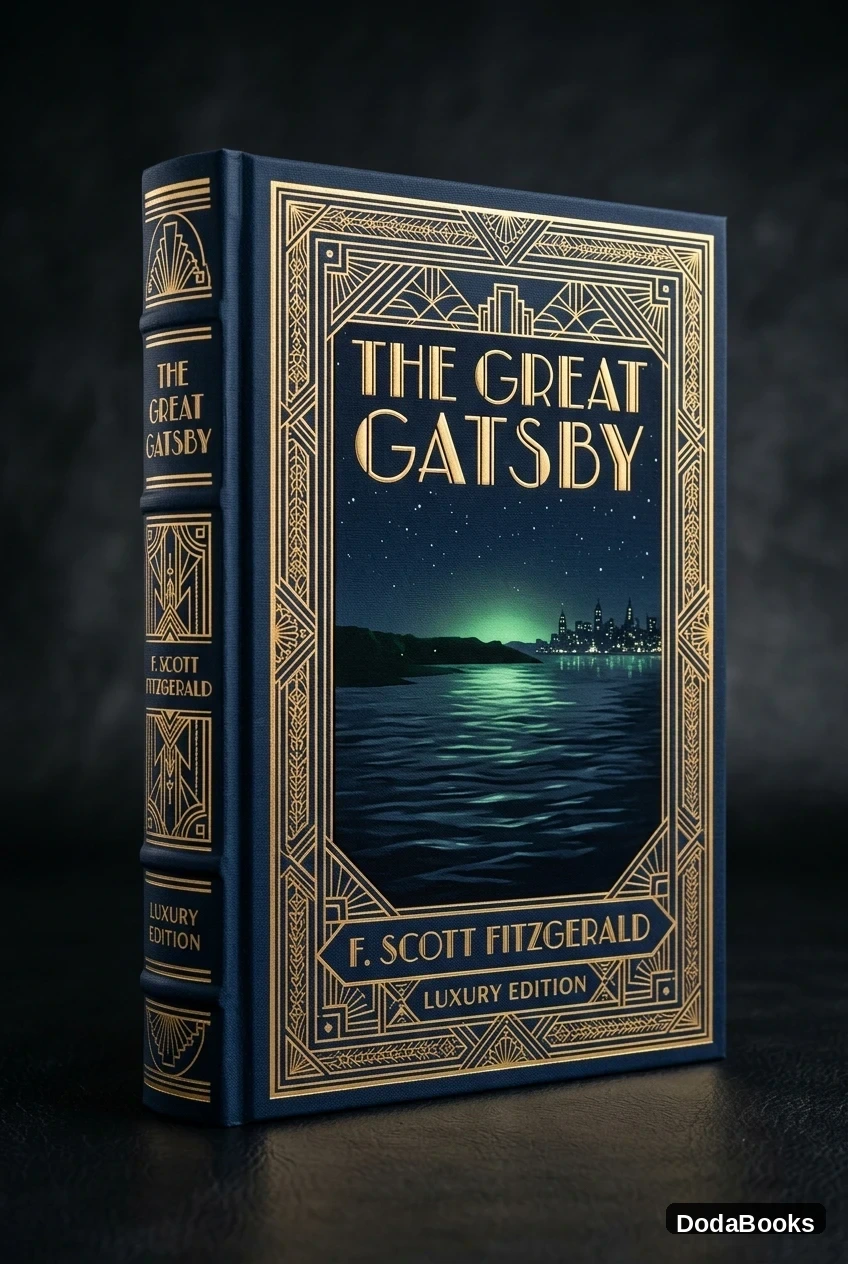
Fast Facts: Masterwork Overview
| Element | Specification |
|---|---|
| Full Title | The Great Gatsby |
| Author | F. Scott Fitzgerald (1896–1940) |
| Publication Date | April 10, 1925 (Charles Scribner’s Sons, New York) |
| Genre | Modernist Fiction, Social Realism, Jazz Age Tragedy, Tragedy of Manners |
| Point of View | First-person limited / retrospective narration (Nick Carraway) |
| Setting | Long Island Sound (East Egg and West Egg), New York City (The Plaza Hotel, 158th Street apartment), and the Valley of Ashes (Queens), Summer 1922 |
| Protagonist / Antihero | Jay Gatsby (born James Gatz in North Dakota) |
| Central Conflict | Gatsby’s monomaniacal quest to recreate the past and win back Daisy Buchanan through ostentatious criminal wealth |
| Climax | The confrontation in the Plaza Hotel suite followed by Daisy fatally striking Myrtle Wilson with Gatsby’s yellow Rolls-Royce |
2-Minute Plot Summary
In the spring of 1922, twenty-nine-year-old Nick Carraway leaves Minnesota to learn the bond business on Wall Street, renting a modest $80-a-month cottage in the unfashionable Long Island community of West Egg. His immediate neighbor is Jay Gatsby, an enigmatic multi-millionaire who lives in a gigantic faux-Norman marble mansion and hosts lavish, hedonistic weekend parties for hundreds of uninvited New York socialites.
Across the bay in aristocratic East Egg live Nick’s distant cousin Daisy Buchanan and her brutish husband Tom, a former Yale football star born into hereditary Gilded Age wealth. Over dinner, Nick meets cynical professional golfer Jordan Baker and discovers that Tom maintains a brazen extramarital affair with Myrtle Wilson, the vulgar wife of George Wilson, an impoverished garage mechanic living in the desolate industrial wasteland known as the Valley of Ashes.
Gatsby invites Nick to one of his extravagant parties. Nick discovers that Gatsby does not drink, does not mingle with his guests, and watches the crowd with vigilant detachment. Through Jordan Baker, Nick learns the secret truth: five years earlier in Louisville, poor army lieutenant James Gatz fell in love with wealthy southern belle Daisy Fay. After Gatsby was shipped to France in World War I, Daisy married Tom Buchanan for his social status and $350,000 pearl necklace. Gatsby bought his colossal mansion directly across the water to stare at the green light at the end of Daisy’s dock, staging his parties in the desperate hope she might wander in.
Gatsby asks Nick to arrange a private tea reunion at his cottage. Overcoming initial awkwardness, Gatsby and Daisy rekindle their affair, touring Gatsby’s estate where Daisy weeps into his imported English silk shirts.
The crisis erupts on the suffocatingly hot final day of summer at the Plaza Hotel in Manhattan. Tom confronts Gatsby, exposing his Oxford pedigree as a fraud and revealing that his millions derive from illicit drugstore bootlegging and stolen bond syndicates with mobster Meyer Wolfsheim. Tom taunts Gatsby that he can never buy his way into East Egg aristocracy. Terrified by Tom’s revelation and Gatsby’s sudden flash of murderous fury, Daisy retreats, begging to go home. Cruelly demonstrating his total dominance, Tom orders Daisy to drive back with Gatsby in his yellow Rolls-Royce.
Speeding through the Valley of Ashes, the car fatally strikes Myrtle Wilson, who ran into the road believing Tom was behind the wheel. The yellow car flees the scene without stopping. Later that evening, Nick discovers Gatsby standing vigil in the Buchanans’ bushes; Gatsby confesses that Daisy was driving, but insists he will take the blame. Inside the house, Nick watches through the kitchen window as Tom and Daisy sit at a table over cold fried chicken and ale, conspiring in intimacy: “They were not happy… yet they were not unhappy either. There was an unmistakable air of natural intimacy about the picture.”
The next afternoon, George Wilson, unhinged by grief and led by Tom Buchanan to believe Gatsby was both Myrtle’s lover and her killer, walks to West Egg. He shoots Gatsby dead in his marble swimming pool and immediately shoots himself.
Nick attempts to organize Gatsby’s funeral, but the hundreds of guests who drank his champagne vanish. Meyer Wolfsheim refuses to attend, claiming he cannot get mixed up with dead men. Daisy and Tom pack their trunks and depart without leaving an address or sending flowers. Only Nick, Gatsby’s heartbroken elderly father Henry C. Gatz, and an unnamed bespectacled guest (“Owl Eyes”) attend the burial. Disgusted by the moral rottenness of the East, Nick breaks his romance with Jordan Baker and returns to the Midwest, reflecting on Gatsby’s colossal capacity for hope.
The Topography of Class: East Egg, West Egg, and the Ashes
Fitzgerald organizes his critique of American capitalism spatially. The geography of the novel is not a passive backdrop; it is an economic coordinate system measuring social legitimacy and moral decay:
Generational wealth, Georgian colonial palaces, and brutal carelessness. Daisy and Tom are insulated by inherited pedigree and lawyers.
Gaudy, theatrical excess financed overnight by bootlegging and bond fraud. Gatsby's faux-Norman palace represents raw, uncredentialed ambition.
The desolate dumping ground between Long Island and Manhattan. Working-class victims like George and Myrtle Wilson choke on the soot of capitalism.
The pressure-cooker of moral compromise, secret apartments, and violent confrontations where the facade of polite society disintegrates.
- East Egg (The Hereditary Aristocracy): White colonial palaces overlooking Long Island Sound. Tom and Daisy Buchanan do not produce; their wealth is generational, rooted in Gilded Age railroads and real estate. Their defining characteristic is an unshakeable, brutal carelessness. They are protected by a forcefield of inherited manners, lawyers, and elite pedigree.
- West Egg (The Nouveau Riche Parvenus): The home of sudden, vulgar wealth. Gatsby’s colossal faux-Norman hotel, forty acres of lawns, marble swimming pool, and neon hydroplanes represent wealth earned overnight through wartime speculation, speakeasies, and syndicate crime. No matter how much money Gatsby spends, East Egg views him as a gaudy impostor.
- The Valley of Ashes (The Industrial Scrapyard): Halfway between West Egg and Manhattan lies Queens—a desolate dumping ground where industrial ashes take the shape of houses, chimneys, and grotesque men. This is the physical byproduct of the luxury enjoyed in the Eggs, populated by disposable working-class figures like George and Myrtle Wilson who choke on the soot of American industrial production.
- The Billboard of Dr. T.J. Eckleburg: Two gigantic blue spectacles perched over nonexistent eyes, staring from an abandoned optometrist’s advertisement across the ash heaps. In Fitzgerald’s moral universe, traditional Christian providence has vacated the sky, replaced by a weathered marketing billboard staring indifferently over human waste.
The Economic Underworld: Prohibition and the Bond Racket
Gatsby’s romantic myth—Oxford education, war medals from Montenegro, hunting big game in the capitals of Europe—is an elaborate theatrical facade designed to achieve social equivalence with Daisy Fay. But where did the money truly come from?
Fitzgerald grounds Gatsby’s fortune in the real criminal syndicates of 1922:
- The Volstead Act & “Drugstore” Bootlegging: Under the 18th Amendment, alcohol could still be dispensed legally for “medicinal purposes” with a physician’s prescription. Gatsby and his associate Meyer Wolfsheim bought up hundreds of side-street pharmacies in Chicago and New York, using them as retail fronts to distribute grain alcohol over the counter.
- The Stolen Bond Syndicates: In Chapter 9, a long-distance telephone call from Chicago interrupts Gatsby’s wake: “Young Parke’s in trouble… they picked him up when he handed the bonds over the counter.” Gatsby was liquidating millions of dollars in stolen municipal circular bonds through fraudulent brokerage networks.
- Meyer Wolfsheim (Arnold Rothstein): Wolfsheim’s cufflinks are made of human molars, and he is explicitly identified as the man who fixed the 1919 World Series.
Gatsby is not a self-made industrialist in the mold of Andrew Carnegie or Thomas Edison. He is an operative of modern criminal syndicate capitalism, demonstrating that in 1920s America, the fastest elevator to immense wealth was bypassing the law entirely.
Gatsby’s Fatal Error: The Conflation of Voice and Value
The tragedy of Jay Gatsby is not that he was dishonest about his past; it is that he invested his immense romantic capacity into a woman incapable of bearing its metaphysical weight.
When Nick attempts to identify the elusive charm of Daisy Buchanan, Gatsby states the reality with shocking candor:
“Her voice is full of money,” he said suddenly. “That was it. I’d never understood before. It was full of money—that was the inexhaustible charm that rose and fell in it, the jingle of it, the cymbals’ song of it… high in a white palace the king’s daughter, the golden girl.”
Daisy does not represent an actual, complex human being to Gatsby; she is the tangible embodiment of everything he was denied as the dirt-poor James Gatz of North Dakota. In Chapter 5, when Gatsby throws his imported English silk and linen shirts across the bedroom table, Daisy breaks down weeping: “They’re such beautiful shirts… it makes me sad because I’ve never seen such—such beautiful shirts before.”
Their reunion is mediated entirely through luxury commodities. The moment Daisy touches the illusion, the illusion begins to dissolve under the weight of material reality:
“Possibility of an infinite youth had ceased. The colossal vitality of his illusion had gone beyond Daisy, beyond everything. He had thrown himself into it with a creative passion, adding to it all the time, decking it out with every bright feather that drifted his way.”
The Final Diagnosis: Tom, Daisy, and the Retreat into Capital
When the catastrophe arrives at the Plaza Hotel, Tom Buchanan exposes Gatsby’s criminal syndicate background. Daisy panics, runs down Myrtle Wilson with Gatsby’s yellow Rolls-Royce, and allows Gatsby to absorb the guilt.
Nick’s judgment in Chapter 9 remains the definitive verdict on the American oligarchy:
“They were careless people, Tom and Daisy—they smashed up things and creatures and then retreated back into their money or their vast carelessness, or whatever it was that kept them together, and let other people clean up the mess they had made.”
Tom and Daisy do not suffer legal punishment, social ostracism, or moral guilt; their generational wealth acts as an impenetrable shield. George Wilson kills Gatsby in his swimming pool and turns the revolver on himself, while the Buchanans pack their luxury luggage and depart for Europe, entirely immune to the human wreckage left behind.
Recommended Critical Editions
The Great Gatsby: The Jazz Age Annotated Text
Complete unabridged 1925 novel accompanied by 200+ historical annotations detailing 1920s bond syndicates, Prohibition slang, luxury automobile mechanics, and critical essays on modernist style.
- ✓ Unabridged 1925 Scribner Text
- ✓ 200+ Historical Prohibition & Wall Street Notes
- ✓ Long Island Topographical Maps
- ✓ DRM-Free Instant EPUB & PDF Download
Related Literature Study Guides
Explore our comprehensive library of literary masterwork analyses:
- The Great Gatsby Themes & Symbolism: An analysis of the green light, the Valley of Ashes, Eckleburg’s eyes, and colors.
- The Great Gatsby Characters Analysis: Deep psychological analysis of Jay Gatsby, Daisy, Nick, Tom, and Myrtle.
- Moby-Dick Study Guide: The definitive master guide to Melville’s epic, featuring labor economics, cetology, and chapter summaries.
- The Pequod in Moby-Dick: Ship Meaning & Symbolism: The barbaric architecture and 30-man union microcosm of Melville’s whaleship.
- Pride and Prejudice Study Guide: Fee tail male entailment, class realism, and narrative irony in Jane Austen.
- Frankenstein Study Guide: The Vitalism controversy, Romantic science, and paternal responsibility in Mary Shelley.
- Crime and Punishment Study Guide: Russian nihilism, utilitarian rationalism, and spiritual resurrection in Dostoevsky.
- Jane Eyre Study Guide: Victorian governess paradox, female autonomy, and Bertha Mason in Charlotte Brontë.
Frequently Asked Questions
What does the Green Light symbolize at the end of Daisy’s dock?
The green light symbolizes Jay Gatsby’s yearning for Daisy Fay, representing his romantic hope, the attainability of the past, and the colossal promise of the American Dream. In the final chapter, Nick expands the symbol to encompass the historical vision of Dutch sailors first glimpsing the untouched North American continent—an orgastic future that perpetually recedes before us.
How did Jay Gatsby actually make his fortune?
Gatsby earned his wealth through organized crime during Prohibition in partnership with underworld boss Meyer Wolfsheim (modeled on Arnold Rothstein). Their syndicates bought up hundreds of side-street drugstores in Chicago and New York to illegally distribute grain alcohol over the counter and traded millions of dollars in fraudulent municipal bonds.
Why is Nick Carraway considered an unreliable narrator?
Nick begins by claiming he is “inclined to reserve all judgements” and boasts that he is “one of the few honest people that I have ever known.” However, he actively facilitates Tom’s extramarital affair with Myrtle, arranges Gatsby’s secret reunion with the married Daisy, conceals Daisy’s guilt in the hit-and-run death of Myrtle, and colors his narrative with romantic nostalgia for Gatsby’s colossal vitality.