The Picture of Dorian Gray Study Guide & Analysis
When Oscar Wilde’s only novel, The Picture of Dorian Gray, appeared in Lippincott’s Monthly Magazine in July 1890, the critical backlash was savage. The Daily Chronicle denounced the work as “a poisonous book, the atmosphere of which is heavy with the mephitic odours of moral and spiritual putrefaction.” The Scots Observer went further, declaring that the author ought to be prosecuted, asking whether the story was written for “none but outlawed noblemen and perverted telegraph-boys.”
In response to the moral hysteria, Wilde famously added an aphoristic Preface to the expanded 1891 book edition, declaring: “There is no such thing as a moral or an immoral book. Books are well written, or badly written. That is all.” Yet beneath its sparkling epigrams and aesthetic posturing, The Picture of Dorian Gray is one of the most devastating moral allegories in the Western canon: a cautionary tale demonstrating that the absolute separation of art and sensuality from human ethics inevitably leads to spiritual rot and violent self-destruction. For a specialized exploration of the portrait motif, the Yellow Book, and Pater’s philosophy, read our companion guide on The Picture of Dorian Gray Themes & Symbolism.
Fast Facts: Masterwork Overview
| Category | Detail |
|---|---|
| Author | Oscar Wilde (1854–1900) |
| First Publication | July 1890 (Lippincott’s Monthly Magazine); revised 20-chapter book edition published April 1891 (Ward, Lock & Co.) |
| Literary Genre | Decadent Fiction / Aesthetic Gothic / Philosophical Novel / Faustian Parable |
| Setting | Late-Victorian London (Mayfair, Grosvenor Square, Covent Garden, Whitechapel opium dens), c. 1870s–1890s |
| Narrative Form | Third-person omniscient narrative laden with paradoxes, dialogue epigrams, and lush aesthetic descriptions |
| Central Conflict | The pursuit of absolute aesthetic and sensory indulgence vs. the inescapable claims of conscience, morality, and time |
| Climax | Dorian’s attempt to destroy the rotting canvas with Basil Hallward’s murder knife (Chapter 20), resulting in his own death |
| Key Motifs | The portrait, the “Yellow Book,” the locked schoolroom, mirrors, opium dens, orchids, white narcissus flowers |
2-Minute Plot Summary: Structural Architecture
The Picture of Dorian Gray is structured across twenty chapters, tracing Dorian’s transition from an uncorrupted, beautiful young aristocrat to a ruthless sensualist and murderer:
- The Studio & The Faustian Wish (Chapters 1–3): In the studio of artist Basil Hallward, Lord Henry Wotton admires a breathtaking, life-sized portrait of young aristocrat Dorian Gray. When Dorian arrives, Lord Henry seduces him with his hedonistic philosophy: youth and physical beauty are the supreme goods in life, and both are fleeting. Overwhelmed by terror of aging, Dorian utters a fateful Faustian prayer: “If it were I who was to be always young, and the picture that was to grow old! For that—for that—I would give everything! Yes, there is nothing in the whole world I would not give! I would give my soul for that!”
- The Sibyl Vane Tragedy & The First Alteration (Chapters 4–8): Dorian falls in love with Sibyl Vane, a seventeen-year-old actress performing Shakespeare in a squalid London theater. When Basil and Lord Henry attend her performance of Juliet, Sibyl acts abominably; she explains to Dorian that because she has experienced real earthly love, stage artifice now feels meaningless. Disgusted that her artistic illusion has collapsed into ordinary reality, Dorian brutally rejects her. Returning to his home, he discovers that the expression on the portrait has subtly altered: the mouth shows a sneer of cold cruelty. The next morning, Dorian learns Sibyl has swallowed prussic acid and died; under Lord Henry’s guidance, Dorian chooses to view her suicide not as a tragedy, but as a masterpiece of dramatic poetry.
- The Attic Sanctuary & The Poisonous Book (Chapters 9–11): Terrified that Basil or his servants will discover the canvas’s changes, Dorian locks the painting in his old childhood schoolroom at the top of the house. Lord Henry sends Dorian a “poisonous” French yellow-backed novel (widely identified as Joris-Karl Huysmans’ À rebours), detailing the life of a Parisian decadent who exhausts every sensory pleasure. For the next eighteen years, Dorian immerses himself in perfumes, jewels, ecclesiastical vestments, and debauchery, maintaining his angelic physical youth while rumors of ruined reputations follow him through London society.
- The Murder of Basil Hallward (Chapters 12–14): On the eve of his thirty-eighth birthday, Basil visits Dorian to urge him to repent and refute the horrific scandals surrounding his name. In a fury of resentment, Dorian leads Basil up to the locked schoolroom and pulls back the curtain, revealing the grotesque, rotting demon staring from the canvas. When Basil weeps and begs Dorian to pray, Dorian is seized by an uncontrollable spasm of hatred, grabs a painter’s knife, and repeatedly stabs Basil to death. Dorian blackmails an estranged chemist friend, Alan Campbell, into dissolving Basil’s corpse with nitric acid.
- The Opium Den, The Retribution & The End (Chapters 15–20): Haunted by his crime, Dorian flees to a squalid East End opium den, where he is ambushed by Sibyl’s vengeful sailor brother, James Vane. Dorian escapes only by pointing out his twenty-year-old face—proving he could not have ruined Sibyl eighteen years earlier. When James Vane is accidentally killed by a shooting party in the country, Dorian resolves to reform his life. He checks the portrait, hoping his decision to spare a country girl (Hetty Merton) has healed the image. Instead, the canvas looks even more repulsive, dripping with fresh blood and wearing an expression of hypocritical vanity. In desperate fury, Dorian seizes the knife that killed Basil and stabs the canvas. Hearing a piercing scream, his servants break in to find the portrait restored to its radiant youthful perfection, while lying on the floor is a withered, wrinkled, and loathsome old man with a knife through his heart, recognized only by his rings.
Aestheticism, Walter Pater, and the “Yellow Book”
To grasp the intellectual foundation of Dorian Gray, one must understand late-Victorian Aestheticism and Decadence.
"To burn always with this hard, gem-like flame, to maintain this ecstasy, is success in life." A philosophy of intense sensory and artistic receptivity.
Sensation divorced from ethical consequence; treating human souls as disposable artistic experiments and seeking forbidden thrills to escape boredom.
1. Walter Pater and the Pursuit of Sensation
Wilde was a student of Oxford critic Walter Pater, whose 1873 book Studies in the History of the Renaissance urged readers to live for intense sensory and artistic impressions rather than abstract dogmas. Pater warned that time is a rushing stream; therefore, the wise individual maximizes moments of exquisite aesthetic appreciation.
Lord Henry Wotton adopts Pater’s ideas but vulgarizes them into a cynical doctrine called the “New Hedonism”:
“A new Hedonism—that is what our century wants. You might be its visible symbol. With your personality there is nothing you could not do. The world belongs to you for a season… The only way to get rid of a temptation is to yield to it. Resist it, and your soul grows sick with longing for the things it has forbidden to itself.”
2. J.K. Huysmans’ À Rebours (The “Yellow Book”)
In Chapter 11, Lord Henry sends Dorian a yellow-backed French novel that dictates Dorian’s life for nearly two decades. During Wilde’s 1895 libel trial against the Marquess of Queensberry, the prosecutor demanded to know if the book was Joris-Karl Huysmans’ 1884 decadent masterwork À rebours (Against Nature).
Wilde admitted under oath that it was heavily inspired by Huysmans. In À rebours, the reclusive aristocrat Jean des Esseintes retreats into a hermetic chateau, decorating his environment with exotic scents, perfumed liquors, and a live tortoise encrusted with gold and gems (which dies from the weight). In Dorian Gray, this aesthetic withdrawal transforms from a harmless artistic game into a toxic psychological pathology: Dorian uses art as an anesthetic to drown out the voice of moral conscience.
The Tripartite Soul: Character Dynamics
Wilde famously remarked in a letter to Ralph Payne in 1894:
“Basil Hallward is what I think I am: Lord Henry what the world thinks me: Dorian what I would like to be—in other ages, perhaps.”
The dispassionate philosophical corrupter. Seduces Dorian into moral ruin through conversational paradoxes while personally risking nothing.
The narcissistic aesthetician. Externalizes his moral decay onto the hidden portrait while indulging in unchecked debauchery in aristocratic society.
The traditional humanist creator. Believes beauty is linked to goodness; murdered when he urges Dorian to seek spiritual redemption.
Basil Hallward: The Moral Creator
Basil is a sincere, serious artist who represents the traditional moral conception of art. His love for Dorian is intense and quasi-erotic, yet spiritually reverent: he puts too much of his own soul into the portrait, which is why he originally refuses to exhibit it in public. Basil believes that beauty is inherently connected to goodness. When he confronts Dorian in Chapter 12 and sees the monstrous painting, his instinct is not disgust, but Christian compassion: he falls to his knees and urges Dorian to pray the Lord’s Prayer. For this moral act, Dorian murders him.
Lord Henry Wotton: The Dispassionate Corrupter
Brilliant, aristocratic, and lazy, “Harry” is an armchair philosopher. He never commits a physical crime himself; instead, he uses conversational paradoxes to seduce Dorian into living out his theoretical experiments:
- He treats Dorian’s soul as a laboratory specimen.
- He watches Dorian’s moral ruin with the detached amusement of a spectator at the opera.
- His cynicism is dazzling but ultimately hollow; he believes in nothing, dismissing human suffering as bad art.
Dorian Gray: The Narcissistic Monster
Dorian begins as a radiant, innocent tabula rasa, but rapidly evolves into a ruthless sociopath. What makes Dorian terrifying is his aestheticization of evil:
- When Sibyl Vane dies, he refuses to mourn: he recasts her suicide as a tragic scene from an Elizabethan play.
- When Basil is murdered, Dorian does not dwell on the blood: he distracts his mind by reading Gautier’s poetry and admiring the delicate glazes of blue china.
- Dorian’s fatal error is believing that human beings can enjoy absolute liberty without paying the price of accountability.
Victorian Hypocrisy and the Double Life
The Picture of Dorian Gray is an unsparing autopsy of the dual morality that defined late-Victorian London society:
Gilded drawing rooms, opera boxes, and pristine social standing. Dorian is revered as the flawless golden boy whose unaging face shields him from all suspicion.
Opium dens, sordid dockside alleys, and violent brawls. Dorian wanders in disguise to indulge the illicit depravities that feed his blackened soul.
In the late Victorian era, social ruin did not result from committing sins; it resulted from being caught. Aristocratic society tolerated adultery, financial exploitation, and severe vice, provided that outward decorum, pedigree, and religious appearances were scrupulously maintained.
Dorian’s unaging face serves as the ultimate aristocratic disguise:
- Because his cheeks remain rosy, his eyes clear, and his forehead unlined, Victorian society refuses to believe the rumors of his depravity.
- Society equates physical beauty with moral virtue. Lady Narborough and the Duchess of Monmouth welcome him into their drawing rooms, convinced that a face so angelic cannot harbor a vile heart.
- By externalizing his sins onto the hidden canvas in the locked attic, Dorian acts out the fantasy of the entire Victorian elite: indulging in every illicit pleasure while maintaining a spotless public reputation.
Comparative Motif Matrix
| Motif / Symbol | Narrative Appearance | Psychological Dimension | Aesthetic / Theological Meaning |
|---|---|---|---|
| The Portrait | Throughout the novel | Conscience, soul, and moral memory | The collapse of aesthetic detachment; art as the ultimate mirror of reality |
| The Locked Schoolroom | Chapter 10 onwards | Repressed guilt and childhood innocence | The dark closet where the psyche hides its trauma and moral deformities |
| The Mirror | Chapters 8 and 20 | Narcissistic comparison and vanity | Dorian compares his unaging reflection with the canvas, reveling in his deception |
| The Yellow Book | Chapter 11 | Intellectual and sensory corruption | The dangerous power of decadent literature to poison an impressionable mind |
| Whitechapel Opium Dens | Chapter 16 | Craving for oblivion and memory erasure | Oblivion through narcotics; the physical descent into urban degradation |
| The Murder Knife | Chapters 13 and 20 | Violent elimination of the accuser | The weapon used to kill the conscience (Basil) eventually destroys the sinner |
Recommended Critical Editions
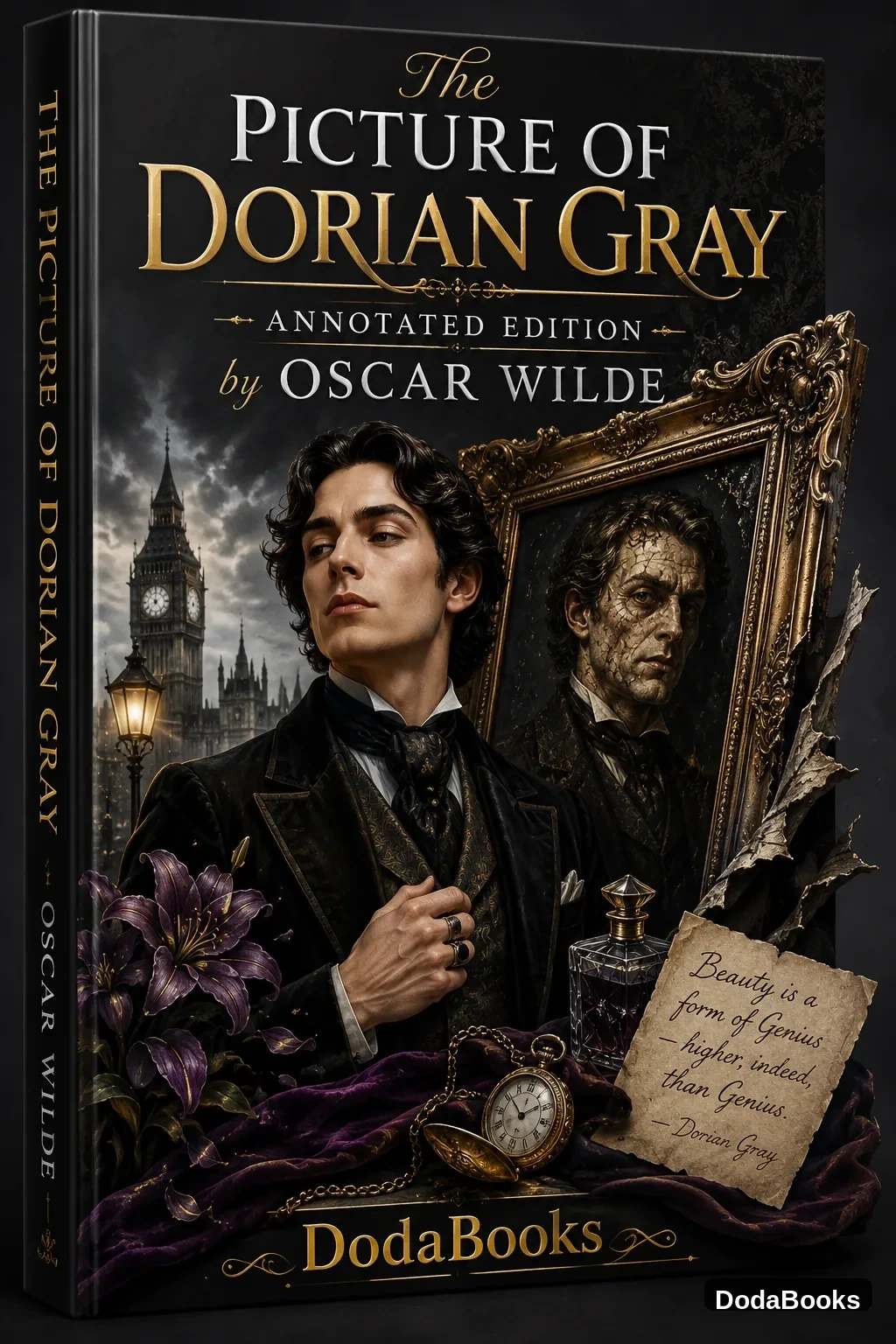
The Picture of Dorian Gray: Annotated Decadent Edition
The complete 1891 twenty-chapter text featuring Oscar Wilde's aphoristic Preface, accompanied by Walter Pater's aesthetic essays, Queensberry trial transcripts, and textual collations with the 1890 Lippincott magazine version.
- ✓ Complete 20-Chapter Unabridged Text
- ✓ 210+ Decadent & Classical Footnotes
- ✓ 1890 vs 1891 Textual Collation
- ✓ Instant DRM-Free EPUB & PDF Download
Related Literature Study Guides
Explore our comprehensive library of literary masterwork analyses:
- The Picture of Dorian Gray Themes & Symbolism: The aesthetic movement, the portrait as conscience, the Yellow Book, and double lives.
- Dracula Study Guide: Reverse colonization anxiety, Victorian New Woman debates, and blood contagion in Bram Stoker.
- Sherlock Holmes Study Guide: Forensic science history, Victorian London, Watsonian narration, and major case studies.
- Alice in Wonderland Study Guide: Mathematical nonsense, Victorian education satire, and Carrollian logic.
- Frankenstein Study Guide: The Vitalism controversy, Romantic science, and paternal abandonment in Mary Shelley.
- Jane Eyre Study Guide: Victorian governess paradox, female autonomy, and Bertha Mason in Charlotte Brontë.
- The Great Gatsby Study Guide: Spatial class division and modernist disillusionment in F. Scott Fitzgerald.
- Crime and Punishment Study Guide: Russian nihilism, utilitarian rationalism, and spiritual resurrection in Dostoevsky.
Frequently Asked Questions
What is the philosophy of Aestheticism in The Picture of Dorian Gray?
Aestheticism was a late-19th-century artistic and philosophical movement that championed ‘art for art’s sake’ (l’art pour l’art), asserting that art should be judged purely on its formal beauty rather than its moral, religious, or political utility. Oscar Wilde’s famous Preface to the novel serves as a manifesto of Aestheticism, claiming that ’there is no such thing as a moral or an immoral book. Books are well written, or badly written. That is all.’
What does the magical portrait symbolize in the novel?
The portrait painted by Basil Hallward symbolizes Dorian Gray’s conscience, soul, and moral reality. While Dorian’s physical body remains miraculously youthful and unblemished, the canvas absorbs the biological aging and spiritual corruption caused by his cruelties and crimes. Confined to an old attic schoolroom, the decaying painting serves as an inescapable mirror of Dorian’s true inner degradation.
How does the novel reflect Victorian hypocrisy and double lives?
The novel dramatizes the profound split in late-Victorian society between public moral respectability and private indulgence. Dorian moves effortlessly between high-society Mayfair drawing rooms and sordid East End opium dens, using his youthful, innocent appearance as an impenetrable shield against social suspicion, exposing an aristocratic culture that tolerated severe moral depravity so long as outward appearances were preserved.