Moby-Dick Characters: Analysis of Ahab, Ishmael & Queequeg
Herman Melville structures the crew of the Pequod as a microcosm of nineteenth-century global civilization. While the overarching narrative follows the fateful hunt for the White Whale, the novel’s enduring philosophical weight stems from its complex, archetypal cast of characters.
From Captain Ahab’s Promethean rebellion to Ishmael’s intellectual humility, each character embodies a distinct philosophical stance toward the cosmos, morality, and human fellowship. This guide provides an exhaustive character study for university students, educators, and literary researchers.
For a comprehensive plot overview and historical labor analysis, consult our primary Moby-Dick Study Guide, our architectural study of The Pequod in Moby-Dick: Ship Meaning & Symbolism, as well as our deep dive into Moby-Dick Themes & Symbolism.
Character Overview & The Pequod Hierarchy
The Pequod functions under a strict maritime command structure, yet Melville subverts this hierarchy by pairing officers from the American Eastern Seaboard with harpooners drawn from indigenous and non-Western societies:
| Character | Shipboard Rank & Origin | Core Philosophical Archetype | Primary Symbol / Attribute | Ultimate Narrative Fate |
|---|---|---|---|---|
| Captain Ahab | Commander; Nantucket Quaker | Tragic hero; Monomaniacal defiance | Prosthetic Ivory Leg; Spanish Doubloon | Strangled by his own harpoon line; dragged to the sea floor |
| Ishmael | Junior Hand; Massachusetts schoolteacher | Skeptical philosopher; Humanist witness | Queequeg’s carved wooden coffin (life-buoy) | Sole survivor; rescued on the third day by the Rachel |
| Queequeg | Harpooner; South Pacific prince (Rokovoko) | Noble animism; Cross-cultural fraternity | Tattooed body; Tomahawk pipe; Carved chest | Perishes when the Pequod sinks; his coffin saves Ishmael |
| Starbuck | First Mate; Nantucket Quaker | Rational conscience; Christian orthodoxy | Prudent commercial duty; Loaded musket | Moral paralysis; drowns with the vessel |
| Stubb | Second Mate; Cape Cod native | Carefree fatalism; Comic nihilism | Short black clay pipe; Indifference to doom | Perishes laughing and swearing in the final sinking |
| Flask (“King-Post”) | Third Mate; Tisbury native | Mindless aggression; Utilitarian brutality | Ignorance of metaphysical dread | Perishes in the Pacific waters |
| Pip | Cabin Boy; Alabama | Visionary madness; Holy fool | Tambourine; Open oceanic abandonment | Perishes in the sinking alongside Ahab |
| Fedallah | Harpooner; Parsee mystic | Demonic shadow; Fatalistic prophecy | Black Chinese silk attire; Turbanned hair | Lashed to the flank of Moby Dick on the second chase |
Captain Ahab: Monomania and the Tragic Hero
Captain Ahab is one of the towering tragic figures of world literature, rivaling Shakespeare’s King Lear, Macbeth, and Milton’s Satan. Melville explicitly crafts Ahab within the tradition of Elizabethan and Jacobean tragedy, giving him soliloquies rich in blank verse rhythms and archaic rhetorical grandeur.
The Psychology of Wounded Pride
Ahab’s monomania—a nineteenth-century psychiatric diagnosis describing obsessive fixation on a single idea in an otherwise rational mind—is sparked by his encounter with Moby Dick off the coast of Japan. The whale severed Ahab’s leg, but the physical mutilation is secondary to the psychological humiliation:
“He piled upon the whale’s white hump the sum of all the general rage and hate felt by his whole race from Adam down; and then, as if his chest had been a mortar, he burst his hot heart’s shell upon it.”
— Chapter 41: “Moby Dick”
Ahab cannot accept that the universe operates through accidental biological encounters. To acknowledge that the whale was merely an unthinking animal obeying its instinct would mean that Ahab suffered agonizing pain for no reason. Consequently, Ahab must elevate the whale into a supernatural agent of malicious intent.
The Ivory Prosthetic
Ahab does not walk on an ordinary wooden peg; his leg is carved from the polished jawbone of a sperm whale. This detail illustrates Ahab’s literal and figurative grounding in the creature he seeks to destroy:
- He is physically supported by the bone of the leviathan.
- When his ivory leg breaks, he has it repaired with materials from his own shipboard forge, isolating him from ordinary human touch.
- The pivot holes drilled into the quarter-deck of the Pequod hold him fixed in place as he gazes outward across the Pacific, transforming him into a living statue of vengeance.
The Strike Through the Mask
In Chapter 36 (“The Quarter-Deck”), Ahab delivers his philosophical manifesto to the hesitating Starbuck:
“All visible objects, man, are but as pasteboard masks. But in each event—in the living act, the undoubted deed—there, some unknown but still reasoning thing puts forth the mouldings of its features from behind the unreasoning mask. If man will strike, strike through the mask! How can the prisoner reach outside except by thrusting through the wall? To me, the white whale is that wall, shoved near to me.”
— Chapter 36: “The Quarter-Deck”
Here Ahab reveals that his vendetta is not merely against a specific whale, but against the metaphysical conditions of human existence. The physical universe is a facade hiding an inscrutable power that mocks human dignity. Ahab views himself as an enslaved titan asserting human sovereignty against divine tyranny.
Ishmael: The Humble Witness and Skeptical Philosopher
While Ahab commands the ship, Ishmael controls the discourse. The opening sentence of the novel—“Call me Ishmael”—announces a narrator who is both self-effacing and enigmatic:
The Biblical Persona of the Outcast
In the Book of Genesis, Ishmael is the son of Abraham and the handmaiden Hagar, cast out into the wilderness of Paran when Isaac is born. By claiming this pseudonym, the narrator positions himself as:
- A rootless wanderer with no fixed inheritance on land.
- An outsider who belongs to no single nation, sect, or commercial class.
- The lone survivor destined to witness catastrophic ruin, echoing Job’s messengers: “And I only am escaped alone to tell thee.”
Negative Capability and Epistemological Humility
Unlike Ahab, who demands absolute certainty and total mastery over nature, Ishmael practices what John Keats called “negative capability”—the capacity to exist in uncertainties, mysteries, and doubts without irritable reaching after fact and reason.
When Ishmael encounters aspects of the whale that defy comprehension (such as the cetological skull measurements in Chapter 103 or the lack of facial features in Chapter 79), he laughs and concedes human ignorance. He recognizes that the universe is too vast, strange, and multifaceted to be reduced to a single dogmatic formula.
Queequeg: The Noble Animist and Democratic Brother
Queequeg is the moral anchor of the novel. Introduced in Chapter 3 (“The Spouter-Inn”) as a terrifying cannibal prince covered in geometric tattoos and selling shrunken New Zealand heads, Queequeg quickly becomes Ishmael’s closest companion and spiritual teacher.
Deconstructing Western Civilized Vanity
Melville uses Queequeg to satirize Western claims of moral and religious superiority. Ishmael quickly discovers that under the savage tattoos beats a heart of impeccable courtesy, physical bravery, and instinctive generosity:
“You cannot hide the soul. Through all his unscratched, virgin skin, the noble savage shone out… I felt a melting in me. No more my splintered heart and maddened hand were turned against the wolfish world. This was the true fellowship of man.”
— Chapter 10: “A Bosom Friend”
While Christian shipowners like Captains Peleg and Bildad exploit whalemen through fractional lays and slop-chest markups, the pagan Queequeg repeatedly risks his life to dive into freezing waters to save drowning crewmen, asking for neither reward nor praise.
The Coffin Life-Buoy
When struck with a life-threatening fever in Chapter 110, Queequeg asks the ship’s carpenter to build him a canoe-shaped wooden coffin modeled on the burial practices of his native island. He places his harpoon, pipe, and biscuits inside, then carves the intricate tattoo patterns of his body onto the lid.
When Queequeg recovers, the coffin is sealed and mounted on the stern of the Pequod to replace a lost life-buoy. When the ship is destroyed by Moby Dick in Chapter 135, Queequeg’s coffin shoots upward from the vortex, providing Ishmael with the buoyant life-raft that keeps him afloat until the Rachel arrives. Queequeg’s friendship literally delivers Ishmael from death.
Starbuck, Stubb, and Flask: The Three Mates
The three mates represent the three common nineteenth-century responses to nature and capitalism:
1. Starbuck: Conscience and Commercial Prudence
Starbuck is a devout Nantucket Quaker whose father and brother were killed by sperm whales. He possesses sober courage, but his heroism is bounded by common sense:
- Commercial Duty: He reminds Ahab that the owners invested capital to acquire spermaceti oil, not to chase private vengeance.
- Moral Confrontation: In Chapter 123 (“The Musket”), Starbuck stands outside Ahab’s cabin holding a loaded firearm while the captain sleeps. He recognizes that executing Ahab is the only way to save the thirty men on board, but his Christian conscience prevents him from assassinating his commander in cold blood.
2. Stubb: Carefree Humor and Comic Resignation
The second mate Stubb meets every crisis with a lighted pipe and an easy joke:
- When whales capsize his boat, Stubb hums a ballad.
- When Ahab delivers terrifying prophecies, Stubb laughs them off as nautical eccentricity.
- Stubb’s philosophy is passive fatalism: whatever must happen will happen, so there is no point in worrying. While this protects him from Ahab’s madness, it leaves him entirely incapable of moral resistance.
3. Flask (“King-Post”): Unthinking Aggression
The short, pugnacious third mate Flask views whales simply as oversized pests that must be slaughtered:
- He exhibits no fear, but also no awe.
- To Flask, there is no poetry, no metaphysics, and no tragic significance in the ocean. He represents the mechanical, unthinking foot-soldier of industrial exploitation.
Pip: The Cabin Boy and the Sacred Fool
The young African-American cabin boy Pip undergoes one of the most poignant transformations in the book:
- The Fall into the Pacific (Chapter 93): During a whale chase, Pip panics and jumps from Stubb’s boat. He is accidentally left floating alone in the middle of the open ocean for hours under the blinding sun.
- The Shattering of Reason: Confronted with the unmediated, infinite silence of the ocean, Pip’s human intellect shatters. He returns to the ship speaking in disjointed prophetic riddles, seeing the foot of God on the ocean floor.
- Ahab’s Kinship with Pip: Ahab recognizes in Pip a fellow soul who has gazed beyond the veil of sanity. Ahab takes Pip by the hand and houses the boy in his own cabin, confessing: “Thou touchest my inmost centre, boy; thou art tied to me by cords woven of my soft entrails.” In his tender care for Pip, Ahab displays the lingering traces of his lost humanity before plunging into total ruin.
Recommended Critical Editions
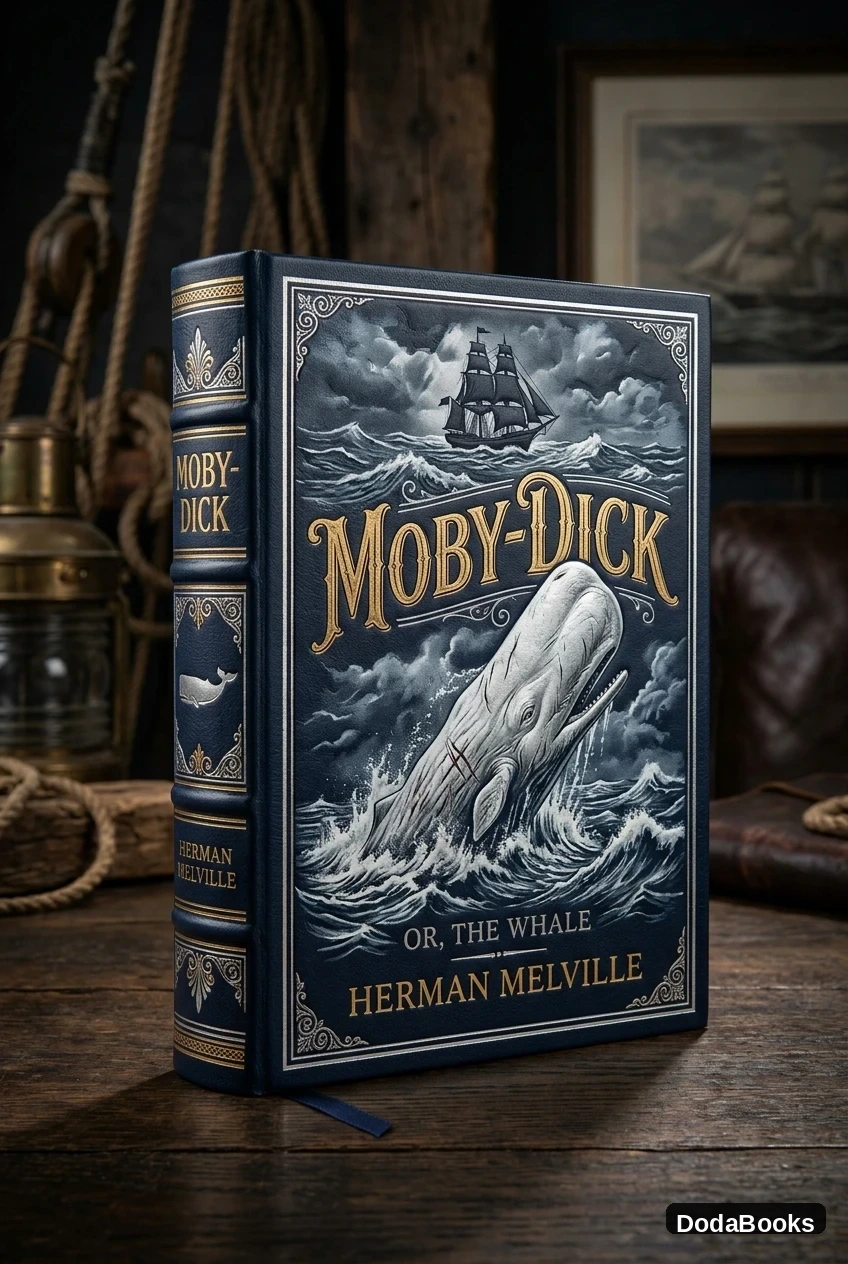
Moby-Dick; or, The Whale — DodaBooks Edition
The complete 135-chapter unabridged text beautifully typeset for modern digital readers. Features clean typography, active dynamic table of contents, zero advertisements, and DRM-free lifetime access.
- ✓ Complete 135 Chapters Unabridged
- ✓ Active Dynamic Table of Contents
- ✓ DRM-Free EPUB & PDF Formats
- ✓ Free Lifetime Digital Updates
Related Literature Study Guides
Expand your critical reading with our in-depth guides to other masterpieces of nineteenth-century world literature:
- The Pequod in Moby-Dick: Ship Meaning & Symbolism: An architectural and sociopolitical analysis of the Pequot namesake, ivory bone fittings, 30-man union microcosm, and the try-works furnace.
- Moby-Dick Study Guide: The core study guide covering fast facts, plot summary, labor economics, and key quotes.
- Moby-Dick Themes & Symbolism: An analysis of whiteness, the Spanish doubloon, the try-works, and cosmic fatalism.
- The Great Gatsby Study Guide: Spatial class division and modernist disillusionment in Fitzgerald’s masterwork.
- Pride and Prejudice Study Guide: Realism, property law, strict entailment, and marriage in Jane Austen.
- Frankenstein Study Guide: The Vitalism controversy, Romantic science, and paternal responsibility in Mary Shelley.
Frequently Asked Questions
What drives Captain Ahab’s obsession with Moby Dick?
Captain Ahab is driven by monomaniacal rage and existential rebellion. Having lost his leg to the White Whale on a previous voyage, Ahab views the animal not merely as a dumb beast, but as an incarnation of cosmic malice and the deceitful mask hiding an indifferent or hostile universe.
Why is Queequeg considered a foil to Captain Ahab?
While Ahab represents the destructive hubris of Western individualism, theological defiance, and alienation from nature, Queequeg embodies harmony with the natural world, instinctual spiritual integrity, and unconditional human fellowship across cultural divides.
What role does Starbuck play aboard the Pequod?
Starbuck, the first mate, represents rational orthodoxy, Christian conscience, and commercial pragmatism. He is the only officer who openly challenges Ahab’s vengeance, arguing that hunting a whale for personal vendetta violates both business contracts and divine law.