Frankenstein Themes & Symbolism: Prometheus, Vitalism & The Monster
Mary Shelley’s Frankenstein; or, The Modern Prometheus (1818) is often treated as a foundational work of Gothic terror, but its enduring brilliance lies in its complex philosophical and symbolic architecture. Writing at the dawn of the Industrial Revolution, the eighteen-year-old Shelley crafted a profound meditation on the ethics of scientific hubris, the limits of human knowledge, and the devastating social cost of emotional alienation.
Through the classical archetype of Prometheus, the dualistic symbolism of fire and ice, and the psychological motif of the Doppelgänger, Shelley interrogates whether Western humanity possesses the moral wisdom required to govern the technological powers it unleashes.
This comprehensive guide analyzes the primary themes and symbolic structures of the novel for university students, educators, and literary researchers.
For complete plot recaps, historical contexts, and the London Vitalism debate, consult our foundational Frankenstein Study Guide.
Central Thematic Matrix
Shelley constructs the novel around several interconnected philosophical binaries:
Baconian mastery over nature: penetrating life and death without moral foresight or ethical responsibility.
Innate benevolence corrupted by aesthetic prejudice, ostracization, and relentless physical persecution.
Victor, Walton, and the Creature operate as psychological mirrors reflecting unchecked ambition and existential isolation.
Vital warmth and destructive flames contrasted with Arctic glacial alienation, moral frost, and frozen death.
1. The Modern Prometheus: Scientific Hubris and Dangerous Knowledge
The novel’s subtitle points directly to two ancient myths of Prometheus:
- Prometheus Pyrphoros (The Fire-Bringer): Stole heavenly fire from Mount Olympus to bestow technology upon humanity, for which Zeus chained him to a Caucasus rock where an eagle eternally devoured his liver.
- Prometheus Plasticator (The Shaper of Men): In Ovid’s Metamorphoses, the titan molded mortal human bodies from lifeless earth and water.
Victor Frankenstein embodies both aspects. Dissatisfied with conventional natural philosophy, he seeks to conquer mortality:
“Life and death appeared to me ideal bounds, which I should first break through, and pour a torrent of light into our dark world. A new species would bless me as its creator and source; many happy and excellent natures would owe their being to me.”
The Baconian Dream Turned Nightmare
Victor embraces the doctrine of Francis Bacon: that nature is a passive female entity whose secrets must be penetrated, conquered, and enslaved to serve human power. Yet Shelley demonstrates that when science severs itself from human empathy and communal accountability, it becomes monstrous:
- The Garret Solitude: Victor pursues his research not in open collegiate collaboration, but in morbid isolation in a high garret, surrounded by rotting meat, bone shavings, and instruments of vivisection. His obsession alienates him from his family, friends, and the natural world.
- The Disavowal of Consequences: When Victor succeeds in imparting life, he experiences immediate revulsion. Like Prometheus punished by Zeus, Victor is tormented by the very spark he stole from the cosmos. His creation stalks him across the globe, dismantling his family piece by piece.
2. The Etiology of Violence: Rousseau’s Noble Savage vs. Society
One of Shelley’s most radical achievements is her explanation for why the Creature becomes a monster. Influenced by her father William Godwin’s political writings and Jean-Jacques Rousseau’s educational treatise Émile, Shelley rejects the Calvinist doctrine of innate depravity.
The Creature is not born evil:
- Upon waking, he is gentle, vegetarian, and filled with instinctual wonder at the birds, the moonlight, and the clear mountain streams.
- When he observes the De Lacey family struggling with poverty, he secretly chops firewood during the night and leaves it at their door to spare them labor.
- In Chapter 16, he risks his life to plunge into a raging river and pull an eight-year-old drowning girl to safety.
Why does the Creature turn to murder? Because every human being he encounters judges him purely by his physical deformity. The villager throws stones; Felix De Lacey beats him with a cudgel; the father of the drowning girl shoots him with a gun.
The Creature’s violence is not an innate biological defect; it is a socially learned behavior. Denied love, fellowship, and acceptance, his thwarted benevolence curdles into apocalyptic rage:
“I am malicious because I am miserable. Am I not shunned and hated by all mankind? You, my creator, would tear me to pieces and triumph; remember that, and tell me why I should pity man more than he pities me?”
3. The Doppelgänger: The Fractured Psyche
A central structural device of Romantic and Gothic literature is the Doppelgänger (the psychological double). In Frankenstein, Shelley creates a tripartite psychic mirror between three figures:
| Character | Psychological Component | Manifestation in Narrative |
|---|---|---|
| Robert Walton | The Uncommitted Potential Ego | Arctic explorer seeking glory; stands on the precipice of Victor’s fatal obsession |
| Victor Frankenstein | The Suppressed, Repressive Ego | Rational natural philosopher who denies his own shadow and flees moral duty |
| The Creature | The Unconscious Id / Repressed Shadow | The raw physical embodiment of Victor’s unacknowledged rage, sexuality, and guilt |
Victor and the Creature as One Being
Throughout the novel, Victor and the Creature speak the identical heightened, Miltonic language. They pursue each other across the earth until their identities collapse:
- The Shared Vow: When the Creature kills William, Henry, and Elizabeth, he murders the very people Victor unconsciously wished to escape. Victor resented domestic obligations; the Creature systematically severs every human relationship tying Victor to conventional society.
- The Wedding Night Blindness: In Chapter 20, when the Creature vows, “I shall be with you on your wedding-night,” Victor narcissistically assumes the threat is directed at his life, blinding himself to Elizabeth’s obvious danger. Victor’s deep-seated dread of adult female sexuality manifests in the Creature strangles his bride on their marriage bed.
- The Polar Convergence: In the frozen Arctic, the pursuer and the pursued become indistinguishable. The Creature leaves food and messages carved in tree bark to keep Victor alive, ensuring their symbiotic chase continues until death.
4. Key Symbolic Motifs
Fire: The Paradox of Illumination and Destruction
Fire is the primary symbolic motif of the novel, reflecting the Promethean myth:
- In Chapter 11, the newborn Creature discovers a campfire left by wandering beggars. He is delighted by the warmth it provides in the cold forest, but when he thrusts his hand into the embers, he experiences agonizing pain. He remarks on the strange duality: “How strange, I thought, that the same cause should produce such opposite effects!”
- This single observation encapsulates the thesis of the book: human technology (fire, electricity, anatomical manipulation) is inherently dualistic. It can warm and enlighten, but if embraced without reverence, it burns and destroys.
- In Chapter 16, after the De Laceys violently cast him out, the Creature uses that same fire to burn their cottage to the ground, dancing around the flames in demonic despair.
- In the final chapter, the Creature vows to end his existence with fire: building a funeral pyre at the North Pole to consume his body, ensuring no future scientist can reconstruct his remains.
Ice and the Arctic Sea: Emotional Desolation
While fire represents dangerous creation, ice represents absolute emotional alienation:
- Victor ascends to the Mer de Glace (Sea of Ice) in Chamonix to escape his guilt, confronting his monster in a frozen, barren wasteland devoid of vegetation.
- The framing narrative takes place in the frozen Arctic pack ice, where Robert Walton’s ship is physically trapped. The ice represents the emotional coldness of Walton and Victor’s obsession: their willingness to sacrifice human warmth and crew survival for geographic triumph.
- Only when Walton heeds the pleading of his mutinous crew and turns his ship south—abandoning his obsessive quest—does the ice break, allowing him to return to human fellowship and survive the fate that consumed Victor.
Recommended Critical Editions
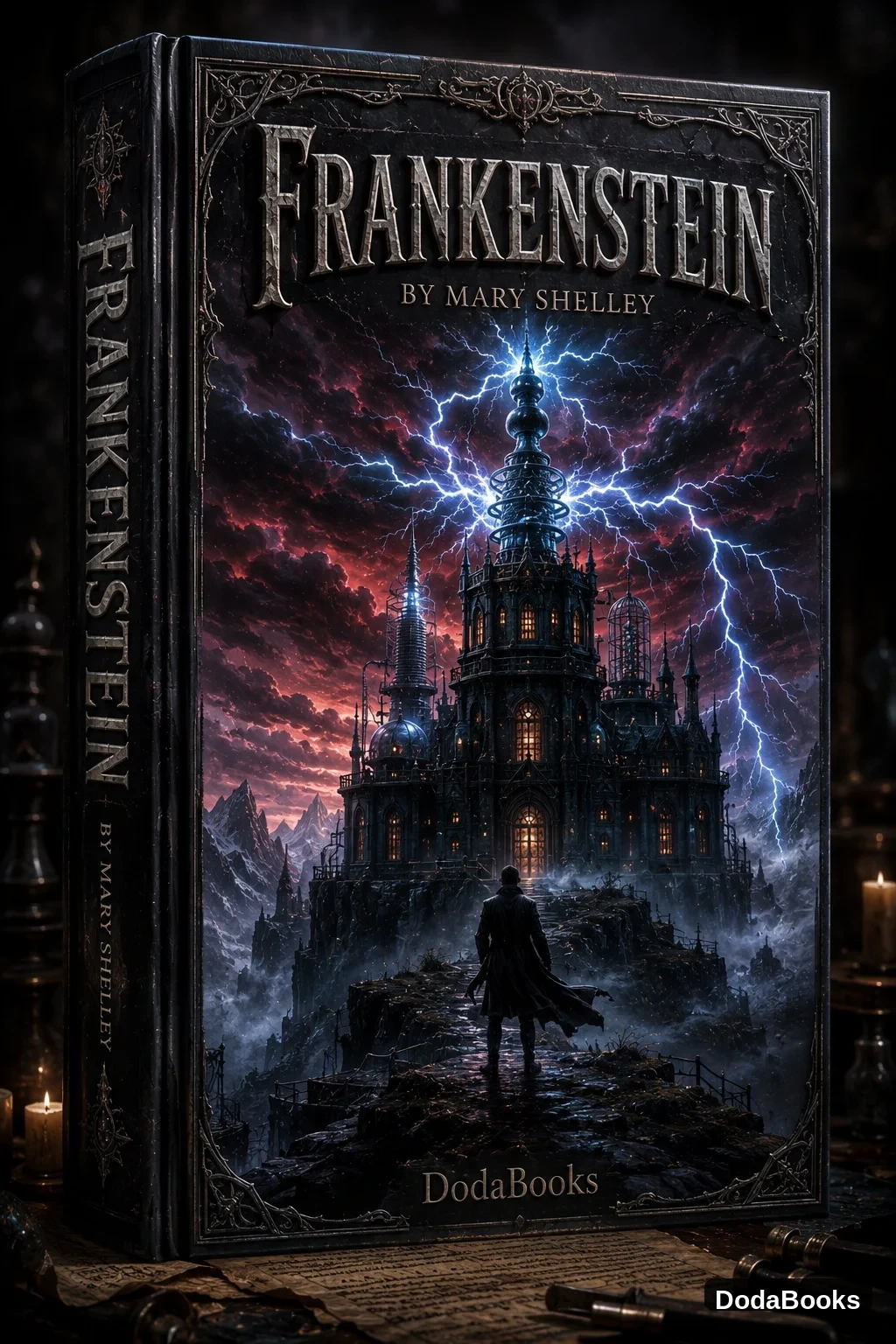
Frankenstein: The Original 1818 Critical Text
The uncensored 1818 first edition accompanied by historical essays on the London Vitalism debate, William Godwin's political philosophy, and Mary Wollstonecraft's feminist legacy.
- ✓ Uncut Original 1818 Text
- ✓ Complete Medical Vitalism Footnotes
- ✓ Comparative 1818 vs 1831 Textual Collation
- ✓ Instant DRM-Free EPUB & PDF Download
Related Literature Study Guides
Explore our comprehensive library of literary masterwork analyses:
- Frankenstein Study Guide: The core study guide covering fast facts, 2-minute plot summary, the Vitalism controversy, and chapter recaps.
- Moby-Dick Themes & Symbolism: An analysis of whiteness, the Spanish doubloon, the try-works, and cosmic fatalism.
- The Pequod in Moby-Dick: Ship Meaning & Symbolism: The barbaric architecture and 30-man union microcosm of Melville’s whaleship.
- Pride and Prejudice Themes & Symbolism: An analysis of entailment law, the marriage market, and Pemberley’s architecture.
- The Great Gatsby Study Guide: Spatial class division and modernist disillusionment in Fitzgerald’s masterwork.
- Crime and Punishment Study Guide: Russian nihilism, utilitarian rationalism, and spiritual resurrection in Dostoevsky.
- Jane Eyre Study Guide: Victorian governess paradox, female autonomy, and Bertha Mason in Charlotte Brontë.
Frequently Asked Questions
Why is Frankenstein subtitled ‘The Modern Prometheus’?
In Greek mythology, Prometheus stole fire from the gods to give to humanity and suffered eternal torment; in later Ovidian myth, Prometheus plasticator molded human beings out of clay. Victor Frankenstein embodies the Modern Prometheus by using modern science (electricity and chemistry) to conquer mortality and create life from lifeless clay, unleashing catastrophic suffering upon himself and his creation.
What does fire symbolize in Frankenstein?
Fire symbolizes the dual nature of scientific knowledge and human technology: capable of providing life-sustaining warmth, light, and enlightenment, but simultaneously capable of catastrophic, uncontrollable destruction when mishandled or weaponized in vengeance.
How does the Doppelgänger motif operate between Victor and the Creature?
Victor and the Creature function as psychological doubles. The Creature embodies Victor’s repressed id, primal rage, and unacknowledged capacity for violence. Their mutual obsession, shared language, and identical suffering across the Arctic ice demonstrate that they are two halves of a fractured psyche.