The Phantom of the Opera Themes & Symbols
When French investigative journalist and author Gaston Leroux published Le Fantôme de l’Opéra as a serialized novel in Le Gaulois between September 1909 and January 1910, he created one of the most enduring modern myths of Gothic romance and horror. While later twentieth-century musical adaptations romanticized the central love triangle, Leroux’s original text is a deeply unsettling psychological detective story grounded in forensic realism, architectural fact, and philosophical inquiry.
Set within the labyrinthine depths of Charles Garnier’s newly inaugurated Paris Opera House (the Palais Garnier), the novel explores the tragic intersection of extraordinary aesthetic genius and horrifying physical deformity. Leroux investigates the dark underside of Belle Époque splendor: the psychological trauma of social alienation, the predatory dynamics of artistic obsession, the boundary between parental love and monstrous gaslighting, and the redemptive miracle of human pity.
While our The Phantom of the Opera Study Guide provides chapter breakdowns, historical annotations, and plot summaries, this thematic guide offers an exhaustive academic analysis of Leroux’s core themes, architectural psychogeography, and symbolic motifs.
Thematic Taxonomy & Analytical Matrix
Leroux’s Gothic masterpiece operates across intersecting aesthetic, psychological, and architectural dimensions:
| Theme / Motif | Textual Manifestation | Historical / Cultural Context | Key Symbolic Representation |
|---|---|---|---|
| Beauty, Deformity & Compassion | Erik’s skeletal face vs. his sublime voice; the redemptive kiss | Belle Époque aestheticism; Victorian anxieties over bodily decay | The black silk mask; the weeping eyes beneath the skull |
| Architectural Psychogeography | Upper gilded balconies vs. five subterranean tiers and underground lake | Haussmannization of Paris; construction of the Palais Garnier (1875) | The grand marble staircase vs. the subterranean black skiff |
| The Disembodied Voice | The “Angel of Music” singing behind the dressing room dressing table | Myth of Orpheus; nineteenth-century spiritualism and phonography | The organ at midnight; the disembodied voice in Box Five |
| Art as Transcendence & Torment | Erik’s lifelong composition of Don Juan Triumphant | Wagnerian Gesamtkunstwerk; romantic agony of the isolated creator | The musical manuscript score; the violin of Tartini |
| Obsession, Gaslighting & Coercion | Erik exploiting Christine’s grief over her dead violinist father | Late-nineteenth-century clinical studies on hysteria and hypnosis | The golden ring; the scorpion vs. grasshopper levers |
| The Fall of Bourgeois Complacency | The counterweight crash of the six-ton grand chandelier | The May 1896 Palais Garnier accident; social class warfare | The shattered crystal chandelier; the skulls of the lake |
1. Beauty, Deformity, and the Ethics of Compassion
At the emotional core of The Phantom of the Opera lies a profound philosophical interrogation of physical beauty and moral monstrosity, directly echoing Mary Shelley’s inquiries in Frankenstein Themes & Symbolism:
The Transformation Through Pity
Leroux makes it explicitly clear that Erik’s cruelty was forged entirely by universal human disgust:
“If I am the Phantom, it is because man’s cruelty has made me so. If I had had a face like other men, I should have been good! I should have loved! I should have wept with tenderness!”
When Christine, facing death in the subterranean torture chamber, looks upon Erik’s sobbing, tear-drenched skull and places a kiss upon his lips without flinching, a spiritual resurrection occurs. Erik experiences the first unconditional human warmth of his life. That single act of selfless compassion shatters his predatory possessiveness: he weeps upon her hands, frees Raoul from the drowning cell, returns the golden ring, and allows the lovers to depart into the world, choosing to die quietly of broken-hearted love in the darkness.
2. The Psychogeography of the Palais Garnier
Gaston Leroux was an investigative court reporter who spent months exploring the actual subterranean infrastructure of Charles Garnier’s opera house. He transforms the theater’s physical anatomy into a multi-tiered allegorical psychogeography:
The Descent into the Underworld
Passing from the street level down into Erik’s house on the lake is an architectural recreation of the classical myth of Orpheus descending into Hades:
- To reach Erik’s home, Christine must descend past five cellar tiers, walk through brick-lined sewers, and cross a subterranean lake of pitch-black water in a flat-bottomed boat.
- The lake is real: during the excavation of the Palais Garnier in 1862, workers struck a massive underground water table that Garnier had to enclose in a massive concrete and brick reservoir to balance hydrostatic pressure. Leroux seizes upon this architectural fact, turning a water reservoir into the mythic river Styx.
3. The Voice as Disembodied Perfection: The Angel of Music
In The Phantom of the Opera, the human voice operates as a supernatural, disembodied power that transcends mortal limits:
- The Folklore of the Father: On his deathbed in Sweden, Christine’s father—an accomplished folk violinist—promised her that when he reached heaven, he would send down the “Angel of Music” to watch over her and bless her art.
- The Predatory Exploitation: When Erik overhears the grief-stricken, lonely chorus girl praying in her dressing room, he exploits this myth. Speaking through the hollow walls, he adopts the identity of the Angel of Music, giving her vocal lessons of transcendent technical brilliance.
- The Dissociation of Sound and Flesh: Christine falls in love not with a man, but with a celestial voice. Her crisis occurs when the physical body behind the divine voice is revealed: instead of a radiant seraph with golden wings, she finds a living skeleton with rotting yellow teeth.
- The Triumph of Music: Yet even after discovering his hideous form, Christine cannot deny the supernatural majesty of his art. When Erik plays his organ at midnight, singing the sacred and demonic melodies of his unfinished masterpiece Don Juan Triumphant, Christine is caught in a state of hypnotic ecstasy, proving that art has the power to obliterate physical horror.
4. Art as Transcendence: Don Juan Triumphant
Erik’s magnum opus, Don Juan Triumphant, is the musical manifestation of his soul:
[The Dual Musicality of The Phantom]
                |
                +---> The Classical Repertoire (Faust, Romeo and Juliet):
                |       • Formal, civilized, public performance.
                |       • Box Five demands, managerial extortion, social decorum.
                |
                v
[Don Juan Triumphant: The Subterranean Symphony]
        • Composed over twenty years in subterranean solitary confinement.
        • Replaces Mozart's classical elegance with burning, unrequited mortal agony.
        • "It burns! It scorches! It consumes the soul!"
        • Music written not for human ears, but to articulate cosmic grief.
                |
                v
[The Ultimate Resolution: Erik burns his score, choosing mortal forgiveness over immortal vengeance]
When Christine touches the manuscript score of Don Juan Triumphant in Chapter 11, Erik screams with violent passion:
“No, no! Don’t touch that! It is Don Juan Triumphant! It has been written with my tears, with my heart’s blood, with my very soul! It is not finished yet, but when it is, it will consume the world! It will never be played in a theater! It will be buried with me in my coffin on the lake!”
For Erik, music is not a profession; it is an agonizing substitute for human connection. Because he cannot be loved by humanity, he attempts to conquer the universe through sound.
5. Symbolic Analysis: Artifacts, Illusions & Explosives
Leroux saturates his narrative with tangible physical objects that carry intense psychological and dramatic weight:
The Hexagonal Mirror Torture Chamber
One of Leroux’s most terrifying inventions is the torture chamber designed by Erik for the Persian Sultan in Mazanderan and replicated beneath the Paris Opera House:
- Constructed as an iron hexagon lined with mirrors, the room contains an artificial iron tree painted to look like an African jungle.
- When high-intensity gas lights are ignited between the double walls, the mirrors reflect infinite burning vistas, disorienting the prisoner with unbearable heat and hallucinatory madness.
- The torture chamber is a psychological metaphor for self-imprisonment: victims do not fight an external enemy; they are driven to madness by infinite reflections of their own terrified, dehydrated selves.
Comparative Matrix: Tragic Monsters Across the Gothic Canon
| Masterwork & Author | The Monster / Outcast | Source of Deformity | Tragic Catalyst & Resolution |
|---|---|---|---|
| The Phantom of the Opera Gaston Leroux (1910) | Erik (The Opera Ghost) | Inborn craniofacial deformity; living skull countenance | Redeemed by Christine’s kiss; dies of grief after granting her freedom. |
| Frankenstein Mary Shelley (1818) | The Creature | Assembled from charnel house corpses; 8-foot giant | Demands a companion; when refused, murders Victor’s loved ones; immolation in Arctic ice. |
| The Hunchback of Notre-Dame Victor Hugo (1831) | Quasimodo | Inborn hunchback, deafness, physical curvature | Sacrifices life for Esmeralda; skeletal embrace in the charnel vault. |
| The Picture of Dorian Gray Oscar Wilde (1891) | Dorian Gray (via Portrait) | Spiritual corruption hidden inside a magical painted canvas | Slashes portrait to escape guilt, instantly transforming into an ancient, rotting corpse. |
Recommended Critical Edition
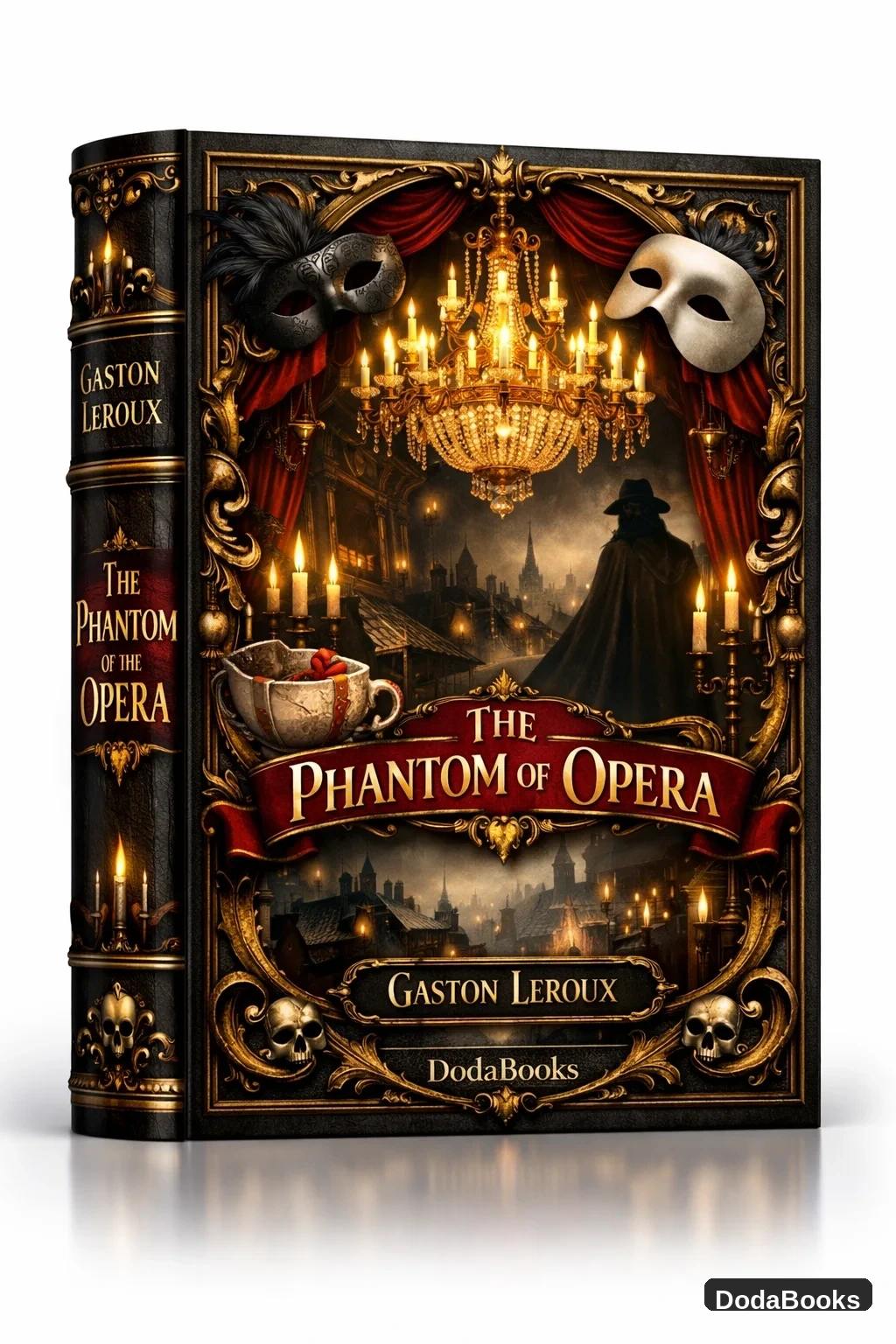
For theatre fans, literature scholars, and mystery lovers seeking the definitive text with complete architectural schematics of Charles Garnier’s Palais Garnier, historical notes on the 1896 chandelier accident, and the full investigative notes of the Persian Daroga, we recommend the unabridged edition from DodaBooks:
Frequently Asked Questions
What was the historical inspiration behind the falling chandelier scene in Chapter 10?
On the evening of May 20, 1896, during a performance of Hellé at the Palais Garnier, a counterweight securing the eight-ton crystal chandelier broke loose from the ceiling trusses, plunged through ceiling fresco panels, and crushed to death a thirty-year-old concierge named Madame Chomette in seat number 13. Leroux was working as an investigative reporter in Paris at the time and personally covered the tragedy. In the novel, Leroux transforms this real mechanical failure into Erik’s deliberate act of terror in response to the managers defying his commands regarding Box Five.
How does Gaston Leroux establish the novel’s journalistic authenticity?
Leroux frames the entire novel as a serious journalistic investigation. Writing in the first-person voice of an investigative reporter, he cites official archival records, interviews retired stagehands, reviews police dossiers, and quotes extensively from the personal memoirs of the Persian (the Daroga). By continually asserting that “the Opera Ghost really existed; he was not, as was long believed, a creature of the imagination of the artists,” Leroux blurs the line between historical reality and Gothic fiction.
Why does Erik construct a subterranean home in the foundation of the opera house?
Erik was originally hired as an architectural contractor during the construction of the Palais Garnier in the 1860s. Recognizing that the building’s massive foundations and double walls provided the ideal labyrinth to hide from the human world, Erik secretly modified the blueprints, constructing a private luxury apartment, hidden staircases inside hollow columns, and a private trapdoor leading directly into Box Five. The opera house became his fortress—an acoustic paradise where he could live in sovereign luxury while remaining completely invisible to civilized society.
Related Masterwork Guides & Deconstructions
Continue your exploration of classic Gothic literature, romantic obsession, and psychological mysteries with our companion guides:
- The Phantom of the Opera Study Guide: Themes & Symbols: The foundational comprehensive study guide to Gaston Leroux’s masterwork.
- Frankenstein Themes & Symbolism: Analysis of Motifs: Deconstruct scientific hubris, physical deformity, and the social etiology of violence.
- Dracula Themes & Symbolism: Analysis of Key Motifs: Explore Bram Stoker’s Gothic classic of occult terror, blood purity, and modern science.
- The Picture of Dorian Gray Themes & Symbolism: Examine aestheticism, vanity, and the hidden rot beneath physical beauty.
- The Count of Monte Cristo Study Guide: Themes & Plot: Analyze Dumas’ epic adventure of subterranean imprisonment, transformation, and moral redemption.