The Hound of the Baskervilles Study Guide: Full Analysis
When The Hound of the Baskervilles began serial publication in The Strand Magazine in August 1901, it caused an unprecedented public sensation. Long queues formed outside newsagents across Britain, and the magazine’s circulation surged by thirty thousand copies. Readers were thrilled by the return of Sherlock Holmes, whom Arthur Conan Doyle had killed off eight years earlier at the Reichenbach Falls in The Final Problem (1893).
Yet The Hound of the Baskervilles is widely recognized by scholars as Doyle’s supreme literary achievement—not merely because it resurrected the world’s greatest consulting detective, but because it achieved an extraordinary synthesis between two seemingly incompatible literary genres: the spine-chilling terror of the Gothic horror romance and the rigorous, modern logic of the scientific detective mystery.
While our foundational Sherlock Holmes Study Guide explores the broader historical development of Doyle’s canon and Joseph Bell’s diagnostic semiotics, this comprehensive study provides a deep critical breakdown of Holmes’s most famous single case.
Fast Facts: Masterwork Overview
| Category | Detail |
|---|---|
| Author | Sir Arthur Conan Doyle (1859–1930) |
| First Publication | Serialized August 1901 – April 1902 (The Strand Magazine); book edition March 1902 (George Newnes, London) |
| Literary Genre | Detective Fiction / Gothic Mystery / Dartmoor Pastoral Gothic / Forensic Procedural |
| Setting | London (221B Baker Street, Northumberland Hotel) and Devonshire (Dartmoor, Baskerville Hall, Grimpen Mire), autumn 1889 |
| Narrative Form | First-person retrospective narration by Dr. John Watson, incorporating diary entries and letters to Holmes |
| Central Conflict | The rationalist, forensic intellect of Sherlock Holmes vs. the superstition of an ancestral family curse and Stapleton’s murder plot |
| Climax | The moonlit fog ambush on the path from Merripit House (Chapter 14), where Holmes shoots the phosphorus-smeared hound |
| Key Motifs | The 1742 manuscript curse, missing boots, candle telegraphy, Neolithic stone huts, entomologist butterfly nets, oil portraits |
1. Setting and Atmosphere: The Primordial Dartmoor Gothic
The defining brilliance of The Hound of the Baskervilles lies in its stark geographical and philosophical contrast between two distinct British realms:
The Symbolism of the Grimpen Mire
Nowhere is Doyle’s symbolic geography more potent than in the Grimpen Mire. In Chapter 7, Jack Stapleton introduces Watson to the great swamp:
“A long agony of sounds—a sort of dense, deep groan, which rose into a shriek and then sank back again into a prolonged, melancholy purr… ‘The mire has him,’ said Stapleton. ‘Two in two days, and many more, perhaps. They once get in, and they never come out. A false step yonder means death to man or beast.’”
The Mire functions as a multidimensional symbol:
- The Deception of Appearance: On its surface, the mire appears as bright, attractive green grass; underneath lies inescapable, suffocating muck. This precisely mirrors Stapleton himself, who presents an innocuous persona as a gentle butterfly collector while concealing cold-blooded sociopathy.
- The Primordial Past: Dartmoor is dotted with the remains of Bronze Age huts. The moor represents an ancient landscape where modern civilized human laws have no power, allowing primitive violence to erupt unchecked.
- The Unconscious Abyss: For late-Victorian readers, the bog represented the dark, repressed instincts of the human mind—the unmapped wilderness beneath Victorian self-control, much like Edward Hyde’s London in Dr. Jekyll and Mr. Hyde Study Guide.
2. Watson’s Dual-Track Investigation Pipeline
A frequent misconception of the Sherlock Holmes stories is that Dr. Watson is merely a passive chronicler who marveled at Holmes’s genius. The Hound of the Baskervilles shatters this stereotype by granting Watson complete narrative and investigative autonomy throughout the novel’s central chapters:
Watson as Action Hero and Epistolary Reporter
During Chapters 7 through 10, Holmes is entirely absent from Watson’s immediate perspective. Instead, the narrative shifts into Watson’s letters and diary entries:
- Watson carries a loaded service revolver and places his physical body between Sir Henry and danger.
- He conducts sharp, methodical interrogations of Jack Stapleton, Beryl Stapleton, and the eccentric antiquarian Frankland.
- He climbs Black Tor at twilight to confront the mysterious stranger, demonstrating undeniable physical bravery.
When Holmes is revealed as the man on the tor, he sincerely praises Watson’s reports: “I must congratulate you upon the serious and painstaking way in which you have discharged your mission… You have made some admirable deductions yourself.”
3. Forensic Science vs. Hereditary Curse
At the core of the mystery is the clash between feudal superstition and modern empirical science.
The Baskerville family believes they are doomed by a supernatural curse dating back to the English Civil War (1642–1651), when the depraved Sir Hugo Baskerville kidnapped a maiden, murdered her upon the moor, and had his throat torn out by a giant black hound. When Sir Charles Baskerville dies of cardiac arrest with an expression of sheer terror upon his face, Dr. Mortimer confesses in a whisper:
“Mr. Holmes, they were the footprints of a gigantic hound!”
Holmes’s Method: The Materialization of the Supernatural
Where others see demonic wrath, Holmes sees a biological problem requiring empirical deconstruction:
| Clue / Physical Artifact | Supernatural Interpretation | Holmes’s Forensic Deduction |
|---|---|---|
| Stolen Tan Boot & Black Boot | Random hotel theft or bad luck. | The killer needed Sir Henry’s personal scent to train a live bloodhound; the new unsoiled tan boot lacked scent, forcing the theft of a worn black boot. |
| Cut-out Times Letter | Paranormal warning from the spirit world. | Assembled with short-bladed nail scissors from yesterday’s Times leading article; composed by an educated person staying in a high-class London hotel. |
| Phosphorus Chemical Preparation | Hellfire and supernatural brimstone radiating from the hound’s jaws. | A cunning concoction of phosphorus that omitted the telltale burning scent, allowing the hound to appear glowing without impairing its sense of smell. |
| Oil Portrait of Hugo Baskerville | A decorative antique painting of an ancestor. | Holmes masks the hat and hair with his hands, revealing the unmistakable facial structure of Jack Stapleton—proving Stapleton is a secret Baskerville heir. |
The Portrait Scene and Phrenological Heredity
In Chapter 13, Holmes performs his most visually brilliant deduction in the novel. Staring up at the family portraits in the dining hall of Baskerville Hall, Holmes uses his fingers to obscure Sir Hugo’s broad plumed hat and ringlets:
“Good heavens!” cried Watson in amazement. “It is Stapleton’s face!"
“Yes, it is an interesting instance of a throwback, both physical and spiritual. A study of family portraits is enough to convert a man to the doctrine of reincarnation. The fellow is a Baskerville—that is evident.”
This scene embodies late-nineteenth-century theories of hereditary atavism. Just as Dr. Jekyll was haunted by his primitive alter ego, Jack Stapleton (born Rodger Baskerville in South America) physically and morally inherits the sadistic, predatory nature of his seventeenth-century ancestor Sir Hugo. Science does not deny the family curse; it translates the curse into the modern biological reality of genetic inheritance.
This thematic interplay between hereditary degeneracy and moral corruption connects Doyle’s work to Oscar Wilde’s The Picture of Dorian Gray Themes & Symbolism and Bram Stoker’s Dracula Study Guide.
4. Characters & Moral Archetypes
Jack Stapleton: The Scientific Sociopath
Jack Stapleton is one of the most chilling villains in the Sherlock Holmes canon. Unlike common London street criminals who act out of sudden passion or crude greed, Stapleton is a cultured intellectual: a former schoolmaster, amateur entomologist, and expert zoologist.
His scientific mind makes him deadly:
- He purchases a massive crossbreed between a bloodhound and a mastiff, keeping it hidden in the heart of the Grimpen Mire.
- He exploits the local peasants’ superstition, knowing that if Sir Charles died of fear, no coroner would rule it a murder.
- He physically abuses his wife, Beryl Garcia, forcing her to pose as his sister to lure Sir Henry into the trap.
Stapleton represents the dark side of Victorian science: intellect divorced from moral conscience.
Sir Henry Baskerville: The Democratic Frontiersman
Arriving from the American West, Sir Henry represents new energy, youthful optimism, and democratic straightforwardness. Unlike his superstitious ancestors, Sir Henry refuses to cower inside the hall:
“There is no devil in hell, Mr. Holmes, and there is no man upon earth who can prevent me from going to the home of my own people.”
His vulnerability stems from his openness; he cannot fathom that a civilized neighbor could plan his violent murder. His near-death experience upon the fog-covered moor leaves him with permanent nervous shock, requiring a worldwide restorative voyage with Dr. Mortimer—reminding the reader that encounters with absolute evil leave permanent psychological scars.
Recommended Critical Edition
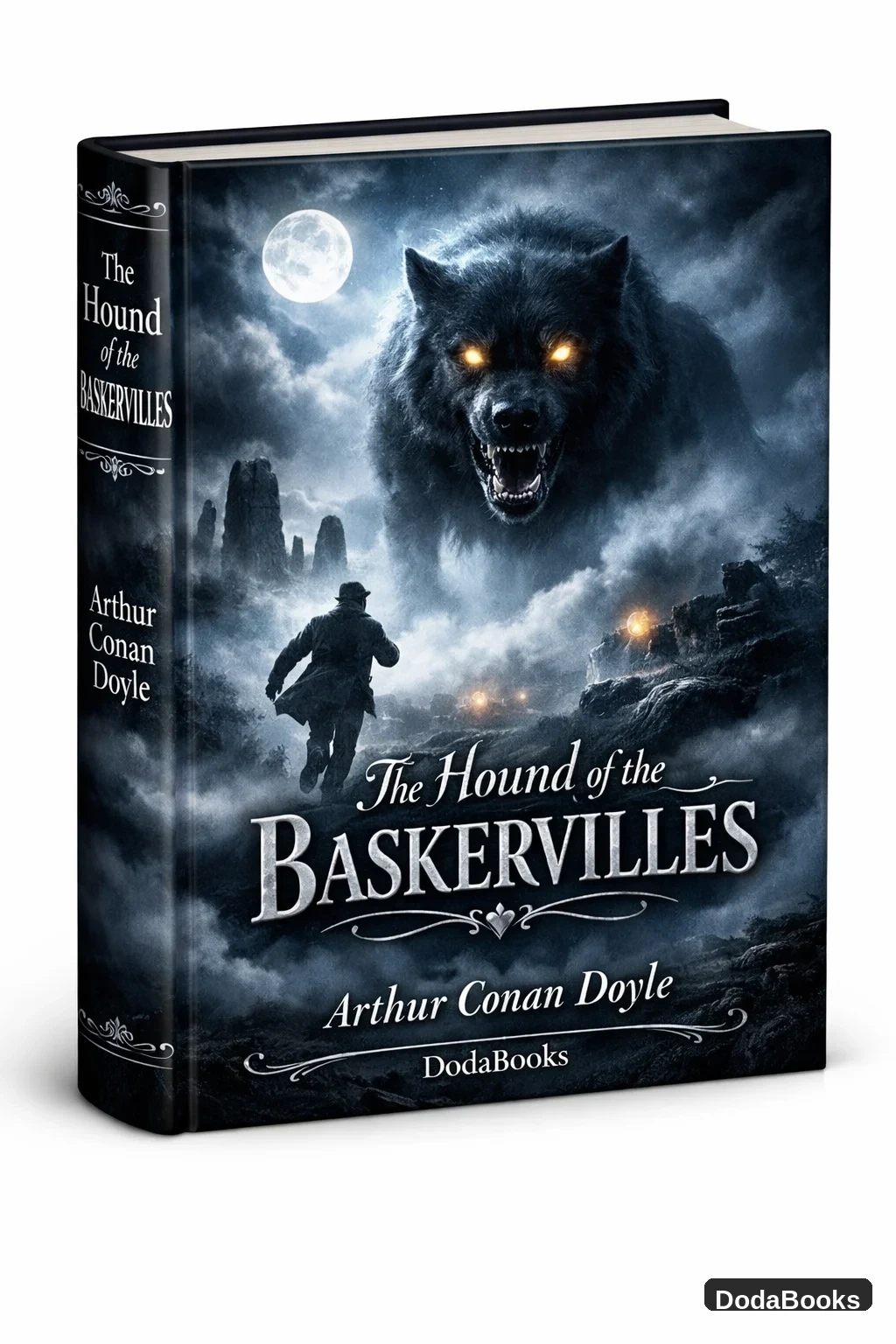
For collectors, scholars, and readers seeking the definitive reading experience with original Sidney Paget illustrations, Dartmoor topographical maps, and comprehensive forensic annotations, we recommend the unabridged edition from DodaBooks:
The Hound of the Baskervilles
Experience Sir Arthur Conan Doyle’s supreme detective triumph in an exquisite digital release. Featuring historical annotations on Victorian phrenology, Dartmoor archaeology, Sidney Paget's original visual layouts, and forensic chemical analysis.
- Complete, authoritative 1902 book text with zero omissions
- Comprehensive footnotes on Dartmoor folklore, Grimpen Mire, and forensic science
- Exquisite custom 3D typography and digital formatting for all devices
- Instant EPUB download compatible with Kindle, Apple Books, and Android
Frequently Asked Questions
How did Stapleton train the hound to attack only the Baskervilles?
Jack Stapleton did not train the hound to recognize Baskerville blood magically; he used basic scent conditioning. In London, Stapleton stole an old, worn boot belonging to Sir Henry from the Northumberland Hotel (after returning a new tan boot that lacked personal scent). He allowed the hound to smell Sir Henry’s worn boot, training the animal to pursue that specific scent across the moor while keeping the beast starved and fierce.
What happened to Jack Stapleton at the end of the novel?
After Holmes shoots the glowing hound and rescues Sir Henry, the detectives race to Merripit House, free the bound and gagged Mrs. Stapleton, and pursue Stapleton into the Grimpen Mire at daybreak. Guided by Stapleton’s hidden path markers, they find Sir Henry’s stolen black boot used to trace the scent, but discover that in the blinding fog and terror of his flight, Stapleton took a false step and was swallowed alive by the bottomless quicksand of the mire.
What role does the escaped convict Selden play in the plot?
Selden, the notorious “Notting Hill murderer,” is the younger brother of Mrs. Barrymore, the housekeeper at Baskerville Hall. The Barrymores secretly feed him upon the moor out of familial loyalty. Crucially, Barrymore gives Selden an old suit of clothes cast off by Sir Henry Baskerville. Because Selden is wearing Sir Henry’s clothes, the hound catches Sir Henry’s scent and hunts Selden down instead, causing the convict to fall over a cliff and break his neck, providing Holmes with crucial advance intelligence before the final ambush.
Explore Related Literature Masterworks
Continue your exploration of classic world literature and iconic mysteries with our companion analyses:
- Sherlock Holmes Study Guide: Analysis of the Canon: The comprehensive companion guide examining Joseph Bell’s diagnostic semiotics, Victorian London crime, and Watson’s role.
- Dracula Study Guide: Summary, Characters & Analysis: Dive into Bram Stoker’s gothic exploration of supernatural horror, technological epistolary forensics, and Victorian anxiety.
- Dr. Jekyll and Mr. Hyde Study Guide: Summary & Themes: Explore Stevenson’s companion masterpiece on dual identities, London gothic topography, and Darwinian atavism.
- Frankenstein Themes & Symbolism: Analysis of Key Motifs: Discover Mary Shelley’s study of creator responsibility, scientific hubris, and the anatomy of monstrosity.