The Phantom of the Opera Characters: Erik & Cast
Gaston Leroux’s The Phantom of the Opera (Le Fantôme de l’Opéra, 1910) is frequently remembered through the romanticized lens of stage and screen adaptations. However, Leroux’s original novel is a forensic, psychologically complex character drama that reads more like a criminal case history than a fairy tale. The characters who inhabit the labyrinthine Palais Garnier are driven by intense psychological compulsions: childhood trauma, artistic obsession, class pride, bureaucratic denial, and existential loneliness.
At the center of this operatic tragedy is Erik—an architectural polymath, illusionist, and musical virtuoso trapped inside a body of horrifying deformity. Around him gravitate Christine Daaé, the gifted Swedish soprano whose voice becomes his salvation; Raoul de Chagny, the impetuous young viscount who battles an unseen specter for her hand; and the enigmatic Persian, whose investigative memoirs provide the key to unlocking Erik’s dark imperial past.
While our The Phantom of the Opera Study Guide traces the historical background and The Phantom of the Opera Themes & Symbols deconstructs its philosophical motifs, this character analysis provides an exhaustive academic exploration of the psychological architectures, structural foils, and dramatic arcs of Leroux’s immortal ensemble.
Complete Character Roster & Structural Foils Matrix
Leroux arranges his cast around competing systems of power, perception, and desire:
| Character | Role / Archetype | Core Motivation | Fatal Flaw / Vulnerability | Ultimate Fate |
|---|---|---|---|---|
| Erik (The Opera Ghost) | Polymath; Composer; Subterranean Master | Longing for ordinary human love; artistic immortality | Pathological possessiveness; violent sadism when rejected | Dies of heartbreak in his subterranean lair; buried by the Persian |
| Christine Daaé | Swedish Soprano; Prima Donna | Spiritual devotion to her father’s memory; artistic truth | Susceptibility to psychological manipulation; emotional isolation | Marries Raoul; departs Paris to live in peaceful obscurity |
| Raoul, Viscount de Chagny | Aristocratic Lover; Naval Officer | Romantic devotion to Christine; chivalric rescue | Impetuous arrogance; blindness to the reality of the Ghost | Survives the torture chamber; departs with Christine |
| The Persian (The Daroga) | Former Chief of Police in Mazanderan | Atoning for past imperial crimes; neutralizing Erik | Bound by ancient oaths to Erik; physical vulnerability | Rescues Raoul; publishes his memoirs proving Erik existed |
| Count Philippe de Chagny | Senior Peer; Raoul’s Elder Brother | Preserving family honor and noble lineage | Aristocratic cynicism; contempt for theater artists | Drowned in the subterranean lake by Erik’s lasso |
| Armand Moncharmin | Co-Manager of the Palais Garnier | Authorial vanity; administrative control | Arrogant skepticism; treats the Ghost as a practical joke | Humiliated by missing 20,000-franc monthly extortions |
| Firmin Richard | Co-Manager of the Palais Garnier; Musician | Musical perfectionism; box office profits | Explosive temper; violent resistance to Erik’s demands | Forced to endure the crashing chandelier and financial chaos |
| Madame Giry | Box-Keeper for Box Five; Erik’s Servant | Financial gratitude; maternal loyalty to Erik | Unquestioning obedience to a dangerous, unseen master | Exonerated by police; remains Erik’s loyal defender |
| Meg Giry | Ballet Dancer; Madame Giry’s Daughter | Professional ambition; curiosity | Childish vanity; gossipy nature in the green room | Becomes an accomplished solo ballerina in later life |
| Carlotta | Spanish Prima Donna; Soprano | Narcissistic vocal dominance; social vanity | Petty jealousy of Christine’s sudden vocal triumph | Croaks like a toad on stage; flees Paris in disgrace |
1. Erik (The Opera Ghost): The Tragic Monster of Genius
Erik is the most versatile and intellectually formidable monster in modern Gothic fiction. Unlike Victor Frankenstein’s creation in Frankenstein Characters Analysis, who is physically massive but socially helpless, Erik possesses polymathic mastery across multiple disciplines:
“He had a heart that could have held the empire of the world; and, in the end, he had to content himself with a cellar.”
The Stages of Erik’s Psychological Evolution
Leroux reveals Erik’s backstory through the investigative dossier of the Persian:
- The Carnival Abjection: Born near Rouen, France, Erik was so repulsive that his mother refused to kiss him and forced him to wear a mask from childhood. At age eight, he fled to a traveling circus, displayed in fairground booths as the “Living Corpse.”
- The Imperial Court of Mazanderan: He traveled through Turkey, Egypt, and Persia, where his genius for ventriloquism, sleight of hand, and mechanical architecture earned him the favor of the Shahinshah. Erik built the infamous mirror torture chambers where the Persian royal court watched political prisoners go mad from dehydration. When the Shah ordered his execution to protect architectural secrets, the Daroga (the Persian) saved his life and helped him flee back to Europe.
- The Opera House Hermitage: Returning to Paris in the 1860s, Erik was hired as an anonymous sub-contractor for Charles Garnier. He secretly modified the blueprints, building a private subterranean palace beneath the underground lake and a network of hollow columns to spy on Box Five.
- The Awakening of Love: When he hears Christine Daaé weeping for her dead father, his desire for human connection awakens. For three years, he acts as her invisible vocal master, transforming her into the greatest soprano in Europe.
- The Final Sacrificial Grace: When Christine kisses his forehead in the cellar, Erik’s lifelong bitter hatred melts into overwhelming tears:
“I felt her tears upon my face—her tears! A woman’s tears! She didn’t run away! She didn’t die! She wept with me! She kissed me! You understand, Daroga? I was a man! I had been kissed! I had never been kissed, not even by my mother!” Erik releases the lovers, returns to his subterranean home, and dies three weeks later of broken-hearted sorrow, begging the Persian to bury his body with the gold ring upon his hand.
2. Christine Daaé: The Soul Between Two Worlds
Christine Daaé is the moral and emotional compass of the novel. Unlike Victorian gothic heroines who faint in the face of terror, Christine possesses extraordinary spiritual resilience and psychological courage:
The Dilemma of Christine’s Dual Loyalty
Christine is caught between two incompatible realities:
- Raoul de Chagny: Represents the sunlit world of childhood memory, aristocratic decorum, and normal marital affection. He is the handsome boy who retrieved her scarf from the sea in Brittany.
- Erik (The Angel of Music): Represents the dark, intoxicating realm of artistic genius, spiritual transcendence, and tragic suffering. Even after learning that Erik is a murderer who cut down the chandelier and lives in an underground tomb, she cannot hate him:
“I have pity for him, Raoul! Such pity as no human being has ever felt! When he plays his organ, the gates of heaven open, and you forget that he is a monster!”
Her decision to kiss Erik is not an act of romantic surrender, but of divine Christian grace (caritas). By refusing to recoil from his physical deformity, she restores his lost humanity.
3. Raoul, Viscount de Chagny: Chivalric Impetuosity
Raoul, Viscount de Chagny, is the romantic protagonist whose passion propels the dramatic rescue:
- The Aristocratic Romantic: Raised in the highest ranks of French nobility, Raoul is accustomed to deference and privilege. His love for Christine is passionate, possessive, and chivalric.
- The Frustration of Incomprehension: Raoul is perpetually baffled by Christine’s cryptic warnings and midnight appointments on the roof of the opera house. Incapable of understanding the supernatural power of Erik’s voice, Raoul repeatedly assumes that Christine is having an affair with a mortal rival.
- The Ordeal in the Underworld: Armed with a pistol, Raoul plunges into the dark cellars of the opera house guided by the Persian. Trapped inside the hexagonal mirror torture chamber, Raoul experiences total sensory disorientation, nearly drowning when the chamber is flooded with water. His survival is entirely dependent on Christine’s moral courage, humbling his aristocratic arrogance.
4. The Persian (The Daroga): The Forensic Witness
The Persian is the most important narrative figure in Gaston Leroux’s investigative structure:
- The Historical Anchor: As the former Daroga (chief of police) of Mazanderan, he provides the forensic backstory that explains how an opera ghost can walk through solid walls, survive beneath water, and construct unpickable locks.
- The Pragmatic Guardian: Knowing Erik’s lethal traps, the Persian walks through the opera house cellars holding his arm raised in the air—the “sign of the open hand” designed to protect his neck from Erik’s invisible Punjab lasso.
- The Chronicler of the End: It is the Persian who records Erik’s final visit to his apartment on the Rue de Rivoli. When Erik arrives emaciated and dying, the Persian listens to his final confession, promises to publish the announcement of his death in the Paris newspapers, and buries his skeletal remains by the subterranean lake.
5. The Comic & Bureaucratic Foils: The New Managers
Leroux brilliantly balances Gothic horror against the satirical comedy of Parisian theatrical management:
- Armand Moncharmin and Firmin Richard: The new co-managers of the Palais Garnier who assume control of the theater with supreme arrogance. They dismiss the warnings of the outgoing directors (Debienne and Poligny) as an elaborate hazing practical joke.
- The Humiliation of Box Five: When Erik’s letters demand that Box Five be reserved exclusively for his use and that his monthly pension of twenty thousand francs be paid promptly, Moncharmin and Richard laugh. Erik retaliates with savage theatrical comedy: causing Carlotta to croak like a toad during her high notes, causing safety pins to magically disappear from Richard’s tailcoat, and pocketing twenty thousand francs directly from Moncharmin’s coat pocket through sleight of hand.
- The Chandelier Catastrophe: Only when the six-ton chandelier plunges into the audience, killing Madame Chomette, do the managers realize that they are dealing with a lethal terrorist whom the legal machinery of Paris cannot capture.
Comparative Matrix: Character Foils & Archetypes
| Base Character | Foil Character | Central Thematic Contrast |
|---|---|---|
| Erik (The Phantom) | Raoul de Chagny | Hideous physical deformity, sublime artistic genius, and subterranean exile vs. aristocratic handsome privilege, sunlit innocence, and social honor. |
| Christine Daaé | Carlotta | Pure, selfless spiritual devotion to vocal art and compassionate pity vs. vain, narcissistic commercial ambition and petty jealousy. |
| The Persian | Armand Moncharmin | Serious forensic investigator who respects the reality of genius vs. superficial bourgeois bureaucrat who treats danger as a practical joke. |
| Erik (The Phantom) | The Persian | The tortured criminal creator who perverts science for vengeance vs. the lawful guardian who risks his life to atone for past errors. |
| Raoul de Chagny | Count Philippe de Chagny | Passionate romantic who defies family rank to marry a singer vs. cynical elder brother who prioritizes aristocratic lineage above love. |
Recommended Critical Edition
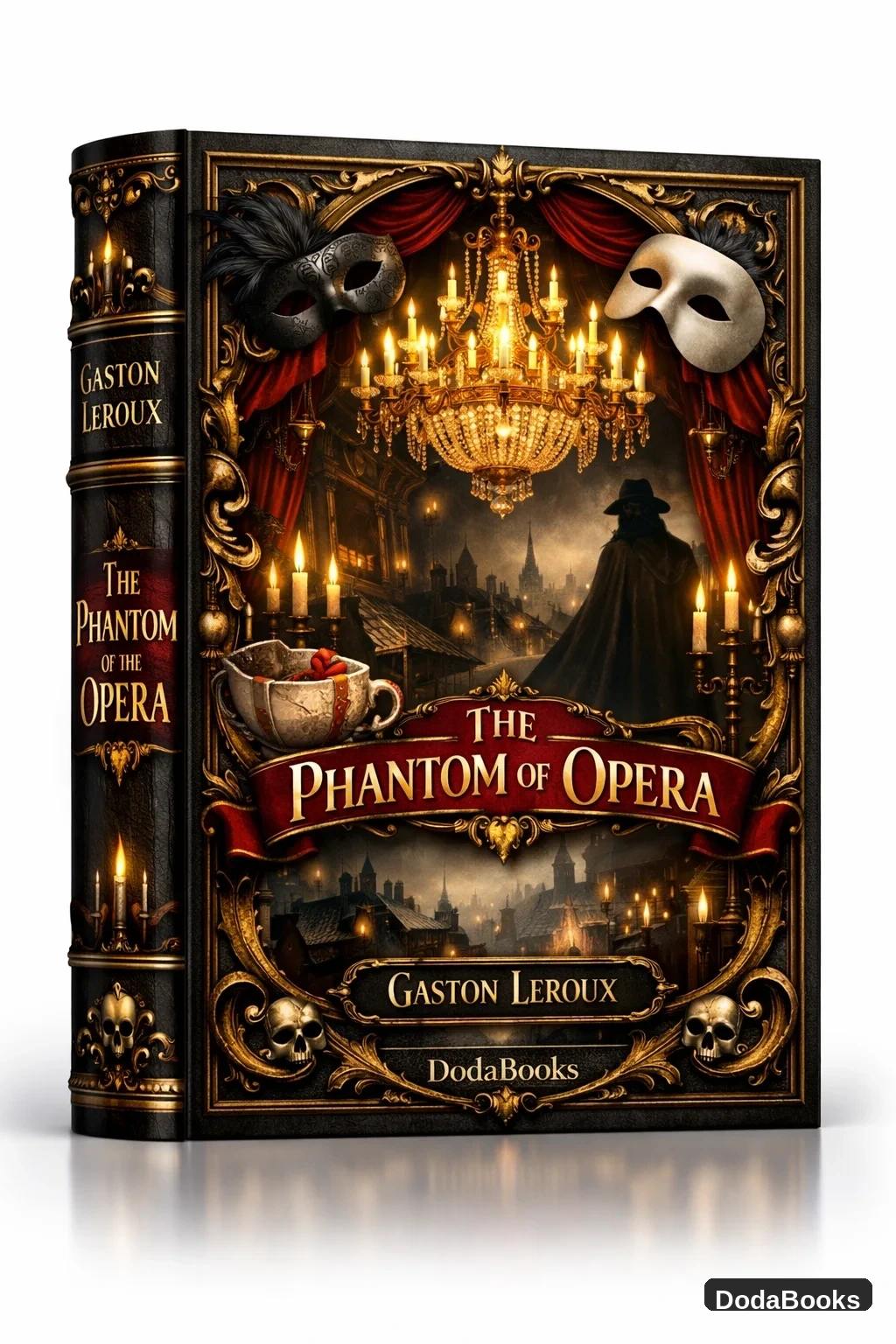
For theater scholars, literature students, and mystery collectors seeking the definitive text with complete architectural floor plans of the Palais Garnier, historical notes on the Parisian Belle Époque, and the full memoirs of the Persian, we recommend the unabridged edition from DodaBooks:
Frequently Asked Questions
Why does Erik demand exactly twenty thousand francs a month from the opera managers?
Erik demands a monthly annuity of twenty thousand francs (totaling 240,000 francs a year) not out of commercial greed, but to establish his financial independence and maintain his sovereign lifestyle in the cellars. Erik spent years living as a hunted fugitive and carnival curiosity; having a secure fortune allows him to purchase rare musical instruments, luxury furnishings, chemical supplies, and fine wines, creating the illusion that he is an independent, wealthy gentleman living privately beneath Paris.
What is the “Punjab lasso” and how does Erik use it?
The Punjab lasso is an execution device Erik mastered during his travels in India and Persia. Made of braided catgut or silk, the lasso is thrown with lightning speed in total darkness, wrapping around the victim’s neck and snapping the cervical vertebrae without making a sound. The Persian teaches Raoul that the only defense against the lasso is to walk with one hand held permanently at eye level, which prevents the descending loop from tightening around the throat. Erik uses the lasso to silently strangle the stagehand Joseph Buquet and Count Philippe de Chagny.
Why does Erik choose to die after Christine kisses him?
Christine’s kiss of pure compassion represents the fulfillment of Erik’s deepest human longing. For his entire life, he had known only screams of horror, physical beatings, and rejection. When Christine weeps for him and kisses his forehead, she acknowledges his humanity, giving him the one gift he believed was impossible: to be loved and pitied by another human being. Having experienced this divine grace, he realizes that he cannot return to being a monstrous jailer. Releasing Christine to Raoul leaves Erik with nothing more to achieve on earth; his physical strength collapses, and he dies peacefully of a broken heart.
Related Masterwork Guides & Deconstructions
Continue your exploration of classic Gothic horror, tragic character dynamics, and psychological literature with our companion guides:
- The Phantom of the Opera Study Guide: Themes & Symbols: The foundational comprehensive study guide to Gaston Leroux’s masterwork.
- The Phantom of the Opera Themes & Symbols: Analyze the Palais Garnier labyrinth, masks, musical genius, and redemption.
- Frankenstein Characters Analysis: Victor & Creature: Examine Mary Shelley’s tragic Promethean creator and the articulate, vengeful Creature.
- Dracula Characters Analysis: Van Helsing & Foils: Deconstruct Bram Stoker’s occult predator, the Crew of Light, and Victorian chivalry.
- The Count of Monte Cristo Characters: Dantès & Foils: Explore Edmond Dantès, Abbé Faria, and the architecture of epic French romance.