The Phantom of the Opera Study Guide: Themes & Symbols
Serialized between September 1909 and January 1910 in the daily newspaper Le Gaulois and published as a complete novel in 1910, Gaston Leroux’s The Phantom of the Opera (Le Fantôme de l’Opéra) is one of the supreme achievements of early twentieth-century French detective fiction and gothic romanticism. While later Hollywood film adaptations and Andrew Lloyd Webber’s blockbuster musical reimagined the story as a sweeping theatrical melodrama, Leroux’s original novel is a gritty, atmospheric mystery novel anchored in historical investigative journalism, architectural engineering, and tragic psychological realism.
At its center stands Erik—the elusive “Opera Ghost”—a polymathic genius, master architect, ventriloquist, composer, and illusionist afflicted from birth with a skeletal, skull-like facial deformity that repulsed even his own mother. Exiled from human society, Erik turns the cavernous subterranean foundations of the Palais Garnier in Paris into his sovereign underground empire, manipulating opera managers through extortion and haunting the stage to tutor the orphaned soprano Christine Daaé as her mysterious “Angel of Music.”
While our companion studies across Dracula Study Guide and The Picture of Dorian Gray Study Guide deconstruct Victorian monsters, infectious aristocrats, and the dark fractures of aesthetic decadence, this comprehensive guide provides an academic deconstruction of Leroux’s narrative technique, operatic symbolism, psychogeography, and moral redemption.
Fast Facts: Masterwork Overview
| Category | Detail |
|---|---|
| Author | Gaston Leroux (1868–1927) |
| Publication Date | Serialized 1909–1910 in Le Gaulois; Book edition published 1910 by Pierre Lafitte |
| Literary Genre | French Gothic Romance / Detective Fiction / Psychological Mystery / Belle Époque Noir |
| Setting | Palais Garnier (Paris Opera House), Paris, France during the late nineteenth century (c. 1880s) |
| Narrative Form | First-person investigative journalistic frame narrative synthesizing diaries, letters, and police testimonies |
| Central Conflict | Erik’s obsessive romantic and artistic claim over Christine Daaé vs. Raoul de Chagny’s protective love |
| Climax | The torture chamber of mirrors beneath the opera lake, culminating in Christine’s redemptive kiss |
| Key Motifs | The corpse-like mask, Box Five, the grand chandelier crash, the underground lake, the subterranean organ |
1. Historical & Architectural Context: Charles Garnier’s Palais Garnier
Unlike purely fictional gothic castles, Leroux set his dark romance within a genuine, world-renowned modern architectural wonder: the Palais Garnier, designed by architect Charles Garnier and inaugurated in Paris in 1875:
The Real Architecture of the Paris Opera House
Gaston Leroux was an acclaimed Parisian courtroom journalist for Le Matin. He possessed intimate access to the deepest catacombs of the Opera, incorporating real structural marvels and historical incidents into his text:
- The Subterranean Reservoir and Lake: When digging the foundations of the Palais Garnier, Garnier encountered high groundwater from an underground tributary of the Seine River. Rather than attempting to pump the water away indefinitely, Garnier engineered an enormous vaulted double-basin concrete reservoir beneath the cellar stages. This artificial subterranean lake—which firefighters still use today for emergency water reserves—became Erik’s mythical underground moat.
- The 1896 Chandelier Counterweight Catastrophe: On May 20, 1896, an electrical short circuit ignited the suspension cables of the eight-ton crystal-and-bronze chandelier, causing a 750-kilogram counterweight to crash through the ceiling into the fourth tier of the auditorium, killing Madame Chomette, a concierge. Leroux adopted this real tragedy for Chapter 10, transforming it into Erik’s deliberate act of terror when the managers defy his commands.
- Subterranean Prisons of the Paris Commune: During the Franco-Prussian War and the 1871 Paris Commune, the unfinished cellars of the Opera were utilized as military ammunition dumps, field hospitals, and execution chambers for political prisoners, infusing the subterranean masonry with historical ghosts of political trauma.
2. Character Dynamics & Archetypal Triangle
Leroux constructs a tense psychological triangle operating across different planes of nineteenth-century French society:
3. Major Thematic Pillars
The Mask and the Double: The Aesthetics of Deformity
The motif of the mask lies at the philosophical heart of The Phantom of the Opera. Erik does not wear a mask merely to conceal his identity; he wears it to exist among ordinary mortals without exciting mortal terror:
- The Living Death’s-Head: Leroux describes Erik’s unmasked face with clinical, horrifying clarity: yellow parched skin stretched tightly over a skull, no cartilage nose (leaving two black triangular cavities), sunken eyes reflecting yellow phosphorescence in darkness, and sparse tufts of greasy hair.
- The Tragedy of Rejection: When his own mother forced him to wear a mask at age eight, Erik internalized the conviction that he was intrinsically unlovable. As Erik weeps to Christine: “If I were handsome, would you have fled? If I am a monster, it is because man’s cruelty has made me one! All I wanted was to be like everybody else—to have a wife who loved me and walked with me on Sundays!”
- The contrast between external physical deformity and internal aesthetic transcendence mirrors the classic gothic monster tradition explored in our Frankenstein Study Guide.
The Voice and the Angel of Music: Art as Hypnotic Coercion
In nineteenth-century European culture, vocal mastery was viewed as a direct channel to divine spirituality. Erik exploits this belief to captivate Christine:
- The Father’s Myth: On his deathbed, Christine’s father promised to send her the “Angel of Music” from heaven to watch over her art. Erik, possessing miraculous ventriloquial skill, whispers through the dressing-room mirror walls, claiming to be that celestial messenger.
- The Hypnotic Transformation: Under Erik’s rigorous, hypnotic vocal instruction, Christine’s voice awakens from mechanical competence into sublime, transcendent artistry. At the gala performance of Gounod’s Faust, her performance of Marguerite electrifies Paris, driving audiences to weeping ecstasy.
- The Poison of Dependency: Christine’s artistic triumph is inseparable from psychological enslavement. She is torn between heavenly artistic inspiration and the terrifying realization that her angel is a homicidal man dwelling in an underground tomb.
4. Psychogeography: The Descent into the Subterranean Underworld
The journey from the roof of the Palais Garnier down into Erik’s lair functions as a classical mythological descent into Hades (katabasis):
This psychogeographic spatial descent mirrors the structure of the human mind: descending from conscious social vanity on the gilded surface, through the rational machinery of backstage labor, down into the primal, dark unconscious where Erik’s lethal traps and grand organ reside.
5. The Torture Chamber and Erik’s Moral Redemption
The resolution of The Phantom of the Opera provides one of the most powerful moral redemptions in gothic literature:
The Hexagonal Chamber of Mirrors
Trapped inside Erik’s hexagonal torture chamber, Raoul and the Persian face psychological disintegration:
- Walls of optical mirrors, heated iron pipes, and an artificial iron tree simulate the agony of dying of thirst in an African desert.
- Erik presents Christine with an agonizing ultimatum: turn the bronze scorpion to consent to marry Erik, or turn the bronze grasshopper to blow up the entire Opera House with hundreds of barrels of gunpowder.
The Power of the Compassionate Kiss
When Christine turns the scorpion to save Raoul and the opera, she chooses not to insult Erik with false hatred. When Erik reveals the depth of his suffering, Christine does what no human being has ever done: she embraces him, kisses his bare, deformed forehead, and weeps for him.
That single kiss shatters Erik’s lifetime of bitterness:
- For forty years, Erik believed he was an inhuman monster unworthy of affection.
- Christine’s compassionate touch delivers absolute emotional catharsis: “I felt her tears upon my face! She did not turn away! I tell you, Daroga, I have known all the happiness of the world in that single moment!”
- Renouncing coercion, Erik releases Christine and Raoul, gives them the family ring, and instructs them to flee to freedom.
- Broken with joy and sorrow, Erik lays down upon his subterranean bed and dies peacefully of a broken heart, asking only that the newspapers announce the death of the Opera Ghost.
Recommended Critical Edition
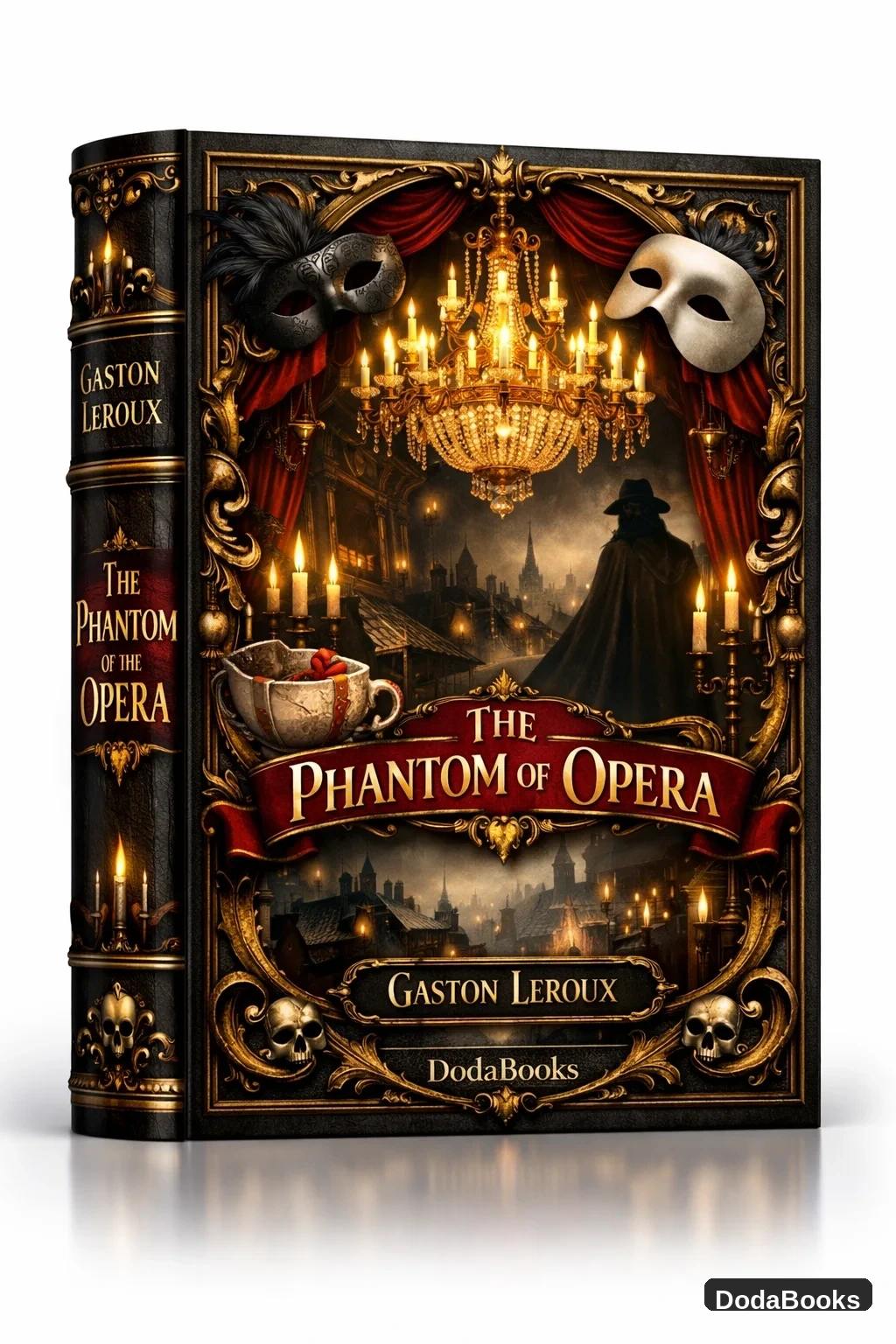
For scholars of French literature, gothic mystery lovers, and theater enthusiasts seeking the authoritative text with historical commentary on the Palais Garnier, nineteenth-century Parisian stage illusions, and textual glosses, we recommend the definitive edition from DodaBooks:
The Phantom of the Opera: Complete Edition
Discover Gaston Leroux’s immortal gothic mystery in a magnificent scholarly edition. Featuring the complete unabridged 26-chapter text, exhaustive historical footnotes on Charles Garnier's architecture, 1890s Parisian stage engineering, and essays on early French detective realism.
- Complete, authoritative unabridged 26-chapter novel text
- Comprehensive architectural and historical notes on the Palais Garnier and Parisian history
- Exquisite custom 3D typography and digital formatting optimized for modern e-readers
- Instant EPUB download compatible with Kindle, Apple Books, and Kobo
Frequently Asked Questions
Did Gaston Leroux believe that the Phantom of the Opera truly existed?
In his preface, Gaston Leroux insists emphatically that the Opera Ghost was a real living person, writing: “The Opera Ghost really existed. He was not, as was long believed, a creature of the imagination of the artists, the superstition of the managers, or a product of the absurd and impressionable brains of the young ladies of the ballet.” While the romantic narrative contains theatrical invention, Leroux based Erik on real historical individuals: an eccentric recluse named Erik who worked on the construction of the Opera cellars, the famous 1896 chandelier counterweight tragedy, and the real subterranean water reservoir.
What was Erik’s backstory before he came to the Paris Opera?
In the novel’s penultimate chapter, the Persian reveals Erik’s extraordinary international past. Born near Rouen with his monstrous deformity, Erik fled his home as a boy, joining a traveling carnival where he learned prestidigitation and ventriloquism. He traveled to Constantinople, working as an architect for the Sultan, and later went to Persia (Iran), where he built secret torture chambers, trick palaces, and amusement pavilions for the Shah. When the Shah ordered his execution to protect state secrets, the Persian helped him escape to France, where Erik was hired as a minor contractor on Garnier’s opera project.
How does Gaston Leroux’s novel differ from Andrew Lloyd Webber’s musical?
While Lloyd Webber’s 1986 musical is a passionate romantic triangle where Erik is a romantic anti-hero with a half-mask covering half his face, Leroux’s novel is a dark detective thriller where Erik wears a full-face mask over a truly monstrous, skull-like deformity. Furthermore, the musical eliminates major characters such as the Persian, removes Erik’s complex international backstory in Persia and Turkey, and alters the climax from an elaborate optical torture chamber into a simpler confrontation in an underground lair.
Explore Related Literature Masterworks
Continue your exploration of classic world literature and gothic masterpieces with our companion analyses:
- Dracula Study Guide: Summary, Characters & Themes: Dive into Bram Stoker’s foundational Victorian vampire thriller of infection, tracking, and gothic horror.
- The Picture of Dorian Gray Study Guide: Summary & Analysis: Explore Oscar Wilde’s dark masterpiece of aesthetic decadence, moral rot, and the painted mirror.
- Frankenstein Study Guide: Summary, Characters & Analysis: Examine Mary Shelley’s tragic Romantic exploration of scientific hubris, creator abandonment, and monstrous revenge.
- The Hound of the Baskervilles Study Guide: Summary & Analysis: Deconstruct Arthur Conan Doyle’s supreme forensic mystery set against the ancient, treacherous Dartmoor mire.