Tom Sawyer Themes & Symbolism: Key Motifs Analysis
When Samuel Langhorne Clemens, writing as Mark Twain, published The Adventures of Tom Sawyer in 1876, he created an enduring American myth of nineteenth-century frontier childhood. Yet behind the nostalgic surface of swimming holes, barefoot piracy, and schoolroom pranks lies a dense tapestry of symbolic motifs, behavioral psychology, and biting cultural critique. Twain’s Missouri borderland is not a simple pastoral paradise, but a microcosm of Victorian society fraught with class stratification, religious hypocrisy, superstition, and racial violence.
By analyzing the central thematic tensions—boyhood innocence versus institutional conformity, organic folk magic versus dogmatic Christian orthodoxy, and romantic illusion versus frontier brutality—readers uncover Twain’s sophisticated interrogation of American identity.
While our foundational analysis in Tom Sawyer Study Guide outlines the novel’s narrative arcs and character profiles, this critical study deconstructs the overarching themes, symbolic objects, and psychogeography that animate Twain’s masterwork.
Thematic Architecture Overview
| Core Dimension | Critical Interpretation | Manifested Symbol or Episode |
|---|---|---|
| Social Labor & Value | Behavioral economics: scarcity creates desire; work is obligation, play is voluntary art. | The whitewashed board fence; the trade for dead rats, apple cores, and brass knobs. |
| Ontological Freedom | The natural borderland as an uncorrupted Eden opposing town hypocrisy and social control. | The Mississippi River; Jackson’s Island; the raft; midnight swimming. |
| Mythic Katabasis | The descent into the subterranean underworld, shedding juvenile illusions to achieve moral rebirth. | McDougal’s Cave; the Ariadne kite string; dwindling candle stubs; Injun Joe’s demise. |
| Epistemological Dualism | Folk superstition and magical rituals as living cultural truths vs. dead church dogma. | The graveyard dead cat; spunk-water wart cures; stray marbles; the pinch-bug in church. |
| Moral Awakening | Internal conscience superseding juvenile peer codes and fear of mortal retribution. | The blood oath on pine shingle vs. court testimony saving Muff Potter from the gallows. |
1. The Whitewashed Fence: Social Psychology & Economic Value
Few episodes in world literature illustrate human psychology with greater brilliance than Chapter 2 of Tom Sawyer. Sentenced by Aunt Polly to spend a glorious, sun-drenched Saturday morning coating thirty yards of rough pine fence with lime whitewash, Tom faces the ultimate juvenile humiliation: being mocked by free boys heading to the swimming hole.
The Invention of Artificial Scarcity
Instead of lamenting his misfortune, Tom executes an intuitive masterclass in cognitive reframing and behavioral economics:
- The Posture of the Master Craftsman: When Ben Rogers approaches imitating a steamboat, Tom does not beg for help. He ignores him, stepping back with the critical eye of an artist inspecting a masterpiece: “Tom surveyed his last touch with the eye of an artist, then gave his brush another gentle sweep and surveyed the result, as before.”
- The Principle of Restricted Access: When Ben begs for a turn, Tom feigns solemn reluctance, insisting that Aunt Polly is extraordinarily particular about this specific fence: “I reckon there ain’t one boy in a thousand, maybe two thousand, that can do it the way it’s got to be done.”
- The Transmutation of Labor into Luxury: By denying access, Tom transforms an oppressive chore into a coveted privilege.
This psychological dynamic contrasts sharply with European explorations of social value, such as the transactional marriage economics explored in our Pride and Prejudice Themes & Symbolism guide.
2. The Mississippi River and Jackson’s Island: Sanctuary of the Soul
In the geography of Tom Sawyer, the Mississippi River is not merely a body of water; it is an ideological borderland separating two irreconcilable modes of existence:
The Town vs. The Current
- The Bank (St. Petersburg): Represents the domestic panopticon. It is the realm of starched Sunday shirts that choke the neck, pinching leather shoes, compulsory Bible recitation, and the schoolmaster’s switch. It is a world of surveillance, where every transgression is noted by Aunt Polly or tattled by Sid.
- The River Current: Represents fluid, uninhibited freedom. It is boundless, deep, and majestic. It carries steamboats to unknown horizons and dissolves the arbitrary social distinctions of the shore.
Jackson’s Island as an American Arcadia
When Tom, Joe Harper, and Huck Finn run away to Jackson’s Island to become pirates, they establish an idyllic pastoral sanctuary:
Twain uses the river to illustrate that youth requires an unpoliced wilderness to test its courage and discover selfhood. When modern civilization seals off the wilderness, it stifles the human spirit.
3. McDougal’s Cave: The Subterranean Katabasis
If Jackson’s Island represents the paradisiacal heights of boyhood pastoral romance, McDougal’s Cave represents its terrifying, chthonic antithesis: the descent into the mythic underworld (katabasis).
The Labyrinth of the Subconscious
McDougal’s Cave is a vast, unmapped limestone labyrinth stretching for miles beneath the Missouri bluffs. In literature, caverns symbolize the human unconscious—the dark, untamed realm where primitive instincts, mortal terrors, and repressed monsters dwell:
- The Illusion of Mastery: The picnic party enters the cave with festive laughter and tallow candles, treating the outer galleries as an amusement parlor. This reflects human hubris—believing nature can be easily domesticated for tourist leisure.
- The Loss of Orientation: Once Tom and Becky wander beyond known corridors, the cave strips away all landmarks. The limestone walls are identical, water drops fall in rhythmic, eternal indifference, and darkness threatens to swallow them alive.
- The Ariadne’s Thread: When their candles dwindle to pathetic smoking stubs, Tom produces a simple kite-string from his pocket. By tying one end to a rock projection and exploring pitch-black side galleries, Tom invents his own classical Ariadne’s thread, demonstrating the transition from frivolous mischief to pragmatic, life-saving intelligence.
Confronting the Shadow: Injun Joe in the Dark
In the deepest recess of the abyss, Tom creeps forward and sees a human hand holding a candle emerge from behind a rock. He leaps with joy, only to behold the terrifying face of Injun Joe:
This encounter is psychological: Injun Joe is Tom’s dark shadow. Where Tom plays at being a pirate and robber out of romantic boyish vanity, Injun Joe is a real, vengeful killer whose heart was hardened by social racism and cruelty. By encountering the monster in the absolute dark and surviving, Tom confronts the reality of human evil and outgrows his make-believe bandit games.
When Judge Thatcher seals the cave with triple-locked iron doors, Injun Joe is trapped inside. His agonizing demise—starving in the dark while using his pocketknife to hollow out a limestone stalagmite to catch a single drop of water every twenty minutes—is one of Twain’s most harrowing portraits of human desperation, ending the dark gothic thread of the frontier narrative.
4. Superstition, Folklore, and Institutional Religion
Throughout the novel, Twain contrasts the vibrant, imaginative vitality of frontier folk superstition with the dead, hypocritical formality of institutional Protestantism:
The Living Grammar of Folk Magic
For the children of St. Petersburg—and particularly Huckleberry Finn—the universe is animated by immediate supernatural forces that require precise ritual propitiation:
Twain demonstrates that these folk superstitions, though factually erroneous, cultivate wonder, poetic imagination, and a visceral moral order among children.
The Satire of Institutional Orthodoxy
In sharp contrast to the genuine awe inspired by folk rituals, institutional religion in St. Petersburg is depicted as an empty, commercialized social performance:
- The Sunday School Ticket Economy: In Sunday School, piety is reduced to mercantilism. Students memorize verses not to comprehend spiritual truth, but to acquire colored paper tickets (blue, red, yellow) that can be redeemed for a cheap leather Bible. Tom games this capitalistic system by trading his whitewashing loot for tickets, winning the Bible before visiting dignitaries, only to collapse in disgrace when asked to name the first two disciples (“David and Goliath!”).
- The Pinch-Bug in Church: During a long, monotonous Sunday sermon about hellfire that puts the congregation to sleep, Tom releases a large black beetle (“pinch-bug”) from his pocket. A stray poodle investigates, sits on the insect, gets bitten, and dashes yelping across the church into the minister’s lap. The entire spiritual solemnity dissolves into suppressed hysterics, revealing the thin veneer of town piety.
This critique of religious hypocrisy mirrors the satire of ecclesiastical dogma found across our Jane Eyre Themes & Symbolism guide.
5. The Evolution of Moral Conscience: The Muff Potter Trial
The central moral trajectory of Tom Sawyer traces Tom’s transition from childish self-preservation to heroic ethical responsibility:
Tom’s decision to testify represents the triumph of authentic moral conscience over both childish superstition (the blood oath) and animal fear. In this moment, Tom proves that genuine goodness consists not in obeying polite rules, but in defending the vulnerable at immense personal cost.
Recommended Critical Edition
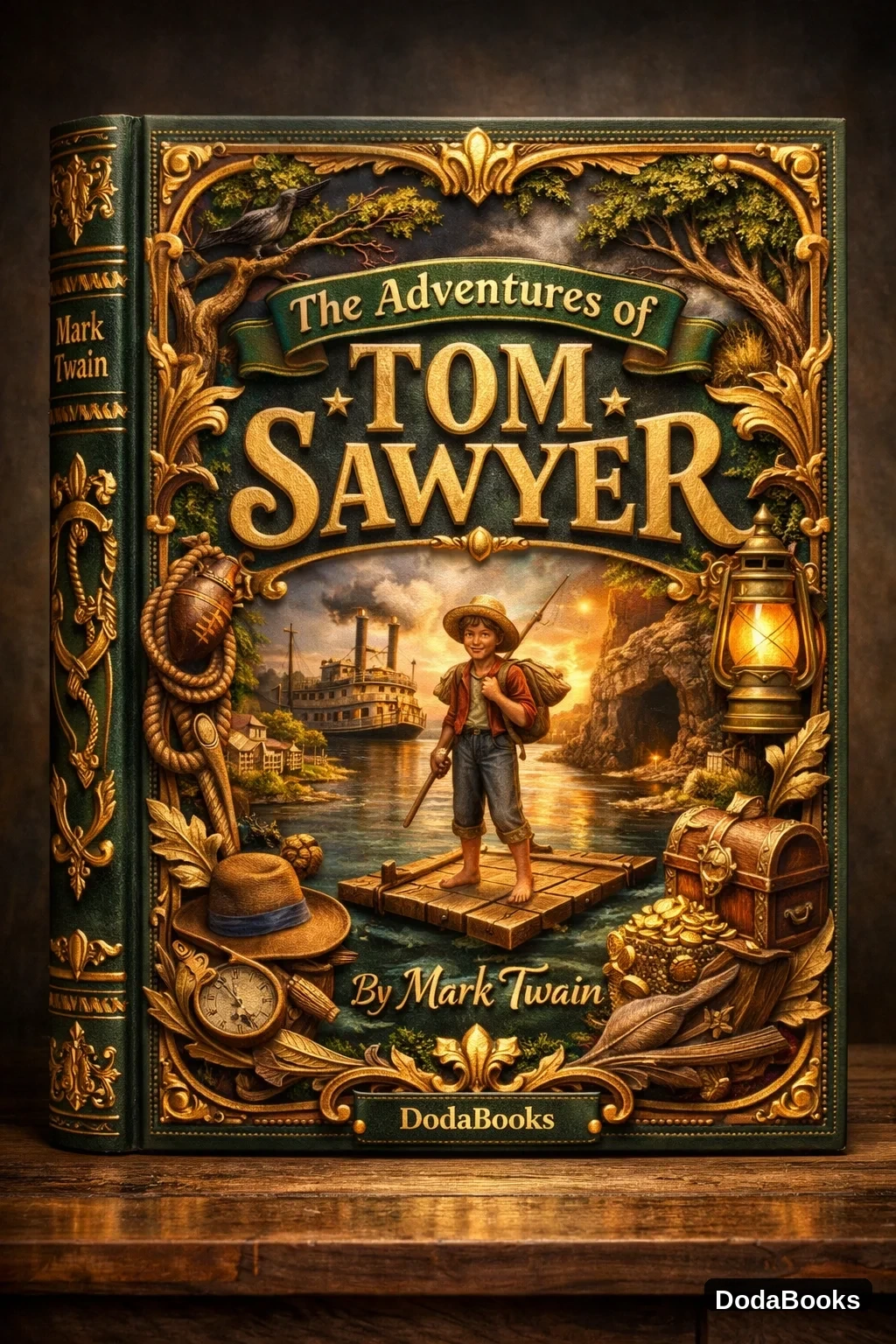
For literature scholars, teachers, and book lovers seeking the authoritative complete text with historical commentary on nineteenth-century Missouri culture, Mississippi steamboat economics, and frontier folklore, we recommend the unabridged edition from DodaBooks:
The Adventures of Tom Sawyer: Complete Edition
Discover Mark Twain’s immortal classic in a magnificent scholarly presentation. Featuring the complete unabridged 35-chapter text, exhaustive historical footnotes on Mississippi steamboat culture, regional dialect glossaries, and essays on nineteenth-century folklore and satire.
- Complete, authoritative unabridged 35-chapter novel text
- Comprehensive historical and cultural annotations on antebellum frontier life
- Exquisite custom 3D typography and digital formatting optimized for modern e-readers
- Instant EPUB download compatible with Kindle, Apple Books, and Kobo
Frequently Asked Questions
Why does Tom Sawyer crave romance and chivalry while Huck Finn is purely pragmatic?
Tom Sawyer is educated and thoroughly intoxicated by romantic adventure literature—Alexander Dumas, Walter Scott, Robin Hood legends, and tales of medieval knights. Tom constantly insists that adventures must be conducted “by the book,” demanding elaborate oaths, secret codes, and romantic theatrics. Huckleberry Finn, having grown up outside the educational system without access to books, is a pure pragmatist who evaluates reality through basic survival needs: food, warm shelter, dry tobacco, and physical safety.
What is the symbolic meaning of the buried treasure found under the cross?
The treasure—twelve thousand dollars in gold coin buried by Murrell’s gang and hidden by Injun Joe under a cross in McDougal’s Cave—symbolizes the paradoxical reward of boyhood adventure. In classical mythology, the hero retrieves gold from the underworld dragon. However, the wealth threatens to trap the boys inside the very civilization they fled: the money is invested at six percent, yielding a dollar a day, and leads directly to Widow Douglas adopting Huck to “civilize” him, demonstrating that gold brings social confinement.
How does the theme of childhood cruelty manifest in the novel?
Twain does not idealize children as purely sweet angels. He depicts their unvarnished capacity for casual cruelty: the schoolchildren laughing when Becky Thatcher is almost whipped, the boys heartlessly torturing Aunt Polly’s yellow cat with painkiller medicine, and Tom enjoying the sight of his aunt weeping over his supposed death without revealing he is alive. Twain shows that children must learn empathy through painful experience rather than innate perfection.
Explore Related Literature Masterworks
Continue your exploration of classic world literature and coming-of-age masterworks with our companion analyses:
- Tom Sawyer Study Guide: Themes, Characters & Plot: The foundational comprehensive study guide to Mark Twain’s frontier masterpiece.
- Alice in Wonderland Themes & Symbolism: Key Motifs: Deconstruct Lewis Carroll’s satirical Victorian masterpiece of linguistic nonsense and childhood logic.
- Pride and Prejudice Themes & Symbolism: Key Motifs: Explore Jane Austen’s sharp examination of marriage economics, class vanity, and self-knowledge.
- Moby-Dick Themes & Symbolism: Analysis of Key Motifs: Discover Herman Melville’s epic meditation on cosmic rebellion, totalitarian will, and the white whale.