Sherlock Holmes Characters: Holmes & Watson
Arthur Conan Doyle’s twelve stories in The Adventures of Sherlock Holmes (1891–1892) did not merely entertain Victorian magazine readers; they created the foundational character archetypes that defined global detective literature for more than a century. The brilliance of Doyle’s storytelling lies not just in the ingenuity of his locked-room mysteries and forensic puzzles, but in the unforgettable psychological chemistry between his eccentric, calculating consulting detective and his steadfast, warm-hearted chronicler.
Surrounding the iconic partnership at 221B Baker Street is a vivid cross-section of late-nineteenth-century British society. From the brilliant American contralto Irene Adler—the only woman who ever outsmarted Holmes—to the plodding bureaucrats of Scotland Yard and a colorful rogue’s gallery of aristocratic blackmailers, abusive stepfathers, and desperate thieves, Doyle constructs a miniature human comedy that exposes the moral fissures beneath the polished veneer of the Victorian Empire.
While our Sherlock Holmes Study Guide outlines the plot architecture of the twelve cases and Sherlock Holmes Themes & Symbolism examines its scientific rationalism, this character analysis provides an exhaustive academic exploration of the psychological dynamics, structural foils, and dramatic personas of Doyle’s immortal cast.
Complete Character Roster & Structural Foils Matrix
Doyle organizes his characters around contrasting cognitive and moral frameworks, balancing amateur genius against institutional routine:
| Character | Role / Archetype | Primary Attribute | Fatal Flaw / Vulnerability | Key Story Appearance |
|---|---|---|---|---|
| Sherlock Holmes | Consulting Detective; Forensic Pioneer | Inductive deduction; microscopic observation | Intellectual vanity; chronic melancholia when unstimulated | All 12 stories in The Adventures |
| Dr. John H. Watson | Chronicler; Army Surgeon; Loyal Companion | Empathy; common sense; military steadfastness | Cognitive blind spots; tends to “see” without “observing” | All 12 stories in The Adventures |
| Irene Adler | Contralto; Adventuress; “The Woman” | Resourcefulness; theatrical agility; independence | Vulnerability to romantic betrayal by European royalty | “A Scandal in Bohemia” |
| Inspector Lestrade | Scotland Yard Detective; Bureaucrat | Tenacity; procedural discipline; stamina | Lack of imagination; fixation on superficial clues | “A Case of Identity”, “Boscombe Valley”, “Noble Bachelor” |
| Dr. Grimesby Roylott | Impoverished Surrey Aristocrat; Murderer | Physical ferocity; medical knowledge of poisons | Violent megalomania; blinding avarice; savage temper | “The Adventure of the Speckled Band” |
| Jabez Wilson | London Pawnbroker; Gullible Victim | Comical credulity; naive simplicity | Vulnerable to absurd commercial scams | “The Red-Headed League” |
| John Clay (Vincent Spaulding) | Aristocratic Thief; Grandson of a Duke | Audacious engineering; intellectual criminal pride | Underestimates Holmes’ investigative speed | “The Red-Headed League” |
| Neville St. Clair (Hugh Boone) | Respectable Country Gentleman / Beggar | Theatrical transformation; financial opportunism | Entrapment within his own lucrative double identity | “The Man with the Twisted Lip” |
| James Ryder | Upper Attendant at the Hotel Cosmopolitan | Opportunistic cunning; petty theft | Moral cowardice; susceptibility to panic under interrogation | “The Adventure of the Blue Carbuncle” |
| Helen Stoner | Persecuted Stepdaughter; Client | Moral courage; devotion to her murdered sister | Physical isolation; constant mortal terror of Roylott | “The Adventure of the Speckled Band” |
1. Sherlock Holmes: The Dispassionate Calculating Machine
Sherlock Holmes is introduced by Dr. Watson not as a warm human hero, but as an intellectual phenomenon:
“All emotions, and that one particularly, were abhorrent to his cold, precise but admirably balanced mind. He was, I take it, the most perfect reasoning and observing machine that the world has seen… Grit in a sensitive instrument, or a crack in one of his own high-power lenses, would not be more disturbing than a strong emotion in a nature such as his.”
The Paradox of Holmes’ Emotional Nature
While Watson frequently describes Holmes as a machine, Holmes repeatedly displays profound moral passion:
- Chivalric Empathy: When Helen Stoner sits shivering before the Baker Street hearth in “The Speckled Band,” Holmes does not merely note her train ticket; he speaks with tender kindness: “It is not cold which makes you shiver… It is fear, Mr. Holmes. It is terror.” He immediately pledges his life to protect her without charging a fee.
- Artistic Sensitivity: His mastery of the Stradivarius violin reveals a soul capable of deep aesthetic transcendence. He uses musical improvisation to process forensic hypotheses that his conscious intellect cannot yet organize.
- Moral Discretion: Holmes repeatedly demonstrates that his ultimate loyalty is to ethical justice rather than the punitive machinery of the state. When he allows James Ryder to flee in “The Blue Carbuncle,” he chooses the redemption of a human soul over the cold mechanics of a criminal trial.
2. Dr. John H. Watson: The Indispensable Chronicler and Moral Anchor
Dr. John H. Watson is often unfairly caricatured in modern screen adaptations as an inept, bumbling buffoon. In Conan Doyle’s original text, Watson is a highly competent, brave, and intellectually observant gentleman:
- Military Background: As an assistant surgeon in the British Army who survived a severe Jezail bullet wound at the Battle of Maiwand and typhoid in Afghanistan, Watson is a hardened military veteran. When danger arises, he reaches instinctively for his service revolver without hesitation.
- The Audience Surrogate: Watson represents the educated, rational Victorian reader. When Holmes announces an impossible deduction, Watson expresses the exact skepticism the reader feels, prompting Holmes to explain his reasoning step by step.
- The Essential Catalyst: In “The Adventure of the Creeping Man,” Holmes explicitly acknowledges his profound debt to his friend:
“It may be that you are not yourself luminous, but you are a conductor of light. Some people without possessing genius have a remarkable power of stimulating it.”
- The Literary Artist: Watson is not merely a recorder of facts; he is a literary stylist. He crafts Holmes’ cases into romantic adventures, deliberately highlighting atmospheric color, human drama, and psychological suspense over dry forensic ledgers—a tendency Holmes frequently criticizes while secretly cherishing.
3. Irene Adler: “The Woman” Who Mastered the Detective
Irene Adler appears in only a single story—“A Scandal in Bohemia”—yet she casts an eternal shadow over the entire Sherlock Holmes canon:
- The Subversion of Victorian Femininity: Born in New Jersey in 1858, Adler is a celebrated opera contralto who performed at La Scala in Milan and served as prima donna of the Imperial Opera of Warsaw. She is self-sufficient, wealthy, and independent, possessing “the face of the most beautiful of women, and the mind of the most resolute of men.”
- Outwitting the Master: When Holmes disguises himself as an injured groom and stages a fake fire to discover where she hides her incriminating photograph with the King of Bohemia, Adler sees through the deception the moment she reveals her secret cabinet. Rather than fleeing in panic, she puts on an ulster coat, tracks Holmes back to 221B Baker Street, and bids him a cheerful “Good night, Mister Sherlock Holmes!” on his own doorstep.
- The Moral Triumph: Adler departs London with her new husband, lawyer Godfrey Norton, leaving behind a letter and a solo portrait for the King. She pledges never to use the photograph to harm the King so long as he does not harass her. Her victory is total: she escapes with the prize, humbles European royalty, and earns Holmes’ lifelong devotion.
- The Lasting Legacy: Watson notes that Holmes forever after referred to her under the honorable title of “the woman.” For Holmes, she becomes the living embodiment of intellectual equality, proving that genius and courage transcend gender boundaries.
4. Inspector Lestrade: The Scotland Yard Foil
Inspector G. Lestrade of Scotland Yard represents the conventional, institutional face of Victorian law enforcement:
- Physical Description: Described by Watson as a “little sallow rat-faced, dark-eyed fellow,” Lestrade is relentless, energetic, and completely devoid of imagination.
- The Institutional Contrast: Lestrade relies on standard police routine: interviewing obvious suspects, checking alibis, and arresting the person with the most apparent motive. In “The Boscombe Valley Mystery,” Lestrade arrests young James McCarthy for his father’s murder simply because they were seen arguing before the crime, entirely missing the physical footprints, cigar ash, and left-handed bludgeon marks that Holmes uses to identify the true killer.
- The Evolution of Respect: In early cases, Lestrade mocks Holmes’ microscopic inquiries as frivolous amateur theories. However, as Holmes repeatedly solves cases that baffle the Yard, Lestrade’s cynicism transforms into genuine professional reverence, culminating in later novels where Lestrade openly declares that all of Scotland Yard feels safer when Holmes is on the case.
5. The Classic Rogues: Foils of Victorian Pathology
Doyle’s villains in The Adventures are not abstract criminal masterminds like Professor Moriarty; they are visceral products of Victorian greed, domestic tyranny, and social decay:
Comparative Matrix: Character Foils & Archetypes
| Base Character | Foil Character | Central Thematic Contrast |
|---|---|---|
| Sherlock Holmes | Dr. John H. Watson | Pure intellectual deduction vs. compassionate human empathy and moral observation. |
| Sherlock Holmes | Inspector Lestrade | Innovative forensic science and amateur freedom vs. rigid bureaucratic procedure. |
| Sherlock Holmes | Irene Adler | The rationalist detective who believes he cannot be tricked vs. the intuitive artist who outwits him. |
| Dr. Grimesby Roylott | Neville St. Clair | Physical savagery and murderous domestic greed vs. harmless bourgeois deceit and economic desperation. |
| John Clay | Jabez Wilson | Audacious, aristocratic criminal intellect vs. gullible, pedestrian middle-class simplicity. |
Recommended Critical Edition
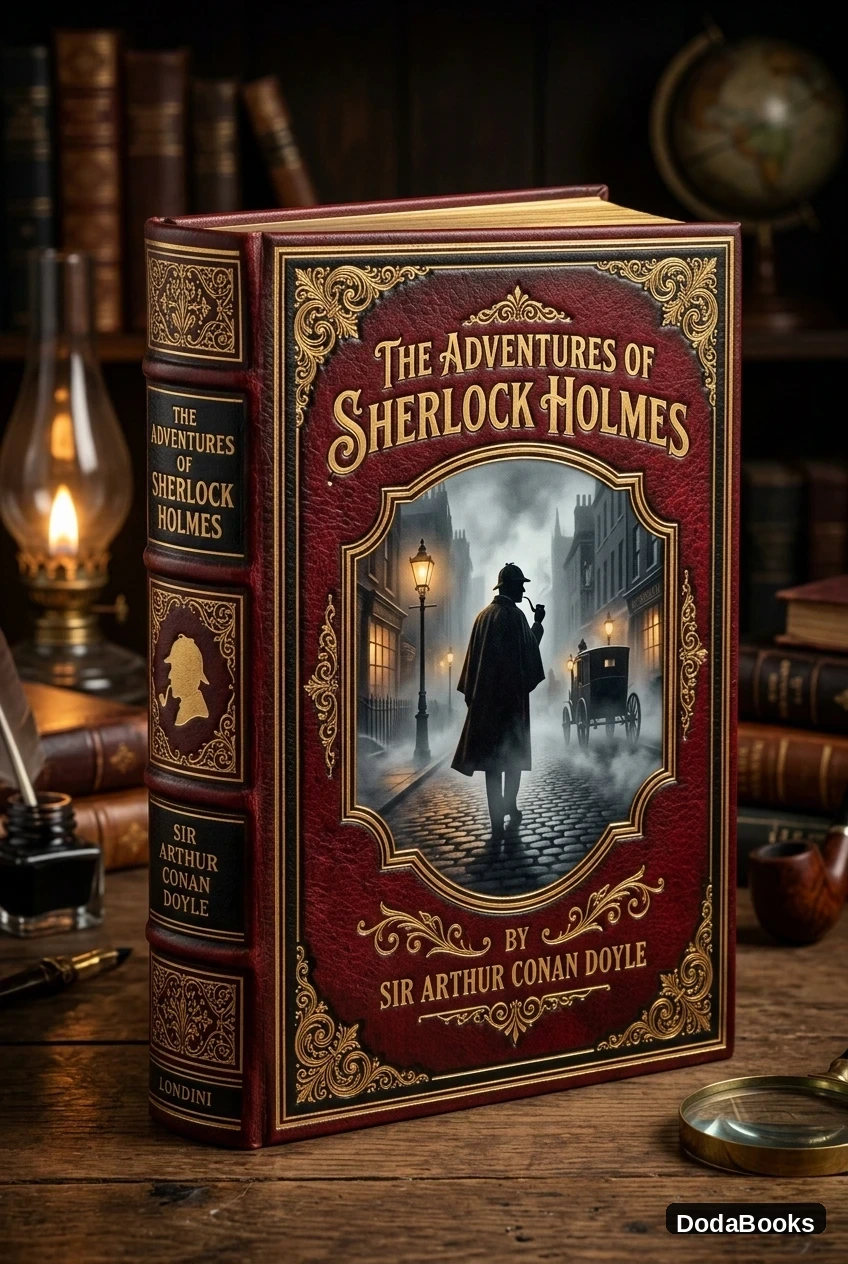
For mystery fans, literature professors, and serious collectors seeking the definitive text with complete character analyses, historical notes on Victorian medical practice, and all original illustrations by Sidney Paget, we recommend the unabridged edition from DodaBooks:
Frequently Asked Questions
Why does Sherlock Holmes use disguises so frequently across the twelve adventures?
Holmes uses disguises not for theatrical vanity, but as a practical forensic tool to penetrate social spheres where an aristocratic gentleman would instantly arouse suspicion. In “A Scandal in Bohemia,” he dresses as a drunken groom to interview cab drivers and later as an amiable clergyman to gain entry into Irene Adler’s parlor; in “The Man with the Twisted Lip,” he disguises himself as an aged opium addict to infiltrate a dangerous dockside den. His mastery of vocal dialects, physical postures, and cosmetic makeup demonstrates his profound understanding of Victorian class semiotics.
Is Dr. Watson portrayed as intelligent in Arthur Conan Doyle’s original stories?
Yes, Dr. Watson is consistently depicted as an intelligent, observant, and capable physician and writer. While he lacks Holmes’ extraordinary genius for microscopic observation and inductive leaps, Watson possesses extensive medical knowledge, military discipline, and exceptional literary skill. Holmes repeatedly praises Watson’s judgment, relies on his medical analyses of wounds and poisons, and entrusts him with armed defense in life-threatening situations. Watson’s perceived slowness is merely a dramatic device designed to highlight Holmes’ superhuman intellect.
What is the thematic importance of the villain Dr. Grimesby Roylott?
Dr. Grimesby Roylott in “The Adventure of the Speckled Band” embodies the terrifying intersection of aristocratic decay, colonial violence, and domestic tyranny. Having served as a physician in India where he served a prison sentence for murdering his native butler, Roylott returns to England with a violent temper, a collection of exotic predatory beasts (a cheetah, a baboon, and an Indian swamp adder), and absolute disdain for civilized law. He symbolizes the predatory domestic monster who exploits Victorian paternal authority to systematically terrorize and murder his own defenseless stepdaughters.
Related Masterwork Guides & Deconstructions
Continue your exploration of classic detective fiction, Victorian literature, and character dynamics with our companion guides:
- Sherlock Holmes Study Guide: Full Case Analysis: The foundational comprehensive study guide to Doyle’s twelve classic cases.
- Sherlock Holmes Themes: Rationalism & Mystery: Analyze the science of deduction, seeing vs. observing, and the London urban gothic.
- The Hound of the Baskervilles Study Guide: Plot & Themes: Examine Doyle’s supreme gothic novel on Dartmoor’s prehistoric moors.
- Dr. Jekyll and Mr. Hyde Characters: Jekyll & Hyde: Deconstruct the psychological duality of Henry Jekyll, Edward Hyde, and Gabriel Utterson.
- Dracula Characters Analysis: Van Helsing & Foils: Explore Bram Stoker’s Crew of Light and their occult battle against Count Dracula.