Romeo and Juliet Study Guide: Themes & Tragedy
Written around 1595–1596 during William Shakespeare’s early lyric period, The Tragedy of Romeo and Juliet remains the world’s most famous dramatic exploration of romantic passion, adolescent defiance, and destructive social factionalism. While popular culture often reduces the play to a sentimental romance of sweet young lovers, Shakespeare’s text is a searing, high-velocity tragedy in which civic violence, toxic masculine honor codes, and generational hatred drag two innocent youths to early graves.
Shakespeare fundamentally transformed his source material—Arthur Brooke’s moralizing 1562 poem The Tragicall Historye of Romeus and Juliet. Whereas Brooke lectured young readers against disobedience and lustful rebellion, Shakespeare sympathizes profoundly with the lovers, portraying Verona as a corrupt, patriarchal society where adult hatred poisons the youth, and where reconciliation can only be purchased through sacrificial blood.
While our companion analyses across Hamlet Study Guide and Jane Eyre Study Guide explore revenge ethics, epistemological paralysis, and the struggle for female autonomy, this comprehensive study guide provides an academic deconstruction of Romeo and Juliet through poetic forms, character foils, temporal acceleration, and tragic fate.
Fast Facts: Masterwork Overview
| Category | Detail |
|---|---|
| Author | William Shakespeare (1564–1616) |
| First Performance | c. 1595–1596 (The Theatre / The Curtain, Shoreditch, London) |
| Literary Genre | Renaissance Lyric Tragedy / Domestic Drama / Elizabethan Verse Drama |
| Setting | Verona and Mantua, Northern Italy, fourteenth-century Renaissance |
| Narrative Form | Five acts alternating blank verse, rhymed couplets, prose satire, and embedded sonnets |
| Central Conflict | The transcendent private love of Romeo and Juliet vs. the ancient civic feud of their households |
| Climax | The street duel in Act III, Scene 1: Tybalt kills Mercutio, Romeo kills Tybalt, leading to banishment |
| Key Motifs | Torches in darkness, holy pilgrim shrines, poisonous apothecaries, nightingales vs. larks |
1. Historical & Cultural Context: Renaissance Verona & Elizabethan Anxiety
To understand the volatile atmosphere of Romeo and Juliet, one must examine the social anxieties of late-Elizabethan London reflected through Renaissance Italy:
Italianate Violence and Elizabethan Urban Feuds
For Elizabethan audiences, Renaissance Italy represented both the height of cultured refinement and a dangerous cauldron of Machiavellian political intrigue, dueling, and vendetta:
- The Cult of the Duel: In 1590s London, young aristocrats abandoned heavy broadswords in favor of Italian rapiers, adopting continental dueling treatises that privileged speed, punctilio, and lethal aggression. Shakespeare dramatizes this craze through Tybalt, whom Mercutio mocks as the “courageous captain of compliments” fighting by the book of arithmetic.
- Civic Disorder: London itself was plagued by violent street riots, apprentice brawls, and aristocratic brawls. Prince Escalus’s furious opening proclamation—“Three civil brawls, bred of an airy word / By thee, old Capulet, and Montague, / Have thrice disturb’d the quiet of our streets”—echoed Queen Elizabeth I’s own royal proclamations against factional street fighting.
The Patriarchal Marriage Economy
In the early modern era, noble marriages were political and financial transactions arranged by patriarchs to consolidate wealth, land, and dynastic alliances:
- Lord Capulet views thirteen-year-old Juliet as legal property to be traded to Count Paris to bolster the Capulet family status.
- When Juliet defies his command in Act III, Scene 5, Capulet’s paternal affection curdles into abusive tyranny, threatening to drag her to church on a hurdle and disown her to starve in the streets: “An you be mine, I’ll give you to my friend; / An you be not, hang, beg, starve, die in the streets.”
- Juliet’s secret marriage to Romeo is thus an act of radical civil disobedience against the absolute authority of the early modern family state.
2. Character Foils & Archetypes
Shakespeare structures his cast around stark dramatic contrasts, using foils to illuminate character flaws and philosophical polarities:
3. Thematic Pillars & Poetic Architecture
The Linguistic Evolution: From Posturing to Authenticity
Shakespeare mirrors Romeo’s psychological development through radical shifts in poetic meter and rhetoric:
- The Rosaline Phase (Petrarchan Artificiality): At the start of the play, Romeo is in love with the idea of being in love. He speaks in clichéd Oxford-style Petrarchan oxymorons copied from fashionable poetry books: “O brawling love, O loving hate, / O any thing, of nothing first create! / O heavy lightness, serious vanity!” His passion is performative, self-absorbed, and cold.
- The Encounter with Juliet (The Shared Sonnet): When Romeo sees Juliet at the feast, his stale rhetoric vanishes. In Act I, Scene 5, their dialogue forms an exquisite 14-line sonnet. The rhyme scheme is shared equally between them, symbolizing absolute spiritual communion and reciprocity.
- Juliet’s Linguistic Directness: Juliet continually demands honest, plain speech over ornamental vows. In the balcony scene (Act II, Scene 2), when Romeo swears by the moon, Juliet instantly interrupts him: “O, swear not by the moon, the inconstant moon, / That monthly changes in her circled orb, / Lest that thy love prove likewise variable.”
Light and Dark Imagery: The Night as Protective Sanctuary
Throughout the drama, Shakespeare establishes an inverted symbolic universe of light and shadow:
- In conventional literature, day represents safety, reason, and divine order, while night represents danger, witchcraft, and crime.
- In Romeo and Juliet, this convention is completely reversed. Daylight brings the blistering, blinding heat of Verona’s streets, where civic brawls erupt and swords are drawn: “For now, these hot days, is the mad blood stirring.”
- Night, by contrast, is the gentle, protective cloaking sanctuary for true love. Under the cover of darkness, Romeo scales the Capulet orchard walls, the lovers consummate their marriage, and their souls connect outside the surveillance of patriarchal Verona.
Yet this night is precarious and ephemeral. The morning lark’s song in Act III, Scene 5 sounds not as an herald of joyful dawn, but as a death knell signaling Romeo’s impending exile: “More light and light: more dark and dark our woes!”
4. The Architecture of Temporal Acceleration
One of Shakespeare’s most radical dramaturgical choices was compressing Arthur Brooke’s nine-month narrative timeline into a breathless four and a half days:
This extreme compression generates intense, claustrophobic momentum. The characters have no time to reflect, deliberate, or mourn. Every decision is made under frantic pressure, highlighting how impetuous youth and rigid adult deadlines conspire to create disaster.
5. The Tragic Catastrophe in the Capulet Tomb
The climax in Act V, Scene 3 inside the Capulet charnel house unites death, eros, and political reconciliation:
- Romeo’s Final Monologue: Beholding Juliet’s radiant beauty in the crypt, Romeo marvels that death has not drained the crimson from her lips and cheeks—a tragic dramatic irony, as the audience knows the potion is wearing off. Defying the stars, he toasts his demise: “Here’s to my love! O true apothecary! / Thy drugs are quick. Thus with a kiss I die.”
- Juliet’s Awakening & Sacrificial Steel: Waking moments later to find Romeo’s corpse warm with recent life, Juliet discovers the empty vial. Refusing Friar Laurence’s cowardice to flee to a nunnery, she seizes Romeo’s dagger: “O happy dagger! / This is thy sheath; there rust, and let me die.”
- The Gold Statues and the Costs of Peace: When the Prince, Montagues, and Capulets arrive, the horrific spectacle of youth sacrificed forces Montague and Capulet to clasp hands in grief. Lord Montague vows to raise Juliet’s statue in pure gold, while Capulet promises equal honor for Romeo. Their ancient feud ends, but only at the cost of everything they cherished.
The final words of the Prince ring as an eternal civic epitaph:
“A glooming peace this morning with it brings;
The sun, for sorrow, will not show his head:
Go hence, to have more talk of these sad things;
Some shall be pardon’d, and some punished:
For never was a story of more woe
Than this of Juliet and her Romeo.”
Recommended Critical Edition
For theater lovers, university students, and Shakespearean actors seeking the authoritative collated Quarto and First Folio text with comprehensive glosses, historical context, and staging notes, we recommend the definitive edition from DodaBooks:
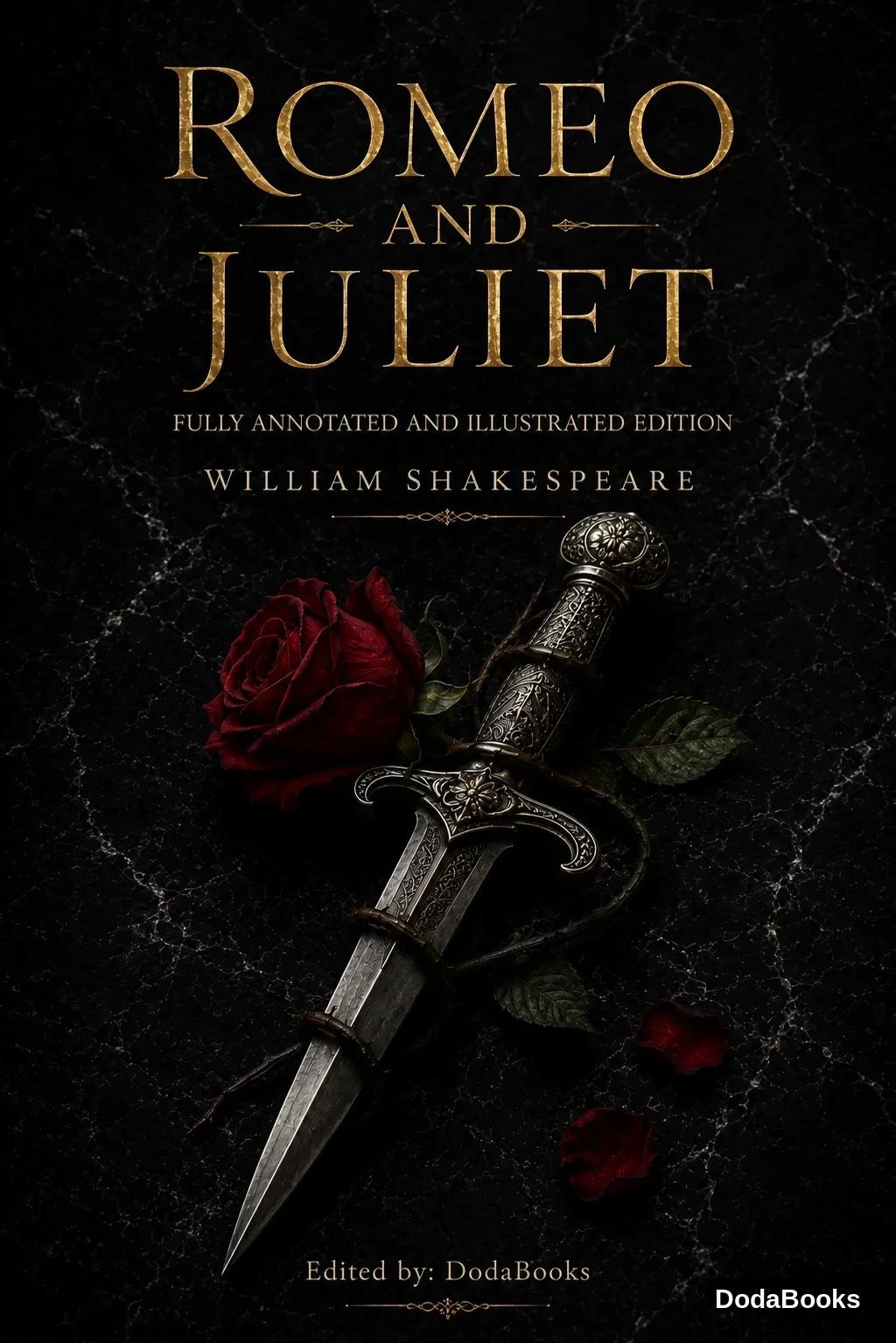
Romeo and Juliet: Fully Annotated Edition
Experience William Shakespeare’s immortal tragedy in a magnificent scholarly edition. Featuring the complete unabridged 5-act text collating the First and Second Quartos, extensive footnotes on Elizabethan wordplay, Italian dueling culture, and essays on Renaissance poetic forms.
- Complete, authoritative unabridged 5-act dramatic text
- Comprehensive line-by-line annotations explaining archaic terms and double entendres
- Exquisite custom 3D typography and digital formatting optimized for modern e-readers
- Instant EPUB download compatible with Kindle, Apple Books, and Kobo
Frequently Asked Questions
Why does Friar Laurence agree to marry Romeo and Juliet in secret?
Friar Laurence explicitly reveals his political and religious motivation in Act II, Scene 3. Although he cautions Romeo against reckless impetuosity (“Wisely and slow; they stumble that run fast”), he agrees to perform the secret ceremony because he envisions it as a divine instrument of peace: “For this alliance may so happy prove, / To turn your households’ rancour to pure love.” Ironically, his optimistic political scheming overestimates human rationality and ultimately precipitates the fatal chain of miscommunications.
Why is Mercutio’s dying curse (“A plague o’ both your houses!”) a turning point in the play?
Until Act III, Scene 1, Romeo and Juliet structurally resembles an Elizabethan romantic comedy: witty wordplay, disguised balls, comic servants, and secret weddings. However, when Tybalt fatally stabs Mercutio under Romeo’s intervening arm, the comedy abruptly dies. Mercutio’s dying curse shifts the narrative irrevocably into dark tragedy. His curse is literally fulfilled when a real outbreak of bubonic plague quarantines Friar John in a house, preventing the life-saving letter from reaching Romeo in Mantua.
What is the thematic significance of the Apothecary scene in Mantua?
In Act V, Scene 1, Romeo visits an impoverished apothecary in Mantua to purchase illegal, fast-acting poison. Shakespeare emphasizes the apothecary’s extreme physical starvation and squalor to illustrate a cynical economic critique: “My poverty, but not my will, consents.” Romeo hands him gold, asserting that gold is far more poisonous to men’s souls than the actual chemical venom: “There is thy gold, worse poison to men’s souls, / Doing more murder in this loathsome world, / Than these poor compounds that thou forbid’st us sell.”
Explore Related Literature Masterworks
Continue your exploration of classic world literature and tragic masterworks with our companion analyses:
- Hamlet Study Guide: Tragedy, Characters & Themes: Deconstruct Shakespeare’s supreme tragedy of philosophical skepticism, revenge ethics, and mortality.
- The Picture of Dorian Gray Themes & Symbolism: Explore Oscar Wilde’s gothic examination of aestheticism, moral vanity, and the rot of the soul.
- Pride and Prejudice Study Guide: Complete Critical Analysis: Discover Jane Austen’s witty dissection of Regency matrimonial economics, class pride, and self-knowledge.
- Frankenstein Study Guide: Summary, Characters & Analysis: Examine Mary Shelley’s foundational Romantic tale of scientific creation, abandonment, and societal tragedy.