Frankenstein Study Guide: Summary, Characters & Analysis
In the wet, volcanic summer of 1816 on the shores of Lake Geneva—the famed “Year Without a Summer” triggered by the apocalyptic eruption of Mount Tambora in the Dutch East Indies—eighteen-year-old Mary Wollstonecraft Godwin sat listening to her lover Percy Bysshe Shelley and Lord Byron debate whether the human corpse could be galvanized into life.
Out of those late-night philosophical conversations emerged Frankenstein; or, The Modern Prometheus (1818), a work that founded modern science fiction by discarding supernatural Gothic demons and castle ghosts in favor of biological laboratory experiment, galvanic electricity, and secular chemistry.
Yet Mary Shelley’s true horror is not biological; it is sociological, parental, and psychological. The tragedy chronicles what happens when scientific technological prowess completely outstrips ethical responsibility, emotional empathy, and communal care.
This comprehensive study guide provides university students, educators, and literary researchers with an exhaustive critical breakdown: featuring fast facts, a chronological plot summary, the medical history of the London Vitalism dispute, the Creature’s intellectual education, and verified textual citations.
For deeper metaphysical explorations of the novel’s motifs, explore our companion analysis: Frankenstein Themes & Symbolism.
Quick Reference & Fast Facts
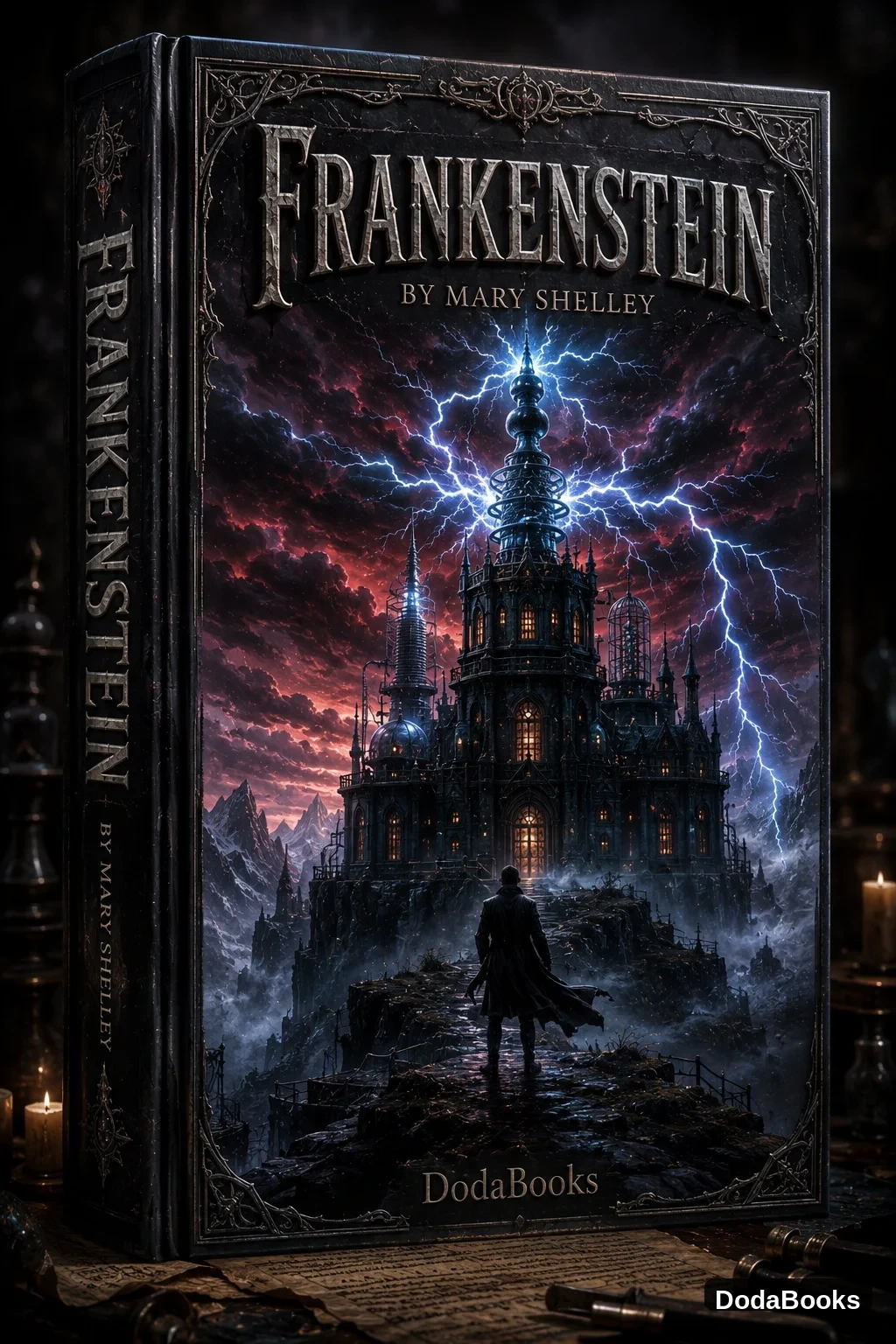
| Element | Specification |
|---|---|
| Full Title | Frankenstein; or, The Modern Prometheus |
| Author | Mary Wollstonecraft Shelley (1818 first edition published anonymously) |
| Publication Date | January 1, 1818 (London: Lackington, Hughes, Harding, Mavor, & Jones) |
| Genre | Science Fiction, Gothic Novel, Philosophical Fiction, Epistolary Frame Narrative |
| Point of View | Three-tier nested first-person: Robert Walton (outer), Victor Frankenstein (middle), The Creature (inner core) |
| Setting | Geneva, Switzerland; Ingolstadt, Bavaria; Mer de Glace (Chamonix); Orkney Islands, Scotland; and the Arctic ice fields (c. 1790s) |
| Protagonist / Antagonist | Victor Frankenstein (obsessive natural philosopher) and his unnamed creation (The Creature / Daemon) |
| Central Conflict | Victor’s catastrophic abandonment of the sentient creature he animates, triggering a lethal cycle of rejection and vengeance |
| Climax | The Creature’s murder of Elizabeth Lavenza on her wedding night in Chapter 23 |
2-Minute Plot Summary
The novel opens with letters from Captain Robert Walton, an ambitious English explorer attempting to navigate an icebound sailing vessel through the Arctic Ocean to discover the Northwest Passage and the secret of terrestrial magnetism. Trapped in pack ice, Walton and his crew observe a giant figure driving a dog sled across the frozen sea. The next morning, they rescue a half-frozen, emaciated traveler: Victor Frankenstein. Seeing that Walton is blinded by the same fanatical desire for intellectual glory that destroyed his own life, Victor agrees to recount his cautionary autobiography.
Born into an affectionate, aristocratic Genevan family, Victor grows up obsessed with alchemy before enrolling at the University of Ingolstadt in Bavaria. Encouraged by his chemistry professor M. Waldman, Victor masters modern anatomy and discovers the secret of imparting animation to dead organic matter. Working for two solitary years in a garret laboratory, Victor stitches together human and animal organs gathered from dissecting rooms, charnel houses, and slaughterhouses.
In Chapter 5, on a dreary November night, the eight-foot-tall creature awakens. Instantly horrified by the creature’s watery yellow eyes, translucent skin, and terrifying proportions, Victor suffers an attack of hysterical revulsion and flees his laboratory. When the gentle, newborn creature wanders to Victor’s bedside seeking guidance, Victor abandons the house entirely, falling into a nervous fever cared for by his loyal friend Henry Clerval.
Months later, Victor receives a letter from his father: his youngest brother, five-year-old William, has been murdered. Returning to Geneva, Victor spots the gigantic silhouette of the Creature near the crime scene. Yet the family servant, gentle Justine Moritz, is falsely accused, condemned by circumstantial evidence, and executed. Paralyzed by cowardice and guilt, Victor refuses to confess that his own creation committed the crime.
Desperate to escape his remorse, Victor treks into the Alpine wilderness of Chamonix. On the Mer de Glace glacier, the Creature confronts Victor. In an articulate, heartbreaking confession (Chapters 11–16), the Creature describes his newborn innocence: wandering cold and blind in the German forests, learning fire and food, and secretly observing an impoverished French peasant family, the De Laceys, from an adjoining pigsty. By watching them, the Creature learns French, discovers the ideals of love, and educates himself by reading three found classics: Milton’s Paradise Lost, Plutarch’s Lives, and Goethe’s The Sorrows of Young Werther.
When the Creature reveals himself to the blind patriarch De Lacey, he is received with warmth. But when the sighted children return, they violently beat him with sticks. Utterly rejected by humanity despite his benevolence, the Creature burns their cottage and journeys to Geneva, killing William in a fit of rage after the boy screams at his appearance.
The Creature demands that Victor construct a female companion sharing his physical defects: “I am malicious because I am miserable. Make me happy, and I shall again be virtuous.” Victor reluctantly agrees and travels to a remote hut in the Scottish Orkney Islands. However, terrified that a breeding pair of creatures might propagate a new species that destroys humanity, Victor tears the half-finished female to pieces while the Creature watches through the window. The Creature delivers a chilling vow: “I shall be with you on your wedding-night.”
The Creature retaliates by strangling Henry Clerval in Ireland. Victor returns to Geneva and marries his beloved cousin Elizabeth Lavenza, mistakenly believing the Creature intends to kill him on their wedding night. While Victor guards the outside hallway with pistols, the Creature slips into the bridal chamber and strangles Elizabeth.
His life utterly destroyed, Victor pursues the Creature across the globe, following his tracks across Russia and into the frozen Arctic wastes, where Walton finds him. Victor dies aboard the ship. That night, Walton enters the cabin and discovers the weeping Creature mourning over his maker’s body. Proclaiming that his own suffering exceeded all the crimes he committed, the Creature vows to build a funeral pyre at the North Pole and burn himself to ashes, vanishing into the icy dark.
The London Vitalism Debate: Abernethy vs. Lawrence
To understand Victor Frankenstein’s laboratory experiments in Ingolstadt, one must reconstruct the scientific civil war that raged across London medical colleges between 1814 and 1819. The dispute pitted John Abernethy against his younger colleague, William Lawrence—who happened to serve as Percy and Mary Shelley’s personal family physician:
- Abernethy’s Vitalist Theory: Argued that life was an ethereal, superadded substance—an invisible electrical fluid breathed into physical matter by a divine Creator, preserving the theological concept of the immortal soul.
- Lawrence’s Materialist Theory: Argued that “life” is simply the physiological operation of physical bodily organs functioning in mechanical harmony. There is no independent soul or vital spark; disrupt the physical apparatus, and life ceases.
Life as an invisible electrical fluid breathed into inert matter, preserving the metaphysical soul.
Life as purely physical mechanics: organs operating in harmony without supernatural or divine addition.
Victor assembles physical parts (materialism) and shocks them to life (vitalism), but completely abdicates parental and moral care.
Victor Frankenstein’s creation synthesizes both positions: he gathers dead biological organs from dissecting rooms and charnel houses (Lawrence’s mechanical materialism) and attempts to infuse them with an electrical spark (Abernethy’s vitalism).
Shelley’s critique is devastating: science may unravel the mechanical secret of animation, but science possesses zero ethical apparatus for dealing with the living, emotional being that results.
The Architecture of Voices: The Nested Narrative Frame
Shelley refuses to tell her story from a single, authoritative perspective. Instead, she structures the novel as three concentric circles of narration:
This nested structure performs vital thematic work:
- The Double (Doppelgänger): Robert Walton is exploring the frozen Arctic in search of the Northwest Passage, risking his crew’s lives for personal glory. When Victor emerges from the ice drift chasing the monster, he is looking at his younger self.
- The Defense of the Creature: By placing the Creature’s voice at the exact physical center of the book (Chapters 11–16), Shelley forces the reader to step inside the mind of the outcast before we see him commit atrocities.
- The Unreliable Narrator: Victor tells Walton that the Creature is an irredeemable demon of slaughter. But when Walton actually confronts the Creature weeping over Victor’s corpse in the final chapter, he discovers a grieving, articulate being driven mad by abandonment.
The Monster’s Curriculum: Three Found Books
Unlike the grunting, brainless brute of Hollywood cinema, Mary Shelley’s creature is an articulate, highly educated intellectual. Hiding in a pigsty adjacent to the De Lacey family’s cottage, he finds an abandoned portmanteau containing three works of world literature:
| Found Text | What the Creature Reads | Epistemological Consequence |
|---|---|---|
| Paradise Lost (John Milton) | The war in heaven; the creation of Adam; the fall of Lucifer | Sees himself as Adam (abandoned by his maker) and Satan (shunned into vengeance) |
| Plutarch’s Lives (Plutarch) | The biographies of Greek and Roman statesmen and lawgivers | Discovers civic virtue, governance, public ethics, and the brutality of human warfare |
| The Sorrows of Young Werther (Goethe) | The intense emotional introspection and suicide of a sensitive young artist | Awakens deep melancholy, domestic longing, and existential loneliness |
From Milton, the Creature learns theology; from Plutarch, politics; from Goethe, psychology. When he approaches Victor at the Mer de Glace, his vocabulary and rhetorical sophistication match his creator’s:
“Remember that I am thy creature; I ought to be thy Adam, but I am rather the fallen angel, whom thou drivest from joy for no misdeed. Everywhere I see bliss, from which I alone am irrevocably excluded. I was benevolent and good; misery made me a fiend. Make me happy, and I shall again be virtuous.”
The Real Sin: Parental Abandonment, Not Creation
Popular culture frequently assumes Victor’s crime was creating life (“playing God”). Mary Shelley’s narrative argues something far more radical: Victor’s crime was abandoning his child.
Notice what happens the second the Creature opens its dull yellow eye in Chapter 5:
- Victor does not examine the creature’s physiology.
- He does not feed it, clothe it, or speak to it.
- He experiences sudden aesthetic disgust: the Creature’s watery eyes and yellow skin violate his standards of symmetry.
- Victor runs out of the laboratory, hides in his bedroom, and falls into a fever.
When the newborn Creature reaches out its hand and mumbles inarticulate sounds of affection toward Victor’s bed, Victor flees the house entirely. Drawing on her mother Mary Wollstonecraft’s Vindication of the Rights of Woman and her father William Godwin’s Political Justice, Shelley demonstrates that human character is forged by early environment. The Creature is born gentle and vegetarian; he becomes a murderer only after every human being he encounters attacks him with stones, clubs, and gunshot.
Recommended Critical Editions
Frankenstein: The Original 1818 Critical Text
The uncensored 1818 first edition accompanied by historical essays on the London Vitalism debate, William Godwin's political philosophy, and Mary Wollstonecraft's feminist legacy.
- ✓ Uncut Original 1818 Text
- ✓ Complete Medical Vitalism Footnotes
- ✓ Comparative 1818 vs 1831 Textual Collation
- ✓ Instant DRM-Free EPUB & PDF Download
Related Literature Study Guides
Explore our comprehensive library of literary masterwork analyses:
- Frankenstein Themes & Symbolism: An analysis of Romantic hubris, the Prometheus myth, light, fire, and the double.
- Moby-Dick Study Guide: The definitive master guide to Melville’s epic, featuring labor economics, cetology, and chapter summaries.
- The Pequod in Moby-Dick: Ship Meaning & Symbolism: The barbaric architecture and 30-man union microcosm of Melville’s whaleship.
- Pride and Prejudice Study Guide: Fee tail male entailment, class realism, and narrative irony in Jane Austen.
- The Great Gatsby Study Guide: Spatial class division and modernist disillusionment in Fitzgerald’s masterwork.
- Crime and Punishment Study Guide: Russian nihilism, utilitarian rationalism, and spiritual resurrection in Dostoevsky.
- Jane Eyre Study Guide: Victorian governess paradox, female autonomy, and Bertha Mason in Charlotte Brontë.
Frequently Asked Questions
What was Victor Frankenstein’s true moral crime in the novel?
Contrary to popular belief, Victor’s fundamental sin was not the scientific creation of life, but the immediate parental and ethical abandonment of his creation. Disgusted by the Creature’s physical appearance, Victor fled his laboratory, leaving a vulnerable, newborn sentient being without food, language, guidance, or emotional care, directly causing the social alienation that turned the benevolent Creature into a murderer.
What is the historical significance of the 1814–1819 Vitalism Debate to Frankenstein?
The Vitalism debate between John Abernethy and William Lawrence (the Shelleys’ personal physician) centered on whether life was an independent divine electrical spirit superadded to matter (Abernethy) or merely the physiological operation of bodily organs (Lawrence). Victor Frankenstein’s experiment synthesizes both views by assembling physical body parts and infusing them with an electrical spark.
How does the nested narrative frame function in Frankenstein?
Shelley structures the novel with three concentric narrative circles: Captain Robert Walton’s outer arctic letters, Victor Frankenstein’s middle retrospective confession, and the Creature’s inner autobiography. This frame creates a psychological double between Walton and Victor, provides the outcast Creature with an articulate central voice, and questions the absolute reliability of Victor’s self-serving narrative.