The Hound of the Baskervilles Themes & Motifs
Serialized in The Strand Magazine between August 1901 and April 1902, Arthur Conan Doyle’s The Hound of the Baskervilles marks the triumphant resurrection of Sherlock Holmes following his apparent death at the Reichenbach Falls in 1893. Widely celebrated as the greatest mystery novel ever written, the book achieves its enduring power by orchestrating a magnificent collision between two seemingly irreconcilable literary genres: the rationalist, forensic detective story and the atmospheric, supernatural Gothic thriller.
Set against the desolate, windswept granite tors and treacherous bogs of Devonshire’s Dartmoor, the novel investigates the terror of the unseen. Through an ancient curse, a spectral hellhound, a mysterious escaped convict, and the suffocating quicksands of the Great Grimpen Mire, Doyle explores the deep anxieties of the late-Victorian and early-Edwardian eras: the dread of evolutionary regression, the persistence of feudal family guilt into the modern age, and the fragility of empirical science when confronted by primeval nature.
While our The Hound of the Baskervilles Study Guide traces the chapter summaries, forensic clues, and plot developments, this thematic guide provides an exhaustive academic analysis of Doyle’s central motifs, symbolic landscapes, and ideological tensions.
Thematic Architecture & Analytical Matrix
Doyle structures the narrative around fundamental philosophical dichotomies that test the limits of modern reason:
| Theme / Motif | Textual Manifestation | Historical / Cultural Context | Key Symbolic Representation |
|---|---|---|---|
| Science vs. Superstition | The 1742 curse manuscript vs. Holmes’ cigarette ash and footprint analysis | The rise of modern secular rationalism vs. Victorian folklore revival | The scientific magnifying glass vs. the ancient parchment |
| Civilization vs. Primeval Wilderness | Baskerville Hall and railway telegraphs vs. prehistoric Dartmoor tors | Industrialization and imperial mastery over wilderness | The ancient Neolithic stone huts; the granite monoliths |
| Evolutionary Atavism & Heredity | Sir Hugo’s portrait matching Jack Stapleton’s face | Darwin’s evolutionary theory; Cesare Lombroso’s criminal phrenology | The seventeenth-century oil portrait; Selden’s facial skull |
| Environmental Treachery & Deception | The deceptive green turf of the Great Grimpen Mire swallowing ponies | Victorian anxieties regarding hidden rot beneath polite exteriors | The Great Grimpen Mire; the butterfly net |
| The Technology of Terror | The phosphorus chemical compound applied to the hound’s muzzle | The misuse of modern chemical and biological science for crime | The luminescent glow; the tin of chemical paste |
| The Imperial Rejuvenation of Britain | Sir Henry Baskerville arriving from Canada to restore the estate | British imperial relations; new-world vitality refreshing old aristocracy | The new tan boots; the clearing of the hall’s darkness |
1. Science and Rationalism vs. Ancient Superstition
The central intellectual drama of The Hound of the Baskervilles is the struggle to preserve scientific sanity in an environment saturated with gothic dread:
The Deconstruction of the Supernatural
Doyle does not simply dismiss superstition; he demonstrates that superstitious terror is the most potent weapon an intelligent criminal can employ. Jack Stapleton does not invent the legend of the hound; he weaponizes an existing 160-year-old family myth to murder Sir Charles Baskerville without leaving a single mark of physical violence:
- Psychological Murder: Sir Charles suffers from serious heart disease and absolute terror of the family curse. Stapleton lures him to the yew alley gate at night using Laura Lyons’ letter, releases the hound, and allows Sir Charles’ own terrified heart to kill him.
- The Forensic Exposure: Holmes never attempts to disprove the supernatural with abstract theological arguments. Instead, he investigates physical facts: measuring paw prints, tracking the purchase of a bloodhound/mastiff cross from Ross and Mangles in London, discovering the tin of chemical phosphorus paste, and ultimately shooting the flesh-and-blood beast with a revolver in the fog.
In this triumph, Doyle declares that mystery is not an indicator of supernatural intervention, but merely of uncompleted scientific observation.
2. Prehistoric Wilderness vs. Victorian Modernity: The Topography of Dartmoor
Dartmoor is not merely a setting in The Hound of the Baskervilles; it is a terrifying, living antagonist. Doyle constructs an intense geographic contrast between the ordered comfort of London and the primeval landscape of Devonshire:
The Neolithic Stone Huts: The Ancient Watchtower
Scattered across Dartmoor are circular stone foundations constructed by prehistoric Britons during the Bronze Age. When Watson discovers a mysterious figure silhouetted against the moon atop a granite tor, he eventually tracks the stranger to one of these Neolithic dwellings.
Inside the primitive stone hut, Watson finds blankets, a tin of spirits, and a note recording his own movements—discovering that the “man on the tor” is Sherlock Holmes himself. The stone hut becomes the ultimate symbolic nexus of the novel: the supreme intellect of modern Victorian civilization lodging inside the prehistoric shelter of cave-dwellers to hunt down a primeval monster.
3. Evolutionary Atavism and Hereditary Guilt
Deeply influenced by nineteenth-century evolutionary science—specifically Charles Darwin’s The Descent of Man and Cesare Lombroso’s theories of criminal anthropology—Doyle saturates the novel with the terror of biological regression:
[The Biological Chain of the Baskerville Curse]
                |
                +---> Sir Hugo Baskerville (1640s): Feudal predator, violent libertine, abductor.
                |
                +---> The Criminal Convict Selden: "The Notting Hill Murderer" with a bestial, ape-like jaw.
                |
                v
[The Discovery in the Dining Hall (Act IV)]
        • Holmes covers Sir Hugo's cavalier hat and flowing curls in the portrait.
        • "Good heavens!" cried Watson in amazement. "It is the face of Stapleton!"
        • "Yes, it is an interesting instance of a reversion to type both physical and spiritual."
                |
                v
[Jack Stapleton / Rodger Baskerville: The polished naturalist unmasked as a murderous genetic throwback]
The Portrait as Forensic Reagent
The dramatic climax of Holmes’ investigation occurs not on the moor, but in the dining hall of Baskerville Hall. Looking up at the ancestral oil paintings, Holmes focuses on the portrait of Sir Hugo Baskerville:
“Holmes held the candle high, so that the light fell upon the dark, wistful face in the corner of the canvas… ‘Do you see anything there?’… Holmes had thrown his left arm across the high hat and down the hair… ‘Good heavens!’ cried Watson, ‘It is the face of Stapleton!’ ‘Yes, an interesting instance of a reversion to type both physical and spiritual. A study of family portraits is enough to convert a man to the doctrine of reincarnation.’”
This revelation shifts the entire nature of the crime. Stapleton is not an unrelated neighbor; he is the secret son of Rodger Baskerville, the black sheep who fled to South America. He has inherited both Hugo’s facial bone structure and his predatory sociopathy. Stapleton is Darwinian atavism incarnate—a primitive feudal monster operating behind the polished spectacles of an English schoolmaster and naturalist.
4. The Great Grimpen Mire: The Symbolic Abyss
The Great Grimpen Mire is the supreme environmental symbol in the Sherlock Holmes canon:
- Surface Appearance vs. Subterranean Reality: The Mire appears from a distance as a brilliant, emerald-green lawn. Yet beneath this bright turf lies a bottomless swamp of suffocating mud.
- The Fate of the Innocent: Watson and Stapleton watch in horror as a wild Dartmoor pony wanders onto the green patch:
“Something brown was rolling and tossing among the green sedges. Then a long, agonized, writhing neck sprang out and a dreadful cry echoed over the moor… It was a pony which had strayed into the mire and was sucked down. He was gone, and the green water oozed and bubbled where he had been.”
- The Reflection of Stapleton’s Mind: The Mire mirrors Jack Stapleton’s psychological structure. On the surface, Stapleton presents a polite, civilized, and harmless demeanor—chasing butterflies with his green net. Beneath this surface lies a treacherous swamp of murderous ambition, having poisoned his wife’s soul, murdered his uncle, and plotted the death of his cousin.
- The Ultimate Retribution: When Stapleton flees through the fog into the Mire after Holmes shoots the hound, he loses his path in the darkness. The earth that he used as his secret accomplice becomes his eternal tomb: sinking into the black mud, he is swallowed forever without leaving a trace, save for Sir Henry’s stolen shoe floating on the slime.
5. Symbolic Analysis: Objects, Chemicals & Artifacts
Doyle anchors the narrative’s psychological suspense in visceral physical objects that carry immense forensic and thematic significance:
The Hound of Flesh and Blood
When the hound finally bursts through the fog in Chapter 14, Doyle delivers the most terrifying visual description in Victorian literature:
“A hound it was, an enormous coal-black hound, but not such a hound as mortal eyes have ever seen. Fire burst from its open mouth, its eyes glowed with a smouldering flame, its muzzle and hackles and dewlaps were outlined in flickering, gaunt fire… In mere size and strength it was a terrible creature which was bounding after us.”
Yet the instant Holmes empties five rounds of his revolver into its flank and the beast rolls over howling in mortal agony, the supernatural spell is broken. Holmes touches the glowing muzzle and smells his fingers:
“Phosphorus,” I said. “A cunning preparation of it,” said Holmes; “no smell which might have interfered with his power of scent.”
The terror was real, but its origin was entirely material. Doyle demonstrates that modern human evil, equipped with chemical science and animal conditioning, is far more lethal than any medieval demon.
Comparative Matrix: Gothic Landscapes Across Canons
| Masterwork & Author | The Gothic Landscape | Nature of the Monster | The Triumph of Reason |
|---|---|---|---|
| The Hound of the Baskervilles Arthur Conan Doyle (1902) | Dartmoor, Devon (granite tors, Neolithic stone huts, Grimpen Mire) | Spectral hound unmasked as a trained mastiff coated in phosphorus | Holmes’ forensic deductions, chemical analysis, and marksmanship |
| Dracula Bram Stoker (1897) | Carpathian Mountains & foggy London ports | Ancient vampire aristocrat wielding shape-shifting and blood contagion | Van Helsing’s synthesis of occult ritual, medical science, and phonographs |
| Frankenstein Mary Shelley (1818) | The Mer de Glace & Arctic sea ice pack | Reanimated giant born of galvanized dead flesh and chemical alchemy | Walton learns from Victor’s tragic hubris and turns the ship south |
| Wuthering Heights Emily Brontë (1847) | Yorkshire moors, violent storms, desolate heather | Heathcliff: demonic human avenger consumed by elemental passion | Death and reconciliation; ghosts wandering the heather together |
Recommended Critical Edition
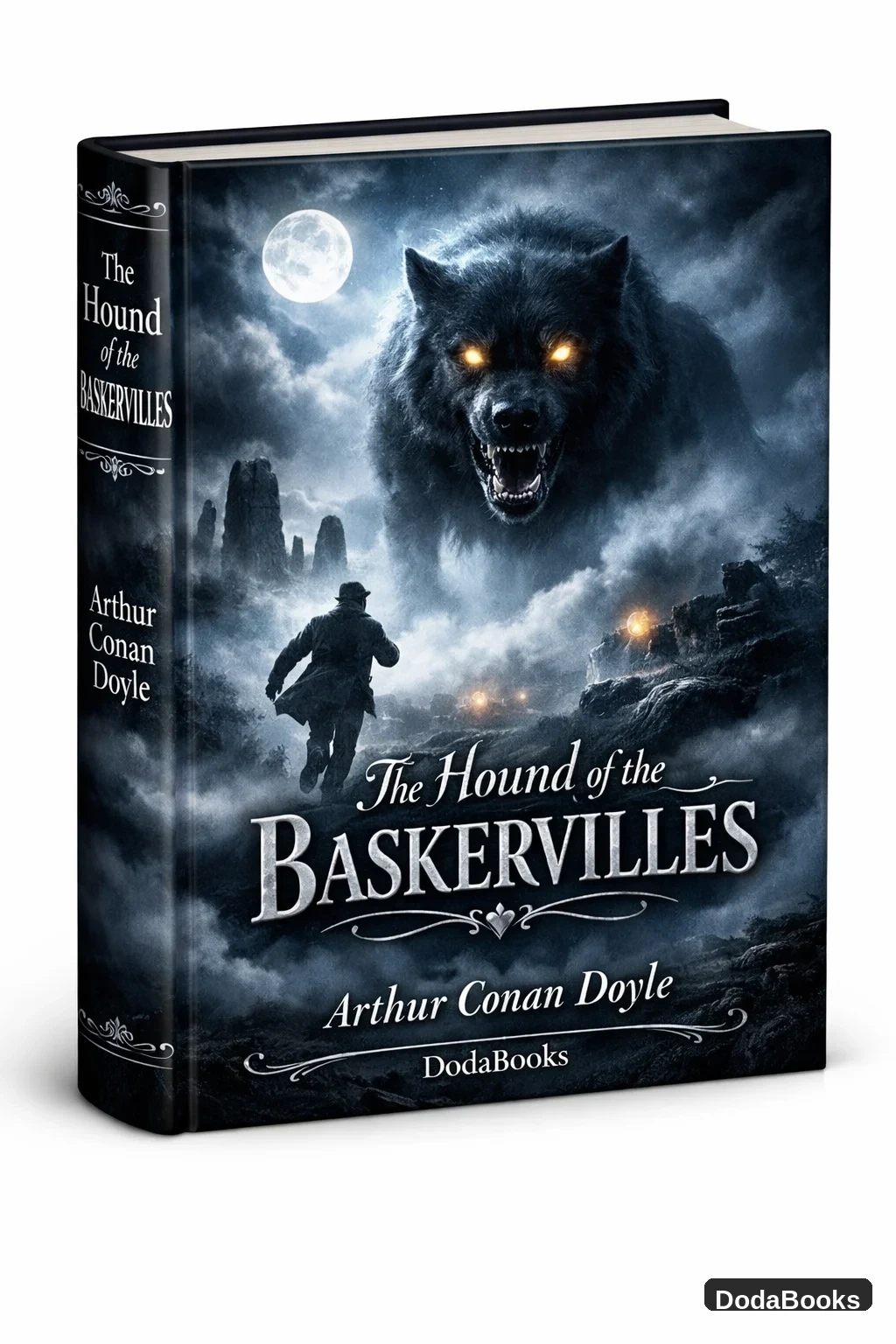
For mystery fans, university literature students, and serious collectors seeking the definitive text with complete historical annotations on Dartmoor geology, Victorian forensic science, and Sidney Paget’s original Strand Magazine illustrations, we recommend the unabridged edition from DodaBooks:
Frequently Asked Questions
Why does Sherlock Holmes conceal his presence on Dartmoor from Dr. Watson?
Holmes conceals himself on the moor in a Neolithic stone hut for two tactical reasons. First, he knows that if the mastermind behind the curse realizes that Sherlock Holmes has arrived in Devonshire, the criminal will become excessively cautious and abandon their plot. Second, by remaining in London ostensibly, Holmes allows Watson to report unfiltered, objective observations without Watson constantly looking to Holmes for validation, enabling Holmes to maneuver independently and observe both the suspects and Watson from an unseen vantage point.
What is the thematic importance of the escaped convict Selden?
Selden, the “Notting Hill Murderer” who escaped from Princetown Prison, serves as a crucial thematic foil to both Sir Henry Baskerville and Jack Stapleton. Selden represents brute, uncivilized, animalistic violence—a creature driven by raw survival instincts on the moor. By dressing in Sir Henry’s discarded clothes, Selden inadvertently attracts the hound, dying by falling headlong from a granite tor. His death demonstrates how animalistic terror strikes indiscriminately, while underscoring that the polished, cultured naturalist Stapleton is infinitely more monstrous than the notorious prison murderer.
Why is the death of Sir Charles Baskerville legally considered natural causes?
When Sir Charles Baskerville’s body was discovered at the end of the yew alley, there were no marks of physical violence, no poison in his system, and no signs of a struggle. His heart had simply ceased beating due to catastrophic stress. Because the footprints of the hound were located twenty yards away, never touching Sir Charles’ body, no Victorian court of law could have convicted Stapleton of homicide under statutory law without the eyewitness testimonies and material evidence that Holmes later assembled.
Related Masterwork Guides & Deconstructions
Continue your exploration of classic detective fiction, Gothic literature, and Victorian character dynamics with our companion guides:
- The Hound of the Baskervilles Study Guide: Plot & Themes: The foundational comprehensive study guide to Doyle’s Dartmoor masterwork.
- Sherlock Holmes Themes: Rationalism & Mystery: Deconstruct forensic semiotics, 221B Baker Street, and seeing vs. observing.
- Sherlock Holmes Characters: Holmes & Watson: Analyze Holmes, Watson, Irene Adler, and Inspector Lestrade.
- Dracula Themes & Symbolism: Analysis of Key Motifs: Explore Bram Stoker’s Gothic masterpiece of modern technology colliding with ancient evil.
- Dr. Jekyll and Mr. Hyde Themes: Victorian Dualism: Examine evolutionary atavism, social hypocrisy, and the divided self.