Alice in Wonderland Study Guide: Summary & Analysis
When Alice’s Adventures in Wonderland was published by Macmillan in November 1865 under the pseudonym Lewis Carroll, it initiated a seismic revolution in English literature. For over a century, Victorian children’s books had functioned almost exclusively as moralistic tracts—gloomy didactic sermons designed to frighten young readers into pious submission, obedience, and social conformity.
Behind the playful facade of grinning cats, smoking caterpillars, and singing mock turtles stood Charles Lutwidge Dodgson: a brilliant Oxford mathematical lecturer at Christ Church, pioneer of formal symbolic logic, and keen observer of the absurdities of adult Victorian society. In Wonderland, Dodgson constructed a masterwork of linguistic philosophy, mathematical satire, and psychological exploration that remains one of the most widely quoted texts in the English language. For a specialized philosophical breakdown of scale anxiety, quaternions, and legal satire, explore our companion analysis on Alice in Wonderland Themes & Symbolism.
Fast Facts: Masterwork Overview
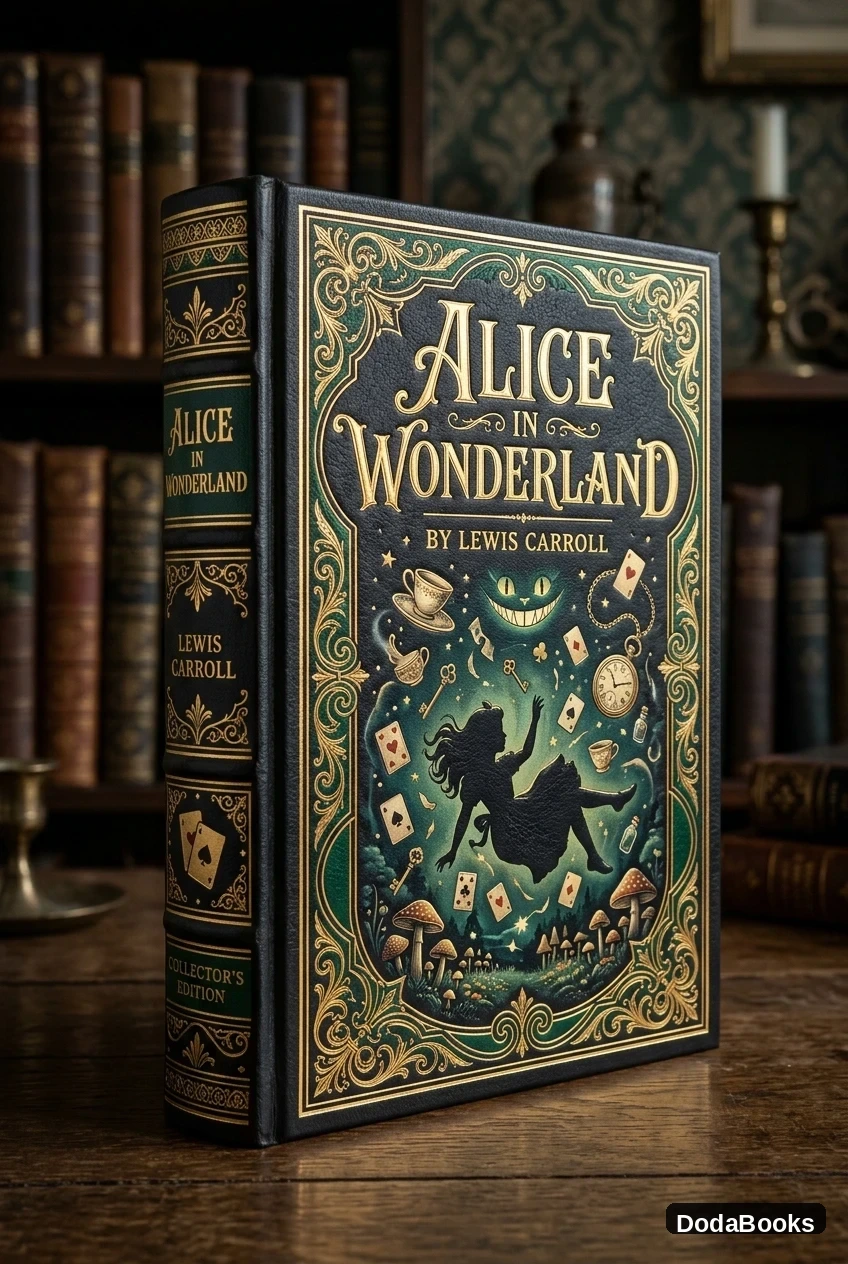
| Category | Detail |
|---|---|
| Author | Lewis Carroll (pen name of Charles Lutwidge Dodgson, 1832–1898) |
| Illustrator | Sir John Tenniel (wood-engraved illustrations for the 1865 Macmillan first edition) |
| First Publication | November 1865 (post-dated 1866), Macmillan & Co., London |
| Literary Genre | Literary Nonsense / Satirical Allegory / Victorian Fantasy / Philosophic Parable |
| Setting | The Subterranean dreamscape of Wonderland, entered via a rabbit-hole near the River Thames |
| Narrative Form | Third-person episodic dream-vision utilizing linguistic paronomasia and semantic inversions |
| Central Conflict | A rational, well-mannered Victorian child’s struggle to maintain bodily identity and logical coherence in an irrational world |
| Climax | The trial of the Knave of Hearts (Chapter 12), where Alice grows to full size and defies the royal court: “You’re nothing but a pack of cards!” |
| Key Motifs | Changes in physical size/scale, predatory animals, clocks and trapped time, arbitrary royal execution, playing cards |
2-Minute Plot Summary: Structural Architecture
Alice’s Adventures in Wonderland is organized across twelve episodic chapters, tracing Alice’s descent through the rabbit-hole into an underground realm governed by irrational social conventions:
- Down the Rabbit-Hole & The Hall of Doors (Chapters 1–2): Bored on a summer riverbank, seven-year-old Alice follows a waistcoat-wearing White Rabbit carrying a pocket watch down a subterranean rabbit-hole. Finding herself in a long hallway of locked doors, she discovers a golden key to a beautiful garden. Consuming enchanted cakes and potions labeled “DRINK ME” and “EAT ME,” she experiences terrifying physical transformations—shrinking to ten inches, then expanding to nine feet—eventually crying a pool of salt tears that floods the hall.
- The Caucus Race & The White Rabbit’s House (Chapters 3–4): Swept into the sea of tears alongside birds and animals, Alice joins the Mouse’s “Caucus-race,” an absurd political game where everyone runs in circles, starts and stops whenever they please, and everyone wins a prize. Sent to fetch gloves for the frantic White Rabbit, Alice drinks another bottle in his cottage and grows so massive her arm sticks out the window; the animals assault the house with pebbles that turn into little cakes, allowing her to shrink and escape.
- Advice from a Caterpillar & The Duchess’s Kitchen (Chapters 5–6): Alice encounters a three-inch blue Caterpillar smoking a hookah atop a mushroom. Challenged by his probing existential question—“Who are you?"—Alice confesses she no longer knows her own identity. The Caterpillar teaches her how to control her height by nibbling opposite sides of the mushroom. Entering the Duchess’s chaotic kitchen filled with blinding pepper, Alice witnesses a violent Cook hurling pots and a baby who morphs into a pig. Leaving the house, she encounters the disembodied Cheshire Cat, who explains that everyone in Wonderland is mad.
- A Mad Tea-Party (Chapter 7): Alice attends an endless outdoor tea-party with the March Hare, the Hatter, and a sleeping Dormouse. The participants are perpetually stuck at six o’clock because the Hatter “quarrelled with Time.” They engage in unsolvable riddles (“Why is a raven like a writing-desk?”), linguistic puns, and musical chair rotations around the unwashed table.
- The Queen’s Croquet-Ground & The Mock Turtle’s Story (Chapters 8–10): Entering the long-sought golden garden, Alice finds gardeners painting white roses red to appease the decapitation-obsessed Queen of Hearts. Alice participates in a bizarre game of croquet using live flamingos as mallets, rolled-up hedgehogs as balls, and arched playing-card soldiers as hoops. She later visits the melancholy Mock Turtle and the Gryphon, who demonstrate the elaborate “Lobster Quadrille” and reminisce about their Victorian schooling in “Reeling and Writhing.”
- The Trial of the Knave of Hearts (Chapters 11–12): The Knave of Hearts stands accused of stealing the Queen’s tarts. The court operates with total disregard for legal procedure: the jury writes down nonsense on their slates, witnesses are threatened with beheading, and the King admits an anonymous nonsense poem as conclusive proof of guilt. As Alice steadily grows back to her normal physical stature, she sheds her fear of their authority. When the Queen screams “Off with her head!”, Alice overturns the jury box, exclaiming: “You’re nothing but a pack of cards!” She awakens on her sister’s lap on the sunny riverbank, realizing her subterranean adventure was a dream.
Satire of Victorian Didacticism and Education
To understand Carroll’s radical subversion, one must examine the 19th-century educational culture Wonderland systematically demolishes:
1. Parodies of Moralistic Children’s Verse
In Victorian schoolrooms, children were forced to memorize solemn, didactic hymns written by authors like Isaac Watts, Jane Taylor, and Robert Southey. These poems drilled children on the virtues of ceaseless industrial labor, obedience, and fear of divine retribution. In Wonderland, every time Alice attempts to recite one of these sacred schoolroom texts to test whether her memory remains intact, her subconscious mind revolts, twisting the pious platitudes into grotesque, violent satires:
| Original Victorian Moral Hymn | Carroll’s Subversive Wonderland Parody | Target of Satire |
|---|---|---|
| Isaac Watts, “Against Idleness and Mischief” (1715): “How doth the little busy bee / Improve each shining hour…” | Chapter 2, “How doth the little crocodile / Improve his shining tail / And pour the waters of the Nile / On every golden scale! / …How cheerfully he seems to grin / How neatly spreads his claws / And welcomes little fishes in / With gently smiling jaws!” | Replaces the industrious Protestant work ethic with deceptive, predatory violence—exposing the hypocrisy of adult economic competition. |
| Robert Southey, “The Old Man’s Comforts” (1799): "‘You are old, Father William,’ the young man cried, / ‘The few locks which are left you are grey…’” | Chapter 5, “You are old, Father William,” where the father stands on his head, turns back somersaults over doors, eats whole geese bones and all, and threatens to kick his whining son down the stairs. | Destroys the myth of pious, serene elderly wisdom; Father William is athletic, gluttonous, and aggressive. |
| Jane Taylor, “The Star” (1806): “Twinkle, twinkle, little star, / How I wonder what you are!” | Chapter 7, The Hatter’s recitation: “Twinkle, twinkle, little bat! / How I wonder what you’re at! / Up above the world you fly, / Like a tea-tray in the sky.” | Replaces transcendent celestial wonder with mundane domestic clutter (a flying tea-tray). |
2. The Absurdity of Rote Learning
Alice constantly regurgitates fragments of geography, history, and etiquette that she has memorized by heart, yet she possesses zero conceptual understanding of their meaning:
- She wonders if falling through the center of the earth will make her emerge among “the Antipathies” (confusing the Antipodes with antipathy).
- The Mouse attempts to dry off the wet animals by reciting the driest, most boring historical fact it knows: a pedantic chronicle of William the Conqueror from a standard school textbook.
- The Mock Turtle explains that his curriculum at the bottom of the sea consisted of “Reeling and Writhing, of course, to begin with… and then the different branches of Arithmetic—Ambition, Distraction, Uglification, and Derision.”
Carroll exposes that Victorian education was an exercise in mechanical memorization that numbed young minds rather than cultivating genuine analytical inquiry.
Mathematical Logic and Carrollian Philosophy
As a lecturer in mathematics at Christ Church, Oxford, Charles Dodgson was deeply engaged in the debates transforming 19th-century mathematics. He was a conservative Euclidean mathematician who looked with deep skepticism upon new abstract developments such as non-Euclidean geometry, symbolic algebra, and quaternions.
| Mathematical Concept | Wonderland Incarnation | Satirical / Philosophical Target |
|---|---|---|
| Quaternions (4D Algebra) | The Mad Tea-Party (Time locked at 6 o’clock) | Satirizes Sir William Rowan Hamilton’s theory of non-commutative rotations without temporal progression. |
| Projective Geometry | Bodily Scale Shifts (Mushroom & Cake/Bottle) | Critiques geometric systems discarding absolute Euclidean proportions and fixed scale invariants. |
| Formal Symbolic Logic | The Cheshire Cat’s Syllogism (“We’re all mad”) | Parodies deductive proofs derived from specious, unexamined premises (“Dogs growl when angry; I growl when pleased…”). |
| Semantic Nominalism | The King & Humpty Dumpty (“Words mean what I choose”) | Exposes linguistic nominalism and the dangerous conflation of arbitrary designations with real-world entities. |
1. The Mad Tea-Party and Hamilton’s Quaternions
In 1843, Irish mathematician Sir William Rowan Hamilton discovered quaternions—a number system extending complex numbers into four dimensions (three spatial axes $i, j, k$, plus time). Hamilton believed quaternions would revolutionize physics because time was integrated directly into spatial coordinates.
Carroll parodies quaternions in Chapter 7:
- The tea-party features three characters (the Hatter, the March Hare, and the Dormouse), corresponding to the three spatial dimensions.
- The fourth parameter—Time—has abandoned them because the Hatter “quarrelled with Time” at the Queen’s concert.
- Without Time to allow progression, the spatial coordinates are trapped in a closed loop, endlessly rotating around the circular table to find clean tea cups. If Time refuses to move, they can never have dinner; it is always six o’clock, locked in an unvarying present.
2. Scale, Proportions, and Inversion
Throughout the book, Alice’s physical dimensions fluctuate violently:
- In Chapter 2, Alice attempts her multiplication table: “Let me see: four times five is twelve, and four times six is thirteen, and four times seven is—oh dear! I shall never get to twenty at that rate!”
- This is not random gibberish. In base 18, $4 \times 5 = 12$; in base 21, $4 \times 6 = 13$; in base 24, $4 \times 7 = 14$. The arithmetic systematically shifts its positional base by 3 with each step, mathematically guaranteeing she will never reach 20 because the system breaks down before base 42!
Character Analysis: Archetypes of Irrationality
Obsessed with rigid schedule and protocol; paralyzed by dread of aristocratic punishment; represents neurotic bureaucratic subservience.
Detached spectator and linguistic saboteur; deconstructs everyday premises; grins autonomously without a physical body.
Totalitarian monarch ruling through capricious terror; demands instant beheadings and subverts judicial reason: "Sentence first—verdict afterwards!"
Alice: The Victorian Rationalist
Seven-year-old Alice is curious, articulate, and meticulously schooled in middle-class manners. She approaches Wonderland with the calm empirical curiosity of a Victorian gentleman explorer. Her fundamental dilemma is existential: whenever her physical body changes size, her sense of self dissolves:
“I wonder if I’ve been changed in the night? Let me think: was I the same when I got up this morning? I almost think I can remember feeling a little different. But if I’m not the same, the next question is, ‘Who in the world am I?’ Ah, that’s the great puzzle!”
Alice’s strength lies in her eventual refusal to accept Wonderland’s arbitrary social codes. When the Queen’s court threatens violence, Alice’s return to adult physical stature allows her to recognize that her oppressors are merely cardboard representations with no moral power.
The Queen of Hearts: The Totalitarian Id
The Queen of Hearts is the explosive, unbridled embodiment of tyrannical rage. While Victorian society celebrated maternal domestic gentility, the Queen is a psychopathic matriarch whose sole solution to every social discord, minor inconvenience, or missed croquet shot is instant decapitation: “Off with their heads!” Significantly, the King of Hearts secretly pardons the prisoners behind her back, indicating that the Queen’s terror is largely theatrical—a caricature of arbitrary political power that rules through hysteria.
The Cheshire Cat: The Detached Epistemologist
The Cheshire Cat is the only creature in Wonderland who does not treat madness as an affliction; he regards it as an inescapable ontological condition:
“We’re all mad here. I’m mad. You’re mad.” “How do you know I’m mad?” said Alice. “You must be,” said the Cat, “or you wouldn’t have come here.”
The Cat’s ability to vanish gradually—leaving only his floating smile—is Carroll’s most brilliant philosophical conceit. It forces the reader to confront the separation between a predicate (the grin) and its physical subject (the cat). Can an attribute exist independently of the substance that generates it?
The Hatter and the March Hare: Time’s Victims
The Hatter’s profession was notorious in 19th-century England for industrial poisoning: hat-makers used mercurous nitrate to cure felt furs, leading to chronic mercury poisoning characterized by slurred speech, tremors, and severe paranoia (“mad as a hatter”). Carroll transforms this occupational tragedy into a dazzling philosophical display of language gone haywire, where riddles have no answers and conversations collapse into endless wordplay.
Major Thematic Dimensions
1. The Terror and Arbitrariness of Adult Rules
Wonderland is not a pastoral paradise; it is a nightmare of arbitrary adult social codes. Alice finds that adults in Wonderland:
- Give orders without logical rationale.
- Change the rules of games midway (the Queen’s croquet).
- Demand obedience based on unearned status rather than merit.
- Demand guilt before establishing facts (the Tart trial).
By presenting adulthood through Alice’s bewildered eyes, Carroll reveals that the adult world’s vaunted “rules of etiquette” are often just as arbitrary and absurd as Wonderland’s nonsense games.
2. The Predatory Nature of the Natural World
Far from the sentimental Victorian view of nature as gentle and benevolent, Carroll’s Wonderland is teeming with predatory threat:
- Big creatures threaten to crush or eat smaller creatures.
- Alice terrifies the Mouse and birds by casually discussing her cat Dinah’s hunting skills.
- The Pigeon attacks Alice as a serpent seeking to devour her eggs.
- The Walrus and the Carpenter (in Through the Looking-Glass) weep crocodile tears while consuming the very young oysters they invited for a pleasant stroll.
Carroll acknowledges the Darwinian reality of nature (“nature red in tooth and claw”) that Victorian children’s literature worked tirelessly to conceal.
Comparative Motif Matrix
| Motif / Symbol | Narrative Appearance | Psychological Dimension | Satirical / Logical Significance |
|---|---|---|---|
| The Rabbit-Hole | Chapter 1 | Descent into the unconscious dreamscape | The threshold between Victorian conscious order and the irrational psyche |
| The Golden Key | Chapter 1 | Frustrated desire and longing | The tantalizing promise of idealized adult freedom that remains just out of reach |
| The Pool of Tears | Chapter 2 | Childhood sorrow and helplessness | The danger of emotional self-drowning; grief becoming a physical hazard |
| The Hookah-Smoking Caterpillar | Chapter 5 | Existential crisis of metamorphosis | The biological and psychological trauma of growing up from child to adult |
| The Pig Baby | Chapter 6 | Disillusionment with maternal sentimentality | Satirizes Victorian idealized child-worship; unruly babies behave like swine |
| The Unpainted Roses | Chapter 8 | Fear of aristocratic punishment | The frantic, hypocritical covering up of cosmetic errors to avoid execution |
| The Pack of Cards | Chapter 12 | The fragility of tyrannical authority | De-mythologization of hierarchy; institutions are paper-thin constructs |
Recommended Critical Editions
Alice's Adventures in Wonderland: Annotated Illustrated Edition
The complete 1865 text featuring all 42 original John Tenniel woodcut illustrations, accompanied by Martin Gardner's landmark mathematical annotations, Victorian nursery rhyme sources, and Oxford logic essays.
- ✓ Complete Original Tenniel Woodcuts
- ✓ 180+ Mathematical & Linguistic Footnotes
- ✓ Facsimile 1865 Typographical Layout
- ✓ Instant DRM-Free EPUB & PDF Download
Related Literature Study Guides
Explore our comprehensive library of literary masterwork analyses:
- Alice in Wonderland Themes & Symbolism: Bodily scale instability, Oxford mathematical satire, linguistic subversion, and arbitrary law.
- Pride and Prejudice Study Guide: Fee tail male entailment, class realism, and narrative irony in Jane Austen.
- Frankenstein Study Guide: The Vitalism controversy, Romantic science, and paternal abandonment in Mary Shelley.
- The Great Gatsby Study Guide: Spatial class division and modernist disillusionment in F. Scott Fitzgerald.
- Crime and Punishment Study Guide: Russian nihilism, utilitarian rationalism, and spiritual resurrection in Dostoevsky.
- Jane Eyre Study Guide: Victorian governess paradox, female autonomy, and Bertha Mason in Charlotte Brontë.
- Moby-Dick Study Guide: Labor economics, cetological classification, and cosmic defiance in Herman Melville.
- The Pequod in Moby-Dick: Ship Meaning & Symbolism: The barbaric architecture and 30-man union microcosm of Melville’s doomed whaleship.
Frequently Asked Questions
How does Alice in Wonderland satirize Victorian children’s education and didactic literature?
Lewis Carroll parodies the moralistic, didactic poetry and rote memorization that dominated 19th-century Victorian education. Throughout the novel, whenever Alice attempts to recite solemn moral verses by Isaac Watts (such as ‘Against Idleness and Mischief’), the words twist uncontrollably into predatory, absurd parodies like ‘How doth the little crocodile,’ exposing the artificiality and emotional uselessness of Victorian rote schooling.
What is the mathematical meaning behind the Mad Tea-Party and changing sizes?
As an Oxford mathematician (Charles Dodgson), Carroll embedded critiques of contemporary 19th-century mathematics into Wonderland. The Mad Tea-Party satirizes William Rowan Hamilton’s discovery of quaternions—a four-dimensional number system where Time is fixed as a fourth parameter. Similarly, Alice’s disorienting changes in physical scale satirize projective geometry and early non-Euclidean systems that abandoned traditional Euclidean proportions.
What does the courtroom trial of the Knave of Hearts reveal about Victorian jurisprudence?
The trial of the Knave of Hearts in Chapters 11 and 12 provides a scathing satire of arbitrary judicial procedure. With the Queen of Hearts demanding ‘Sentence first—verdict afterwards!’ and the King misinterpreting meaningless doggerel as incriminating evidence, Carroll illustrates how formal legal apparatuses can devolve into instruments of tyrannical absurdity when divorced from empirical reason and natural justice.