Dr. Jekyll and Mr. Hyde Themes: Victorian Dualism
When Robert Louis Stevenson published Strange Case of Dr Jekyll and Mr Hyde in January 1886, the novella captured the deep anxieties of late-Victorian Britain with explosive immediacy. Selling over forty thousand copies in its first six months and adapted almost instantaneously for the London stage, Stevenson’s chilling tale tapped directly into late-nineteenth-century terrors: the terrifying implications of Darwinian evolutionary theory, the suffocating hypocrisy of bourgeois respectability, and the fragility of human consciousness.
Rather than presenting a simple moral fable of good triumphing over evil, Stevenson crafts an intricate psychological and philosophical allegory. Dr. Henry Jekyll is not a blameless victim poisoned by an external monster; he is a prosperous, highly esteemed physician whose obsessive desire to indulge his illicit pleasures without endangering his social reputation leads him to invent a chemical escape hatch. In doing so, he discovers that the human soul is not single, but profoundly fractured.
While our Dr. Jekyll and Mr. Hyde Study Guide outlines the novella’s chapter breakdowns, historical context, and critical reception, this analytical guide provides an exhaustive deconstruction of Stevenson’s overarching themes, psychological motifs, and symbolic architecture.
Thematic Taxonomy & Analytical Matrix
Stevenson orchestrates a multi-layered thematic structure where urban geography, medical science, legal procedure, and spiritual anxiety intersect:
| Theme / Motif | Core Textual Manifestation | Philosophical / Historical Context | Key Symbolic Representation |
|---|---|---|---|
| The Duality of Human Nature | Jekyll’s division into respectable philanthropist and savage predator | Hegelian dialectics, proto-Freudian Id/Ego dynamics | The chemical draught; the looking-glass in the cabinet |
| Victorian Hypocrisy & Repression | Gentlemen who protect reputations while concealing nocturnal vice | The strict social codes of late-Victorian Mayfair and Edinburgh | The locked desk drawers; unmentioned gentlemanly sins |
| Evolutionary Atavism & Degeneration | Hyde’s ape-like posture, troglodytic face, and dwarfish stature | Darwin’s Descent of Man (1871); Cesare Lombroso’s criminal anthropology | The stomping of the little girl; the slaughter of Carew |
| Urban Gothic Psychogeography | London’s spatial divide: elegant Cavendish Square vs. squalid Soho | Class segregation, industrial filth, and moral concealment | The double doorway (respectable front vs. blind back door) |
| Epistemological Collapse of Science | Dr. Lanyon’s death from metaphysical shock upon witnessing transformation | The clash between orthodox empirical rationalism and transcendental biology | The shattered laboratory door; the impure chemical salt |
| Language, Law & Reticence | Utterson’s reluctance to pry; unspoken pacts among respectable gentlemen | Victorian gentlemanly code of non-interference and legal suppression | Sealed letters, wills, and posthumous confessions |
1. The Duality of Human Nature: The Polyphonic Self
The foundational philosophical premise of Stevenson’s novella is articulated directly in Dr. Jekyll’s final testamentary confession:
“With every day, and from both sides of my intelligence, the moral and the intellectual, I thus drew steadily nearer to that truth, by whose partial discovery I have been doomed to such a dreadful shipwreck: that man is not truly one, but truly two.”
Stevenson pushes even further, having Jekyll prophetically speculate that future scientists will discover that “man will be ultimately known for a mere polity of multifarious, incongruous and independent denizens.” In this observation, Stevenson anticipates modern psychoanalysis and the fragmented, polyphonic self that would dominate twentieth-century literature.
The Asymmetry of the Division
A critical insight often overlooked in popular adaptations is that Jekyll’s chemical experiment does not produce an equal split between pure good and pure evil:
- Hyde is Pure Evil: Hyde is smaller, lighter, and younger because the evil side of Jekyll had been historically starved and repressed. He is distilled, concentrated malice—“alone in the ranks of mankind, pure evil.”
- Jekyll Remains a Composite: Jekyll, however, is never purely good. Even after taking the potion and reverting to his doctor persona, Jekyll remains a divided creature who secretly enjoys Hyde’s escapades, pays for Hyde’s lodging, and protects Hyde with his legal will.
- The Parasitic Inversion: Over time, the balance of power reverses. At first, Jekyll summons Hyde at will; eventually, Hyde erupts spontaneously during Jekyll’s sleep. The parasite outgrows and consumes the host, proving that evil, once indulged and given autonomous form, systematically devours the moral intellect.
2. Victorian Respectability and Institutional Hypocrisy
Stevenson grew up in Edinburgh—a city famously divided into the elegant, neoclassical Georgian New Town and the dark, labyrinthine medieval Old Town. This dual urban upbringing profoundly shaped his understanding of bourgeois duplicity.
In late-Victorian society, social status, professional standing, and gentlemanly decorum were preserved at all costs. Stevenson populates his narrative entirely with bachelors—lawyers, doctors, merchants—who maintain an iron code of reticence. When Utterson and Enfield walk through London and witness the mysterious door, Enfield remarks:
“I am ashamed of my long tongue. Let us make a bargain never to refer to this again.”
This refusal to question, investigate, or name sinful behavior constitutes the conspiracy of silence that enables Hyde to thrive. Victorian gentlemen preferred to ignore depravity rather than risk the social disruption of public exposure.
3. Darwinian Degeneration and Lombrosian Atavism
Published less than two decades after Charles Darwin’s The Descent of Man (1871), Stevenson’s novella articulates the dark underside of evolutionary science: if humanity has ascended from animal ancestors through millennia of natural selection, humanity might just as easily degenerate back into bestiality.
Stevenson consistently characterizes Edward Hyde using animalistic, evolutionary, and pre-human imagery:
- Physical Appearance: Hyde is described as “pale and dwarfish,” giving an impression of “deformity without any nameable malformation.” He moves with an “ape-like spite” and attacks Sir Danvers Carew with “ape-like fury.”
- Troglodytic Nature: Utterson remarks that Hyde appears “hardly human! Something troglodytic, shall we say?"—referencing prehistoric cave-dwellers.
- The Lombrosian Criminal: Italian criminologist Cesare Lombroso argued in the 1870s and 1880s that born criminals could be identified by physical stigmata (asymmetrical skulls, prominent jaws, excessive hairiness) that represented biological regressions to primitive evolutionary stages. Hyde is the fictional embodiment of Lombroso’s atavistic criminal—an evolutionary throwback lurking beneath the tailored waistcoats of Victorian gentlemen.
This motif mirrors the anxieties explored in our Dracula Themes & Symbolism Guide and Frankenstein Themes & Symbolism Guide, where gothic monsters represent scientific and biological threats to Victorian imperial supremacy.
4. Urban Gothic Psychogeography: London as a Fractured Mind
Stevenson transforms the topography of London into an externalized psychogeographical map of Dr. Jekyll’s divided mind. Rather than locating his Gothic terror in a distant Transylvanian castle or an ancient medieval abbey, Stevenson places it in the beating heart of the British Empire.
The Contrast of Neighborhoods
- Cavendish Square and Mayfair: The domain of Dr. Jekyll and Dr. Lanyon, characterized by spacious, neoclassical squares, polished brass knockers, blazing hearths, and respectful domestic servants. It represents the conscious, moral, and civilized Ego.
- Soho and the River Docks: The nocturnal refuge of Edward Hyde, characterized by muddy streets, flickering gas lamps half-smothered in yellow fog, shuttered brothels, gin shops, and ragged children. It represents the dark, unpoliced, instinctual Subconscious.
The Anatomy of the House and Double Doorway
The most powerful architectural symbol in the novella is Dr. Jekyll’s residence, which physically embodies his psychological split:
- The Stately Front: A handsome townhouse on a respectable square, possessing a large, comfortable hall decorated with oak wainscoting and classical furnishings—the public face of Dr. Henry Jekyll.
- The Disreputable Back (The Dissecting Rooms): A sinister, two-story building showing neither window nor bell-pull, with a blind, blistered door covered in scratches from tramps. This door opens directly onto a dingy alleyway—the private portal through which Edward Hyde slips into the London night.
- The Subterranean Anatomy: The two buildings are connected internally by a courtyard and a narrow corridor leading to the anatomical dissecting theatre of a previous surgeon. To pass from the respectable parlor to the dissecting theatre is to travel backward from civilization to cold dissection, and ultimately downward into atavistic savagery.
5. Symbolic Analysis: Objects, Substances & Manifestations
Stevenson’s narrative is meticulously constructed around recurring physical symbols that anchor its psychological and ethical inquiries:
[The Central Symbols of Dr. Jekyll and Mr. Hyde]
        |
        +---> The Chemical Draught: The illusion of chemical control over ethical nature.
        |
        +---> The Looking-Glass: Unflinching self-confrontation with the primal shadow.
        |
        +---> The Shattered Cane: The violent destruction of patriarchal Victorian order.
        |
        +---> London Fog & Gaslight: Atmospheric blindness, moral obscurity, and denial.
        |
        v
[The Locked Cabinet Door: The bourgeois boundary separating public decorum from psychic horror]
The Chemical Draught (The Potion)
The potion is composed of a volatile red liquor, a crystalline white salt, and ether fumes that boil with a smoky vapor before turning from red to dark purple, and finally to a watery green.
- Not a Creator, but a Solvent: The potion does not inject evil into Jekyll; it merely dissolves the chemical bonds of his social conscience. It is a solvent of moral inhibition.
- The Impurity of the Salt: When Jekyll attempts to brew a fresh batch of potion to halt his involuntary transformations, the newly purchased chemical salts fail to work. He realizes that the original batch contained an unknown, accidental impurity that made the transformation possible. This brilliant narrative device signifies that humanity cannot master moral nature through scientific mechanics; evil cannot be neatly measured, bottled, and regulated.
The Looking-Glass in the Laboratory
In the private cabinet above the dissecting room hangs a cheval-glass (a full-length mirror). When Utterson and Poole break down the door, they are astonished to find a large luxury mirror in a gloomy scientific workspace:
- In this mirror, Dr. Jekyll first gazes upon the face of Edward Hyde and feels, terrifyingly, not horror, but “a leap of welcome.” While the rest of humanity recoils from Hyde with visceral revulsion, Jekyll recognizes Hyde as his authentic, unadorned self.
- In his final days, as Hyde begins to take over his body during sleep, Jekyll shudders to look into the glass, fearing the reflection of the beast that has usurped his countenance.
The Heavy Cane of Sir Danvers Carew
The murder of Sir Danvers Carew—an elderly, white-haired Member of Parliament—is executed with a heavy cane of rare foreign wood that Utterson had presented to Jekyll years earlier as a gentlemanly gift:
- The cane represents civilized friendship, patriarchal authority, and legal stability.
- In Hyde’s hands, this instrument of gentlemanly elegance is transformed into a murderous bludgeon, broken in half during the fury of the assault. One splintered half is left in the gutter; the other half is found hidden behind the door in Hyde’s Soho apartment, serving as the material evidence that links the respectable Dr. Jekyll directly to the murder.
The Fog and Gaslight
London’s atmosphere is dominated by a pervasive, choking yellow fog—the famous “pea-souper” generated by coal smoke and Thames humidity:
- The fog acts as a visual shroud that conceals crime, isolates characters, and obscures moral clarity. It rolls over the city in bank-like waves, at times revealing a street corner bathed in gaslight, only to immediately swallow it again in darkness.
- It reflects the psychological blindness of Utterson and the London establishment, who walk through familiar streets unable to perceive the monstrous reality unfolding behind polished oak doors.
Comparative Symbolism: Gothic Doubling Across Masterworks
To comprehend Stevenson’s place within the nineteenth-century Gothic canon, compare his motifs of psychological doubling with contemporary literary landmarks:
| Work & Author | The Double / Shadow Self | Catalyst of Fragmentation | Ultimate Tragic Consequence |
|---|---|---|---|
| Dr. Jekyll and Mr. Hyde Robert Louis Stevenson (1886) | Edward Hyde: physical atavism, evolutionary regression | Chemical potion (scientific hubris, desire for illicit indulgence) | Complete psychic invasion; suicide behind locked laboratory door |
| The Picture of Dorian Gray Oscar Wilde (1891) | The rotting portrait in the attic: decayed spiritual reflection | Aesthetic pact; yellow book; pursuit of unbridled hedonism | Slashing the portrait, which transfers death and decay back to Dorian |
| Frankenstein Mary Shelley (1818) | The Creature: abandoned son, physical projection of Victor’s hubris | Galvanic reanimation of dead tissue; denial of parental duty | Annihilation of family, domestic happiness, and life in Arctic ice |
| Crime and Punishment Fyodor Dostoevsky (1866) | Svidrigailov: cynical nihilism and uncontrolled sensual predation | Utilitarian rationalism (“extraordinary man” ideology) | Svidrigailov commits suicide; Raskolnikov repents in Siberia |
Recommended Critical Edition
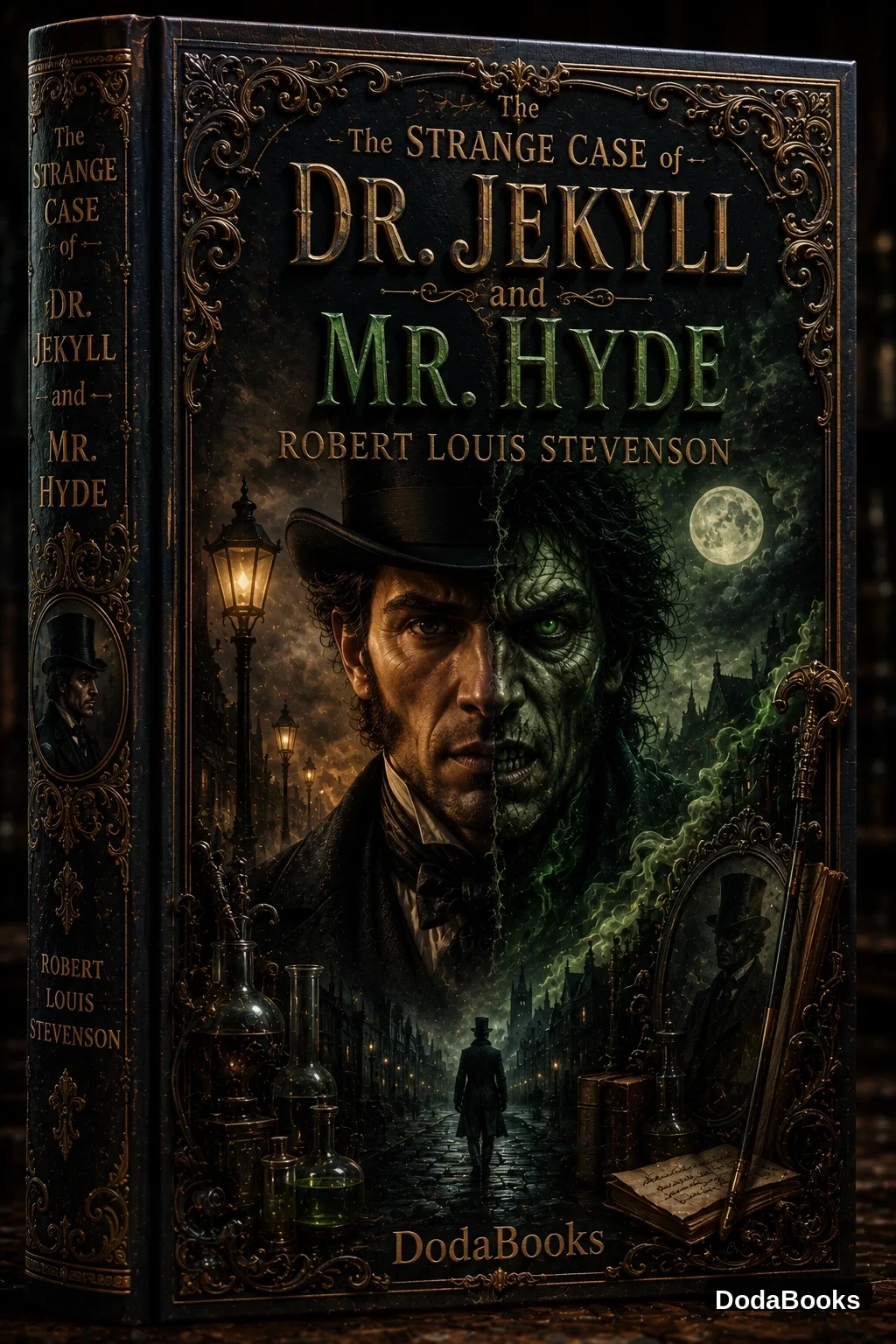
For scholars, university literature students, and avid readers seeking the definitive unabridged text with comprehensive annotations on Victorian medical science, Edinburgh architecture, and psychogeography, we recommend the unabridged edition from DodaBooks:
Frequently Asked Questions
Why does Edward Hyde appear physically smaller and younger than Dr. Jekyll?
Edward Hyde is smaller, lighter, and younger because the evil, instinctual side of Dr. Jekyll’s character had been severely starved and repressed throughout decades of strict Victorian social conformity. Because Jekyll spent forty years cultivating his moral, professional persona while suffocating his darker appetites, the evil component of his nature was less developed physically. As Jekyll indulges Hyde more frequently, Hyde grows noticeably larger, stouter, and more vigorous, visually demonstrating how unchecked indulgence nourishes the dark side of human consciousness.
What is the significance of Dr. Hastie Lanyon’s death?
Dr. Hastie Lanyon represents orthodox, dogmatic Victorian scientific materialism. When Jekyll first began his transcendental investigations into the chemical nature of the soul, Lanyon dismissed him with contempt, branding his research as “unscientific balderdash.” When Lanyon is forced to witness Hyde drinking the potion and transforming into Jekyll before his very eyes, the shock completely destroys Lanyon’s epistemological framework. Incapable of reconciling this metaphysical horror with his mechanistic worldview, Lanyon’s will to live collapses, and he dies within weeks, demonstrating the catastrophic failure of narrow empirical rationalism when confronted by the true mystery of human evil.
Is Edward Hyde an independent monster or a part of Dr. Jekyll?
Edward Hyde is not an independent demonic entity or an external organism; he is entirely a component of Dr. Henry Jekyll himself. Stevenson makes this explicitly clear in Jekyll’s full confession. Hyde is the concentrated, uninhibited embodiment of Jekyll’s own repressed selfish, sadistic, and sensual desires. While Hyde feels no loyalty or empathy toward Jekyll, Jekyll initially views Hyde with profound tenderness, referring to him as his child and taking delight in the immunity from social consequences that Hyde’s persona provides.
Related Masterwork Guides & Academic Analyses
Deepen your understanding of Gothic literature, psychological fragmentation, and Victorian horror with our companion guides:
- Dr. Jekyll and Mr. Hyde Study Guide: Full Analysis: The foundational comprehensive study guide to Stevenson’s novella.
- The Picture of Dorian Gray Themes & Symbolism: Deconstruct Oscar Wilde’s decadent masterpiece of aestheticism, moral rot, and the painted double.
- Frankenstein Themes & Symbolism: Analysis of Motifs: Examine Mary Shelley’s anatomy of scientific hubris, parental neglect, and monstrous revenge.
- Dracula Themes & Symbolism: Analysis of Key Motifs: Explore Bram Stoker’s gothic nightmare of reverse colonization, blood purity, and modern technology.
- The Hound of the Baskervilles Study Guide: Plot & Themes: Analyze Arthur Conan Doyle’s collision between Dartmoor gothic superstition and Holmesian rationalism.