Sherlock Holmes Themes: Rationalism & Mystery
When Arthur Conan Doyle published the twelve stories of The Adventures of Sherlock Holmes in The Strand Magazine between July 1891 and June 1892, he transformed the detective genre from sensationalist pulp fiction into a triumphant celebration of nineteenth-century scientific rationalism. Illustrated by Sidney Paget’s iconic pen-and-ink drawings, these tales established Sherlock Holmes and Dr. John H. Watson not merely as literary characters, but as permanent mythic figures of western culture.
Yet beyond their ingenious puzzles and gaslit London atmosphere, Doyle’s stories engage in a profound sociological and philosophical exploration of late-Victorian anxieties. Across the twelve classic cases, Doyle investigates the fragility of aristocratic prestige, the claustrophobia of domestic greed, the limits of formal British jurisprudence, and the terrifying realization that modern crime can thrive just as easily in a quiet rural vicarage as in the foggy alleys of Whitechapel.
While our Sherlock Holmes Study Guide provides comprehensive case summaries and historical contexts, this thematic guide offers an exhaustive academic deconstruction of Doyle’s core themes, forensic epistemologies, and symbolic architectures.
Thematic Taxonomy & Analytical Framework
Doyle’s detective fiction operates across several intersecting ideological axes:
| Theme / Motif | Core Textual Manifestation | Historical / Cultural Context | Key Symbolic Representation |
|---|---|---|---|
| Forensic Scientific Rationalism | Holmes’ deduction from cigar ash, typewriter wear, boot clay | Rise of forensic pathology, Joseph Bell’s diagnostic semiotics | The magnifying glass; chemical reagent test tube |
| Seeing vs. Observing | The seventeen steps to 221B; Watson’s cognitive blind spots | Empirical philosophy; Francis Bacon; modern scientific method | The trained eye; the mental filing cabinet |
| Justice vs. Statutory Law | Holmes freeing James Ryder in “The Blue Carbuncle”; private discretion | The limitations of the Victorian legal system and penal codes | Holmes’ private judgment; sovereign conscience |
| Urban Gothic & Imperial Labyrinth | London’s opium dens, dense fog, hansoms, and subterranean vaults | Victorian imperial expansion, metropolitan anonymity, fear of decay | Yellow London fog; the dark hansom cab |
| Domestic Greed & Family Treason | Stepfathers defrauding stepdaughters in “A Case of Identity” and “Speckled Band” | Victorian property and marriage laws; Married Women’s Property Acts | The poisoned swamp adder; the altered will |
| Subversion of Gender & Class | Irene Adler outwitting Holmes; European royalty humbled by blackmail | The emergence of the “New Woman”; decline of aristocratic power | The Sovereign’s photograph; the cabman’s disguise |
1. The Science of Deduction: Epistemology and Forensic Semiotics
The supreme philosophical premise of Doyle’s detective fiction is that the universe is governed by unbreakable laws of cause and effect, and that every human action leaves an indelible, readable physical record. Holmes articulates this doctrine in his foundational methodology:
“From a drop of water a logician could infer the possibility of an Atlantic or a Niagara without having seen or heard of one or the other. So all life is a great chain, the nature of which is known whenever we are shown a single link of it.”
The Deductive Sequence: From Observation to Truth
Holmes’ analytical process follows a precise four-stage cognitive pipeline:
2. Justice vs. The Law: Holmes as Sovereign Moral Magistrate
One of the most radical dimensions of The Adventures of Sherlock Holmes is Holmes’ persistent subversion of official state jurisprudence. Holmes is an unofficial, consulting detective; his primary loyalty is to abstract justice and individual conscience, not the penal code of the British Empire:
- The Pardon of James Ryder (“The Blue Carbuncle”): When the terrified hotel attendant James Ryder confesses to stealing the Countess of Morcar’s carbuncle and framing an innocent plumber, Holmes lets him go free:
“I suppose that I am commuting a felony, but it is just possible that I am saving a soul. This fellow will not go wrong again; he is too terribly frightened. Send him to prison now, and you make him a gaol-bird for life. Besides, it is the season of forgivings.”
- The Protection of Aristocratic Scandals (“A Scandal in Bohemia”): Holmes works to protect Irene Adler’s sovereign right to preserve her safety, respecting her moral victory over the self-righteous King of Bohemia.
- The Silent Execution in “The Speckled Band”: When Dr. Grimesby Roylott is bitten by his own swamp adder after Holmes lashes the snake back through the ventilator, Holmes acknowledges his moral responsibility without legal guilt:
“I am no doubt indirectly responsible for Dr. Grimesby Roylott’s death, and I cannot say that it is likely to weigh very heavily upon my conscience.”
Holmes acts as a private, chivalric knight-errant in an industrialized world where formal legal institutions are frequently rigid, corrupt, or inept.
3. The Urban Gothic and the Pastoral Deception
Doyle creates an unforgettable psychogeography of late-nineteenth-century Britain, balancing the urban terrors of London against an even darker rural horror:
The Imperial Gothic of London
London in The Adventures is an atmospheric labyrinth:
- Rolling banks of yellow sulfurous fog swallow streetlamps, creating pockets of sensory deprivation where criminals maneuver unseen.
- The city encompasses staggering extremes: the opulent drawing rooms of the Bohemian King, the dingy pawnshop of Jabez Wilson in Saxe-Coburg Square, the underground vault of the City & Suburban Bank, and the terrifying opium den in “The Man with the Twisted Lip,” where Neville St. Clair sheds his respectable identity to become Hugh Boone the beggar.
- London functions as the great cesspool of the British Empire, drawing criminals, colonial veterans, and foreign treasures into a volatile urban vortex.
The Myth of Pastoral Innocence
In “The Adventure of the Copper Beeches,” Watson remarks on the charm of the passing Hampshire countryside, prompting Holmes to deliver one of his most chilling sociological observations:
“It is my belief, Watson, founded upon my experience, that the lowest and vilest alleys in London do not present a more dreadful record of sin than does the smiling and beautiful countryside… The pressure of public opinion can do in the town what the law cannot accomplish. There is no lane so vile that the scream of a tortured child, or the thud of a drunkard’s blow, does not beget sympathy and indignation among the neighbours… But look at these lonely houses, each in its own fields, filled for the most part with poor ignorant folk who know little of the law. Think of the deeds of hellish cruelty, the hidden wickedness which may go on, year in, year out, in such places, and none the wiser.”
Doyle dismantles the Victorian romantic myth of the countryside, showing that geographic isolation breeds unchecked tyranny and domestic abuse.
4. Class Vulnerability and Aristocratic Rot
While Sherlock Holmes operates among all social classes, the stories consistently expose the moral decrepitude, financial desperation, and arrogance of the British and European ruling class:
- The King of Bohemia (“A Scandal in Bohemia”): Wilhelm Gottsreich Sigismond von Ormstein is willing to discard Irene Adler for a dynastic marriage, but quakes in terror that his former mistress will expose his love letters and ruin his royal wedding. His aristocratic pride is humbled by a common American opera singer.
- The Stolen Beryl Coronet (“The Adventure of the Beryl Coronet”): A member of the British royal family pledges a priceless national treasure—the Beryl Coronet—as collateral for a personal loan of fifty thousand pounds, exposing the financial recklessness of the monarchy.
- Lord Robert St. Simon (“The Adventure of the Noble Bachelor”): An arrogant aristocrat who treats marriage as a transactional exchange of pedigree for American mining wealth, only to be abandoned at the altar because he lacks genuine emotional humanity.
Doyle, writing for the burgeoning bourgeois readership of The Strand Magazine, demonstrates that aristocratic pedigree is no guarantee of intellect, honor, or capability; true nobility resides in merit, intellect, and moral integrity.
5. Symbolic Analysis: Relics of the Detective Mythos
Doyle anchors the legendary world of Sherlock Holmes in visceral physical objects that carry immense symbolic significance:
[The Central Symbols of the Sherlock Holmes Canon]
                |
                +---> 221B Baker Street: The intellectual sanctuary of order amid metropolitan chaos.
                |
                +---> The Magnifying Glass & Reagent: The instruments of empirical semiotics.
                |
                +---> The Stradivarius Violin: Emotional transcendence and cognitive incubation.
                |
                +---> The Seven-Percent Solution: The dark cost of intellectual boredom.
                |
                v
[The Photograph of Irene Adler: The lasting symbol of intellectual humility and female equality]
221B Baker Street
The sitting room at 221B Baker Street is the sacred sanctuary of western detective fiction:
- It represents the ultimate fusion of intellectual order and bohemian eccentricity: Persian slippers filled with tobacco, correspondence pinned to the wooden mantelpiece with a jack-knife, chemical apparatus bubbling on a deal table, and bullet pocks in the wall tracing the royal monogram “VR” (Victoria Regina).
- Outside its bow windows lies the violent, muddy chaos of London; inside, illuminated by a blazing coal fire, reason and logic reign supreme.
The Magnifying Glass and Tape Measure
Unlike conventional detectives who relied on informants or confessions, Holmes arrives at crime scenes armed with optical and measuring instruments:
- They symbolize the triumph of the minute: the recognition that the grandest crimes are solved by paying attention to the most microscopic physical traces—scratches on a keyhole, the ash of a Trichinopoly cigar, or the depth of a carriage wheel’s impression in mud.
The Stradivarius Violin
Holmes’ violin playing represents the emotional and intuitive counterweight to his cold, calculating intellect:
- When wrestling with an intractable problem, Holmes plays weird, discordant improvisations in the dark, using musical harmonics to incubate hypotheses.
- It proves that Holmes is not a mechanical automaton; his scientific brilliance is fueled by artistic imagination and aesthetic sensitivity.
The Seven-Percent Solution of Cocaine
When deprived of complex intellectual problems, Holmes descends into profound melancholic depression, injecting cocaine to escape the agony of mental inactivity:
- This controversial motif reflects the dark price of hyper-intellect: a mind so powerful that ordinary mortal existence feels suffocatingly mundane.
- It humanizes Holmes, providing a tragic vulnerability that Watson continually battles to cure.
The Sovereign’s Photograph of Irene Adler
At the conclusion of “A Scandal in Bohemia,” the grateful King of Bohemia offers Holmes an emerald snake ring. Holmes refuses the jewel, asking instead for the photograph of Irene Adler:
- Irene Adler is forever “the woman” to Holmes—the only individual who ever outwitted him.
- Kept upon his mantelpiece, the photograph serves as a permanent memento of intellectual humility, reminding the world’s greatest detective that human brilliance is never the monopoly of gender or class.
Comparative Symbolism: Detectives Across Literary Traditions
| Masterwork & Author | The Detective / Inquirer | Primary Investigative Method | Philosophical Worldview |
|---|---|---|---|
| The Adventures of Sherlock Holmes Arthur Conan Doyle (1892) | Sherlock Holmes | Inductive forensic deduction, chemical semiotics, keen observation | The universe is rational, orderly, and decipherable through science. |
| The Hound of the Baskervilles Arthur Conan Doyle (1902) | Holmes & Dr. Watson | Field forensics vs. ancient Dartmoor folklore and spectral terror | Prehistoric superstition can be unmasked by empirical rationalism. |
| Dr. Jekyll and Mr. Hyde Robert Louis Stevenson (1886) | Gabriel John Utterson | Legal interrogation, examining wills, gentlemanly reticence | The human soul is dual; empirical science cannot contain moral evil. |
| The Murders in the Rue Morgue Edgar Allan Poe (1841) | C. Auguste Dupin | Analytical ratiocination, psychological empathy with the criminal | The mind can transcend physical circumstance through pure logic. |
Recommended Critical Edition
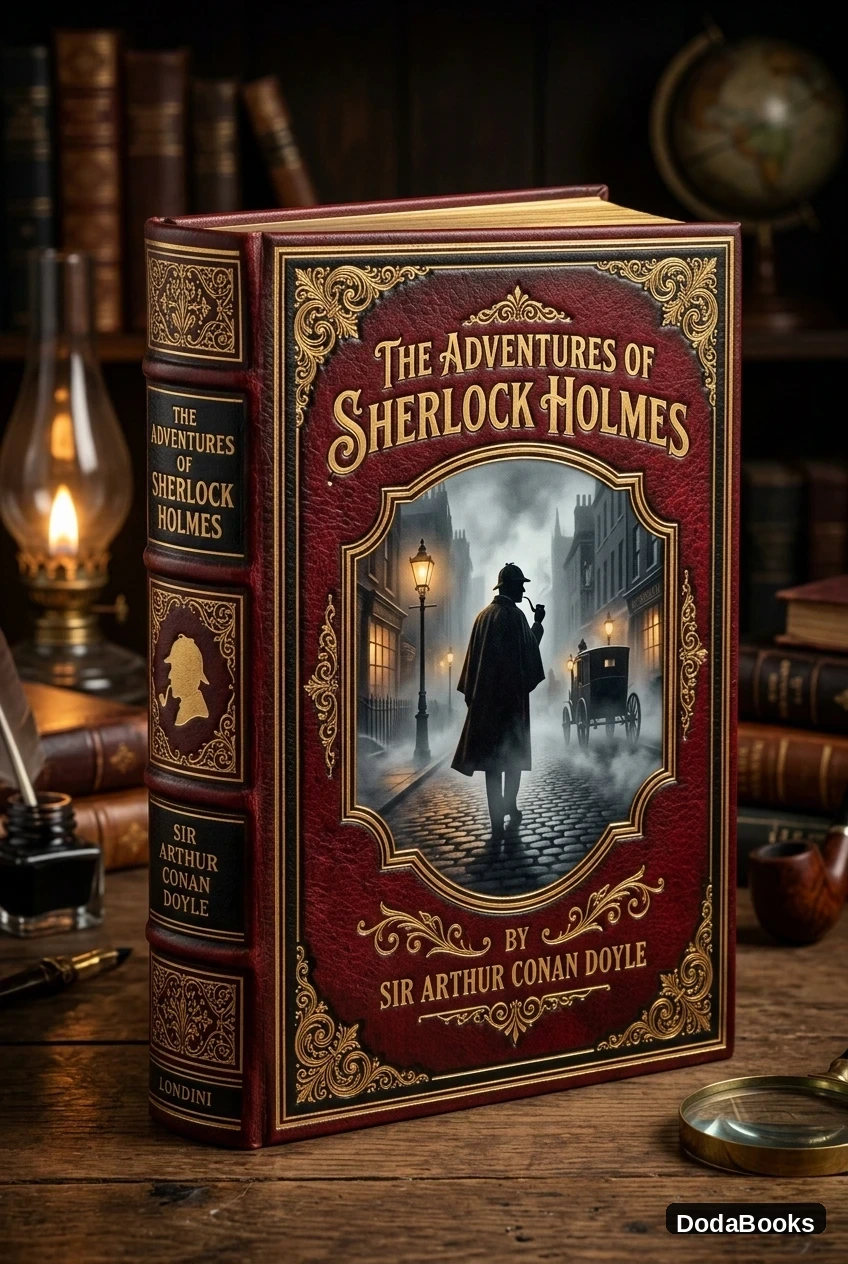
For mystery fans, university literature students, and collectors seeking the complete collection with Sidney Paget’s original Victorian illustrations, historical notes on Victorian crime, and comprehensive annotations on 1890s London street geography, we recommend the unabridged edition from DodaBooks:
Frequently Asked Questions
What is the specific difference between inductive and deductive reasoning in Holmes’ methods?
Although Holmes famously refers to his technique as the “science of deduction,” logicians point out that he primarily employs abductive reasoning (inference to the best explanation) and inductive reasoning. Strict deduction moves from universal premises to guaranteed specific conclusions (e.g., “All men are mortal; Socrates is a man; therefore Socrates is mortal”). Holmes, by contrast, observes specific physical details (red clay on a boot, worn typewriter keys, chalk on fingers) and infers the most probable cause based on vast empirical experience and forensic knowledge.
Why does Irene Adler hold such an exceptional place in Sherlock Holmes’ esteem?
Irene Adler is the only adversary in the original twelve stories who completely outwits Sherlock Holmes. In “A Scandal in Bohemia,” when Holmes disguises himself as an injured clergyman to trick her into revealing the location of the hidden photograph, Adler quickly detects the deception, puts on male attire to follow Holmes back to 221B Baker Street, and flees the country with the evidence before Holmes can retrieve it. Holmes admires her intellect, courage, and resourcefulness, forever revising his previously dismissive views on female intelligence and referring to her reverently as “the woman.”
Why is “The Adventure of the Speckled Band” considered Arthur Conan Doyle’s supreme locked-room mystery?
“The Speckled Band” is widely regarded as the masterpiece of the collection because it combines Gothic horror with brilliant forensic rationalism. The setting—an ancient, decaying Surrey manor house presided over by an unstable, violent Anglo-Indian aristocrat (Dr. Roylott) with a collection of predatory exotic beasts—creates terrifying suspense. Holmes solves the impossible puzzle of how a young woman was murdered in a sealed room with locked shutters and no marks of violence by discovering the dummy bell-rope, the ventilator connecting two bedrooms, and the trained Indian swamp adder, producing a climax of unmatched dramatic intensity.
Related Masterwork Guides & Deconstructions
Continue your exploration of classic detective fiction, Victorian literature, and forensic mystery with our companion guides:
- Sherlock Holmes Study Guide: Full Case Analysis: The foundational comprehensive study guide to Doyle’s twelve classic cases.
- The Hound of the Baskervilles Study Guide: Plot & Themes: Master Arthur Conan Doyle’s supreme gothic novel on the prehistoric Dartmoor moors.
- Dr. Jekyll and Mr. Hyde Themes: Victorian Dualism: Explore late-Victorian urban gothic horror, hypocrisy, and psychological duality.
- Dracula Themes & Symbolism: Analysis of Key Motifs: Deconstruct Bram Stoker’s gothic nightmare of reverse colonization and modern forensic technology.
- The Adventures of Tom Sawyer Themes & Symbolism: Analyze Mark Twain’s classic American frontier adventure and social satire.