The Brothers Karamazov Study Guide: Full Analysis
When Fyodor Dostoevsky published his final masterpiece, The Brothers Karamazov, in The Russian Messenger between 1879 and 1880, he was terminally ill with pulmonary emphysema and possessed by urgent spiritual vision. Writing at the intersection of murder mystery, philosophical treatise, family drama, and theological confession, Dostoevsky produced what many critics, philosophers, and writers—from Sigmund Freud and Albert Einstein to Franz Kafka and Virginia Woolf—have declared the greatest novel ever written.
At its dramatic core, The Brothers Karamazov is a gripping courtroom thriller centered on the violent patricide of the buffoonish, debauched landowner Fyodor Pavlovich Karamazov. Yet beneath the forensic mystery lies the ultimate existential inquiry of the modern era: If God does not exist, is everything permitted? Can human beings bear the agonizing gift of free conscience? And how can faith in divine love survive in a universe drenched in the unmerited suffering of innocent children?
While our companion guides on Crime and Punishment Study Guide and Crime and Punishment Themes & Symbolism explore Dostoevsky’s early dissection of the utilitarian “extraordinary man,” this comprehensive study explores the crowning theological and psychological synthesis of his literary life.
Fast Facts: Masterwork Overview
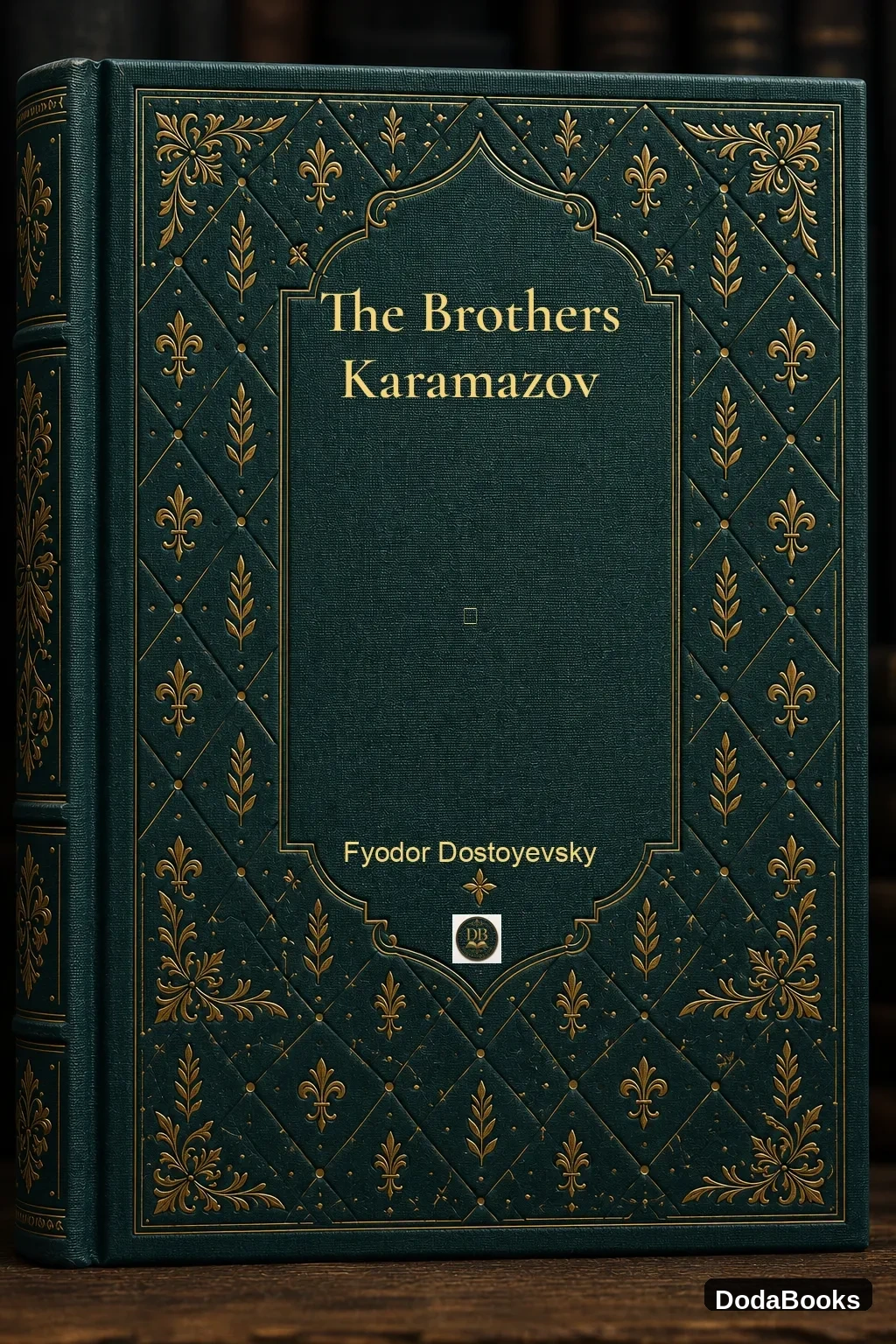
| Category | Detail |
|---|---|
| Author | Fyodor Dostoevsky (1821–1881) |
| First Publication | Serialized January 1879 – November 1880 (The Russian Messenger); book edition December 1880 (St. Petersburg) |
| Literary Genre | Philosophical Novel / Psychological Realism / Family Tragedy / Courtroom Drama |
| Setting | The provincial Russian market town of Skotoprigonyevsk (“Cattle-pen Town”), c. 1866 |
| Narrative Form | Heterodiegetic local narrator employing polyphonic dialogue, letters, parables, and judicial transcripts |
| Central Conflict | The spiritual and biological clash between the sensual patriarch Fyodor Karamazov and his four sons |
| Climax | The murder of Fyodor Pavlovich (Book 8), the fever-hallucination of the Devil (Book 11), and the wrongful conviction of Dmitri (Book 12) |
| Key Motifs | The Grand Inquisitor, unavenged tears of children, the odor of corruption, three thousand rubles, the walnut pestle, the onion parable |
1. The Four Karamazov Archetypes: An Anatomy of Russia
The genius of Dostoevsky’s character design is that the four sons of Fyodor Pavlovich do not merely operate as realistic individuals; they embody four distinct dimensions of the human soul and four competing philosophical trajectories in nineteenth-century Russia:
Fyodor Pavlovich: The Carnal Patriarch
At the center of this constellation sits Fyodor Pavlovich Karamazov, a greedy, manipulative clown who embodies what Dostoevsky calls “Karamazovian earthiness”—an insatiable, animalistic hunger for money, food, and sensual pleasure. Fyodor abandoned all four sons in childhood, caring for them only when they threatened his estate.
When Fyodor and his eldest son Dmitri find themselves competing for the love of the same local temptress, Agrafena Alexandrovna (Grushenka), the sexual and financial rivalry pushes the family into explosive conflict, setting the psychological stage for patricide.
2. “The Grand Inquisitor” and the Crisis of Human Freedom
Book 5, Chapter 5—“The Grand Inquisitor”—stands as one of the towering intellectual achievements of world literature. Conceived by Ivan Karamazov as a prose poem told to his pious brother Alyosha in a tavern, the story imagines Jesus Christ returning to sixteenth-century Seville during the height of the Spanish Inquisition.
Having witnessed Christ perform miraculous healings and raise a dead girl, the ninety-year-old Grand Inquisitor has Jesus arrested and locked in the Holy Office dungeon. In the midnight darkness, the Inquisitor delivers an unforgettable monologue:
Ivan’s Theodicy: “Returning the Ticket”
Preceding the Inquisitor parable, Ivan delivers his devastating indictment of divine justice in Chapter 4 (“Rebellion”). Ivan clarifies that he does not necessarily reject the existence of God; he rejects the world that God created.
Documenting real newspaper reports of innocent children being brutally abused—a child torn apart by hunting hounds before his mother’s eyes, a five-year-old girl smeared with excrement and locked in an icy outhouse by her parents—Ivan challenges Alyosha:
“Tell me yourself, I challenge you: answer. Imagine that you are creating a fabric of human destiny with the object of making men happy in the end, giving them peace and rest at last, but that it was essential and inevitable to torture to death only one tiny creature… Would you consent to be the architect on those conditions? Speak and don’t lie!” “No, I would not consent,” said Alyosha softly.
Ivan declares that if the eternal harmony of paradise must be purchased with the unavenged tears of a single tortured child, he respectfully declines the purchase: “It’s not God that I do not accept, Alyosha, only I most respectfully return him the ticket.”
3. Zosima’s Theodicy: Active Love and Cosmic Guilt
Dostoevsky recognized that Ivan’s rationalist critique was so powerful that it could not be answered with abstract philosophical debate. Instead, in Book 6 (“The Russian Monk”), Dostoevsky presents the death and teachings of Elder Zosima as an existential, living counterweight to Ivan’s intellectual nihilism.
The Doctrine of Universal Responsibility
Zosima’s spiritual philosophy rests upon three radical pillars:
| Spiritual Principle | Zosima’s Teaching | Philosophical Significance |
|---|---|---|
| Active Love vs. Love in Dreams | Loving real, flawed individuals in everyday physical acts rather than admiring abstract humanity. | Directly refutes Ivan, who loves humanity in theory but cannot bear to sit in the same room with ordinary people. |
| Universal Guilt | “Each of us is guilty before all for everyone and for everything.” | Shatters legalistic individualism; because humanity is spiritually unified, any sin committed by one harms all, making mutual forgiveness an absolute duty. |
| All Nature as Divine Glory | Kissing the earth, watering it with tears, and loving every blade of grass, bird, and animal. | Pre-modern ecological mysticism: redemption is not an escape from physical creation into abstract heaven, but the sanctification of the earth. |
The Crisis of the “Odor of Corruption”
When Elder Zosima dies in Book 7, the townspeople and superstitious monks eagerly expect his corpse to work miraculous healings and emit a sweet floral fragrance. Instead, due to summer heat and his advanced age, Zosima’s body begins to decompose rapidly, emitting a foul odor of corruption.
This event plunges the young Alyosha into spiritual crisis: God appears to have dishonored His greatest saint while rewarding secular mockers. Yet through the simple peasant parable of The Little Onion told by Grushenka and his ecstatic vision of Cana of Galilee, Alyosha realizes that true faith does not demand magical spectacles. Alyosha throws himself onto the earth, kisses the soil, and arises a transformed apostle of active love, ready to enter the secular world.
This contrast between sensory reality and spiritual truth echoes Herman Melville’s examination of cosmic mystery in Moby-Dick Themes & Symbolism.
4. The Murder Mystery and the Psychology of Patricide
In Book 8, the simmering family tensions culminate in violence: Fyodor Pavlovich is discovered dead in his bedroom, his skull shattered with a brass pestle, and three thousand rubles meant for Grushenka stolen.
The Real Killer vs. The Philosophical Accomplice
While Dmitri is immediately arrested due to his blood-soaked clothes and drunken spending spree, the physical murderer is revealed in Book 11 to be the valet Pavel Smerdyakov.
In three chilling private interviews with Ivan, Smerdyakov reveals that he murdered Fyodor Pavlovich only because Ivan gave him permission:
“You were the chief murderer; I was only an instrument, your minion… You murdered him, because if there is no everlasting God, then there is no such thing as virtue, and there’s no need of it at all. It was you who said that!”
Smerdyakov took Ivan’s intellectual slogan—“If there is no God, everything is permitted”—and translated it from salon philosophy into physical murder. Just as Lord Henry corrupted Dorian Gray in The Picture of Dorian Gray Themes & Symbolism, Ivan’s abstract intellectual vanity spawned real-world bloodshed, driving Ivan into acute brain fever and a terrifying hallucination of the Devil as a shabby, middle-aged Russian gentleman sitting on his sofa.
5. The Courtroom Show Trial: The Failure of Western Rhetoric
Book 12 (“A Judicial Error”) provides Dostoevsky’s scathing critique of modern Western judicial institutions:
- The Prosecutor (Ippolit Kirillovich): Uses psychological theories to construct a brilliant, compelling narrative showing that Dmitri murdered his father. His logic is flawlessly coherent, yet completely wrong.
- The Defense Attorney (Fetyukovich): A celebrity lawyer from St. Petersburg who dazzles the court with soaring humanist rhetoric, arguing that Fyodor Pavlovich was such a monster that he was not truly a father at all.
- The Russian Jury: Composed of twelve local peasants and clerks who listen quietly, ignore the expensive legal rhetoric, and return a swift verdict of guilty.
Dostoevsky demonstrates that rationalist legal procedure is inherently limited: it can evaluate circumstantial physical evidence, but it cannot penetrate the subterranean spiritual truth of the human soul.
Dmitri accepts his sentence of twenty years of hard labor in Siberia not because he killed his father, but because he recognized that in his heart, he wished his father dead:
“I accept the punishment, not because I killed him, but because I meant to kill him, and perhaps I really might have killed him… We are all responsible for all!”
Recommended Critical Edition
For scholars, university students, and serious readers seeking the definitive English translation with scholarly commentary, historical annotations, and family lineage charts, we recommend the digital edition from DodaBooks:
The Brothers Karamazov (Unabridged Edition)
Experience Fyodor Dostoevsky’s crowning literary achievement in a magnificent digital release. Featuring extensive critical notes on Orthodox theology, 19th-century Russian judicial reform, the Grand Inquisitor source material, and complete character genealogies.
- Complete, authoritative unabridged translation of all 12 Books and Epilogue
- Comprehensive annotations explaining biblical, philosophical, and Russian cultural contexts
- Exquisite custom 3D typography and digital formatting optimized for all screens
- Instant EPUB download compatible with Kindle, Apple Books, and Android
Frequently Asked Questions
What does the epigraph from the Gospel of John (12:24) mean in The Brothers Karamazov?
The novel opens with Christ’s words: “Verily, verily, I say unto you, Except a corn of wheat fall into the ground and die, it abideth alone: but if it die, it bringeth forth much fruit.” This biblical epigraph serves as the spiritual blueprint for the entire novel. It signifies that moral renewal, spiritual resurrection, and communal redemption require the death of the selfish ego. Dmitri, Alyosha, and Russia itself must endure suffering, self-sacrifice, and death to bear the fruit of active love.
Why does Smerdyakov commit suicide before Dmitri’s trial?
Pavel Smerdyakov commits suicide by hanging himself in Book 11 after confessing the murder to Ivan. Smerdyakov murdered his father under the delusion that he and Ivan were intellectual equals who would share the stolen money and escape together. When he sees that Ivan is horrified by the crime and intends to confess in court, Smerdyakov realizes that Ivan genuinely despises him and that his rationalist philosophy has led only to utter isolation and despair.
What is the significance of the novel’s final scene at Ilyusha’s funeral stone?
The novel concludes in the Epilogue with Alyosha delivering his “Speech at the Stone” to twelve young schoolboys following the funeral of the impoverished child Ilyusha. Alyosha urges the boys never to forget this moment of pure, shared grief and brotherly fellowship: “Let us always remember how good it is here, when we are all together, united by a good and kind feeling.” The scene represents the triumph of love over despair, offering hope that the next generation can break the cycle of Karamazovian brutality.
Explore Related Literature Masterworks
Continue your exploration of classic world literature and psychological masterworks with our companion analyses:
- Crime and Punishment Study Guide: Summary & Analysis: Explore Dostoevsky’s landmark psychological thriller on Raskolnikov’s rationalist hubris and redemption.
- Crime and Punishment Themes & Symbolism: Examine the yellow motif, the extraordinary man theory, and the Lazarus resurrection motif.
- The Picture of Dorian Gray Themes & Symbolism: Explore the toxic consequences of amoral aestheticism, double lives, and the soul’s degeneration.
- Moby-Dick Themes & Symbolism: Analysis of Key Motifs: Dive into Herman Melville’s examination of cosmic defiance, monomania, and epistemological doubt.