Sherlock Holmes Study Guide: Analysis of the Canon
When Sherlock Holmes first appeared in Beeton’s Christmas Annual in November 1887 in the novel A Study in Scarlet, he did more than establish a popular literary archetype: he codified the modern detective story and revolutionized the forensic imagination of the Western world. Created by Scottish physician Arthur Conan Doyle, Holmes transformed crime-solving from a crude exercise in informer networks and coercive confessions into an exact, empirical science.
Across four novels and fifty-six short stories (collectively known to scholars as “The Canon”), Conan Doyle captured the anxieties and triumphs of the late-Victorian and Edwardian eras. Holmes represented the supreme triumph of Enlightenment rationalism over the chaotic, fog-choked underworld of the imperial metropolis.
Fast Facts: Masterwork Overview
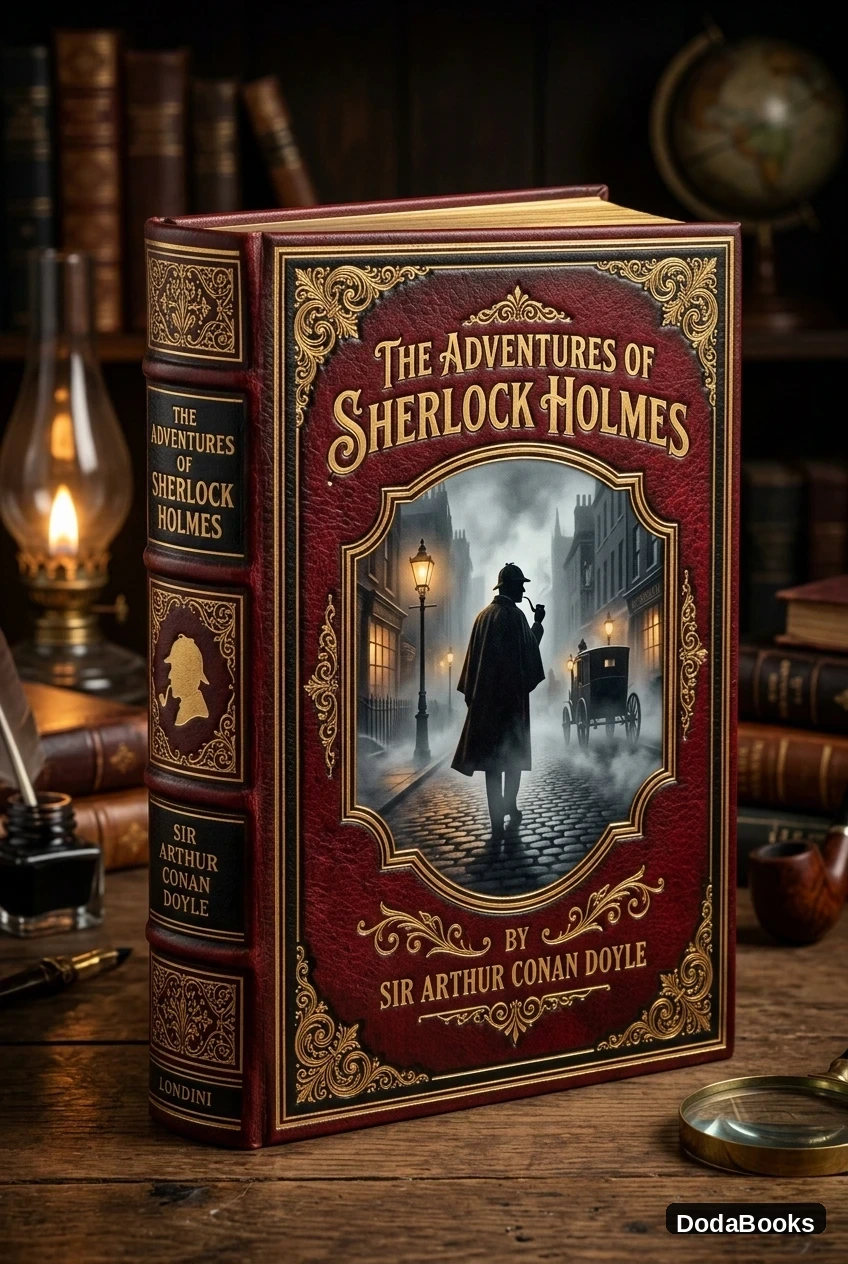
| Category | Detail |
|---|---|
| Author | Sir Arthur Conan Doyle (1859–1930) |
| First Appearance | A Study in Scarlet (November 1887, Beeton’s Christmas Annual) |
| The Canon Corpus | 4 Novels (A Study in Scarlet, The Sign of the Four, The Hound of the Baskervilles, The Valley of Fear) and 56 Short Stories collected in 5 volumes |
| Literary Genre | Detective Fiction / Victorian Mystery / Forensic Realism / Urban Gothic |
| Setting | Victorian and Edwardian London (221B Baker Street), the English countryside, and European locales, c. 1881–1914 |
| Narrative Form | First-person retrospective memoirs narrated by Dr. John H. Watson, M.D. (with two third-person exceptions and two narrated by Holmes) |
| Central Method | The Science of Deduction and Analysis: rigorous physical observation, backward inference (abduction), and forensic examination |
| Arch-Nemesis | Professor James Moriarty (“The Napoleon of Crime”) |
| Key Motifs | 221B Baker Street sitting room, violin playing, chemical retorts, the London pea-souper fog, footprint casts, disguise |
2-Minute Canon Overview: The Four Pillars
The Sherlock Holmes Canon is anchored by four landmark novels that map the evolution of Conan Doyle’s narrative formula:
- A Study in Scarlet (1887): Dr. John Watson, invalided home from the Second Anglo-Afghan War with a bullet wound from Maiwand, seeks an affordable flatmate in London and is introduced to eccentric medical researcher Sherlock Holmes at St. Bartholomew’s Hospital. In an abandoned Brixton house, an American named Enoch Drebber is found poisoned, with the word “RACHE” (German for revenge) scrawled in blood on the wall. Holmes solves the case using cab tracks, cigar ashes, and a blood-reagent test, revealing a historical tale of Mormon pioneer violence and romantic vengeance in the Salt Lake Valley.
- The Sign of the Four (1890): Miss Mary Morstan arrives at Baker Street seeking counsel regarding the mysterious annual receipt of lustrous pearls following her father’s disappearance. Holmes and Watson navigate the nighttime Thames in pursuit of Jonathan Small, an escaped convict from the Andaman Islands penal colony, and his aboriginal companion Tonga, who fires poisoned blowpipe darts. The case introduces Holmes’s seven-percent cocaine habit (used to combat intellectual boredom), Watson’s courtship of Mary, and the dark undercurrents of imperial plunder during the 1857 Indian Mutiny.
- The Hound of the Baskervilles (1901–1902): The undisputed masterpiece of the Canon. Following the mysterious death of Sir Charles Baskerville on the mist-shrouded moors of Devonshire—his face frozen in terror near the footprints of an enormous hound—Dr. James Mortimer consults Holmes to protect the Canadian heir, Sir Henry. Doyle masterfully balances Gothic superstition (an ancient family curse) against Holmesian empiricism, ultimately exposing naturalist Jack Stapleton, who coated a ferocious bloodhound-mastiff cross in luminous phosphorus to claim the family inheritance.
- The Valley of Fear (1914–1915): Triggered by a cipher message from an operative inside Professor Moriarty’s criminal organization, Holmes investigates the brutal shotgun murder of John Douglas at Birlstone Manor in Sussex. The mystery hinges on a missing wedding ring, an ancient moat, and a bloody footprint on a windowsill, before shifting to an extended flashback exposing violent union racketeering (“The Scowrers”) in a Pennsylvania coal mining community.
The Epistemology of Detection: How Holmes Thinks
To understand the enduring brilliance of Sherlock Holmes, one must analyze the philosophical and scientific foundations of his method.
1. Dr. Joseph Bell and Medical Semiotics
While studying medicine at the University of Edinburgh in the late 1870s, Conan Doyle served as an outpatient clerk for Dr. Joseph Bell. Bell stunned students by diagnosing not only a patient’s medical affliction, but their trade, nationality, and personal history before they spoke a single word. Bell analyzed calluses, gait, dialect, tattoo ink, and stains on trouser cuffs.
Doyle transferred Bell’s clinical diagnosis to criminal investigation. When Holmes first meets Watson in A Study in Scarlet, he instantly deduces Watson’s recent military service:
“Here is a gentleman of a medical type, but with the air of a military man. Clearly an army doctor, then. He has just come from the tropics, for his face is dark, and that is not the natural tint of his skin, for his wrists are fair. He has undergone hardship and sickness, as his haggard face says clearly. His left arm has been injured. He holds it in a stiff and unnatural manner. Where in the tropics could an English army doctor have seen much hardship and got his arm wounded? Clearly in Afghanistan.”
2. Forensic Innovations Ahead of Real Police Science
Long before Scotland Yard or French police established formal crime laboratories, Conan Doyle equipped Holmes with real forensic techniques that anticipated the modern science of criminology:
| Forensic Technique | In the Holmes Canon | Historical Reality / Official Adoption |
|---|---|---|
| Chemical Blood Reagent | A Study in Scarlet (1887): Holmes invents a reagent that precipitates solely with hemoglobin, distinguishing human blood from mud or rust. | The Kastle-Meyer phenolphthalein blood test was discovered in 1901; the luminol test followed in 1928. |
| Forensic Soil / Trace Analysis | The Sign of the Four (1890): Holmes identifies clay and chalk splashes on trousers, matching them to specific London construction pits. | Georg Popp pioneered geological soil comparison in forensic murder trials in Germany in 1904. |
| Cigar and Tobacco Ash Monograph | A Study in Scarlet (1887): Holmes authors a monograph identifying 140 varieties of pipe, cigar, and cigarette ashes. | Systematic forensic identification of combustion residues emerged as standard police procedure in the 1920s. |
| Typewriter Document Identification | “A Case of Identity” (1891): Holmes unmasks an impostor by analyzing worn letterforms and misalignments in typewritten correspondence. | The first forensic textbook on typewriter identification, Albert S. Osborn’s Questioned Documents, was published in 1910. |
| Plaster Footprint Preservation | Throughout the Canon: Holmes measures tread depth, pace length, and uses plaster casts to reconstruct physical interactions. | Hans Gross codified crime-scene footprint casting in his 1893 manual Handbuch für Untersuchungsrichter. |
The Watsonian Foil: Anatomy of Narrative Perspective
The partnership between Sherlock Holmes and Dr. John H. Watson is the foundational template for all buddy-procedurals and mystery duos in modern narrative fiction.
| Dimension | Sherlock Holmes | Dr. John H. Watson |
|---|---|---|
| Cognitive Core | Pure calculating intellect and cold deductive logic | Moral conscience, warmth, and human empathy |
| View of Emotion | Regarded as emotional static that jams delicate instruments | Deep chivalry and emotional responsiveness to suffering |
| Domestic Habits | Bohemian eccentric (indoor revolver shooting, chemical retorts) | Conventional Victorian gentleman of modesty and order |
| Background | Independent consulting specialist and chemist | Second Anglo-Afghan War veteran and practicing physician |
| Narrative Function | The brilliant computational engine | The indispensable human voice that connects genius to the reader |
Why Watson Must Narrate
Had Conan Doyle narrated the stories from Holmes’s perspective, the mystery genre would have collapsed into tedious technical soliloquy. The detective’s mind operates so rapidly that revealing his internal monologue would instantly spoil the solution in the opening chapter.
Watson serves three vital artistic functions:
- The Reader’s Intellectual Proxy: Watson possesses the intelligence of an educated gentleman, but lacks Holmes’s specialized perceptual genius. When Watson overlooks the significance of a burned match or a dog that did not bark in the night, the reader shares his blindness.
- The Humanizing Screen: In private, Holmes is an austere, moody eccentric who fasts for days during cases and injects cocaine when bored. Through Watson’s warm, loyal, and forgiving perspective, Holmes’s cold misanthropy is reframed as heroic dedication.
- The Literary Chronicler: Watson’s romanticization of cases is a running source of comic friction between the roommates. In The Sign of the Four, Holmes complains: “Detection is, or ought to be, an exact science and should be treated in the same cold and unemotional manner. You have attempted to tinge it with romanticism, which produces much the same effect as if you worked a love-story or an elopement into the fifth proposition of Euclid.”
Character Profiles: Pillars of the Canon
Sherlock Holmes: The Thinking Machine
Living at 221B Baker Street under the maternal care of landlady Mrs. Hudson, Holmes is the world’s first and only “consulting detective.” Tall, gaunt, with hawk-like features and piercing gray eyes, Holmes lives for pure intellectual problem-solving. He disdains public acclaim, regularly allowing Scotland Yard inspectors (such as Lestrade and Gregson) to claim credit for his discoveries. He views romance and sexual passion as dangerous distractions that introduce bias into an analytical instrument: “Grit in a sensitive instrument, or a crack in one of his own high-power lenses, would not be more disturbing than a strong emotion in a nature such as his.”
Professor James Moriarty: The Napoleon of Crime
Introduced in “The Final Problem” (1893) to allow Conan Doyle to kill off the detective at the Reichenbach Falls in Switzerland, Professor Moriarty is Holmes’s intellectual mirror:
- A mathematical genius who authored A Treatise on the Binomial Theorem at age twenty-one.
- The mastermind of a criminal syndicate whose tentacles extend across the European continent.
- Described by Holmes as a spider sitting motionless at the center of an immense web, vibrating at thousands of radiating strands while remaining physically invisible to the police.
Irene Adler: “The Woman”
Appearing in only a single story, “A Scandal in Bohemia” (1891), American opera singer Irene Adler achieves legendary status by outsmarting Holmes. Hired by the hereditary King of Bohemia to recover a compromising photograph, Holmes orchestrates an elaborate deception to locate the picture. However, Adler sees through his disguise, escapes to the Continent with the evidence, and leaves behind a letter outwitting the great detective. Forever after, Holmes refers to her with profound reverence as “the Woman.”
London as an Imperial Gothic Labyrinth
Conan Doyle’s London is not merely a geographic backdrop; it is an active mythological ecosystem:
- The Pea-Souper Fog: The yellow London fog (“the great greasy brown swirl”) functions as a visual manifestation of moral obscurity, urban pollution, and hidden crime. Within the fog, Victorian boundaries dissolve; hansom cabs emerge from the gloom like phantom vessels.
- Imperial Infiltration: London is depicted as the drainage basin of the British Empire:
“London, that great cesspool into which all the loungers and idlers of the Empire are irresistibly drained.”
- Crimes investigated by Holmes rarely originate from ordinary domestic squabbles; they are propelled by the return of imperial sins—stolen jewels from Indian maharajas, Ku Klux Klan revenge letters from America, Australian gold-rush betrayals, and venomous creatures transported across trade routes.
Comparative Matrix of Key Canon Stories
| Title | Publication | Key Forensic Innovation | Central Thematic Conflict |
|---|---|---|---|
| “A Scandal in Bohemia” | July 1891 | Psychological profiling; human disguise | Gendered intellect; Holmes humbled by a woman’s superior cunning |
| “The Red-Headed League” | August 1891 | Analysis of knee-worn trousers; subterranean acoustics | The absurdity of modern corporate fronts disguising underground bank robberies |
| “The Speckled Band” | May 1892 | Inspection of dummy bell-ropes and unventilated air-shafts | Imperial rot; Anglo-Indian violence penetrating the English country manor |
| “Silver Blaze” | December 1892 | Negative evidence (“the curious incident of the dog in the night-time”) | Professional horse-racing fraud and nocturnal veterinary surgery |
| “The Final Problem” | December 1893 | Criminal organization theory; alpine psychological combat | Order vs. chaos; the mutual annihilation of genius at Reichenbach Falls |
| The Hound of the Baskervilles | 1901–1902 | Paleontological bone reconstruction; chemical luminescence | Ancient superstition and ancestral guilt conquered by Enlightenment empiricism |
Recommended Critical Editions
The Adventures of Sherlock Holmes: Annotated Victorian Edition
The complete collection of all 12 original 1891–1892 Strand Magazine stories, accompanied by Sidney Paget's iconic original illustrations, Victorian forensic history essays, and Baker Street topographical itineraries.
- ✓ All 104 Original Sidney Paget Illustrations
- ✓ 240+ Forensic & Topographical Annotations
- ✓ Complete Strand Magazine Layout Collation
- ✓ Instant DRM-Free EPUB & PDF Download
Related Literature Study Guides
Explore our comprehensive library of literary masterwork analyses:
- Alice in Wonderland Study Guide: Mathematical nonsense, Victorian education satire, and Carrollian logic.
- Frankenstein Study Guide: The Vitalism controversy, Romantic science, and paternal abandonment in Mary Shelley.
- The Great Gatsby Study Guide: Spatial class division and modernist disillusionment in F. Scott Fitzgerald.
- Crime and Punishment Study Guide: Russian nihilism, utilitarian rationalism, and spiritual resurrection in Dostoevsky.
- Jane Eyre Study Guide: Victorian governess paradox, female autonomy, and Bertha Mason in Charlotte Brontë.
- Moby-Dick Study Guide: Labor economics, cetological classification, and cosmic defiance in Herman Melville.
- The Pequod in Moby-Dick: Ship Meaning & Symbolism: The barbaric architecture and 30-man union microcosm of Melville’s doomed whaleship.
Frequently Asked Questions
How did Arthur Conan Doyle pioneer forensic science in detective fiction?
Conan Doyle drew directly from his medical training under Dr. Joseph Bell at the University of Edinburgh, who emphasized diagnosing patients through razor-sharp observation of minute physical clues. In the Holmes canon, Doyle anticipated real-world forensic breakthroughs decades before police forces adopted them—including chemical blood tests (predating the Kastle-Meyer test), forensic soil and cigar ash analysis, footprint preservation via plaster casts, and document typewriter analysis.
What is the literary and psychological function of Dr. John H. Watson as narrator?
Dr. Watson functions as the essential surrogate for the reader and the humanizing foil to Holmes’s cold, calculating intellect. As an intelligent, honorable army physician with conventional Victorian sensibilities, Watson records facts without immediately seeing their underlying significance. His narrative perspective creates dramatic suspense, cushions Holmes’s eccentricities with warm domesticity, and allows the reader to marvel at the eventual revelation of the detective’s reasoning.
How does Sherlock Holmes reflect late-Victorian anxieties about imperial crime and urban chaos?
Published during the twilight of the British Empire, the Holmes stories dramatize anxieties regarding foreign contagion, imperial plunder, and urban decay in London. Murder plots frequently involve colonial artifacts, exotic poisons, and returning soldiers or colonists carrying the violence of the frontier back into the heart of the metropolis (such as the swamp adder in ‘The Speckled Band’ or the Andaman poison dart in The Sign of the Four). Holmes restores order by applying Enlightenment reason to an unruly global empire.