The Call of Cthulhu Study Guide: Themes & Cosmic Horror
Written in the summer of 1926 and published in the pulp magazine Weird Tales in February 1928, Howard Phillips Lovecraft’s The Call of Cthulhu stands as the founding scripture of modern cosmic horror and the cornerstone of the celebrated “Cthulhu Mythos.” Across its three intricately interlocking sections, the novella dismantled nineteenth-century gothic romance, substituting traditional supernatural specters with an overwhelming, scientifically grounded dread of cosmic indifference.
Lovecraft begins with what is arguably the most famous opening thesis in speculative literature: “The most merciful thing in the world, I think, is the inability of the human mind to correlate all its contents. We live on a placid island of ignorance in the midst of black seas of infinity, and it was not meant that we should voyage far.” Rather than presenting terror through jump-scares or physical gore, Lovecraft explores epistemological despair—the realization that human science, reason, and religious morality are petty illusions waiting to be obliterated by ancient cosmic entities.
While our companion studies across Dracula Study Guide and Frankenstein Study Guide deconstruct Victorian biological contagion, imperial anxiety, and Promethean scientific overreaching, this comprehensive guide provides an academic deconstruction of Lovecraft’s narrative architecture, cosmic philosophy, non-Euclidean geometry, and cult psychology.
Fast Facts: Masterwork Overview
| Category | Detail |
|---|---|
| Author | H. P. Lovecraft (Howard Phillips Lovecraft, 1890–1937) |
| Composition & Publication | Written August–September 1926; Published in Weird Tales (February 1928) |
| Literary Genre | Cosmic Horror / Weird Fiction / Epistolary Mystery / Speculative Realism |
| Key Locations | Providence, Rhode Island; New Orleans, Louisiana; Auckland, New Zealand; R’lyeh (South Pacific) |
| Narrative Form | Tripartite archival mystery narrated by Francis Wayland Thurston collating deceased scholars’ notes |
| Central Conflict | Fragile human rationalism and sanity vs. the awakening of ancient, extraterrestrial cosmic gods |
| Climax | The maritime collision between the steam yacht Alert and the emerging titan Cthulhu in R’lyeh |
| Key Motifs | Bas-relief clay sculptures, non-Euclidean architecture, collective telepathic dreams, primordial slime |
1. Historical & Scientific Context: 1920s Epistemological Crisis
To understand why The Call of Cthulhu produced such revolutionary terror in 1926, one must examine the profound revolutions reshaping Western science during the early twentieth century:
The Collapse of the Newtonian Clockwork Universe
For over two centuries, Newtonian physics assured Western civilization that the universe was orderly, rational, predictable, and fundamentally benevolent to human contemplation. However, the first three decades of the twentieth century violently shattered this comforting certainty:
- Einstein’s General Relativity (1915): Albert Einstein demonstrated that space and time were not fixed, immutable absolutes, but a curved, dynamic four-dimensional continuum warped by gravity. Space itself could bend, contract, and twist in ways incomprehensible to everyday human sensory experience.
- Quantum Mechanics (1920s): Pioneers like Werner Heisenberg and Niels Bohr revealed that at the subatomic level, deterministic causality broke down into probabilistic uncertainty and quantum indeterminacy.
- The Hubble Expansion (1924): Edwin Hubble’s observations through the 100-inch Hooker telescope at Mount Wilson proved that the Milky Way was merely one of billions of galaxies hurtling through an unfathomably vast, expanding abyss.
Lovecraft seized upon these scientific breakthroughs. For Lovecraft, the terror was not that science was wrong, but that science was right—and that as human instruments peered deeper into the cosmos, humanity would uncover realities so monstrous, ancient, and alien that human sanity would disintegrate under the burden of knowledge.
2. The Tripartite Narrative Architecture
Lovecraft structures The Call of Cthulhu into three distinct, forensic dossiers, leading the narrator—and the reader—from localized eccentricities to global horror:
This forensic structure creates a relentless sense of documentary authenticity. Thurston does not witness Cthulhu firsthand; rather, he acts as an intellectual archivist whose methodical cross-referencing of global data forces him into the terrifying realization that the cult is real, ancient, and everywhere.
3. Key Figures & Forensic Investigators
Lovecraft constructs a network of scholars, lawmen, and sailors whose disparate encounters converge upon the central cosmic mystery:
4. Philosophical Pillars: Cosmicism vs. Traditional Gothic Horror
Lovecraft’s literature fundamentally redefined terror by distinguishing Cosmicism from classical supernatural fiction:
The Rejection of Moral Anthropocentrism
In traditional Western gothic fiction—exemplified by Bram Stoker’s Dracula or Mary Shelley’s Frankenstein—the monster is inherently linked to human morality:
- Dracula is an anti-Christian fiend who shrinks from the crucifix and consecrated wafer.
- Frankenstein’s creature is an outcast shaped by human cruelty and lack of parental love.
In The Call of Cthulhu, however, the entities are not evil in any human sense; they are utterly beyond human concepts of morality. Just as human beings do not hate the ants they inadvertently step on while crossing a garden path, the Great Old Ones regard humanity with complete indifference. Cthulhu is not a demon to be exorcised by prayer; he is an extraterrestrial titan whose physical presence warps terrestrial reality.
The Fragility of Sanity and the Curse of Knowledge
In classical detective fiction (such as our companion Sherlock Holmes Study Guide), rational deduction solves the crime, brings order out of chaos, and reassures the reader of human intellectual supremacy.
In Lovecraft’s fiction, this paradigm is completely inverted:
- Deductive logic does not save the investigator; it destroys him.
- The more evidence Thurston correlates, the closer he comes to psychic collapse.
- Once the truth is perceived, blissful ignorance can never be recovered: “I have looked upon all that the universe has to hold of horror, and even the skies of spring and the flowers of summer must ever afterward be poison to me.”
- Thurston ends his manuscript in dark seclusion, terrified that the worldwide cult will silence him as they silenced his grand-uncle and Johansen.
5. Non-Euclidean Geometry and the Architecture of R’lyeh
One of Lovecraft’s most striking literary devices is his use of non-Euclidean geometry to represent spatial madness:
Lovecraft’s non-Euclidean architecture is a physical metaphor for ontological impossibility. It demonstrates that the laws of human Euclidean geometry (parallel lines never intersect; the angles of a triangle equal 180 degrees) are merely parochial local rules of three-dimensional space, utterly inapplicable to higher-dimensional cosmic entities.
6. The Maritime Climax: Johansen’s Desperate Stand
The confrontation between Gustaf Johansen and Cthulhu aboard the steam yacht Alert provides the novella’s visceral climax:
- The Panic of the Crew: As Cthulhu shambles into the water pursuing the fleeing sailors, three men die of pure fright on deck. Another, Briden, laughs hysterically, descending into lifelong madness.
- The Act of Primitive Desperation: Recognizing that the yacht cannot outrun the swimming titan, Johansen makes an extraordinary decision: he turns the ship around, builds up maximum boiler steam, and rams the prow of the Alert directly into the monster’s gelatinous neck.
- The Gory Nebulous Explosion: The steel bow cleaves through the abomination with a sickening explosion of black, venomous slime.
- The Horrific Reconstitution: Even as the ship speeds away, Johansen looks back and watches in horror as the severed gaseous pieces of Cthulhu instantly begin reforming and reconnecting in the churning wake.
This resolution confirms the fundamental Lovecraftian truth: humanity cannot defeat the Old Ones with mechanical technology or military weapons. Johansen’s desperate ramming merely buys a momentary reprieve until the sunken city sinks beneath the waves once more, waiting for the stars to come right.
Recommended Critical Edition
For scholars of weird fiction, horror enthusiasts, and university literature students seeking the authoritative text with historical commentary on 1920s pulp magazines, astronomical breakthroughs, and Lovecraft’s letters, we recommend the definitive edition from DodaBooks:
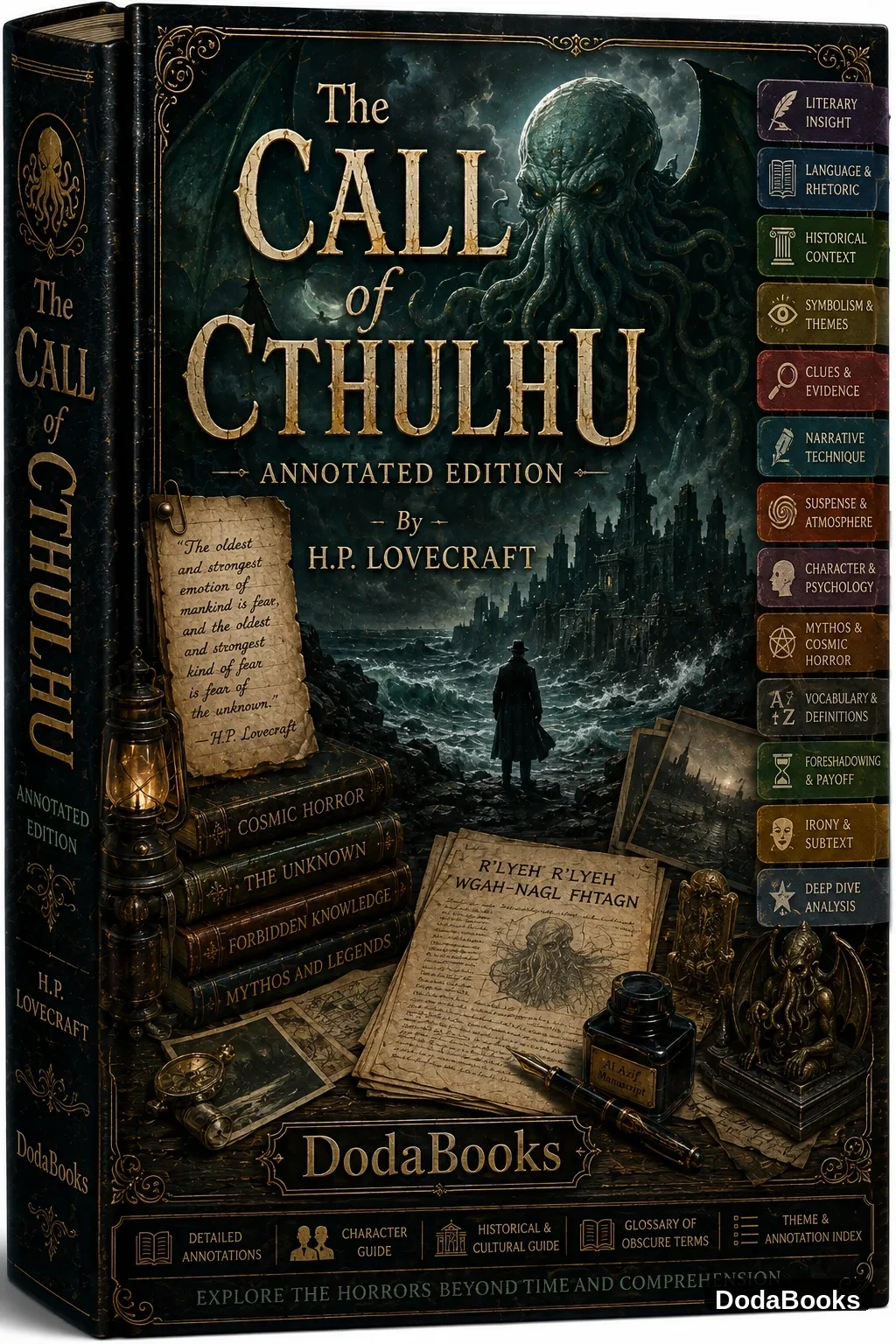
The Call of Cthulhu: Annotated Edition
Discover H. P. Lovecraft’s founding masterwork of cosmic horror in a magnificent scholarly edition. Featuring the complete unabridged 1928 text, exhaustive footnotes on early twentieth-century science, non-Euclidean geometry, the Rhode Island artistic circle, and critical essays on the Cthulhu Mythos.
- Complete, authoritative unabridged text collated from original Weird Tales printings
- Comprehensive historical and philosophical annotations on cosmicism and 1920s physics
- Exquisite custom 3D typography and digital formatting optimized for modern e-readers
- Instant EPUB download compatible with Kindle, Apple Books, and Kobo
Frequently Asked Questions
What does the famous cult chant “Ph’nglui mglw’nafh Cthulhu R’lyeh wgah’nagl fhtagn” mean?
In Chapter 2, Old Castro and the captured Louisiana bayou cultists translate the archaic alien language: “In his house at R’lyeh, dead Cthulhu waits dreaming.” The phrase encapsulates the paradox of the Great Old Ones: they are neither alive nor dead in ordinary biological terms, but exist in a death-like suspended animation preserved by ancient cosmic spells until the celestial planetary alignments allow them to reassert dominion over the Earth.
How did Lovecraft physically describe Cthulhu?
Lovecraft describes Cthulhu through an impressionistic collage of cephalopod, dragon, and human anatomy: “A monster of vaguely anthropoid outline, but with an octopus-like head whose face was a mass of feelers, a scaly, rubbery-looking body, prodigious claws on hind and fore feet, and long, narrow wings behind.” Rather than depicting a static biological animal, Lovecraft emphasizes its fluid, semi-gelatinous texture, green luminous hue, and mountain-like scale that defies earthly zoology.
What is the lasting cultural influence of The Call of Cthulhu on modern horror and science fiction?
The Call of Cthulhu revolutionized modern speculative storytelling by liberating horror from gothic folklore (haunted castles, ghosts, and vampires) and wedding it to astrophysics, archaeology, and cosmic exploration. Its influence permeates twentieth- and twenty-first-century culture: from Ridley Scott’s Alien and John Carpenter’s The Thing to Stephen King’s cosmic fiction (It), modern gaming (Bloodborne, Call of Cthulhu RPG), and contemporary philosophical treatises on speculative realism and pessimism.
Explore Related Literature Masterworks
Continue your exploration of classic world literature and gothic masterpieces with our companion analyses:
- Dracula Study Guide: Summary, Characters & Themes: Explore Bram Stoker’s Victorian vampire masterpiece examining imperial anxiety, contagion, and modern technology.
- Frankenstein Study Guide: Summary, Characters & Analysis: Deconstruct Mary Shelley’s foundational science fiction exploration of hubris, galvanism, and social isolation.
- Dr. Jekyll and Mr. Hyde Study Guide: Themes & Characters: Examine Robert Louis Stevenson’s dark gothic investigation into Victorian hypocrisy and chemical dualism.
- Moby-Dick Themes & Symbolism: Analysis of Key Motifs: Explore Herman Melville’s epic meditation on cosmic defiance, epistemological dread, and the white whale.