Moby-Dick Themes & Symbolism: Analysis of the White Whale & Motifs
Herman Melville’s Moby-Dick (1851) is universally recognized as America’s greatest philosophical novel because its physical maritime narrative is constantly infused with metaphysical symbolism. What begins as a New England commercial whaling venture transforms into a profound meditation on epistemology, divine order, and the fate of humanity in an indifferent universe.
This comprehensive guide analyzes the central themes and motifs of the novel, providing literary scholars, college students, and educators with rigorous textual citations and analytical frameworks.
For character profiles and psychological archetypes, read our companion Moby-Dick Characters Analysis. For an architectural and sociopolitical breakdown of the ship, explore The Pequod in Moby-Dick: Ship Meaning & Symbolism. For plot overviews, fast facts, and the lay wage system, see the primary Moby-Dick Study Guide.
Thematic Architecture of Moby-Dick
Melville structures the novel around several interconnected philosophical binaries:
Cetological science, skeletal measurements, and phrenology attempting to measure the blank inscrutability of cosmic nature.
The terrifying optical void of nature: an all-color of atheism indifferent to human suffering and moral projection.
Ishmael and Queequeg's cross-cultural solidarity: finding salvation and sanity through communal affection and shared labor.
"Strike through the mask!" Subverting collective human welfare in an apocalyptic assault on metaphysical constraints.
| Theme / Symbol | Narrative Appearance | Core Philosophical Dimension | Key Chapters |
|---|---|---|---|
| The White Whale | Foreshadowed throughout; chased in Ch. 133–135 | Sublime natural indifference vs. demonic projection | Ch. 41 (“Moby Dick”), Ch. 133–135 |
| The Whiteness | Theoretical exposition in Ch. 42 | Optical blankness; atheism of the universe | Ch. 42 (“The Whiteness of the Whale”) |
| The Gold Doubloon | Nailed to the mainmast in Ch. 36 | Epistemological relativism; interpretive mirror | Ch. 36, Ch. 99 (“The Doubloon”) |
| The Try-Works | Nighttime boiling scene in Ch. 96 | Industrial alienation; hellish mechanization of labor | Ch. 96 (“The Try-Works”) |
| Queequeg’s Coffin | Built in Ch. 110; serves as buoy in Epilogue | Rebirth; salvation through cross-cultural fellowship | Ch. 110, Ch. 126, Epilogue |
| The Mat-Maker | Sword-mat weaving on the quarter-deck | Dialectic of Necessity, Free Will, and Chance | Ch. 47 (“The Mat-Maker”) |
| The Nine Gams | Meetings with 9 passing whaling vessels | Allegorical spectrum of human attitudes toward reality | Ch. 53, 54, 71, 81, 91, 100, 115, 128, 131 |
1. The Whiteness of the Whale: The Blankness of the Cosmos
Chapter 42 (“The Whiteness of the Whale”) is widely regarded by literary critics as the intellectual and theological core of the novel. Ishmael interrupts the plot to investigate why an albino whale arouses such visceral horror in the human psyche:
“Is it that by its indefiniteness it shadows forth the heartless voids and immensities of the universe, and thus stabs us from behind with the thought of annihilation, when beholding the white depths of the milky way? Or is it, that as in essence whiteness is not so much a color as the visible absence of color, and at the same time the concrete of all colors; is it for these reasons that there is such a dumb blankness, full of meaning, in a wide landscape of snows—a colorless, all-color of atheism from which we shrink?”
— Chapter 42: “The Whiteness of the Whale”
Whiteness as Cosmic Neutrality
In Western iconography, white traditionally represents purity, holiness, divine majesty, and innocence. Melville systematically subverts this association:
- The Absence of Color: Whiteness is not a positive hue; it is an optical blank slate. When stripped of human imaginative projections, nature possesses no inherent moral purpose or divine benevolence.
- The “Great Principle of Light”: Ishmael concludes that human perception of color is merely an optical illusion painted over the stark, bleached skull of material existence. The cosmos is fundamentally neutral, silent, and cold.
- Ahab vs. Ishmael: While Captain Ahab insists on interpreting this blankness as a malicious mask hiding a deceitful deity, Ishmael recognizes it as pure cosmic indifference. Nature does not hate humanity; it simply does not care.
2. The Gold Doubloon: Epistemological Relativism
In Chapter 36 (“The Quarter-Deck”), Ahab nails a 16-doubloon gold piece from the Ecuadorian mint of Quito to the mainmast, promising it to whichever sailor first raises the White Whale. In Chapter 99 (“The Doubloon”), the coin becomes an explicit test of human interpretation:
| Observer | What They See on the Coin | Epistemological Significance |
|---|---|---|
| Captain Ahab | His own solitary pride (“The firm tower, that is Ahab”) | Narcissistic projection; sees only his own heroic ego in nature. |
| Starbuck | Christian allegory of duty and the dark shadow of death | Conventional religious piety attempting to tame cosmic forces. |
| Stubb | The astrological Zodiac read through a tavern drinking calendar | Comic hedonism; using humor to ward off existential dread. |
| Flask | A round lump of metal worth 16 dollars or 960 cigars | Raw economic reductionism; blind to metaphysical wonder. |
| Queequeg | Similarities between Quito figures and his sacred tattoos | Pagan animism; recognizing universal spiritual glyphs in physical matter. |
| Pip | Grammatical conjugation: “I look, you look, he looks…” | Tragic insight of the holy fool; language exposes subjective isolation. |
Pip’s grammatical conjugation encapsulates Melville’s point: the coin is an unmoving object upon which human beings project their own internal desires, dreads, and philosophies. Meaning is not inherent in material objects; it is constructed entirely by the observer.
3. The Try-Works: Industrial Hell and Labor Alienation
In Chapter 96 (“The Try-Works”), Melville presents one of the most vivid critiques of early industrial capitalism in American literature. The try-works consists of two massive cast-iron cauldrons set in a brick furnace between the foremast and mainmast, used to boil whale blubber into oil:
“The hatch, removed from the top of the works, now afforded a full glimpse into the interior… It was like looking down into the mouth of the bottomless pit. By the midnight search-fires of that try-works, the barbarian harpooners flensed and boiled; the tallow-pots hissed; a pungent, sickening odor filled the air; and through the smoke, the crew moved like devils stoking the fires of hell.”
— Chapter 96: “The Try-Works”
The Price of Commercial Illumination
Melville draws a sharp contrast between the luxurious, refined homes of New York and London—illuminated by clean-burning spermaceti candles—and the horrific, soot-stained exploitation at sea that made that luxury possible:
- Whalemen work thirty-six hours without sleep in smoke so dense it turns their skin black and coats their lungs with blubber soot.
- As Ishmael stands at the ship’s helm gazing into the flames, he falls into a trance, nearly capsizing the vessel because he has turned his back on the clean light of the stars.
- The scene warns against the psychological peril of becoming entirely consumed by industrial mechanization and unnatural labor.
4. Queequeg’s Coffin: Death, Rebirth, and Fellowship
Queequeg’s coffin is the novel’s most complex physical symbol, tracing a trajectory from a container of mortality into a vehicle of resurrection:
- Mortuary Box (Chapter 110): Believing himself to be dying of a tropical fever, Queequeg commissions the ship’s carpenter to build him a canoe-shaped chest, filling it with his pipe, iron harpoon, and dried provisions in accordance with South Pacific funerary tradition.
- The Inscription of Wisdom: Upon recovering, Queequeg spends hours using his pocket-knife to carve the lid with the intricate geometric designs tattooed across his skin. Ishmael observes that these tattoos were placed upon Queequeg by a prophet on his native island, containing a complete treatise on the heavens and earth which neither Queequeg nor any living man can read.
- The Stern Life-Buoy (Chapter 126): When the Pequod’s ordinary cork life-buoy is lost overboard, the carpenter caulks Queequeg’s coffin and mounts it on the stern to serve as the emergency rescue float.
- Resurrection in the Vortex (Epilogue): When Moby Dick rams the ship and the Pequod is sucked into the ocean abyss, the suction draws everything down except the coffin:
“Buoyed up by that coffin, for almost one whole day and night, I floated on a soft and dirgelike main. The unharming sharks, they glided by as if with padlocks on their mouths; the savage sea-hawks sailed with sheathed beaks. On the second day, a sail drew near, nearer, and picked me up at last. It was the devious-cruising Rachel, that in her retracing search after her missing children, only found another orphan.”
— Epilogue
The wooden chest that represents pagan fellowship, natural wisdom, and cross-cultural love outlasts Ahab’s iron harpoon and the Pequod’s civilized greed.
5. Fate, Free Will, and “The Mat-Maker”
In Chapter 47 (“The Mat-Maker”), Ishmael weaves a sword-mat alongside Queequeg on the quarter-deck. Melville turns the physical craft of loom-weaving into a precise philosophical metaphor for human agency:
- The Warp (Necessity / Fate): The vertical, taut threads stretched fixed on the loom represent predetermined cosmic conditions that humans cannot alter.
- The Woof (Free Will): The handheld shuttle that Ishmael passes back and forth through the warp represents human choice and voluntary decision.
- The Sword (Chance): Queequeg’s heavy wooden sword, struck sideways with unthinking carelessness to drive the threads together, represents unpredictable, random luck.
Melville suggests that human destiny is neither absolute Calvinist predestination nor unconstrained free will; rather, it is a complex tapestry where human choices interact with inflexible natural laws and random collisions of circumstance.
Recommended Critical Editions
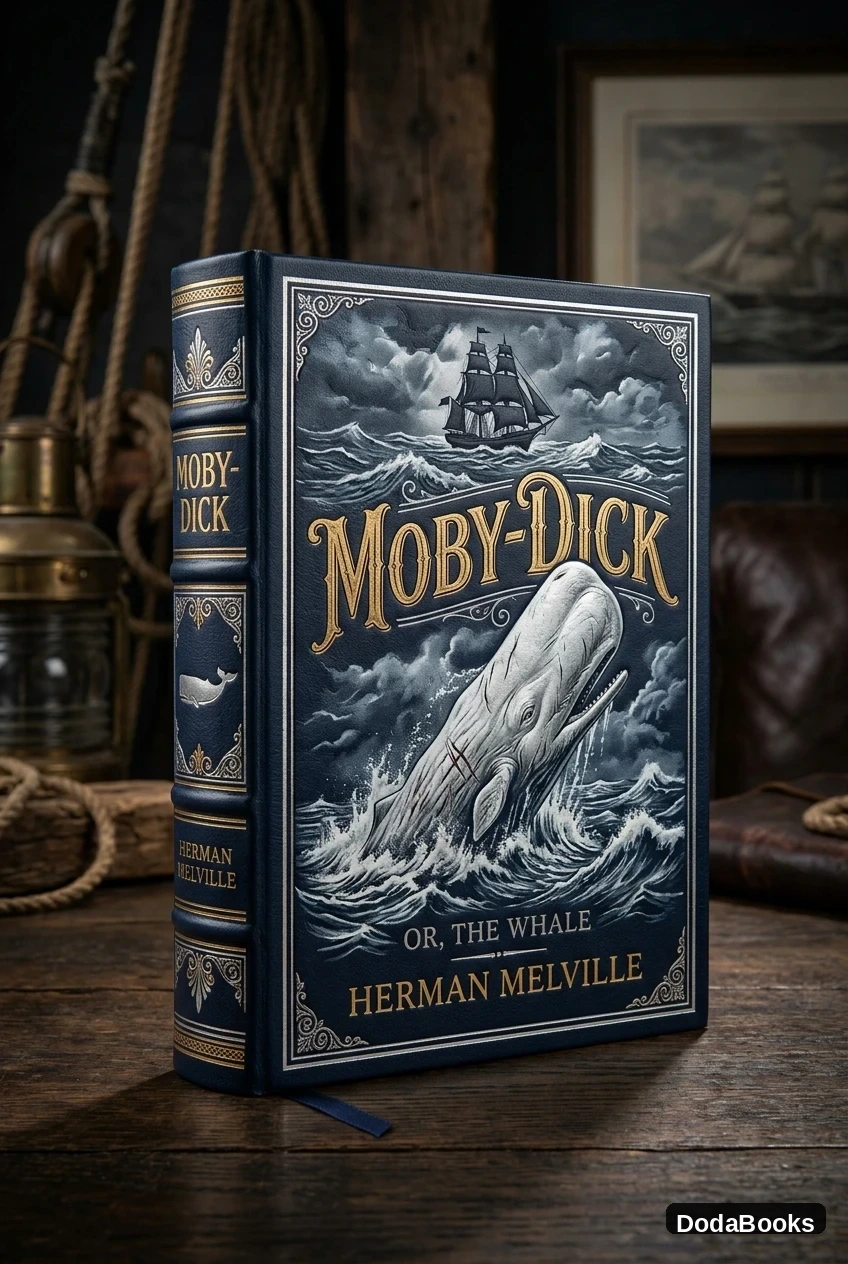
Moby-Dick; or, The Whale — DodaBooks Edition
The complete 135-chapter unabridged text beautifully typeset for modern digital readers. Features clean typography, active dynamic table of contents, zero advertisements, and DRM-free lifetime access.
- ✓ Complete 135 Chapters Unabridged
- ✓ Active Dynamic Table of Contents
- ✓ DRM-Free EPUB & PDF Formats
- ✓ Free Lifetime Digital Updates
Related Literature Study Guides
Explore our companion guides covering classic world literature:
- The Pequod in Moby-Dick: Ship Meaning & Symbolism: An architectural and sociopolitical analysis of the Pequot namesake, ivory bone fittings, 30-man union microcosm, and the try-works furnace.
- Moby-Dick Study Guide: The foundational master guide with 2-minute summary, fast facts, and chapter outlines.
- Moby-Dick Characters Analysis: Comprehensive psychological profiles of Ahab, Ishmael, Queequeg, and Pip.
- The Great Gatsby Study Guide: Class, consumerism, and the tragic failure of romantic idealism.
- Pride and Prejudice Study Guide: Social realism, property entailment, and marriage economics.
- Frankenstein Study Guide: Gothic science, the Vitalism controversy, and the creature’s suffering.
Frequently Asked Questions
What does the White Whale symbolize in Moby-Dick?
The White Whale symbolizes the inscrutable, indifferent majesty of the cosmos, the limits of human knowledge, and nature’s complete neutrality. To Captain Ahab, the whale represents cosmic deceit and malice; to Ishmael, it embodies the awe-inspiring sublime.
What is the meaning of the Spanish gold doubloon in Chapter 99?
The gold doubloon nailed to the mast functions as an epistemological mirror. Each member of the crew gazes upon the coin and reads their own psychology and worldview into its engraved zodiac symbols, demonstrating that human beings project subjective meaning onto an indifferent physical universe.
How does Melville depict industrial capitalism through the try-works?
The try-works—brick furnaces built on deck to boil whale blubber into oil—is described in nocturnal scenes resembling a floating Dantean inferno. Melville uses it to critique nineteenth-century industrial extraction, where human workers are consumed and dehumanized in service of commercial fuel.