Little Women Study Guide: Themes, Characters & Plot
Published in two volumes in 1868 and 1869, Louisa May Alcott’s Little Women stands as an enduring monument of American domestic realism, proto-feminist literature, and moral philosophy. Commissioned by publisher Thomas Niles to write a simple story for young girls, Alcott drew directly upon her own impoverished upbringing in Concord, Massachusetts, transforming the everyday struggles, artistic dreams, and sisterly bonds of the March family into a profound exploration of nineteenth-century womanhood.
Unlike the sentimental didactic fiction prevalent during the Civil War era, Little Women presented girls with complex interior lives, authentic faults, and fierce ambitions. At its emotional center stands Jo March—Alcott’s semi-autobiographical surrogate—whose ink-stained fingers, tomboyish independence, and defiance of traditional marriage created an indelible archetype that inspired generations of women writers, from Simone de Beauvoir and Virginia Woolf to Cynthia Ozick and Greta Gerwig.
While our companion analyses across Jane Eyre Study Guide and Pride and Prejudice Study Guide explore European class structures, female governess dilemmas, and the Regency marriage market, this comprehensive study guide deconstructs Little Women through Transcendentalist ethics, domestic economics, sisterly psychology, and nineteenth-century publishing politics.
Fast Facts: Masterwork Overview
| Category | Detail |
|---|---|
| Author | Louisa May Alcott (1832–1888) |
| Publication Date | Part 1: October 1868; Part 2 (Good Wives): April 1869 |
| Literary Genre | American Domestic Realism / Bildungsroman / Family Drama / Proto-Feminist Literature |
| Setting | Concord, Massachusetts and New York City during and immediately following the American Civil War |
| Narrative Form | Third-person omniscient narration with an empathetic, conversational, and philosophically grounded voice |
| Central Conflict | The sisters’ artistic ambitions and desire for autonomy vs. Victorian domestic conventions and financial hardship |
| Emotional Climax | The tragic decline and passing of Beth March; Jo’s subsequent emotional and creative rebirth |
| Key Motifs | The Pilgrim’s pack, burned manuscripts, piano melodies, ink-stained aprons, European sketchbooks |
1. Historical & Intellectual Context: Concord Transcendentalism
To fully appreciate the ethical depth of Little Women, one must examine the intellectual atmosphere of Concord, Massachusetts during the 1850s and 1860s:
The Influence of Bronson Alcott, Emerson, and Thoreau
Louisa May Alcott was raised in the crucible of New England Transcendentalism—the philosophical movement emphasizing the primacy of spiritual intuition over empirical materialism, the divine spark within every individual, and the virtue of self-reliance:
- Amos Bronson Alcott’s Educational Philosophy: Louisa’s father was an educational pioneer who banned corporal punishment, encouraged children to analyze their own emotions, and championed female intellectual development. In Little Women, Father March’s quiet spiritual presence reflects this radical child-centered ethos.
- Ralph Waldo Emerson’s Spiritual Fellowship: Emerson provided both philosophical inspiration and financial lifelines to the destitute Alcott family. Louisa spent hours reading in Emerson’s library, absorbing his doctrine that true character is forged through nonconformity and reliance on internal spiritual truth.
- Henry David Thoreau’s Natural Simplicity: Thoreau led Louisa on botanical expeditions through the Concord woods, instilling in her a lifelong reverence for voluntary simplicity, physical labor, and nature as a sanctuary from commercialized society.
The Civil War and Female Economic Mobilization
The novel opens during the bleak winter of the American Civil War. Father March is serving as an army chaplain in Washington, D.C., leaving Marmee and her four daughters to manage the household in financial strain:
- The sisters knit socks, stitch army shirts, and give away their Christmas breakfast to the starving immigrant Hummel family.
- The wartime backdrop fundamentally transforms the domestic sphere into a civic battlefield where self-sacrifice, resourcefulness, and mutual support become patriotic duties.
- Rather than waiting passively for men to provide, the March women actively earn money: Meg works as a governess for the affluent King family, Jo attends to cantankerous Aunt March, and Marmee manages relief charities.
2. The Four March Sisters: Archetypes of Womanhood
Alcott differentiates her four protagonists through distinct personality traits, artistic talents, and moral struggles:
3. Major Thematic Pillars
The Quest for Female Autonomy and Vocation
In nineteenth-century America, the acceptable life arc for middle-class women was strictly confined to marriage, motherhood, and domestic submission. Alcott radically challenges this orthodoxy by granting each sister an authentic vocation:
- Jo’s Literary Vocation: Jo does not write merely for recreation; she writes to earn income, pay family debts, and secure financial self-determination. She negotiates contracts with New York editors, faces down patronizing advice, and navigates the boundary between sensational commercial potboilers and genuine artistic expression.
- Amy’s Artistic Ambition: In Paris and Rome, Amy dedicates herself to classical sculpture and painting. Though she eventually recognizes that her talent is not genius (“Talent isn’t genius, and no amount of energy can make it so”), she approaches art with professional seriousness rather than as a frivolous parlor trick.
- Economic Independence as Dignity: When Father March falls ill in Washington, Jo commits the ultimate act of physical sacrifice: she cuts off her “one beauty”—her luxuriant chestnut hair—and sells it to a wig-maker for twenty-five dollars, asserting her power to financially rescue her family.
The Pilgrim’s Progress Framework: Conquering the Inner Self
Alcott structures the moral maturation of the March girls around John Bunyan’s Christian allegory The Pilgrim’s Progress:
Sisterly Conflict and Reconciliation: The Burned Manuscript
One of the most psychologically acute episodes in the novel occurs in Chapter 8 when Amy, enraged at being excluded from a trip to the theatre, throws Jo’s handwritten manuscript of fairy tales into the parlor fire.
The scene demonstrates Alcott’s refusal to sanitize sibling rivalry:
- The Magnitude of the Loss: The manuscript represents years of Jo’s creative labor, sweat, and irreplaceable literary hope.
- The Peril of Wrath: Paralyzed by incandescent fury, Jo refuses Amy’s tearful apologies. The next day, when Amy follows Jo and Laurie onto the frozen river, Jo deliberately ignores Amy’s precarious position until Amy crashes through thin ice into freezing water.
- The Epiphany of Remorse: Pulling Amy from the river, Jo confronts the terrifying realization that her uncontrolled wrath could have caused her sister’s death. In Marmee’s arms that night, Jo confesses her inner darkness, learning that moral strength requires conscious, daily mastery over instinctive resentment.
4. The Rejection of Laurie and the Marriage to Professor Bhaer
Few plot developments in nineteenth-century literature sparked more heated debate among readers than Jo’s rejection of Theodore “Laurie” Laurence and her eventual union with Professor Friedrich Bhaer:
Why Jo Could Not Marry Laurie
Readers in 1869 inundated Alcott with letters begging her to marry Jo to Laurie. Alcott adamantly refused, writing in her journal: “Girls write to ask who the little women marry, as if that was the only end and aim of a woman’s life. I didn’t marry Jo to Laurie to please anyone.”
The narrative logic underlying this separation is profound:
- Temperamental Discord: Jo and Laurie are too much alike—both impulsive, romantic, and theatrical. As Jo perceptively tells him, they would provoke each other into endless clashes and misery.
- The Threat of Subjugation: Marrying the wealthy Laurence heir would have reduced Jo to a society hostess in Boston, suffocating the fierce creative fire that defines her soul.
- Laurie’s Real Complement: Laurie needs someone to guide his unfocused elegance into disciplined purpose. In Europe, Amy March accomplishes precisely this, challenging Laurie to abandon indolent melancholy and become an honorable man.
The Significance of Friedrich Bhaer
In Friedrich Bhaer—an impoverished, middle-aged German scholar living in a New York boarding house—Alcott crafts a partner based on intellectual equality and mutual respect:
- Bhaer does not worship Jo as a prize; he respects her intellect and challenges her ethically when she stoops to writing exploitative sensational potboilers for quick cash.
- He introduces her to German philosophy, poetry, and compassionate philanthropy.
- Their eventual union at Plumfield—turning Aunt March’s estate into an experimental progressive school for boys—allows Jo to preserve her active teaching, intellectual leadership, and literary voice.
5. Beth March: The Sacred Center and the Aesthetics of Grief
Beth March occupies a unique spiritual position within the March household. While her sisters venture into the wider world—Meg into marriage, Jo into New York publishing, Amy into European salons—Beth remains anchored to the home hearth:
The Scarlet Fever Contagion
Beth contracts scarlet fever not through personal recklessness, but while selflessly nursing the impoverished Hummel children when her sisters neglect their charitable duties. Although she survives the acute infection, the illness permanently damages her heart.
The Poetry of Decline
Alcott portrays Beth’s slow physical decline with understated emotional realism rather than melodramatic sentimentality:
- Beth does not rail against fate; she quietly realizes that her gentle spirit was not built for the rough struggles of earthly life: “I’m not like the rest of you; I never made any plans about what I’d do when I grew up; I couldn’t seem to think of any, or see any, or wish for any.”
- Beth’s passing becomes the spiritual catalyst for Jo’s ultimate literary breakthrough. Stricken with devastating sorrow, Jo abandons commercial thrillers and writes from the raw depths of her authentic grief, producing a simple poem about Beth that captures the hearts of readers across the nation.
Recommended Critical Edition
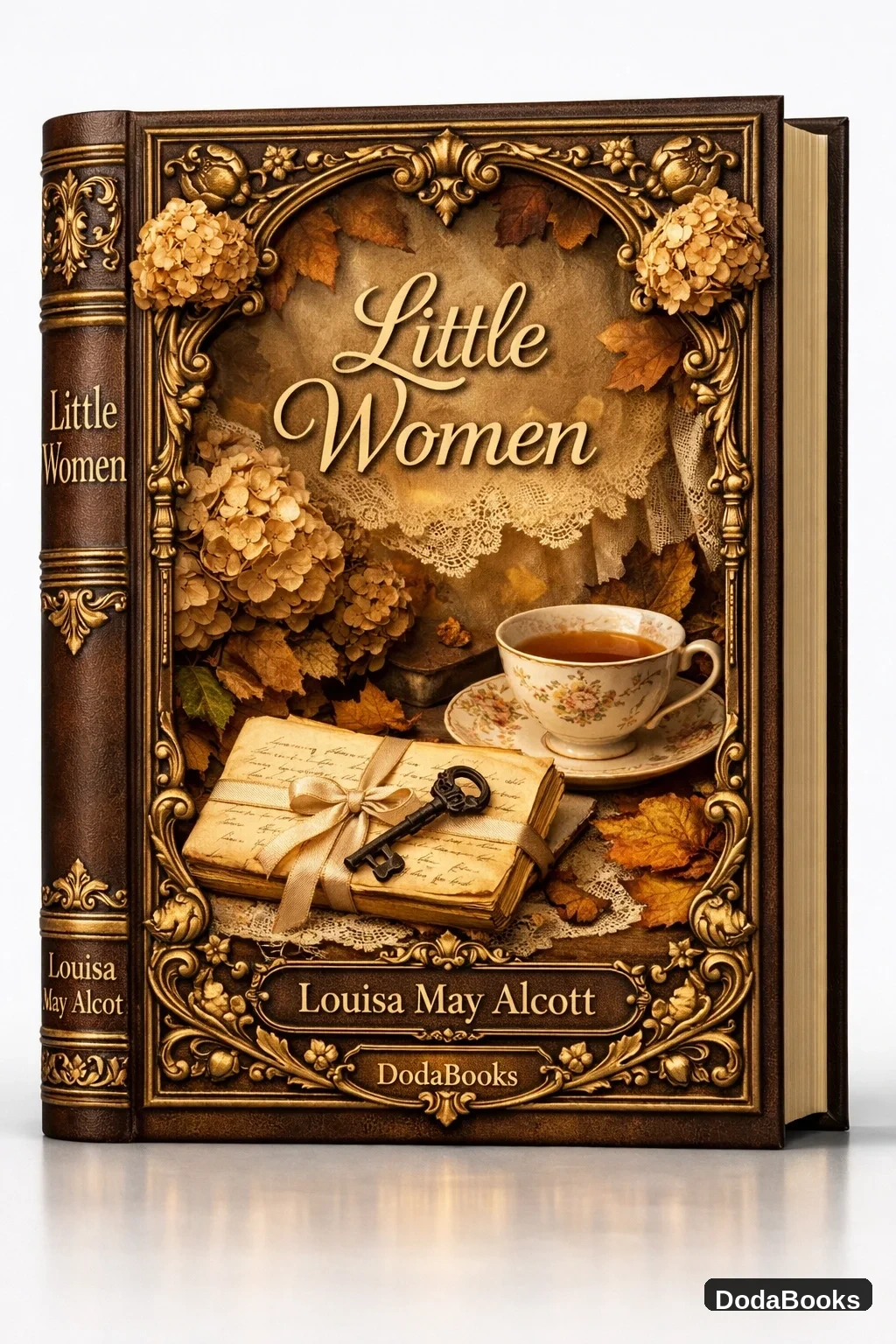
For literature scholars, teachers, and book lovers seeking the authoritative complete text with historical commentary on Concord Transcendentalism, nineteenth-century domestic culture, and textual variants, we recommend the unabridged edition from DodaBooks:
Little Women: Complete Unabridged Text
Experience Louisa May Alcott’s immortal classic in a magnificent scholarly presentation. Featuring the complete unabridged 47-chapter text combining both original volumes, comprehensive annotations on Concord Transcendentalism, Civil War home front history, and biographical essays.
- Complete, authoritative unabridged text combining Little Women and Good Wives
- Comprehensive historical footnotes on New England culture and nineteenth-century domestic economy
- Exquisite custom 3D typography and digital formatting optimized for modern e-readers
- Instant EPUB download compatible with Kindle, Apple Books, and Kobo
Frequently Asked Questions
Is Little Women based on Louisa May Alcott’s real family?
Yes. Little Women is intensely autobiographical. Louisa based the March family directly on her own family in Concord, Massachusetts: Anna Alcott became Meg, Louisa herself became Jo, Elizabeth (Lizzie) Alcott became the gentle Beth (who tragically died at age twenty-two following scarlet fever), and May Alcott became the artistic Amy. Marmee and Father March mirror Abigail May Alcott and Amos Bronson Alcott, though Louisa deliberately softened her father’s eccentric financial impracticalities to make the household more relatable to contemporary readers.
Why was Amy March often disliked by readers, and how has modern criticism re-evaluated her?
For decades, casual readers resented Amy March because she burned Jo’s cherished manuscript and ultimately married Laurie, whom many readers wanted for Jo. However, modern feminist criticism has substantially re-evaluated Amy as a pragmatic, clear-eyed realist. In an era where women were legally barred from the professions, Amy recognized that marriage was an economic proposition for women without fortunes. Her discipline as an artist, her emotional growth in Europe, and her refusal to settle for being second-best in Laurie’s heart demonstrate remarkable intelligence and self-respect.
What is the lasting feminist legacy of Jo March in American literature?
Jo March represents a watershed moment in American literary history: the first widely beloved female protagonist who unapologetically prioritized professional vocation, creative intellectual work, and economic autonomy over traditional decorative femininity. Jo demonstrated that a young woman could be clumsy, passionate, outspoken, and ambitious without losing her capacity for deep love and family devotion. Writers including Louisa May Alcott, Simone de Beauvoir, and modern novelists have credited Jo March with validating their right to exist as independent thinkers and authors.
Explore Related Literature Masterworks
Continue your journey through classic world literature and coming-of-age masterworks with our companion critical analyses:
- Jane Eyre Study Guide: Summary, Characters & Themes: Examine Charlotte Brontë’s immortal Victorian masterpiece exploring female dignity, moral resilience, and social rebellion.
- Pride and Prejudice Study Guide: Complete Critical Analysis: Explore Jane Austen’s razor-sharp social satire of the English gentry marriage market and self-knowledge.
- Tom Sawyer Study Guide: Themes, Characters & Plot: Discover Mark Twain’s classic celebration of frontier boyhood, moral awakening, and Mississippi satire.
- Frankenstein Study Guide: Summary, Characters & Analysis: Dive into Mary Shelley’s Romantic deconstruction of scientific obsession, domestic tragedy, and social alienation.