Hamlet Characters: The Tragedy of Elsinore
William Shakespeare’s The Tragedy of Hamlet, Prince of Denmark stands as the monumental achievement of Renaissance dramatic literature largely because of its revolutionary characterization. Rather than deploying static, allegorical figures typical of medieval morality plays or flat avengers common to Elizabethan revenge melodrama, Shakespeare creates characters endowed with layered subconscious motivations, existential doubt, and intense psychological interiority.
At the center of Elsinore’s royal court stands Prince Hamlet, whose hyper-conscious mind interrogates the meaning of action, truth, and death. Surrounding him is a constellation of figures who reflect the multifaceted moral decay of Denmark: the pragmatic usurper King Claudius, the sexually compromised Queen Gertrude, the surveillance-obsessed courtier Polonius, and the tragic, patriarchal victim Ophelia.
While our Hamlet Study Guide traces the dramatic arc and Hamlet Themes & Symbolism examines the play’s philosophical motifs, this character analysis provides an exhaustive academic exploration of the psychological dynamics, structural foils, and tragic fates governing Shakespeare’s greatest cast.
Character Roster & Structural Foils Matrix
Shakespeare structures the tragedy around explicit psychological and behavioral contrasts, measuring Hamlet’s contemplative hesitation against the impetuous action of other sons seeking vengeance:
| Character | Dramatic Role | Core Motivation | Fatal Flaw / Vulnerability | Ultimate Fate |
|---|---|---|---|---|
| Prince Hamlet | Prince of Denmark; Scholar; Avenger | Philosophical truth, moral integrity, filial duty | Paralysis of over-contemplation; melancholic cynicism | Mortally wounded by poisoned foil; names Fortinbras king |
| King Claudius | Usurping King of Denmark; Hamlet’s uncle | Political power, marital possession, self-preservation | Fratricidal guilt; ruthless Machiavellian corruption | Forced to drink poisoned wine and stabbed by Hamlet |
| Queen Gertrude | Queen of Denmark; Hamlet’s mother | Domestic security, maternal affection, sensual peace | Moral blindness; complacency within an incestuous marriage | Inadvertently drinks the poisoned cup prepared for Hamlet |
| Ophelia | Daughter of Polonius; Hamlet’s beloved | Filial obedience, romantic devotion to Hamlet | Total patriarchal subjugation; emotional isolation | Falls into madness after Polonius’ death; drowns in brook |
| Polonius | Lord Chamberlain; Chief Counselor | Maintaining political prestige, paternal control | Tedious verbosity; obsession with surveillance and deceit | Mistakenly stabbed by Hamlet through the bedchamber arras |
| Laertes | Son of Polonius; Brother to Ophelia | Chivalric family honor; immediate blood-revenge | Rashness, easily manipulated by Claudius’ treachery | Wounded by his own poisoned blade; repents and forgives Hamlet |
| Horatio | Fellow student at Wittenberg; Scholar | Philosophical truth, unconditional loyalty to Hamlet | Stoic reserve; initial desire to follow Hamlet into death | Survives the massacre to tell Hamlet’s story to the world |
| Prince Fortinbras | Crown Prince of Norway; Martial Leader | Reclaiming lost national territory; military glory | Lack of intellectual reflection; relentless martial drive | Arrives victorious in Elsinore; claims the Danish throne |
1. Prince Hamlet: The Anatomy of Consciousness
Prince Hamlet is the most scrutinized protagonist in the history of global theater. He is not merely an Elizabethan prince; he is the archetypal modern intellectual:
“What a piece of work is a man! how noble in reason! how infinite in faculty! in form and moving how express and admirable! in action how like an angel! in apprehension how like a god! the beauty of the world! the paragon of animals! And yet, to me, what is this quintessence of dust?”
The Paradox of Tragic Inaction
Hamlet’s famous hesitation is not a product of cowardice. He demonstrates swift, lethal courage when boarding the pirate ship at sea, executing Rosencrantz and Guildenstern with royal seal forgeries, and lunging with his sword through the arras. Why, then, does he delay executing Claudius?
- The Epistemological Dilemma: He cannot act upon the unverified word of a ghost that might be a demonic delusion sent to damn his soul.
- The Horror of Contamination: To kill Claudius within the corrupt conventions of Elsinore risks reducing Hamlet to Claudius’ level—becoming another treacherous assassin in an unweeded garden.
- Hyper-Consciousness: Hamlet sees through all human institutions. Revenge, politics, courtly etiquette, and military conquests are all rendered absurd by the inescapable reality of bodily decomposition and the mystery of what dreams may come in the sleep of death.
2. King Claudius: The Smiling Machiavellian
King Claudius is one of Shakespeare’s most brilliant portraits of political villainy. Unlike Richard III, who announces his wicked nature to the audience with gleeful sadism, Claudius is an exceptionally skilled, charismatic statesman:
- The Political Facade: In Act I, Scene 2, Claudius addresses the Danish council with polished rhetorical equilibrium, effortlessly balancing grief for his dead brother with celebration of his marriage to Gertrude, while swiftly handling diplomatic threats from Norway.
- The Pragmatic Murderer: Claudius murdered King Hamlet not out of ideological zeal, but for tangible earthly rewards: the crown, the kingdom, and Queen Gertrude.
- The Prayer Scene Crisis: In Act III, Scene 3, Shakespeare grants Claudius a soliloquy that exposes his psychological torment:
“O, my offence is rank, it smells to heaven; / It hath the primal eldest curse upon’t, / A brother’s murder. Pray can I not, / Though inclination be as sharp as will… / But, O, what form of prayer / Can serve my turn? ‘Forgive me my foul murder’? / That cannot be; since I am still possess’d / Of those effects for which I did the murder, / My crown, mine own ambition and my queen.”
- The Master of Exploitation: When his safety is threatened by Hamlet, Claudius never hesitates. He weaponizes Laertes’ raw grief over Polonius, proposing an unbated fencing foil dipped in deadly poison, backed up by a poisoned chalice. When his treachery rebounds upon him in Act V, he dies hated, exposed, and repudiated by the court.
3. Queen Gertrude: Maternal Love and Moral Ambiguity
Queen Gertrude is the emotional catalyst of Hamlet’s psychological disintegration. Rather than an overt co-conspirator, Shakespeare portrays Gertrude as a woman of sensual passivity and fragile moral awareness:
Gertrude’s pivotal moment occurs in Act III, Scene 4 (the Closet Scene). When Hamlet forces her to compare portraits of the noble King Hamlet (“Hyperion’s curls”) and the villainous Claudius (“a mildew’d ear”), Gertrude is shattered by the realization of her moral degradation. In the final scene, her maternal instinct achieves tragic nobility: she openly defies Claudius’ order, drinks the poisoned wine, and cries out with her final breath: “The drink, the drink! I am poison’d!"—saving Hamlet from the poisoned cup.
4. Ophelia: The Silenced Martyr of Patriarchal Power
Ophelia is the most tragic figure in Hamlet. Unlike Juliet in Romeo and Juliet Characters Analysis, who actively defies patriarchal tyranny to choose her own destiny, Ophelia has no independent social agency:
- Total Familial Subjugation: Her brother Laertes lectures her on guarding her virtue against Hamlet’s royal status, while her father Polonius cruelly demands that she surrender Hamlet’s love letters and cut off all communication: “I shall obey, my lord” is her characteristic submission.
- The Pawn of Espionage: Ophelia is used as live bait by Polonius and Claudius, who hide behind the arras to observe Hamlet. When Hamlet realizes she is complicit in the surveillance, his fury explodes in the “Nunnery Scene,” verbally assaulting her with bitter misogynistic rage: “Get thee to a nunnery: why wouldst thou be a breeder of sinners?”
- Madness as Liberation: Following the sudden murder of her father by the man she loved, Ophelia’s psyche collapses. Her madness in Act IV, Scene 5 is deeply political: by distributing symbolic flowers (rosemary, pansies, fennel, rue) and singing frank songs about sexual exploitation and abandonment, she finally voices the harsh truths that polite court etiquette silenced.
- The Poetic Drowning: Ophelia’s death—described by Gertrude as she weaves floral garlands and falls into the weeping brook, floating like a creature native to the element until her heavy garments drag her to muddy death—remains one of the most sublime and heartbreaking elegies in world drama.
5. Polonius: The Tedious Spymaster
Polonius, the Lord Chamberlain, represents the decaying, self-satisfied establishment of Elsinore:
- The Pedantic Moralist: He dispenses famous platitudes to Laertes (“Neither a borrower nor a lender be,” “To thine own self be true”), yet his actual life is built on deceit, eavesdropping, and political intrigue.
- The Arrogant Inquirer: He assumes he knows the cause of Hamlet’s transformation—attributing it entirely to love-sickness over Ophelia—and refuses to consider deeper political or existential realities.
- The Absurd Demise: Polonius dies precisely as he lived: lurking behind a wall hanging to spy on another’s intimate conversation. Hamlet’s callous reaction to his corpse (“Thou wretched, rash, intruding fool, farewell!”) underscores how Polonius commodified his own humanity into state machinery.
6. The Sons of Vengeance: Laertes & Fortinbras as Foils
Shakespeare creates two external foils who illuminate Hamlet’s character through contrasting approaches to filial revenge:
Laertes: Passion Without Thought
When Laertes learns of Polonius’ death, he storms Elsinore with a mob of commoners, ready to tear down the monarchy. Unlike Hamlet, Laertes has no religious scruples or moral hesitation. Yet, his lack of intellectual depth makes him an easy instrument for Claudius, who flatters his swordsmanship and induces him to coat his rapier with uncurable poison. In the end, Laertes recognizes his moral degradation: “I am justly kill’d with mine own treachery,” begging Hamlet’s forgiveness before he dies.
Fortinbras: Action Without Inwardness
Prince Fortinbras of Norway represents pure martial capability. When Hamlet sees Fortinbras leading twenty thousand soldiers across Denmark to fight Poland for an eggshell plot of land, Hamlet is both shamed and horrified by the arbitrary nature of worldly honor. At the tragedy’s close, Fortinbras enters the blood-soaked hall, delivers military honors to Hamlet’s corpse (“For he was likely, had he been put on, / To have proved most royal”), and restores political stability to Denmark.
Comparative Matrix: Tragic Foils & Contrasts
| Primary Figure | Foil Figure | Core Philosophical Contrast |
|---|---|---|
| Prince Hamlet | King Claudius | Moral and philosophical introspection vs. cold Machiavellian pragmatism. |
| Prince Hamlet | Laertes | The philosopher who hesitates to damn a soul vs. the rash avenger who defies damnation. |
| Prince Hamlet | Prince Fortinbras | The burdened, hyper-conscious intellect vs. the efficient martial conqueror. |
| Prince Hamlet | Horatio | The emotionally volatile, melancholic genius vs. the serene, balanced Stoic. |
| Ophelia | Queen Gertrude | The silenced, sacrificed virgin daughter vs. the sensually compromised royal matriarch. |
Recommended Critical Edition
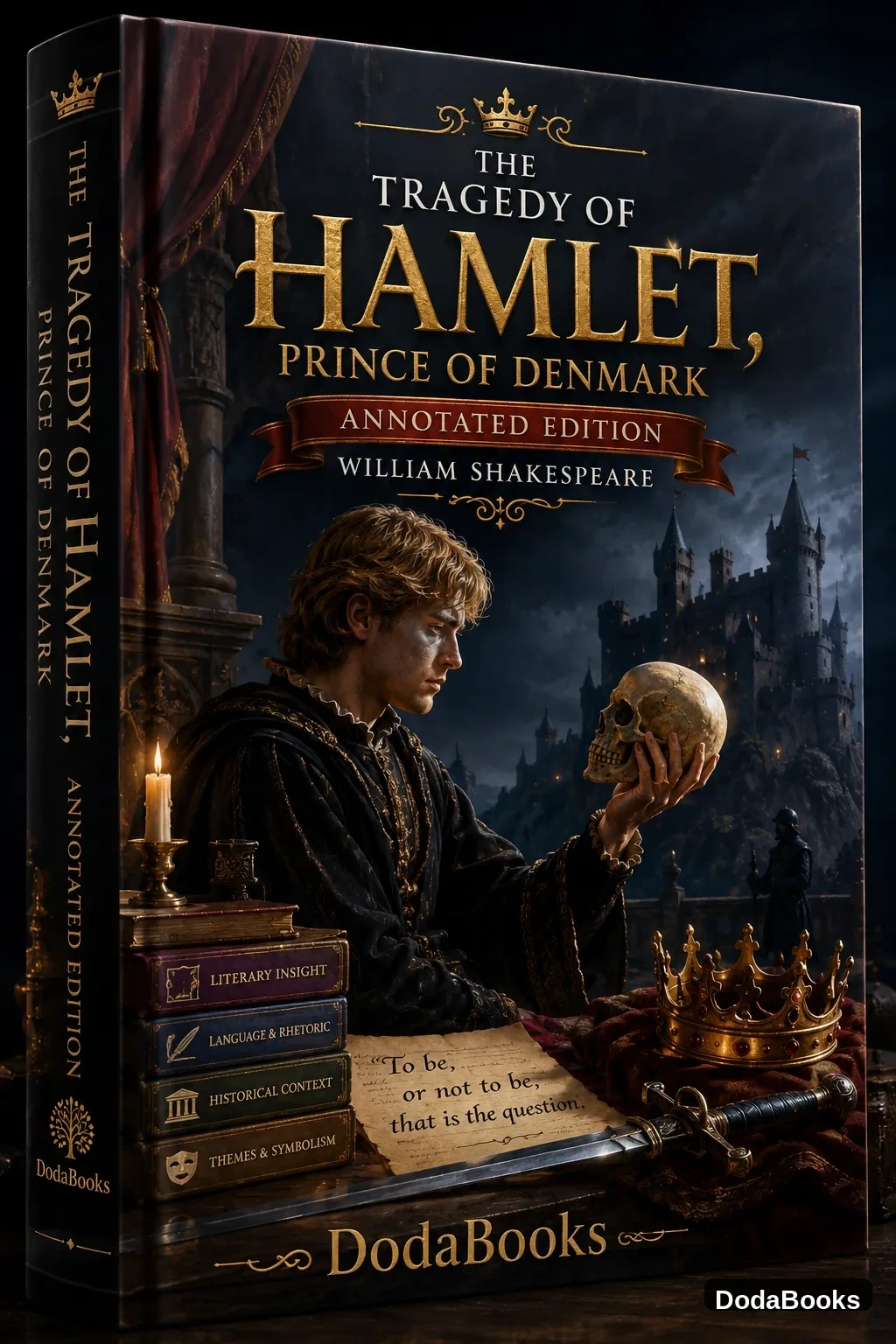
For university students, theatre professionals, and literary scholars seeking the definitive text with complete scene-by-scene character glossaries, historical notes on Elizabethan staging, and textual variants between the First Quarto, Second Quarto, and First Folio, we recommend the unabridged edition from DodaBooks:
Frequently Asked Questions
Did Hamlet truly love Ophelia?
Hamlet genuinely loved Ophelia prior to the events of the play, as evidenced by his impassioned love letters and his dramatic outburst at her grave: “I loved Ophelia: forty thousand brothers / Could not, with all their quantity of love, / Make up my sum.” However, his mother’s hasty marriage to Claudius deeply poisoned Hamlet’s perception of female sexuality and fidelity. When Ophelia returns his letters and participates in Polonius’ surveillance, Hamlet feels betrayed, projecting his disgust with Gertrude onto Ophelia and treating her with cruel contempt.
Why does Hamlet forbid Horatio from drinking the remaining poisoned wine?
In Act V, Scene 2, as Hamlet lies dying, Horatio declares, “I am more an antique Roman than a Dane,” attempting to drink the dregs of the poisoned cup to follow his beloved prince into death. Hamlet wrestles the cup from Horatio’s hands, pleading: “If thou didst ever hold me in thy heart, / Absent thee from felicity awhile, / And in this harsh world draw thy breath in pain, / To tell my story.” Hamlet understands that without Horatio’s honest testimony, his name and legacy would be permanently tainted as a mad, bloodthirsty assassin. Horatio must live to bear witness to the truth.
Why is Fortinbras chosen to become the next King of Denmark?
With his dying breath, Hamlet gives his “dying voice” to Fortinbras because the royal Danish bloodline has been entirely extinguished in the final massacre. Fortinbras possesses an ancient hereditary claim through his father, and more importantly, he possesses the decisive leadership, martial strength, and moral integrity required to restore order to a corrupted state. Hamlet recognizes that Denmark needs Fortinbras’ active strength to heal the wounds inflicted by Claudius’ disease of state.
Related Masterwork Guides & Deconstructions
Continue your exploration of classic drama, revenge tragedy, and psychological character arcs with our companion guides:
- Hamlet Study Guide: Tragedy, Characters & Themes: The foundational comprehensive study guide to Shakespeare’s masterpiece.
- Hamlet Themes & Symbolism: Analysis of Key Motifs: Deconstruct contemplation vs. action, surveillance, Yorick’s skull, and the Mousetrap.
- Romeo and Juliet Characters: Analysis of Key Figures: Analyze Romeo, Juliet, Mercutio, and Tybalt in Shakespeare’s lyric tragedy.
- The Count of Monte Cristo Characters: Dantès & Foils: Examine Edmond Dantès, Abbé Faria, and the architecture of epic vengeance.
- Dr. Jekyll and Mr. Hyde Characters: Jekyll & Hyde: Explore the psychological duality of Henry Jekyll, Edward Hyde, and Gabriel Utterson.