Romeo and Juliet Characters: Analysis of Key Figures
William Shakespeare’s The Tragedy of Romeo and Juliet endures not merely because of its incandescent lyric poetry, but because of its astonishingly modern, multi-dimensional characterization. Moving far beyond the rigid moralizing types of Arthur Brooke’s 1562 source poem, Shakespeare animated Renaissance Verona with a vibrant constellation of personalities whose conflicting loyalties, toxic codes of masculine honor, and desperate bids for personal autonomy collide with catastrophic velocity.
At the tragedy’s center stands the contrast between the impetuous, lyrical Romeo and the clear-eyed, courageous Juliet, whose profound spiritual communion transcends the tribal feud of their households. Surrounding them are unforgettable figures: the anarchic, mercurial wit Mercutio, the militant tribal fanatic Tybalt, the well-meaning political schemer Friar Laurence, and the vulgar domestic realist The Nurse.
While our companion Romeo and Juliet Study Guide and Romeo and Juliet Themes & Symbolism explore the play’s four-day timeline and inverted light/dark symbolism, this comprehensive critical study provides an academic character analysis of Shakespeare’s dramatic cast, dissecting their psychological motivations, rhetoric, and tragic choices.
Master Character Roster & Archetypal Matrix
| Character | Social Station | Archetype | Central Conflict |
|---|---|---|---|
| Romeo Montague | Montague heir | The Petrarchan Idealist / Tragic Hero | Passionate romantic fatalism vs. civic tribal vendettas and violent impulse. |
| Juliet Capulet | Capulet heiress | The Moral Agent / Autonomous Rebel | Heroic private selfhood vs. patriarchal property commodification. |
| Mercutio | Kinsman to the Prince | The Anarchic Satirist / Comic Foil | Anti-romantic cynicism and mercurial wit vs. lethal codes of honor. |
| Tybalt Capulet | Juliet’s first cousin | The Militant Tribalist / “Prince of Cats” | Fanatical aristocratic honor and blood feud vs. royal civic law. |
| Friar Laurence | Franciscan herbalist | The Optimistic Political Schemer | Botanical wisdom vs. naive overconfidence in engineering peace through deceit. |
| The Nurse | Juliet’s surrogate mother | The Earthy Pragmatist | Maternal affection and vulgar comedy vs. pragmatic moral betrayal. |
| Lord Capulet | Head of House Capulet | The Authoritarian Patriarch | Paternal vanity and economic despotism vs. belated, grief-stricken remorse. |
1. Romeo Montague: From Petrarchan Poseur to Tragic Hero
Romeo Montague is often misunderstood in popular culture as a static romantic archetype. In reality, Shakespeare crafts Romeo through a dramatic psychological evolution:
The Artificial Melancholy of Rosaline
In Act I, Romeo is trapped inside the trendy Elizabethan pose of the melancholic courtier:
- He is in love not with a real woman, but with the idea of being in love. His affection for the unseen Rosaline is expressed in mechanical, clichéd Petrarchan oxymorons: “O brawling love, O loving hate, / O any thing, of nothing first create! / O heavy lightness, serious vanity!”
- His behavior is self-absorbed and theatrical: wandering through sycamore groves at dawn, weeping artificial tears, and retreating home to close his shutters and create an artificial night. His melancholy is performative and sterile.
Romeo’s transition from a silly boy whining over Rosaline to a resolute tragic titan willing to embrace death to preserve eternal union mirrors Prince Hamlet’s existential journey, analyzed in our Hamlet Study Guide.
2. Juliet Capulet: Female Agency in an Authoritarian World
Juliet Capulet is arguably the most brilliant, mature, and courageous protagonist in Shakespeare’s early dramatic canon. Though barely fourteen years old, she exhibits intellectual poise and moral fortitude that vastly outshine Romeo:
The Deconstruction of Romantic Cliché
From her very first encounter with Romeo on the balcony (Act II, Scene 2), Juliet systematically dismantles conventional romantic posturing:
- Demanding Plain Speech: When Romeo begins swearing by the moon, Juliet instantly cuts him off: “O, swear not by the moon, the inconstant moon, / That monthly changes in her circled orb, / Lest that thy love prove likewise variable.”
- Pragmatic Realism: She acknowledges the terrifying danger of their encounter: “If they do see thee, they will murder thee.” She recognizes that their love is “too rash, too unadvis’d, too sudden; / Too like the lightning, which doth cease to be / Ere one can say ‘It lightens.’”
- Taking Initiative: It is Juliet, not Romeo, who proposes marriage. She establishes the terms, demands an honorable contract, and sends her messenger the next morning to arrange the vows.
Juliet’s defiance of her father’s commodification of her body stands as a monumental moment in Renaissance drama, paralleling the struggles for female self-determination explored in our Pride and Prejudice Characters Analysis.
3. Mercutio: The Anarchic Satirist and Turning Point
Mercutio is Shakespeare’s most electrifying comic creation before Falstaff: a mercurial, bawdy aristocrat whose cynical wit punctures all romantic illusions:
The Queen Mab Satire
In Act I, Scene 4, when Romeo claims he had a dream predicting doom, Mercutio launches into his legendary Queen Mab monologue. Rather than treating dreams as mystical divine omens, Mercutio deconstructs them with savage psychological realism:
- Queen Mab is an insect-sized fairy riding in an empty hazelnut chariot through the human body at night.
- She makes lawyers dream of fees, courtiers dream of curtsies, soldiers dream of cutting Spanish throats, and lovers dream of lust.
- Mercutio demonstrates that dreams are merely the mirror of humanity’s basest, most selfish waking appetites: “True, I talk of dreams, / Which are the children of an idle brain, / Begot of nothing but vain fantasy.”
The Catalyst of Doom
Mercutio belongs to neither house; he is kinsman to Prince Escalus. Yet his obsession with masculine wit and dueling honor drags him into the Capulet-Montague feud:
4. Tybalt Capulet: The Toxic Cult of Martial Honor
Tybalt Capulet, whom Mercutio mocks as the “Prince of Cats” (after the cunning cat in the fable Reynard the Fox), is the pure embodiment of Verona’s toxic tribal factionalism:
The Absolute Absence of Reason
In his very first entrance in Act I, Scene 1, Tybalt establishes his fanatical rejection of civil peace:
“What, drawn, and talk of peace? I hate the word,
As I hate hell, all Montagues, and thee:
Have at thee, coward!”
Tybalt cannot comprehend individuality; he perceives humans only through factional heraldry. When he overhears Romeo’s voice at the Capulet feast, he instantly demands his rapier, viewing the mere physical presence of a Montague as an intolerable insult. When Lord Capulet rebukes him, ordering him to keep the peace and praising Romeo as a virtuous youth, Tybalt’s pride curdles into venomous resentment, swearing to seek bloody revenge on the streets.
Tybalt fights by the book of arithmetic—trained in Italian fencing manuals with precise rapiers, steps, and lunges. Yet behind his refined dueling technique lies primal, irrational hatred. His swift death at Romeo’s hands proves that tribal fanaticism inevitably consumes its practitioners.
5. Friar Laurence and The Nurse: The Failure of Adult Counsel
Romeo and Juliet are surrounded by adult mentors who profess deep love for them, yet whose flawed counsel and moral cowardice precipitate the catastrophe:
Friar Laurence: The Machiavellian Peacemaker
Friar Laurence is a holy Franciscan friar and skilled herbalist, yet his actions are governed by political scheming:
- The Political Motive: He agrees to perform the secret wedding not because he approves of the lovers’ reckless haste (“These violent delights have violent ends”), but because he envisions the marriage as an instrument of civic peace: “For this alliance may so happy prove, / To turn your households’ rancour to pure love.”
- The Flawed Potion Plot: When Capulet forces Juliet’s marriage to Paris, Friar Laurence devises an impossibly intricate scheme involving a 42-hour death-simulating botanical potion, letters sent by courier to Mantua, and a midnight rescue from a crypt.
- The Cowardice in the Tomb: When his plan collapses and Juliet awakens to find Romeo dead, the Friar hears the watchmen approaching. Terrified of being implicated, he urges Juliet to flee to a nunnery, abandoning a traumatized, suicidal thirteen-year-old girl alone with two fresh corpses: “I dare no longer stay.”
The Nurse: Earthy Pragmatism and Betrayal
The Nurse provides the domestic comedy of the first half of the play: garrulous, coarse, sentimental, and fiercely protective of Juliet. However, when real crisis strikes, her moral bankruptcy is exposed:
- When Lord Capulet threatens to disown Juliet, the Nurse offers practical, cynical advice: forget the banished Romeo and marry Paris, who is rich, handsome, and locally present: “I think it best you married with the county. / O, he’s a lovely gentleman! / Romeo’s a dishclout to him.”
- To Juliet, this advice is an unpardonable betrayal of sacred oaths. Juliet severs her heart from her lifelong nurse forever: “Ancient damnation! O most wicked fiend!” From this moment forward, Juliet is entirely alone.
6. Lord Capulet and Prince Escalus: Authority in Crisis
The play’s sociopolitical dimensions are anchored by two contrasting figures of institutional authority:
Lord Capulet: The Despotic Patriarch
Lord Capulet begins the play as an apparently benevolent father, telling Count Paris that Juliet is too young to marry and that Paris must win her consent. However, this benevolence is a veneer that shatters the moment Juliet expresses autonomous will:
- In Act III, Scene 5, when Juliet politely refuses Paris, Capulet explodes into abusive, violent rage: calling her a “green-sickness carrion,” “tallow-face,” and “baggage,” threatening to drag her to church on a hurdle.
- Capulet treats his daughter as marketable property. His grief at her presumed death is stained with narcissism: he laments the death not because he loved Juliet’s spirit, but because death has ruined his dynastic wedding celebrations.
Prince Escalus: The Impartial Voice of Law
Prince Escalus represents the civic state attempting to maintain the rule of law over feudal violence:
- In the opening scene, he decrees the death penalty for future street brawls. Yet when Romeo kills Tybalt, Escalus tempers justice with mercy, commuting Romeo’s death sentence to exile because Tybalt had already slain Mercutio.
- In the play’s closing lines, Escalus delivers the definitive moral verdict: “A glooming peace this morning with it brings… For never was a story of more woe / Than this of Juliet and her Romeo.” Escalus acknowledges his own guilt in tolerating the feud too long: “And I for winking at your discords too / Have lost a brace of kinsmen: all are punish’d.”
Recommended Critical Edition
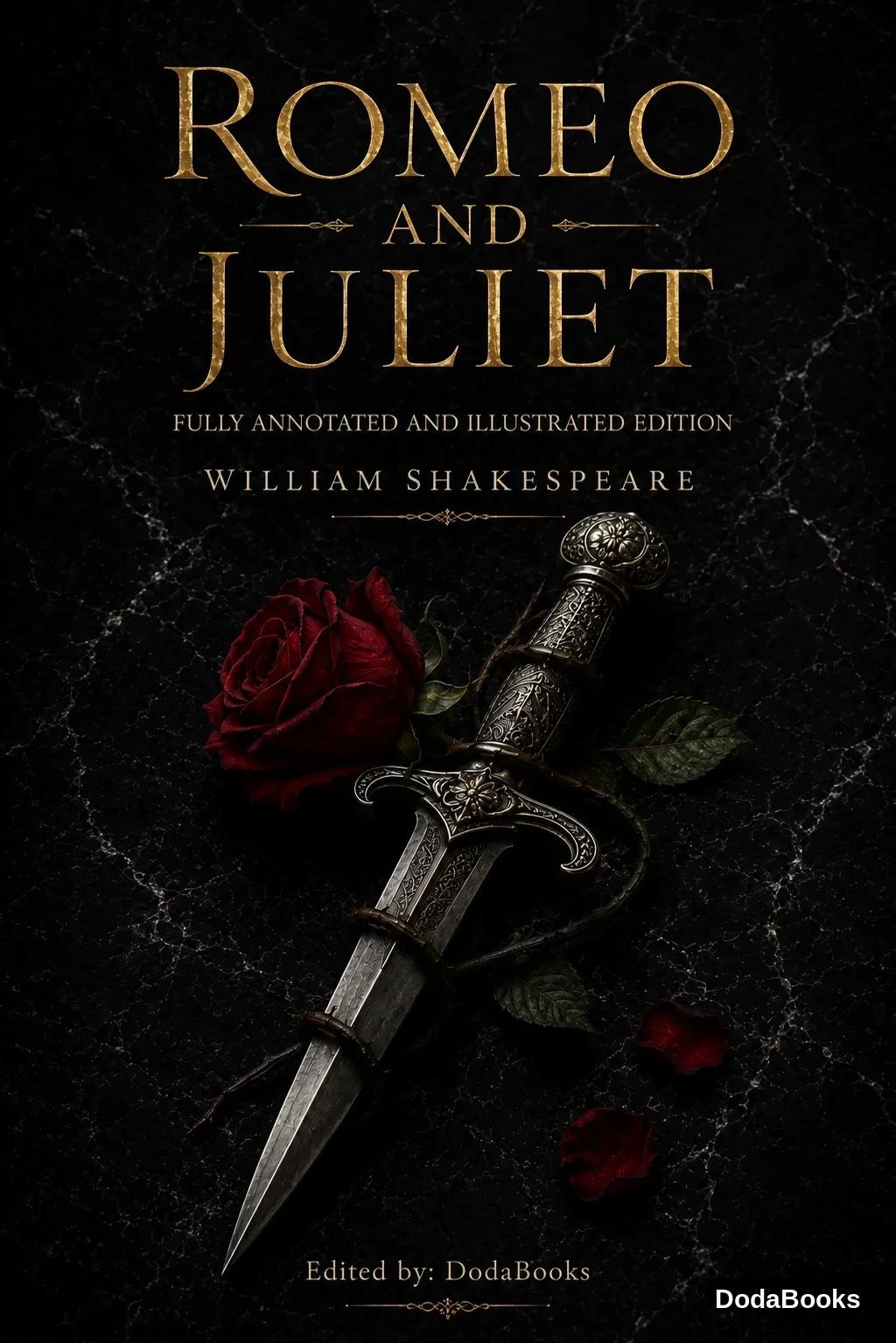
For theater lovers, actors, university students, and Shakespearean scholars seeking the authoritative collated Quarto and First Folio text with extensive character analyses, historical notes, and staging commentary, we recommend the definitive edition from DodaBooks:
Romeo and Juliet: Fully Annotated Edition
Experience William Shakespeare’s immortal tragedy in a magnificent scholarly edition. Featuring the complete unabridged 5-act text collating the First and Second Quartos, exhaustive character profiles, line-by-line glosses of Elizabethan wordplay, and essays on Renaissance staging history.
- Complete, authoritative unabridged 5-act dramatic text
- Comprehensive character analyses and rhetorical breakdowns of verse and prose
- Exquisite custom 3D typography and digital formatting optimized for modern e-readers
- Instant EPUB download compatible with Kindle, Apple Books, and Kobo
Frequently Asked Questions
Why does Romeo refuse to fight Tybalt in Act III, Scene 1 before Mercutio intervenes?
Immediately prior to the street confrontation in Act III, Scene 1, Romeo was secretly married to Juliet in Friar Laurence’s cell. Because Tybalt is Juliet’s first cousin, Romeo now considers Tybalt family. Romeo attempts to deflect Tybalt’s insults with gentle, cryptic words of affection: “I do protest, I never injured thee, / But love thee better than thou canst devise, / Till thou shalt know the reason of my love.” Romeo’s refusal to fight is an act of pacifism and familial loyalty, but to Mercutio and Tybalt, it appears as vile, dishonorable cowardice.
What is the character function of Count Paris in the play?
Count Paris represents the eligible, aristocratic suitor favored by society and patriarchal law. Unlike Romeo, Paris conducts his courtship strictly “by the book,” negotiating business terms with Lord Capulet rather than wooing Juliet directly. While Paris is not an evil villain—he genuinely mourns Juliet and brings flowers to her tomb—he views marriage as a conventional social contract and fails to perceive Juliet’s complex emotional interior, serving as the dramatic foil to Romeo’s passionate, reciprocal spiritual bond.
How does Shakespeare distinguish between blank verse and prose among the characters?
Shakespeare uses meter and prose as precise markers of class, emotion, and rhetorical stance. Aristocratic characters speak in refined iambic pentameter blank verse during moments of elevated passion, grief, and state ceremony. Lower-class servants (such as Peter and the musicians) speak in colloquial prose. Interestingly, Mercutio fluidly shifts between dazzling, ribald prose when mocking romantic clichés and sharp, piercing verse when delivering the Queen Mab speech or uttering his dying curse.
Explore Related Literature Masterworks
Continue your exploration of classic world literature and tragic character arcs with our companion analyses:
- Romeo and Juliet Study Guide: Themes & Tragedy: The foundational comprehensive study guide to Shakespeare’s early lyric masterpiece.
- Romeo and Juliet Themes & Symbolism: Key Motifs: Deconstruct inverted light and dark symbolism, the pharmacology of poison, and sonnet forms.
- Hamlet Study Guide: Tragedy, Characters & Themes: Examine Shakespeare’s supreme tragedy of philosophical skepticism, revenge ethics, and mortality.
- Pride and Prejudice Characters: Elizabeth, Darcy & Cast: Explore Jane Austen’s psychological breakdown of Elizabeth Bennet, Fitzwilliam Darcy, and Regency society.