Hamlet Study Guide: Tragedy, Characters & Themes
First performed around 1600–1601 by the Lord Chamberlain’s Men at the Globe Theatre in London, William Shakespeare’s The Tragedy of Hamlet, Prince of Denmark stands as the supreme masterpiece of world drama. No literary text in the English language has generated more critical commentary, philosophical inquiry, or theatrical reinterpretation.
While Elizabethan England loved the traditional blood-and-thunder revenge tragedy pioneered by Thomas Kyd’s The Spanish Tragedy, Shakespeare fundamentally transformed the genre. Instead of offering a brisk sequence of murders, he internalized the dramatic action, placing the focal point of the drama inside the fractured, brilliant, and agonizing consciousness of Prince Hamlet himself.
While our companion studies across Frankenstein Study Guide and Moby-Dick Themes & Symbolism examine intellectual obsession and cosmic defiance across later literary epochs, this comprehensive guide provides an academic deconstruction of Shakespeare’s foundational tragedy.
Fast Facts: Masterwork Overview
| Category | Detail |
|---|---|
| Author | William Shakespeare (1564–1616) |
| First Performance | c. 1600–1601 (Globe Theatre, Bankside, London) |
| Literary Genre | Renaissance Revenge Tragedy / Philosophical Drama / Psychological Tragedy |
| Setting | The royal castle of Elsinore (Kronborg Castle), Denmark, late medieval / early modern period |
| Narrative Form | Five-act blank verse and prose drama utilizing seven major introspective soliloquies |
| Central Conflict | The moral and epistemological paralysis of Prince Hamlet vs. the usurping tyrant King Claudius |
| Climax | The poisoned fencing duel in Act V, Scene 2, ending in the deaths of Gertrude, Laertes, Claudius, and Hamlet |
| Key Motifs | Poison in the ear, the skull of Yorick, unweeded gardens, theatrical actors, mirrors, ears and hearing |
1. Historical & Philosophical Context: The Renaissance Mind in Crisis
To grasp the tragedy of Hamlet, one must understand the profound intellectual tension between two historical worldviews colliding in late-Elizabethan England:
Feudal Revenge Code vs. Renaissance Humanism
- The Archaic Feudal Code: Embodied by the Ghost of King Hamlet, who arrives clad in complete battle armor demanding bloody eye-for-an-eye retribution (lex talionis). In the heroic Viking past, a son’s duty was swift, unreflective murder to avenge his slaughtered father.
- The Renaissance Humanist Ideal: Embodied by Prince Hamlet, who has been studying philosophy, theology, and the arts at the University of Wittenberg (the intellectual center of Martin Luther and Protestant Reformation thought). Hamlet does not believe in blind obedience; he questions everything, demands empirical verification, and agonizes over the salvation of his soul.
When Hamlet is commanded to kill, his modern philosophical consciousness rebels against the primitive duty forced upon him. As Hamlet famously laments at the end of Act I:
“The time is out of joint: O cursed spite,
That ever I was born to set it right!”
2. The Foils of Hamlet: A Study in Contrast
Shakespeare highlights Hamlet’s unique psychological complexity by contrasting him with three distinct dramatic foils who face similar crises of lost fathers and political duty:
Why Hamlet Envies Fortinbras and Laertes
In Act IV, Scene 4, watching Fortinbras’ army march past, Hamlet delivers his blistering soliloquy “How all occasions do inform against me”. He marvels that twenty thousand men will march to their graves for an eggshell of land, while he—with a father murdered and a mother defiled—cannot bring himself to act.
Yet Shakespeare does not endorse Laertes’ or Fortinbras’ blind action. Laertes easily falls into Claudius’ dishonorable trap of using an unbated, poisoned rapier, while Fortinbras represents military brute force. Hamlet’s hesitation, though tragic, is the mark of a superior moral conscience refusing to commit an unexamined act.
This contrast between rash action and agonizing moral reflection links Hamlet to Raskolnikov’s intellectual turmoil in Crime and Punishment Themes & Symbolism.
3. The Soliloquy Progression: The Architecture of Thought
Hamlet’s seven major soliloquies map the evolution of the Western human consciousness, tracing a path from suicidal despair to philosophical transcendence:
4. Surveillance, Corruption, and “The Mousetrap”
Elsinore is not a sanctuary of royal majesty; it is a surveillance state infected with moral rot. Marcellus’ famous observation in Act I—“Something is rotten in the state of Denmark”—functions as the political and biological diagnosis of the realm.
The Network of Spies
King Claudius rules through domestic espionage:
- He tasks Rosencrantz and Guildenstern with feigning childhood affection to extract Hamlet’s secret thoughts.
- He places Polonius behind tapestries (arras) to eavesdrop on Hamlet’s intimate conversations with Ophelia and Gertrude.
- Polonius sends his servant Reynaldo to Paris to spy on his own son Laertes by spreading false rumors of drunkenness and gambling.
In Elsinore, words are weapons, faces are masks, and trust is non-existent.
The Play-Within-a-Play as Forensic Trap
In Act III, Scene 2, Hamlet weaponizes art to pierce this web of deception. He invites traveling players to perform The Murder of Gonzago, inserting twelve to sixteen lines recreating the exact method of his father’s murder: pouring poison into the sleeping king’s ear.
Hamlet positions himself and Horatio to observe Claudius’ face:
“The play’s the thing
Wherein I’ll catch the conscience of the King.”
When the actor pours poison into the sleeper’s ear, Claudius abruptly rises in terror, shouting: “Give me some light. Away!” The court scatters in confusion. Art has triumphed where words failed: by presenting a mirror of truth, the drama breaks through Claudius’ armor of political hypocrisy.
This use of artistic representation to reveal the soul’s hidden corruption connects directly to Oscar Wilde’s portrait in The Picture of Dorian Gray Themes & Symbolism.
5. Mortality and the Leveling of Human Pride
In Act V, Scene 1, Shakespeare brings Hamlet to the cemetery in one of the most celebrated scenes in world literature.
Leaning into an open grave, the Gravedigger tosses up human skulls with his shovel while singing jaunty drinking songs. When Hamlet takes the skull of Yorick—the royal jester who carried young Hamlet on his back twenty-three years earlier—he confronts the cold, physical reality of death:
“Alas, poor Yorick! I knew him, Horatio: a fellow of infinite jest, of most excellent fancy: he hath borne me on his back a thousand times; and now, how abhorred in my imagination it is! My gorge rims at it. Here hung those lips that I have kissed I know not how oft. Where be your gibes now? Your gambols? Your songs?”
The Ultimate Leveler
Hamlet traces the biological decay of earth’s greatest conquerors:
- Alexander the Great died, was buried, returned to dust, dust became earth, earth made loam, and that loam was used to plug a beer barrel.
- Imperial Caesar, turned to clay, might patch a wall to keep the cold winter wind away.
In the cemetery, Hamlet’s intellectual torment dissolves. He realizes that all human beauty, philosophical learning, and political tyranny end in the same universal grave. This realization grants him an unshakeable inner peace. When Horatio urges him to decline the suspicious duel with Laertes, Hamlet calmly declines:
“There is a special providence in the fall of a sparrow. If it be now, ’tis not to come; if it be not to come, it will be now; if it be not now, yet it will come: the readiness is all.”
Recommended Critical Edition
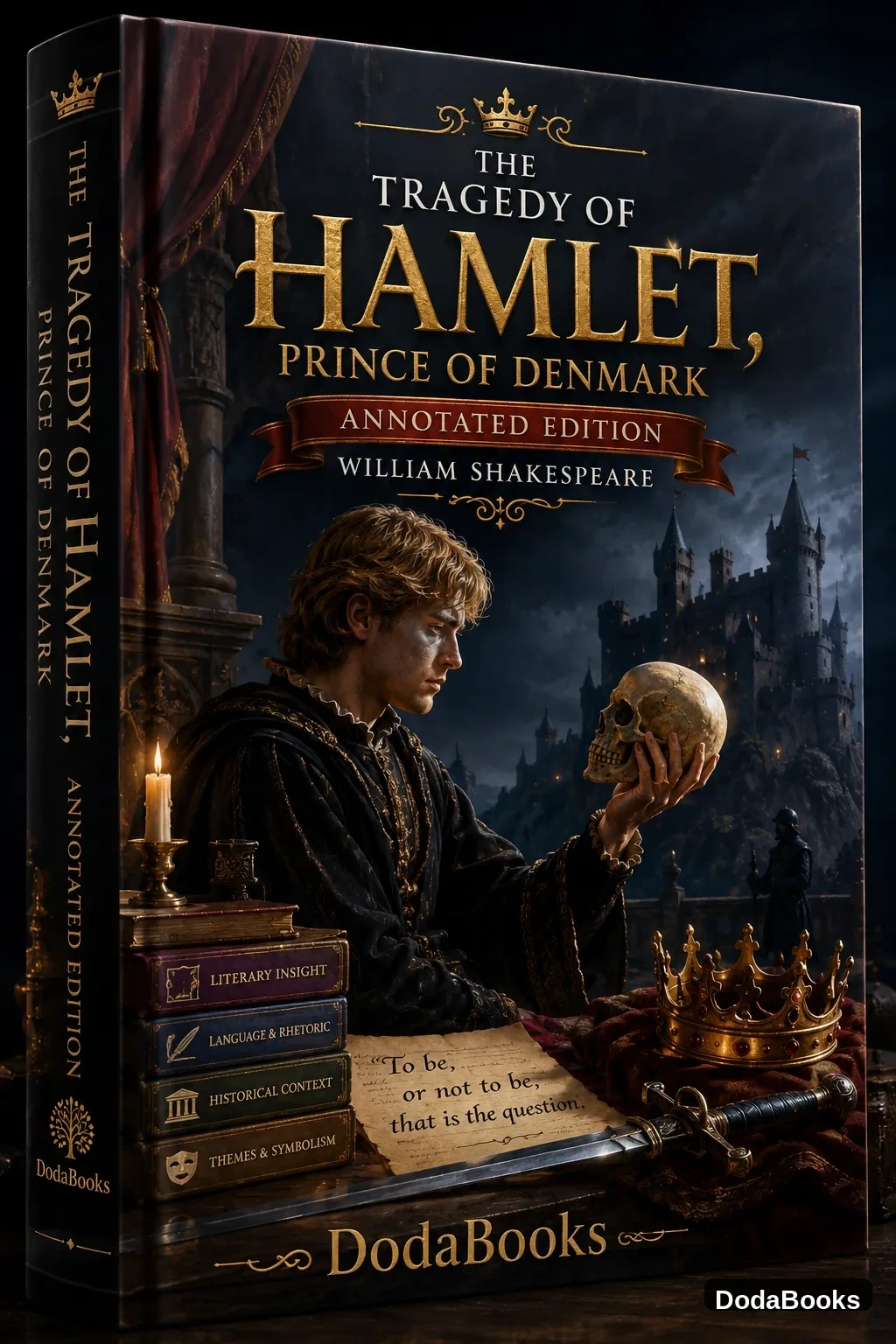
For theater lovers, university students, and serious Shakespearean scholars seeking the authoritative Folio and Quarto collated text with extensive line-by-line glosses and historical commentary, we recommend the definitive edition from DodaBooks:
The Tragedy of Hamlet, Prince of Denmark
Discover William Shakespeare’s immortal tragedy in a magnificent scholarly edition. Featuring extensive line-by-line textual annotations explaining archaic Elizabethan terms, historical theatrical context, the First and Second Quarto textual variants, and complete critical essays.
- Complete, authoritative 5-act unabridged text collating the 1604 Quarto and 1623 First Folio
- Comprehensive footnotes on Renaissance philosophy, Elsinore politics, and metadrama
- Exquisite custom 3D typography and digital formatting optimized for modern e-readers
- Instant EPUB download compatible with Kindle, Apple Books, and Android
Frequently Asked Questions
Why does Hamlet treat Ophelia with such cruelty in the “Get thee to a nunnery” scene?
Hamlet’s cruelty toward Ophelia in Act III, Scene 1 stems from multiple psychological layers. First, his mother Gertrude’s rapid remarriage has destroyed his faith in all women (“Frailty, thy name is woman!”). Second, Hamlet suspects that Ophelia has been set up as bait by Claudius and Polonius, which is confirmed when he asks, “Where’s your father?” and Ophelia lies by replying, “At home, my lord.” Realizing that the woman he loved is complicit in the court’s surveillance, Hamlet’s rage explodes into bitter misogynistic denunciation.
Why does Hamlet not kill Claudius while he is praying in Act III, Scene 3?
When Hamlet discovers Claudius kneeling alone in prayer, he draws his sword, realizing he could execute his revenge instantly. However, Hamlet pauses because he believes that if he kills Claudius while he is praying and confessing his sins, Claudius’ soul will go straight to heaven—which would be a reward rather than a punishment for murdering his father while asleep with all his sins unconfessed. Ironically, as soon as Hamlet walks away, Claudius admits to the audience that his prayers were empty: “My words fly up, my thoughts remain below: / Words without thoughts never to heaven go.”
What are Hamlet’s dying words, and what do they mean?
Hamlet’s final words before expiring in Horatio’s arms are: “The rest is silence.” This haunting declaration carries multiple profound meanings. It signifies the peaceful end of his exhausting intellectual and emotional turmoil, the mystery of what lies beyond the veil of death, and the tragic cessation of human speech and consciousness in the face of eternal oblivion.
Explore Related Literature Masterworks
Continue your exploration of classic world literature and tragic masterworks with our companion analyses:
- Frankenstein Study Guide: Summary, Characters & Analysis: Explore Mary Shelley’s Romantic masterpiece examining intellectual overreaching and the creation of life.
- The Picture of Dorian Gray Themes & Symbolism: Dive into Oscar Wilde’s gothic examination of vanity, moral rot, and the painted mirror of conscience.
- Moby-Dick Themes & Symbolism: Analysis of Key Motifs: Examine Herman Melville’s epic study of monomania, cosmic rebellion, and the white whale.
- Crime and Punishment Themes & Symbolism: Discover Dostoevsky’s exploration of guilt, moral redemption, and the extraordinary man theory.