Jane Eyre Study Guide: Themes, Characters & Analysis
When Jane Eyre: An Autobiography appeared in London in October 1847 under the androgynous pseudonym Currer Bell, it shocked the Victorian literary establishment. The conservative Quarterly Review declared that if the book were written by a woman, “she must be one who had, for some sufficient reason, long forfeited the society of her own sex.” What alarmed reviewers was neither the Gothic haunting nor the ruined country estates; it was the uncompromising moral voice of an impoverished, plain female protagonist demanding absolute equality with men and society.
Charlotte Brontë’s masterpiece shattered the conventions of 19th-century domestic romance by treating a woman’s interior life, sexual longing, religious conscience, and economic survival with radical seriousness.
Fast Facts: Masterwork Overview
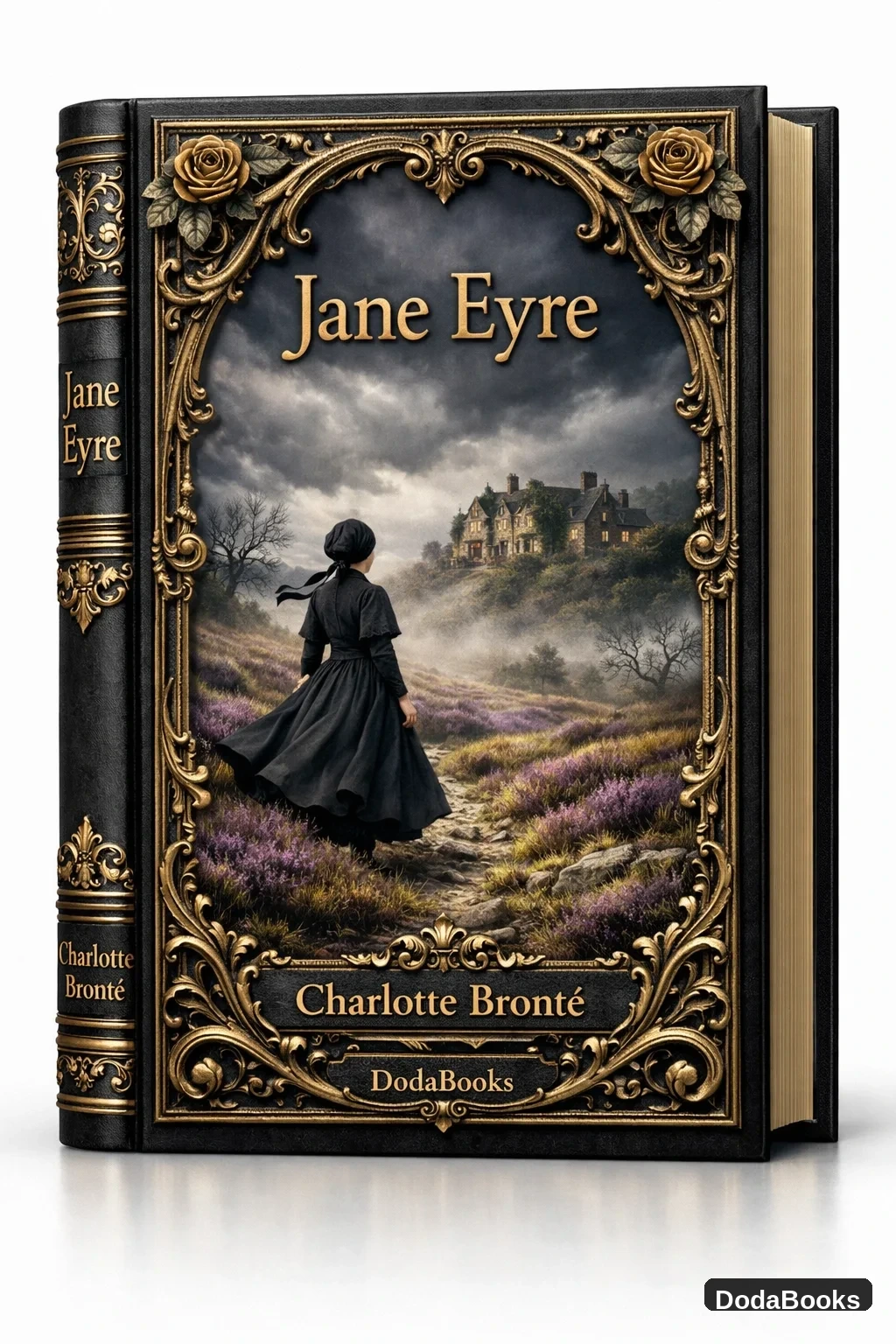
| Category | Detail |
|---|---|
| Author | Charlotte Brontë (published under the pseudonym Currer Bell) |
| First Publication | October 19, 1847 (Smith, Elder & Co., London) |
| Literary Genre | Bildungsroman / Victorian Realism / Gothic Romance |
| Setting | Northern England (Gateshead Hall, Lowood School, Thornfield Hall, Moor House, Ferndean Manor), c. early 1800s |
| Narrative Form | First-person retrospective autobiographical confession (“Currer Bell’s Autobiography”) |
| Central Conflict | Individual integrity and female autonomy vs. patriarchal authority, social class oppression, and erotic temptation |
| Climax | The interrupted wedding at Thornfield Hall (Chapter 26) and Jane’s nocturnal flight across the moors (Chapter 27) |
| Key Motifs | The Red-Room, fire and ice, Bertha Mason’s laugh, the split chestnut tree, the telepathic cry across the moors |
2-Minute Plot Summary: Spatial Architecture
Charlotte Brontë structures Jane’s moral pilgrimage through five distinct physical locations, each functioning as a crucible testing a specific dimension of her spirit:
- Gateshead Hall (Childhood Oppression): Orphaned as an infant, ten-year-old Jane lives as an outcast in the wealthy household of her cruel aunt, Mrs. Reed, and abusive cousin John. When Jane retaliates against John’s physical attacks, she is locked in the terrifying Red-Room—the bedchamber where her uncle died. The psychological trauma triggers a physical collapse and hardens Jane’s resolve never to submit to tyranny.
- Lowood Institution (The Crucible of Discipline): Sent to a charity boarding school for orphans, Jane suffers under the sadistic, hypocritical regime of Mr. Brocklehurst, who starves pupils under the guise of Christian mortification. Here Jane befriends Helen Burns, who teaches her spiritual endurance, and Miss Maria Temple, who provides intellectual guidance. A typhus epidemic exposes Lowood’s squalor, leading to systemic reforms; Jane remains eight years, six as student and two as teacher.
- Thornfield Hall (The Erotic Inferno): Seeking the wider world, Jane accepts a governess post instructing Adèle Varens, the French ward of the brooding, sardonic Edward Rochester. An intense intellectual and romantic bond develops between master and governess. Rochester proposes marriage, but the wedding ceremony is violently aborted when a London solicitor reveals Rochester’s living legal wife: Bertha Antoinetta Mason, a violent lunatic locked in the third-story attic. Refusing Rochester’s plea to become his Parisian mistress, Jane flees penniless into the wilderness.
- Moor House / Marsh End (The Crucible of Ice): Collapsing near starvation on the Yorkshire moors, Jane is rescued by clergyman St. John Rivers and his sisters, Diana and Mary. Jane becomes a village schoolmistress, discovers the Rivers are her maternal cousins, and inherits £20,000 from an uncle in Madeira, instantly dividing it equally among the four cousins. St. John asks Jane to marry him and join him as a missionary in India, demanding she sacrifice her emotional life to spiritual duty. On the brink of capitulation, Jane hears Rochester’s telepathic cry echoing across the dark moors.
- Ferndean Manor (The Egalitarian Haven): Jane rushes back to Thornfield, finding it a blackened ruin burned down by Bertha, who leaped to her death from the battlements. Rochester, maimed and blinded during his desperate rescue attempt, now lives in solitary seclusion at Ferndean Manor. Reunited on equal economic and spiritual terms, Jane and Rochester marry, achieving true emotional and intellectual union.
The Governess Dilemma: The Victorian Social Pariah
To appreciate Jane’s crisis at Thornfield Hall, one must understand the unique social agony of the 19th-century English governess.
For an educated gentlewoman whose family had lost their fortune, Victorian society offered virtually no respectable employment. Manual labor or retail trade meant immediate expulsion from the middle class. Becoming a governess was the sole sanctioned refuge—yet it was an occupation engineered for profound psychological alienation:
- Neither Servant nor Family: The governess resided inside a wealthy household, but could not fraternize with the lower servants (cooks, footmen, chambermaids) without losing her caste authority.
- Social Invisibility in the Drawing Room: She was equally excluded from her employer’s aristocratic circle. When the master entertained guests, the governess was expected to sit silently in the background, ignored like a piece of quiet furniture (as Blanche Ingram and her mother cruelly demonstrate in Chapter 17).
- Economic Precariousness: Governesses received meager salaries (£15 to £30 a year), held no legal contract, and could be dismissed on an employer’s whim without references, leaving them instantly homeless and destitute.
When Edward Rochester invites Jane into the drawing room for nightly philosophical duels, he shatters every code of Victorian decorum. Jane’s razor-sharp intellect captivates him, but her dependent status ensures that any romantic entanglement outside legal marriage would reduce her to the status of a discarded courtesan.
Character Analysis: The Battle of Wills
Sardonic Byronic master. Demands sensual surrender and urges Jane to become his mistress, risking her moral integrity for romantic ecstasy.
The unwavering soul. Refuses to trade her self-respect for Rochester's love, or her emotional vitality for St. John's cold duty.
Ascetic missionary inquisitor. Demands spiritual self-mutilation and a loveless marriage, weaponizing religious duty against Jane's heart.
Jane Eyre: The Uncompromising Ego
Small, plain, and poor, Jane overturns the conventional archetype of the radiant Victorian heroine. Her power rests entirely on moral integrity and ferocious self-respect. From childhood, Jane refuses to submit to arbitrary authority: she strikes back at John Reed, denounces Mrs. Reed’s hypocrisy, and openly defends herself against Mr. Brocklehurst’s public humiliation. Her iconic speech to Rochester in Chapter 23 establishes the modern feminist credo:
“Do you think I am an automaton?—a machine without feelings? and can bear to have my morsel of bread snatched from my lips, and my drop of living water dashed from my cup? Do you think, because I am poor, obscure, plain, and little, I am soulless and heartless? You think wrong!—I have as much soul as you,—and full as much heart!”
Edward Fairfax Rochester: The Byronic Master
Cynical, wounded, and autocratic, Rochester embodies the Byronic hero. Haunted by a youthful marriage arranged by his father for Jamaican fortune, Rochester spent fifteen years wandering Europe in dissipation, collecting mistresses (Céline, Giacinta, Clara) whom he grew to loathe. In Jane, Rochester recognizes his spiritual equal. However, his attempt to deceive Jane into a bigamous union reveals his lingering aristocratic arrogance: he expects moral rules to bend to his romantic desperation. Only through the physical destruction of Thornfield and the loss of his sight and right hand is his arrogance burned away.
Bertha Antoinetta Mason: The Madwoman in the Attic
Bertha Mason, the Creole heiress from Spanish Town, Jamaica, is the dark sun around which Thornfield’s mystery orbits. Confined behind a hidden tapestry door under the care of the drunken Grace Poole, Bertha is described in dehumanizing Gothic language: a “clothed hyena,” a purple-faced specter with bloodshot eyes. In feminist criticism (notably Gilbert and Gubar’s 1979 landmark study), Bertha is Jane’s suppressed rage incarnate:
- She tears Jane’s aristocratic bridal veil the night before the wedding.
- She sets Rochester’s bed on fire when Jane experiences romantic confusion.
- She burns Thornfield to ashes, destroying the feudal house of Rochester’s dominance.
St. John Rivers: The Christian Inquisitor
Parish priest of Morton, St. John (pronounced “Sin-jin”) possesses flawless classical Greek beauty and a completely frozen heart. Devoted to missionary martyrdom in India, St. John views human affection as weakness. He recognizes Jane’s exceptional endurance and demands she marry him—not because he loves her, but because she would make an efficient, obedient missionary companion. St. John represents the temptation of religious fanaticism: the total sacrifice of earthly selfhood to abstract divine duty.
Thematic Analysis: Core Literary Conflicts
1. Spiritual Autonomy vs. Social and Religious Tyranny
Throughout the novel, Brontë wages war against institutional hypocrisy. Three distinct forms of corrupt religion are exposed:
- Sadistic Evangelicalism (Mr. Brocklehurst): Brocklehurst preaches that girls’ bodies must be mortified to save their souls, ordering naturally curly hair shorn while his own daughters arrive in velvet, silk, and false curls.
- Passive Pacifism (Helen Burns): Helen Burns preaches absolute Christian non-resistance and forgiveness (“Love your enemies”). While Jane admires Helen’s angelic purity, she rejects passive endurance in this life: “When we are struck at without a reason, we should strike back again very hard; I am sure we should—so hard as to teach the person who struck us never to do it again.”
- Ascetic Fanaticism (St. John Rivers): St. John uses biblical imperatives as psychological coercion, attempting to force Jane into a loveless marriage by declaring that rejecting him is equivalent to rejecting God.
Jane’s faith is distinct: it is personal, intuitive, and rooted in natural moral law. When tempted by Rochester to stay with him in the Mediterranean, she appeals not to societal opinion, but to internal integrity: “Laws and principles are not for the times when there is no temptation: they are for such moments as this, when body and soul rise in mutiny against their rigor.”
2. Imperial Wealth and the Colonial Repressed
Postcolonial critics (such as Gayatri Chakravorty Spivak) have highlighted that Thornfield Hall’s luxury and Rochester’s aristocratic freedom are subsidized by colonial exploitation. Rochester’s father married him to Bertha for her £30,000 Jamaican dowry, linking English domestic romance directly to Caribbean plantation slavery. Similarly, Jane’s liberating £20,000 inheritance originates from her uncle John Eyre’s wine and trade ventures in Madeira. The novel cannot fully extricate itself from the imperial economy, yet Bertha’s incendiary revenge forces English domesticity to confront its colonial debts.
3. The Reversal of Power Dynamics
The resolution of Jane Eyre is among the most radical in Victorian literature because it requires the complete dismantling of male privilege:
| Dimension | Thornfield Hall Dynamic (Master and Governess) | Ferndean Manor Dynamic (Egalitarian Partners) |
|---|---|---|
| Rochester’s Status | Wealthy, sighted, aristocratic master commanding obedience | Dependent, blind, maimed amputee seeking companionship |
| Jane’s Status | Penniless, dependent governess on a meager £30 salary | Financially independent heiress holding £5,000 in capital |
| Balance of Power | Bigamous deception and unbridgeable caste hierarchy | Full mutual equality: “Reader, I married him” |
When Jane proclaims, “Reader, I married him,” she declares her agency. She does not say “He married me,” nor does she accept a passive role. She arrives as an equal partner, capable of providing economic support, physical care, and intellectual companionship.
Recommended Critical Editions
Jane Eyre: The Annotated Feminist & Historical Edition
Includes the complete 1847 text with 260+ annotations on Victorian governess contracts, Lowood School parallels, Bertha Mason colonial essays, and manuscript notes.
- ✓ Unabridged 1847 First Edition
- ✓ 260+ Scholarly Historical & Legal Footnotes
- ✓ Victorian Governess Contract Collation
- ✓ Instant DRM-Free EPUB & PDF Download
Related Literature Study Guides
Explore our comprehensive library of literary masterwork analyses:
- Jane Eyre Themes & Symbolism: An analysis of the Red-Room trauma, Bertha Mason as doppelgänger, and the split chestnut tree.
- Pride and Prejudice Study Guide: Fee tail male entailment, class realism, and narrative irony in Jane Austen.
- Frankenstein Study Guide: The Vitalism controversy, Romantic science, and paternal abandonment in Mary Shelley.
- The Great Gatsby Study Guide: Spatial class division and modernist disillusionment in F. Scott Fitzgerald.
- Crime and Punishment Study Guide: Russian nihilism, utilitarian rationalism, and spiritual resurrection in Dostoevsky.
- Moby-Dick Study Guide: Labor economics, cetological classification, and cosmic defiance in Herman Melville.
- The Pequod in Moby-Dick: Ship Meaning & Symbolism: The barbaric architecture and 30-man union microcosm of Melville’s doomed whaleship.
Frequently Asked Questions
Why did Jane Eyre cause such a scandal among Victorian critics upon publication in 1847?
Jane Eyre alarmed Victorian reviewers because its female protagonist—an impoverished, plain, dependent orphan—openly asserted her moral, emotional, and intellectual equality with men. Rather than submitting meekly to social authority or accepting the status of a kept mistress, Jane fiercely demanded autonomy, rebelled against religious hypocrisy, and claimed equal spiritual rights before God.
What is the critical significance of Bertha Mason, the ‘Madwoman in the Attic’?
Bertha Mason functions as both a colonial critique and Jane’s psychological double (doppelgänger). Confined to the attic of Thornfield Hall, Bertha embodies the violent rage and sexual passion that Victorian decorum forced Jane to suppress. Her arson exposes the toxic colonial origins of Rochester’s wealth in Jamaican slave plantations and clears the way for an egalitarian union at Ferndean.
What does the famous line ‘Reader, I married him’ signify about Jane’s autonomy?
The phrasing ‘Reader, I married him’—rather than ‘He married me’—grammatically and thematic crowns Jane as the active agent of her own destiny. By the final chapter, Jane has inherited independent financial wealth, while Rochester has lost Thornfield, his vision, and his physical dominance, allowing them to unite as genuine equals based on mutual respect rather than economic dependency.