Little Women Themes & Symbolism: Motifs and Meaning
When Louisa May Alcott published Little Women in 1868–1869, she created far more than a sentimental domestic story for young girls; she authored a profound, multi-layered philosophical treatise on nineteenth-century American womanhood, moral self-discipline, and democratic ethics. Raised in Concord, Massachusetts at the intellectual epicenter of New England Transcendentalism, Alcott wove Ralph Waldo Emerson’s doctrines of spiritual self-reliance and Amos Bronson Alcott’s radical educational ideals into the everyday domestic fabric of the March household.
Behind the cozy fireplace gatherings, amateur theatricals, and pickwickian clubs lies an incisive exploration of female ambition, economic anxiety during the Civil War, and the painful transition from youthful idealism to adult maturity. Objects within the March home are never merely decorative; they serve as resonant symbols charting the sisters’ psychological and moral development.
While our companion Little Women Study Guide breaks down the complete plot arcs and character trajectories, this comprehensive critical analysis examines the novel’s major thematic pillars, symbolic motifs, and philosophical foundations.
Thematic Architecture Overview
| Thematic Dimension | Critical Interpretation | Manifested Symbol or Episode |
|---|---|---|
| Spiritual Self-Mastery | Christian allegory translated into domestic psychological self-discipline. | Bunyan’s Pilgrim’s Progress; Marmee’s guidebooks; carrying daily burdens. |
| Female Economic Agency | The physical renunciation of decorative femininity to secure family survival. | Jo cutting her chestnut hair for $25; writing sensation thrillers for pay. |
| Creative Destruction | Artistic creation, sisterly resentment, and the fragility of intellectual labor. | The burning of Jo’s fairy tale manuscript; Amy’s plunge into the frozen river. |
| Transcendentalist Simplicity | Voluntary poverty as spiritual nobility vs. high-society materialism. | Giving away Christmas breakfast to the Hummels; Meg’s violet ball gown. |
| Domestic Intellectual Equality | Partnership founded on mutual intellectual respect rather than aristocratic polish. | Professor Bhaer’s umbrella in the rain; the founding of Plumfield school. |
1. The Pilgrim’s Progress Allegory: Domesticating Bunyan’s Epic
The overarching structural and moral foundation of Little Women is John Bunyan’s seventeenth-century Puritan masterpiece The Pilgrim’s Progress. However, Alcott executes a radical literary transformation: she domesticates Bunyan’s epic, transposing the solitary Christian warrior fighting demons in desolate wastelands into four teenage sisters conquering internal character flaws within a cozy New England parlor.
The Four Sisters’ Individual Burdens
On Christmas morning, Marmee places a pocket copy of Bunyan’s allegory beneath each daughter’s pillow, framing their daily chores and emotional trials as spiritual pilgrimages:
Alcott borrows Bunyan’s classical geography to title her chapters:
- “Beth Finds the Palace Beautiful”: Beth overcoming her dread of the imposing Laurence mansion to play Mr. Laurence’s grand piano.
- “Amy’s Valley of Humiliation”: Amy being struck by Mr. Davis’s cane and forced to stand before the class after bringing pickled limes to school.
- “Jo Meets Apollyon”: Jo battling the monstrous demon of her own explosive wrath after Amy burns her manuscript.
This thematic transformation demonstrates that heroic spiritual virtue is forged not on distant battlefields, but in the mundane self-restraint required in family life.
2. Jo’s Shorn Hair: The Renunciation of Decorative Womanhood
In nineteenth-century America, a woman’s hair was celebrated as her crowning aesthetic glory—the quintessential symbol of feminine modesty, romantic allure, and decorative beauty. In Chapter 15, Jo’s decision to cut off her luxuriant chestnut locks stands as the novel’s most radical symbolic gesture:
The Economic Motive vs. Domestic Passivity
When Father March falls gravely ill with pneumonia in a Washington military hospital, the family needs forty dollars to send Marmee south. While Meg weeps and Aunt March offers money attached to humiliating scoldings, Jo takes direct economic action:
By shearing her hair, Jo symbolically casts off the restrictive expectations of decorative courtship. Her short, boyish crop externalizes her internal resistance to Victorian gender roles, aligning her with male soldiers marching to war. She becomes an active economic provider, proving that love expresses itself through courageous physical sacrifice.
3. The Burned Manuscript: Creative Destruction and Forgiveness
The burning of Jo’s fairy tale manuscript in Chapter 8 is one of the most psychologically intense episodes in American literature:
The Weight of Intellectual Labor
For Jo, writing is not a superficial hobby; it is the core of her identity, her soul’s authentic voice, and her pathway to economic autonomy. The burned manuscript represents years of solitary creative toil, imagination, and hopes for publication:
- Amy’s Act of Vengeance: Enraged at being left behind from the theatre by Jo and Laurie, Amy burns the handwritten manuscript in the kitchen fire. It is a targeted, devastating strike aimed precisely at what Jo cherishes most.
- The Incandescence of Wrath: When Jo discovers the charred embers, her grief explodes into blinding fury. She shakes Amy violently, shouting: “You wicked, wicked girl! I never can write it again, and I’ll never forgive you as long as I live!”
- The Frozen River Ordeal: The next afternoon on the iced-over river, Jo’s refusal to speak to Amy nearly causes a catastrophe. Amy falls through thin ice; only Laurie’s quick thinking and Jo’s desperate efforts save her from drowning.
The Theological Lesson of Grace
Pulling Amy’s shivering body from the freezing water shatters Jo’s rage:
- In the parlor that evening, Jo confesses her terror to Marmee: she realized with horror that for a split second, her anger made her hesitate to warn Amy about the fragile ice.
- Marmee reveals her own lifelong struggle with a furious temper, teaching Jo that anger is a dangerous fire that must be watched constantly: “You think your temper is the worst in the world, but mine used to be just like it… I’ve been trying to cure it for forty years, and have only succeeded in watching it.”
The burned manuscript thus serves as the crucible of Jo’s emotional maturity, teaching her that love and forgiveness are infinitely more precious than any artistic creation. This theme of moral reckoning through domestic trials echoes the spiritual redemption explored in our Jane Eyre Themes & Symbolism guide.
4. Concord Transcendentalism: Voluntary Poverty & Spiritual Riches
The philosophical worldview animating Little Women is rooted in Concord Transcendentalism—the belief that spiritual and intellectual integrity far outweighs material luxury:
The Hummel Breakfast Sacrifice
In the opening chapter, the March family sits down to a rare Christmas feast: fresh bread, butter, cream, and muffins. When Marmee returns from visiting the impoverished German immigrant Hummel family—where a newborn baby and six shivering children are freezing without food—she asks her daughters if they will give their breakfast away:
Meg at Vanity Fair: The Moffat Party
The contrast between genuine spiritual dignity and corrupt commercialism is dramatized when Meg attends the wealthy Moffat party:
- Meg allows her aristocratic friends to dress her in a low-cut violet silk gown, crimp her hair, paint her face, and lace her waist until she can barely breathe.
- Drinking champagne and flirting like a superficial coquette, Meg feels debased and dirty. She realizes that her wealthy friends view her not as an equal, but as an impoverished doll to be played with and pitied.
- Returning home, Meg confesses her shame to Marmee, cementing her rejection of fashionable vanity in favor of honest, modest labor.
5. Castles in the Air vs. Domestic Realism
In Chapter 13, lounging upon the grassy hillside on a tranquil summer afternoon, the sisters and Laurie reveal their secret utopian dreams—their “Castles in the Air”:
- Meg’s Castle: A grand palace with rooms full of luxurious tapestries, delicious food, carriages, and servants. Meg eventually trades this fantasy for a tiny cottage with John Brooke, discovering that sewing curtains and caring for twins brings profound joy.
- Jo’s Castle: A room overflowing with books, horses to ride, and heroic literary fame that echoes throughout world history. Jo eventually trades commercial melodrama for honest, heartfelt writing, transforming Aunt March’s Plumfield estate into a progressive school for impoverished boys.
- Amy’s Castle: Traveling to Rome, painting masterworks that rival Raphael and Michelangelo, and being celebrated as the queen of fine art. Amy matures into an artist who recognizes her limitations with grace, using her wealth and refined taste to support struggling creators.
- Beth’s Castle: Remaining safe at home with father and mother, caring for the family forever. Beth alone asks for nothing external, reflecting her saintly transcendence of earthly ambition.
Alcott shows that growing up does not mean abandoning ideals; it means anchoring castles in the air upon the solid ground of everyday compassion and responsibility.
6. The Umbrella in the Rain: Intellectual Companionship
The resolution of Jo’s romantic arc occurs not in a candlelit ballroom or an aristocratic garden, but beneath a dripping, tattered umbrella on a muddy street in New York:
Why Friedrich Bhaer Outweighs Laurie
In nineteenth-century romance, heroes were expected to be young, wealthy, handsome, and dashed with Byronic brooding (such as Mr. Darcy in our Pride and Prejudice Study Guide or Edward Rochester in Jane Eyre Study Guide):
- Laurie Laurence: Young, dashing, extraordinarily wealthy, but emotionally volatile and lacking clear vocational purpose. Marrying Laurie would have reduced Jo to an ornament in Boston society, extinguishing her literary spark.
- Friedrich Bhaer: Middle-aged, poor, thick-waisted, speaking with a heavy German accent, wearing patched coats, and supporting two orphaned nephews. Yet Bhaer is an intellectual giant, a scholar of German philosophy, and a man of boundless moral integrity.
The Climax Under the Umbrella
In Chapter 46, when Bhaer comes to say goodbye before taking a teaching post in the West, Jo walks beside him in a drenching rainstorm:
- Bhaer holds his large umbrella over Jo, completely ignoring the rain soaking his own shoulders.
- When Jo weeps at the thought of him leaving, Bhaer stops in the mud, drops the umbrella, and confesses his love: “Heart’s dearest! Why do you cry?”
- Their partnership is built on complete transparency, shared labor, and intellectual equality. Together at Plumfield, they establish an educational community where learning is experiential, physical punishment is banned, and girls and boys are nurtured as equals.
Recommended Critical Edition
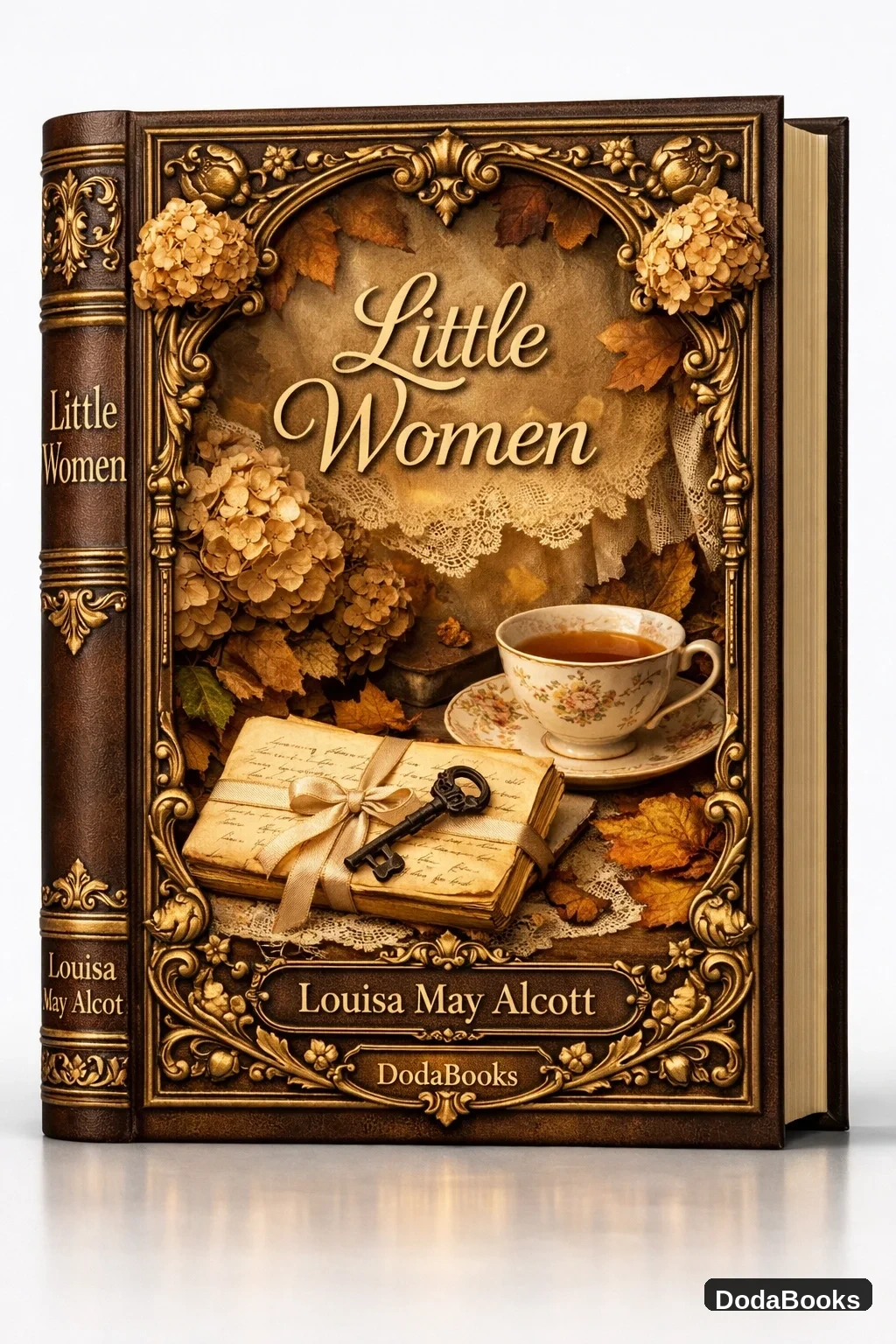
For scholars of American literature, teachers, and book collectors seeking the definitive complete text with historical commentary on Concord Transcendentalism, Civil War domestic life, and textual variants, we recommend the unabridged edition from DodaBooks:
Little Women: Complete Unabridged Edition
Experience Louisa May Alcott’s immortal classic in a magnificent scholarly presentation. Featuring the complete unabridged 47-chapter text combining both original volumes, comprehensive annotations on Concord Transcendentalism, nineteenth-century domestic economy, and feminist literary criticism.
- Complete, authoritative unabridged text combining Little Women and Good Wives
- Comprehensive historical footnotes on New England culture and nineteenth-century domestic economy
- Exquisite custom 3D typography and digital formatting optimized for modern e-readers
- Instant EPUB download compatible with Kindle, Apple Books, and Kobo
Frequently Asked Questions
Why does Jo March abandon sensational fiction (“potboilers”) in New York?
In Chapter 34, Jo earns good money in New York writing lurid sensation thrillers filled with poison, daggers, and scandalous passion for the Weekly Volcano. However, Professor Bhaer severely critiques sensational pulp literature as intellectual poison that debases readers’ moral sensibilities. Ashamed, Jo examines her stories and realizes they are artificial, hollow, and spiritually toxic. She burns her sensation manuscripts, choosing to write only from genuine emotional truth and personal experience, which later enables her to write her masterpiece about Beth.
What is the symbolic function of Beth’s piano?
Beth’s piano symbolizes spiritual harmony, domestic tranquility, and the healing power of selfless love. Her tiny old instrument at home is battered and out of tune, yet she coaxed beautiful melodies from it without complaint. When Mr. Laurence gifts her a magnificent new cabinet piano after hearing her play, the instrument symbolizes the transcendent power of quiet goodness to break through the armor of embittered, grieving men.
How does Louisa May Alcott critique Victorian marriage conventions in Little Women?
Alcott critiques Victorian marriage by rejecting the idea that marriage is a woman’s sole economic destiny or highest achievement. She depicts four distinct models of womanhood: Meg chooses companionate domesticity; Amy chooses pragmatic social partnership; Jo demands intellectual and vocational equality; and Beth achieves spiritual transcendence without marriage. Alcott insists that women must first develop complete, autonomous selfhood before uniting with another.
Explore Related Literature Masterworks
Continue your exploration of classic world literature and Victorian masterworks with our companion analyses:
- Little Women Study Guide: Themes, Characters & Plot: The foundational comprehensive study guide to Louisa May Alcott’s American classic.
- Jane Eyre Themes & Symbolism: Analysis of Central Motifs: Examine Charlotte Brontë’s exploration of female dignity, Byronic passion, and moral autonomy.
- Pride and Prejudice Themes & Symbolism: Key Motifs: Explore Jane Austen’s sharp social satire of English gentry marriage economics and pride.
- Frankenstein Themes & Symbolism: Analysis of Key Motifs: Dive into Mary Shelley’s Romantic deconstruction of scientific ambition, parental neglect, and societal prejudice.