The Call of Cthulhu Themes & Cosmicism Symbolism
When H. P. Lovecraft penned The Call of Cthulhu in 1926, he permanently altered the trajectory of modern speculative horror. Prior to Lovecraft, Western supernatural literature was anchored in traditional Judeo-Christian dualism: ghosts seeking vengeance for unburied bones, vampires repelled by crucifixes, and demons bound by holy water. Lovecraft swept aside this moralizing gothic apparatus, replacing spiritual specters with an uncompromising, scientifically informed worldview known as Cosmicism.
In Lovecraft’s cosmos, there is no divine protector, no cosmic justice, and no special purpose for humanity. The Earth is merely a dust mote drifting through cold, black seas of infinity, temporarily infested by human beings who are completely ignorant of the vast extraterrestrial titans sleeping beneath the ocean floor.
While our comprehensive The Call of Cthulhu Study Guide analyzes the plot architecture and forensic investigators of the narrative, this critical study deconstructs the philosophical themes, spatial motifs, epistemological dread, and psychological terror that define Lovecraft’s supreme masterwork.
Thematic Architecture Overview
| Core Dimension | Critical Interpretation | Manifested Symbol or Motif |
|---|---|---|
| Cosmic Indifference | Humanity as a temporary, fragile accident in an unfeeling, ancient universe. | The Great Old Ones; millions of years of slumber; cosmic scale. |
| Epistemological Dread | Knowledge as a fatal contagion; correlating truth leads to psychological annihilation. | The inherited locked box; Professor Angell’s notes; Thurston’s paranoia. |
| Non-Euclidean Madness | Spatial architecture violating human geometry, representing ontological impossibility. | Sunken R’lyeh; cyclopean masonry; acute angles acting obtuse; swallowing doors. |
| Psychic Telepathy | The human subconscious as a porous, involuntary antennae for alien broadcasts. | Wilcox’s delirium sculpture; global nightmares of poets and mystics. |
| The Primordial Abyss | The ocean as an opaque barrier concealing unfathomable cosmic horrors. | South Pacific oceanic expanse; the slime-coated tomb; the ramming of the Alert. |
1. Cosmicism: The Annihilation of Anthropocentrism
The foundational philosophical pillar of The Call of Cthulhu is Cosmicism—the terrifying realization of human insignificance:
The Illusion of Human Supremacy
Since the Renaissance and the Enlightenment, Western philosophy proclaimed humanity as the apex of terrestrial creation. Whether through the biblical narrative of divine dominion or the secular narrative of scientific progress, humans believed that the universe was intelligible, orderly, and ultimately benevolent to human flourishing.
Lovecraft destroys this anthropocentric conceit:
- Deep Geological Time: The Great Old Ones—exemplified by Cthulhu—descended from the stars hundreds of millions of years before the first primate walked upright. They built towering basalt cities when the Earth was young, fought interstellar wars, and sank beneath the waters during ancient continental cataclysms.
- Absolute Moral Indifference: Cthulhu does not hate humanity. Hate implies an emotional relationship. Cthulhu regards human beings exactly as a human traveler regards microbial organisms beneath a boot heel. The monster’s re-emergence would eradicate human civilization not out of wrath, but simply as a byproduct of its awakening.
This cosmic pessimism sharply contrasts with Mary Shelley’s human-centered tragedy explored in our Frankenstein Themes & Symbolism guide, where suffering arises from moral rejection rather than cosmic indifference.
2. Non-Euclidean Geometry and Spatial Madness
In literature, setting typically provides a stable physical framework within which dramatic action unfolds. In The Call of Cthulhu, the physical setting of R’lyeh becomes an active psychological weapon that assaults the human mind:
The Mathematics of Spatial Horror
When Gustaf Johansen and his fellow sailors set foot upon the risen masonry of R’lyeh in the South Pacific, they encounter architecture that violates terrestrial geometry:
Lovecraft drew upon the revolutionary nineteenth-century non-Euclidean geometries of Bernhard Riemann and Nikolai Lobachevsky, which proved that on curved surfaces, Euclid’s classical axioms fail. By constructing R’lyeh with non-Euclidean parameters, Lovecraft symbolizes the horrific intrusion of higher-dimensional space into our three-dimensional world. Human reason collapses because the sensory organs cannot process geometry that terrestrial evolution never prepared them to encounter.
3. Epistolary Forensics and Archival Paranoia
Lovecraft constructs The Call of Cthulhu not as a traditional third-person narrative, but as an archival mystery assembled by narrator Francis Wayland Thurston:
The Methodology of the Poisoned Archive
The story opens with the narrator examining the posthumous papers of his grand-uncle, Professor George Gammell Angell. Thurston does not embark on an adventure; he sits in an academic study, sorting through locked boxes, newspaper clippings, diary fragments, and police interrogation transcripts:
- The Mosaic of Dread: No single document reveals the full truth. Professor Angell holds the clay bas-relief notes; Inspector Legrasse holds the Louisiana swamp idol and cult testimonies; Gustaf Johansen’s widow holds the handwritten maritime diary in Oslo.
- The Horror of Correlation: Lovecraft’s famous opening sentence establishes the epistemological thesis: “The most merciful thing in the world, I think, is the inability of the human mind to correlate all its contents.”
- The Deadly Realization: Each document is innocuous in isolation. But when Thurston cross-references the dates—realizing that on the exact day Wilcox sculpted the bas-relief in Providence, the swamp cult went wild in Louisiana, and the sailors landed on R’lyeh—the correlation snaps together, revealing a global cosmic conspiracy.
Paranoia and Incurable Isolation
Once the evidence is correlated, the researcher’s life is permanently ruined:
- Thurston realizes that Professor Angell was murdered—bumped by a mysterious sailor in Providence—and that Johansen was assassinated in Oslo by nautical foreigners.
- Knowledge acts as a mortal infection. The seeker becomes the hunted: “I know too much, and the cult still lives… I shall never sleep calmly again.”
- Thurston writes his final testament knowing that when he dies, the papers must be burned to prevent another human soul from glimpsing the truth.
This technique of epistolary forensic deduction turning into psychological horror parallels the investigative terror of Bram Stoker’s Dracula, explored in our Dracula Themes & Symbolism guide.
4. The Human Mind as an Involuntary Telepathic Antenna
One of Lovecraft’s most innovative motifs is the portrayal of the human subconscious as a porous, involuntary receiver for alien psychic energy:
In Lovecraft’s mythology, the Great Old Ones cannot physically speak through water; they communicate through telepathic dream broadcasts. Thus, the unconscious mind during sleep is not a sanctuary of rest, but an open portal through which ancient cosmic horrors invade human sanity.
5. The Sea as the Primordial Abyssal Void
While nineteenth-century maritime literature—exemplified by Herman Melville’s Moby-Dick—viewed the ocean as a theater of human industrial triumph, democratic labor, and metaphysical combat, Lovecraft views the ocean as an opaque, suffocating abyss:
The Unstable Lid of Civilization
- The Deep Pacific: Lovecraft deliberately places R’lyeh in the most remote quadrant of the South Pacific (Latitude 47° 9’ S, Longitude 126° 43’ W), as far as possible from any human continent. It is the geographic pole of inaccessibility.
- The Black Waters as Seal: For millions of years, miles of pitch-black ocean water have acted as a gravitational and psychic buffer, muffling Cthulhu’s telepathy and trapping the ancient city in the dark.
- The Terror of the Surface: When tectonic tremors briefly thrust R’lyeh into the sunlit atmosphere, the boundary between the ancient alien realm and modern human navigation dissolves.
The Maritime Collision: Fragility of Industrial Technology
The confrontation between Gustaf Johansen’s steam yacht Alert and Cthulhu exposes the pathetic limits of human industrial machinery:
- Humanity’s proudest technological triumph in the 1920s was the steel steam engine—the mechanical embodiment of industrial power and conquest over nature.
- In desperation, Johansen uses his ship as a battering ram, driving hundreds of tons of roaring steel through Cthulhu’s neck.
- The monster bursts apart like a noxious nebula of putrid slime, yet within seconds, the severed fragments effortlessly reform and recombine in the churning waters.
- Human technology cannot destroy cosmic matter. Johansen’s desperate victory is an illusion; the yacht escapes only because the city sinks beneath the waves once more, pulled down by natural oceanic cycles.
This cosmic insignificance of human technology resonates with Captain Ahab’s doomed war against the white whale, deconstructed in our Moby-Dick Themes & Symbolism guide.
Recommended Critical Edition
For scholars of weird fiction, horror enthusiasts, and students of speculative literature seeking the definitive text with extensive annotations on early twentieth-century physics, Lovecraft’s correspondence, and the Cthulhu Mythos, we recommend the unabridged edition from DodaBooks:
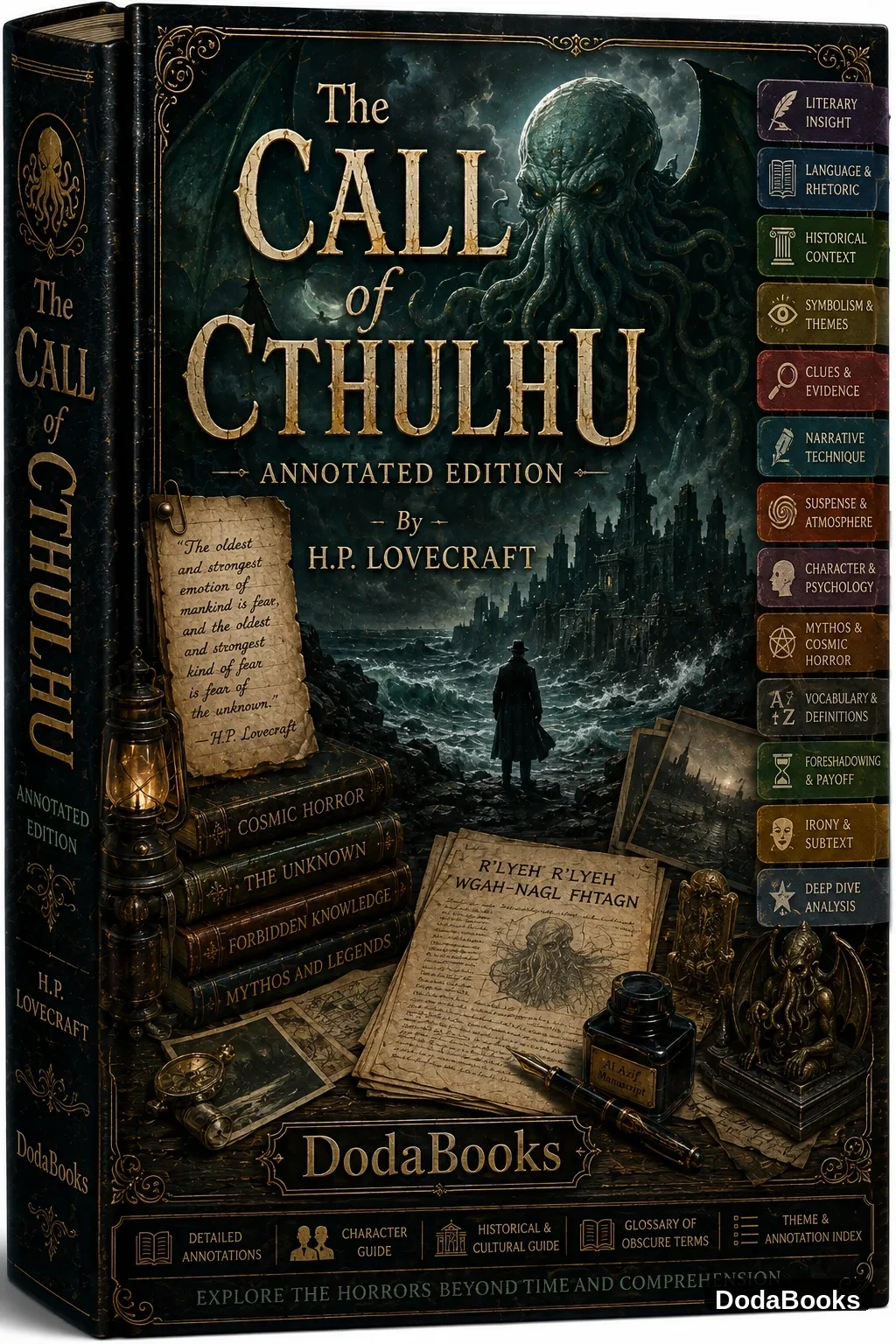
The Call of Cthulhu: Annotated Edition
Discover H. P. Lovecraft’s founding masterwork of cosmic horror in a magnificent scholarly edition. Featuring the complete unabridged 1928 text, exhaustive footnotes on early twentieth-century science, non-Euclidean geometry, the Rhode Island artistic circle, and critical essays on the Cthulhu Mythos.
- Complete, authoritative unabridged text collated from original Weird Tales printings
- Comprehensive historical and philosophical annotations on cosmicism and 1920s physics
- Exquisite custom 3D typography and digital formatting optimized for modern e-readers
- Instant EPUB download compatible with Kindle, Apple Books, and Kobo
Frequently Asked Questions
Why does Lovecraft emphasize the date of March 23, 1925?
March 23, 1925 is the central chronological fulcrum around which the entire narrative revolves. On that specific date, an undersea earthquake raised the cyclopean city of R’lyeh to the ocean surface. Simultaneously across the globe: Wilcox awakened in Providence feverishly sculpturing the bas-relief, the Louisiana bayou cult launched into frantic nocturnal rituals, and artists across Europe suffered sudden psychological delirium. The convergence of dates provides empirical forensic proof of Cthulhu’s global psychic broadcast.
What is the symbolic significance of the clay bas-relief sculpted by Wilcox?
The clay bas-relief functions as the material bridge between the cosmic dream realm and physical reality. Sculpted by Wilcox while in a somnambulic trance, the tablet contains an exact visual rendering of Cthulhu and alien hieroglyphic scripts that the young artist had never consciously seen. When Professor Angell discovers that Wilcox’s sculpture is identical to the prehistoric stone idol seized by police in the Louisiana swamps seventeen years earlier, the artifact proves that the dream visions are not random psychiatric hallucinations, but objective telepathic transmissions.
How does Lovecraft’s depiction of the cult reflect 1920s racial and social anxieties?
Modern literary criticism acknowledges that Lovecraft’s depiction of the Cthulhu cult—concentrated among mixed-race sailors, Louisiana swamp dwellers, and non-Western seamen—reflects his own documented xenophobia and racial paranoia of the 1920s. Lovecraft projected his fear of cultural change and immigration onto monstrous cultists worshipping chaotic cosmic deities. However, the narrative’s enduring power transcends these prejudices: the cultists are terrifying not because of their race, but because they have surrendered human moral agency to an ancient cosmic nihilism that threatens all of humanity equally.
Explore Related Literature Masterworks
Continue your exploration of classic world literature and gothic masterpieces with our companion analyses:
- The Call of Cthulhu Study Guide: Themes & Cosmic Horror: The foundational comprehensive study guide to H.P. Lovecraft’s weird fiction masterpiece.
- Dracula Themes & Symbolism: Analysis of Key Motifs: Explore Bram Stoker’s gothic investigation into reverse colonization, blood taboos, and technological forensics.
- Moby-Dick Themes & Symbolism: Analysis of Key Motifs: Discover Herman Melville’s epic meditation on cosmic defiance, epistemological dread, and the white whale.
- Frankenstein Themes & Symbolism: Analysis of Key Motifs: Deconstruct Mary Shelley’s Romantic investigation into scientific ambition, alienation, and monstrous doublehood.