Little Women Characters: The March Sisters Analysis
When Louisa May Alcott published Little Women in 1868–1869, she fundamentally transformed the landscape of nineteenth-century domestic fiction. Drawing upon her own impoverished childhood in Concord, Massachusetts, Alcott rejected the formulaic, pious caricatures common in Victorian Sunday school literature. Instead, she created four complex, flesh-and-blood sisters whose distinct temperaments, artistic passions, and moral conflicts established enduring archetypes of American womanhood.
At the narrative’s heart is Jo March—Alcott’s semi-autobiographical surrogate—whose fiery independence, ink-stained aprons, and professional literary ambition inspired generations of female writers. Yet the brilliance of Alcott’s character design lies in the dynamic interplay between all four sisters: the domestic elegance of Meg, the saintly transcendence of Beth, and the pragmatic artistry of Amy. Surrounding them are transformative figures: the guiding moral compass Marmee, the unanchored romantic heir Laurie, and the intellectual soulmate Professor Friedrich Bhaer.
While our companion Little Women Study Guide and Little Women Themes & Symbolism analyze plot trajectories and Transcendentalist motifs, this comprehensive study provides an academic character analysis of Alcott’s cast, examining their psychological dynamics, social contexts, and developmental arcs.
Master Character Roster & Archetypal Matrix
| Character | Archetype | Primary Vocational Drive | Central Internal Conflict |
|---|---|---|---|
| Jo March | The Creative Rebel / Professional Author | Literary creation & financial self-determination | Fierce autonomy vs. emotional loneliness; managing explosive wrath. |
| Meg March | The Domestic Traditionalist | Maternal homemaking & social grace | Longing for luxury and fashionable vanity vs. modest domestic reality. |
| Beth March | The Spiritual Hearth / Saintly Mystic | Musical devotion & family harmony | Extreme social timidity vs. physical illness and quiet acceptance of death. |
| Amy March | The Aesthetic Pragmatist | Visual fine arts & high-society refinement | Childish vanity and petulance vs. disciplined craft and social realism. |
| Marmee (Mrs. March) | The Transcendentalist Matriarch | Moral mentorship & community charity | Conquering internal anger to guide daughters with gentle patience. |
| Laurie Laurence | The Unanchored Aristocrat | Musical dilettantism & romantic pursuit | Aimless wealth and emotional volatility vs. finding honorable purpose. |
| Prof. Friedrich Bhaer | The Democratic Intellectual | Scholarly education & ethical mentorship | Poverty and foreign outsider status vs. deep philosophical integrity. |
1. Jo March: The Vanguard of Female Authorial Independence
Jo March is widely celebrated as one of the most influential heroines in world literature. Based directly on Louisa May Alcott herself, Jo embodies the struggle of the nineteenth-century woman artist fighting for vocational autonomy in a patriarchal society:
The Rejection of Decorative Femininity
From the novel’s opening dialogue—“Christmas won’t be Christmas without any presents,” grumbled Jo, lying on the rug—Jo establishes her physical and psychological refusal to conform to Victorian decorum:
- She laments being born a girl, resenting the social rules that confine women to sewing, simpering, and sitting quietly while men march to war and conquer the globe.
- Her physical mannerisms are deliberately clumsy and boyish: whistling in public, burning her dresses before the parlor grate, stretching out on carpets, and running through woods with her dog.
- When she shears her luxuriant chestnut hair to raise twenty-five dollars for Father March, she externalizes her refusal to participate in the decorative marriage market, proving that her primary allegiance is economic rescue rather than ornamental courtship.
This psychological struggle for female autonomy and dignity parallels the journey of Jane Eyre, analyzed in our companion Jane Eyre Study Guide.
2. Amy March: The Pragmatic Artist and Modern Feminist Re-evaluation
For generations, casual readers treated Amy March with hostility, viewing her as a selfish, spoiled child who burned Jo’s beloved manuscript and snatched Laurie away. However, modern feminist literary criticism has substantially re-evaluated Amy, recognizing her as the novel’s most pragmatic, self-aware, and disciplined character:
From Petulant Vanity to Disciplined Mastery
Amy begins the novel as a vain, dramatic schoolgirl obsessed with her flat nose (which she clamps with a clothes-pin at night) and social prestige:
- The Pickled Limes Crisis: In Chapter 7, Amy trades pickled limes as currency in school to gain social status, facing public humiliation when caught. This incident initiates her lifelong recognition that social vanity without substance yields only shame.
- The Discipline of European Study: In Paris and Rome, Amy dedicates herself to classical sculpture and painting with rigorous work ethic. Unlike Laurie, who lounges in melancholy indolence, Amy wakes early, sketches in galleries, and studies anatomy.
- The Courage of Self-Honesty: When Amy realizes that her artistic talent will never achieve supreme genius, she does not succumb to bitter despair. She declares with remarkable clarity: “Talent isn’t genius, and no amount of energy can make it so. I want to be great, or nothing: I won’t be a common-place dauber, so I intend to give it up.”
Amy’s Feminist Pragmatism
In Chapter 39, when Laurie mocks her for considering marriage to the wealthy Fred Vaughn, Amy delivers her famous defense of female economic reality:
“I’m not ambitious for a fortune, but a girl cannot work as you can. You have money, education, and open doors everywhere. A woman has none of that! And if she hasn’t fortune of her own, she must marry it, or be a burden to her family. I may be mercenary, but I am realistic.”
Amy recognizes that nineteenth-century women were economically disenfranchised. Rather than playing the passive victim, Amy navigates the societal rules with dignity, securing independence and wealth which she then uses to empower others.
3. Meg March: The Sanctity of Domestic Realism
As the eldest sister, Margaret “Meg” March represents the beauty and poise of traditional Victorian womanhood. Yet Alcott does not depict Meg’s domestic trajectory as easy or passive:
The Temptation of Vanity Fair
Meg remembers when the March family was wealthy before Father March lost his property assisting an unfortunate friend. Consequently, Meg feels the sting of poverty most acutely:
- She works as a daily governess for the spoiled children of the affluent King family, enduring patronizing snubs.
- At the Moffat party (“Meg Goes to Vanity Fair”), she succumbs to peer pressure, allowing wealthy socialites to dress her in a provocative silk gown, lace her waist, and treat her like an exotic toy.
- Meg’s shame after the ball leads her to realize that material luxury acquired through vanity debases the soul.
4. Beth March: The Sacred Heart and Mystical Transcendence
Elizabeth “Beth” March occupies the spiritual center of the novel. Quiet, musical, and intensely shy, Beth is the only sister who never desires to leave the domestic sanctuary:
The Music of the Hearth
Beth’s instrument is her battered old piano, from which she draws sweet, comforting hymns that soothe the household:
- While her sisters’ ambitions look outward toward the world—Meg toward society, Jo toward publishing, Amy toward European galleries—Beth’s love flows entirely inward toward her family and neighbors.
- It is Beth who faithfully visits the impoverished, destitute Hummel family when her sisters neglect their charity, contracting the scarlet fever that permanently damages her heart.
The Aesthetics of Sacred Grief
Beth’s slow decline and passing in Chapter 40 forms the emotional climax of the novel:
- The Absence of Bitterness: Beth does not rail against death. She quietly confesses to Jo that she felt from childhood that her gentle soul was not built for the rough struggles of adult earthly life.
- The Catalyst for Jo’s True Art: Beth’s death breaks Jo’s heart, but shatters her literary superficiality. In the lonely garret, Jo abandons sensational commercial thrillers and writes from the raw depths of her grief, producing a simple, heartfelt poem about Beth that captures the soul of the nation.
- The Unifying Spirit: Beth’s memory becomes an eternal moral touchstone for the surviving sisters, reminding them of the primacy of selfless love over earthly ambition.
5. Laurie vs. Professor Bhaer: The Duality of Male Partnership
The central romantic debates of Little Women revolve around the contrasting figures of Theodore “Laurie” Laurence and Professor Friedrich Bhaer:
Why Laurie Could Not Marry Jo
Laurie is dashing, affectionate, and deeply embedded in the March family circle. Yet Alcott recognized that a marriage between Jo and Laurie would have been disastrous:
- Temperamental Volatility: Both are stubborn, passionate, and impetuous. As Jo tells him during his proposal on the hill, they would fight incessantly and make each other miserable.
- The Threat to Vocation: Laurie was an heir to massive merchant wealth. Had Jo married him, society would have demanded that she abandon writing to host high-society Boston dinner parties, reducing her to an ornamental socialite.
- Laurie’s Transformation with Amy: Laurie needed a partner who would challenge him to grow up. In Europe, Amy confronts his self-pitying melancholy, inspiring him to put away his aimless piano noodling and become an active, honorable philanthropist.
Why Friedrich Bhaer is Jo’s True Equal
In Friedrich Bhaer, Alcott crafted an unconventional hero modeled on the German intellectual traditions revered by Concord Transcendentalists:
- Ethical Honesty: Bhaer does not flatter Jo. When he discovers her writing cheap sensational thrillers for the Weekly Volcano, he directly challenges her: “I would rather give my boys gunpowder to play with than these stories! They are poison to the mind.”
- Intellectual Fellowship: He shares books of German poetry, discusses philosophy, and respects Jo’s fierce intellect without feeling threatened by her ambition.
- The Democratic Partnership: At Plumfield, Jo and Bhaer establish an experimental school where they work side-by-side as educators, proving that marriage can be an egalitarian partnership founded on shared labor and mutual respect.
6. Marmee (Mrs. March): Transcendentalist Motherhood
Margaret “Marmee” March is the philosophical anchor of the household, translating the lofty Transcendentalist doctrines of Emerson and Bronson Alcott into daily domestic parenting:
The Art of Guiding Without Crushing
Unlike Victorian parents who demanded blind obedience through fear and corporal punishment, Marmee practices progressive, child-centered guidance:
- Allowing Natural Consequences: When the girls complain of their daily chores, Marmee grants them an entire week of total idleness (“An Experiment”). By Saturday, the house is in chaotic squalor, meals are burned, and the canary dies of neglect. Marmee lets the natural misery of idleness teach them that voluntary labor is the true foundation of happiness.
- The Confession of Anger: In one of the novel’s most remarkable scenes, Marmee reveals to Jo that she was not born gentle: “I am angry nearly every day of my life, Jo; but I have learned not to show it; and I still hope to learn not to feel it, though it may take me another forty years.” By confessing her own moral struggle, Marmee destroys the barrier between parent and child, becoming Jo’s trusted confidante and spiritual mentor.
Recommended Critical Edition
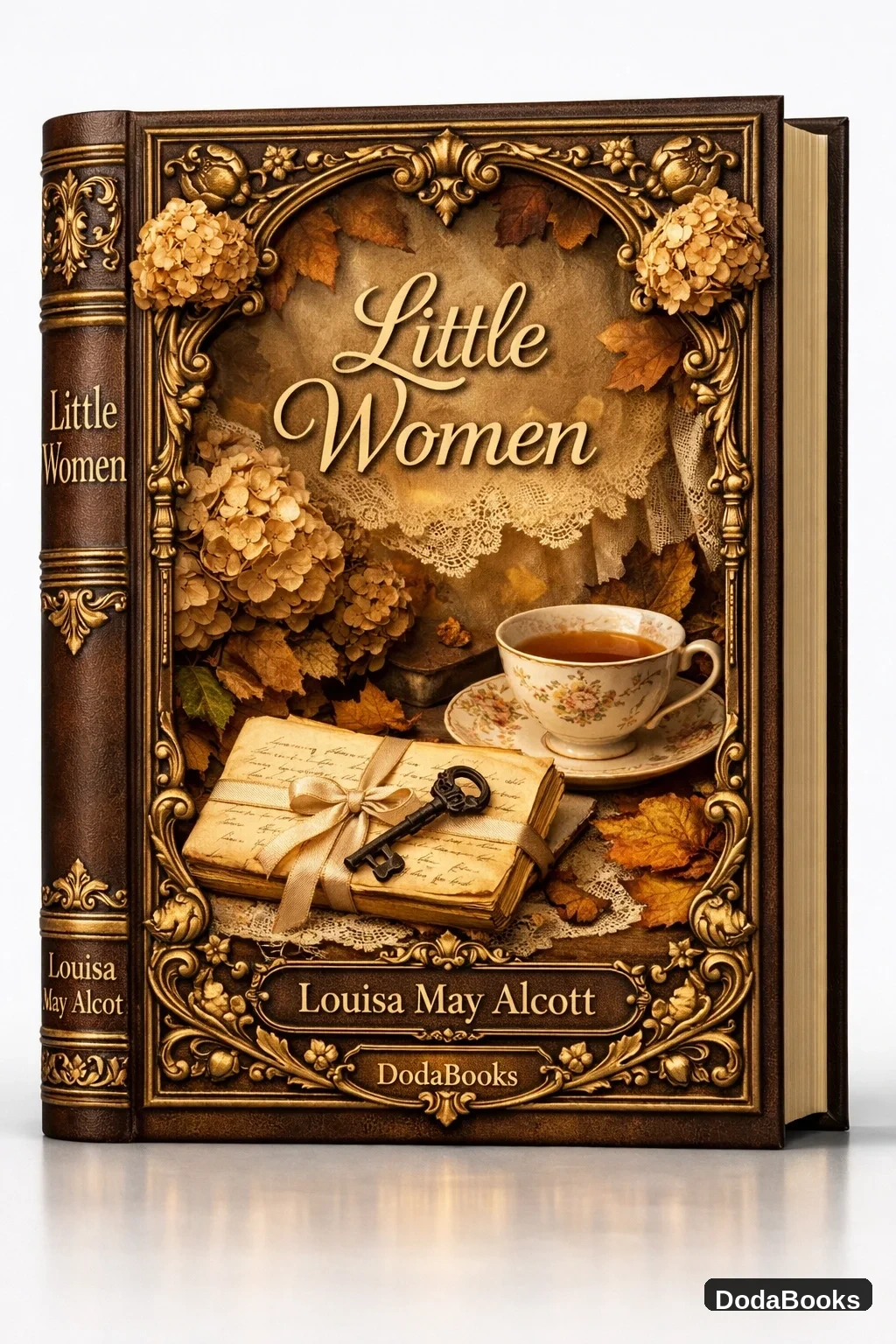
For scholars, teachers, and book lovers seeking the authoritative complete text with comprehensive character profiles, historical notes on nineteenth-century New England domestic culture, and critical essays, we recommend the unabridged edition from DodaBooks:
Little Women: Complete Unabridged Edition
Discover Louisa May Alcott’s immortal classic in a magnificent scholarly presentation. Featuring the complete unabridged 47-chapter novel text combining both original volumes, comprehensive character analyses, historical annotations on Concord Transcendentalism, and feminist literary criticism.
- Complete, authoritative unabridged text combining Little Women and Good Wives
- Comprehensive character profiles and historical notes on Civil War home front life
- Exquisite custom 3D typography and digital formatting optimized for modern e-readers
- Instant EPUB download compatible with Kindle, Apple Books, and Kobo
Frequently Asked Questions
Why did Louisa May Alcott base the March family on her own sisters?
Louisa May Alcott drew directly from her real childhood in Concord, Massachusetts to ensure authentic emotional realism. Her elder sister Anna became the beauty-loving Meg; Louisa herself became the tomboy author Jo; Elizabeth (Lizzie) became the gentle, tragic Beth, who died young at age twenty-two following scarlet fever; and May became the ambitious artist Amy. Alcott’s intimate knowledge of sisterly rivalry, shared laughter, and devastating grief gave the novel an emotional resonance unmatched in nineteenth-century American fiction.
What is the character function of Aunt March in the sisters’ lives?
Aunt March represents the rigid, wealthy, and conservative Victorian establishment. Rich, peevish, and constantly lecturing the family on their poverty and eccentric philosophy, Aunt March acts as a constant test of character for the girls. Yet beneath her scolding exterior, she possesses hidden generosity: she employs Jo, finances Amy’s artistic education in Europe, and ultimately bequeaths her sprawling Plumfield estate to Jo, enabling the founding of the progressive boys’ school.
Why does Jo March feel such profound grief over Meg’s marriage to John Brooke?
Jo initially views Meg’s marriage as a devastating betrayal of the sisterhood. To Jo, marriage represents an invasive social institution that enters happy families, tears sisters apart, and scatters them into separate lives. Jo fears that losing Meg means the end of their beloved childhood realm, crying: “I wish I could marry Meg myself, and keep her safe in the family!” Her eventual acceptance of John Brooke represents Jo’s painful recognition that growing up requires letting go of childhood exclusivity.
Explore Related Literature Masterworks
Continue your exploration of classic world literature and female character arcs with our companion analyses:
- Little Women Study Guide: Themes, Characters & Plot: The foundational comprehensive study guide to Louisa May Alcott’s classic.
- Little Women Themes & Symbolism: Motifs and Meaning: Deconstruct the Pilgrim’s Progress allegory, shorn hair, and Transcendentalist ethics.
- Jane Eyre Study Guide: Themes, Characters & Analysis: Examine Charlotte Brontë’s immortal Victorian exploration of female autonomy, moral dignity, and passionate resilience.
- Pride and Prejudice Characters: Elizabeth, Darcy & Cast: Explore Jane Austen’s psychological breakdown of Elizabeth Bennet, Fitzwilliam Darcy, and Regency society.