Hamlet Themes & Symbolism: Analysis of Key Motifs
When William Shakespeare staged The Tragedy of Hamlet, Prince of Denmark at London’s Globe Theatre around 1600–1601, he fundamentally dismantled and revolutionized the conventions of Elizabethan revenge tragedy. Inheriting the blood-soaked genre pioneered by Thomas Kyd’s The Spanish Tragedy, Shakespeare took what was typically a mechanical plot of retribution and turned it inward, creating the supreme masterpiece of western philosophical drama.
At the core of Hamlet lies an agonizing epistemological crisis. The play does not ask simply whether a murdered king should be avenged; it interrogates whether human beings can ever achieve moral certainty in a world governed by deception, state surveillance, religious ambiguity, and inevitable physical decay. Through seven towering introspective soliloquies, Shakespeare tracks the fracturing of a brilliant Renaissance intellect caught between feudal honor codes and existential skepticism.
While our Hamlet Study Guide provides comprehensive act-by-act analyses, character overviews, and historical background, this thematic guide offers an exhaustive academic breakdown of the central themes, symbolic architectures, and visual motifs that animate Shakespeare’s greatest drama.
Thematic Taxonomy & Symbolic Architecture
Shakespeare’s tragedy weaves interconnected psychological, political, and metaphysical inquiries into a unified dramatic tapestry:
| Theme / Motif | Core Textual Manifestation | Renaissance / Philosophical Context | Key Symbolic Representation |
|---|---|---|---|
| Contemplation vs. Action | Hamlet’s delay; inability to strike the praying Claudius | Renaissance Humanism vs. Medieval Feudal Code | Hamlet’s inky cloak; the drawn, unstriking sword |
| Corruption & Disease of State | “Something is rotten in the state of Denmark”; ulcer imagery | The Divine Right of Kings; body politic doctrine | The unweeded garden; hidden internal abscess |
| Surveillance & Elsinore Panopticon | Spying courtiers; eavesdropping behind tapestries | Elizabethan police state of Sir Francis Walsingham | The arras; intercepted letters; unsealed commissions |
| Theatrical Illusion & Metadrama | The Murder of Gonzago; Hamlet lecturing the Players | Baroque aesthetic; “all the world’s a stage” | The Mousetrap; actor’s simulated tears; masks |
| Mortality & Physical Leveling | Graveyard reflections on Alexander and Caesar | Renaissance memento mori; Danse Macabre tradition | Yorick’s skull; decaying corpses; worms |
| Misogyny & Fractured Sexuality | “Frailty, thy name is woman”; “Get thee to a nunnery” | Post-Reformation anxieties over female autonomy | Ophelia’s symbolic bouquet; Gertrude’s hasty bed |
1. Contemplation vs. Action: The Paralysis of Intellect
The defining philosophical problem of Hamlet is the phenomenon of tragic delay (procrastinatio). While figures in conventional revenge tragedies strike swiftly once summoned by supernatural apparitions, Prince Hamlet spends four acts examining the metaphysical, theological, and psychological implications of action:
The Seven Soliloquies as Cognitive Evolution
Hamlet’s inner journey unfolds across seven distinct soliloquies, each marking a crucial stage in his intellectual evolution:
- Act I, Scene 2 (“O, that this too too solid flesh would melt”): Grief, filial despair, disgust with maternal incest, and longing for non-existence.
- Act I, Scene 5 (“O all you host of heaven!”): Traumatic shock and vows of vengeance following the Ghost’s revelation.
- Act II, Scene 2 (“O, what a rogue and peasant slave am I!”): Self-reproach for lack of passion compared to the traveling actor; formulation of the Mousetrap test.
- Act III, Scene 1 (“To be, or not to be: that is the question”): Universal meditation on suicide, the fear of afterlife dreams, and the paralysis of moral intellect.
- Act III, Scene 2 ("‘Tis now the very witching time of night"): The psychological readiness for cruelty before entering Gertrude’s bedchamber.
- Act III, Scene 3 (“Now might I do it pat, now he is praying”): The intellectualized refusal to kill Claudius during prayer to avoid sending the king’s soul to heaven.
- Act IV, Scene 4 (“How all occasions do inform against me”): Shame upon witnessing Fortinbras’ army marching to fight for a worthless patch of ground; final vow to dedicate all thoughts to bloody action.
2. The Disease of the State: Bodily and Political Corruption
In Renaissance political theory, the monarch was not merely an administrative official; the king was the physical embodiment of the commonwealth—the “head” of the mystical “body politic.” In Hamlet, Claudius’ crime is fratricide and regicide simultaneously, an unnatural crime that infects the entire state:
Shakespeare’s Medical Imagery
Throughout the text, Shakespeare saturates the dialogue with pathological and dermatological metaphors:
- Marcellus famously diagnoses the geopolitical disorder: “Something is rotten in the state of Denmark” (I.4).
- Hamlet describes the moral corruption of Claudius’ court as an internal tumor: “It will but skin and film the ulcerous place, / Whilst rank corruption, mining all within, / Infects unseen” (III.4).
- Claudius himself describes Hamlet’s madness using infectious terminology: “Like the hectic in my blood he rages, / And thou must cure me” (IV.3).
- The Ghost describes how the poison curdled his blood, covering his body with a “vile and loathsome crust, / All my smooth body bark’d about, / Most lazar-like” (I.5).
This medical vocabulary demonstrates that evil in Hamlet is not a localized incident; it is an aggressive, metastasizing malignancy that requires a catastrophic surgical purge to restore cosmic balance.
3. Surveillance and Panopticon Politics in Elsinore
Elsinore is not a sanctuary of royal dignity; it is a claustrophobic fortress of universal espionage. Every character is either watching, being watched, or eavesdropping from behind furnishings:
- Polonius as Master of Surveillance: Polonius dispatches his servant Reynaldo to Paris with instructions to spy on his own son Laertes, suggesting that Reynaldo use “indirections” and false rumors to uncover Laertes’ vices: “Your bait of falsehood takes this carp of truth.”
- The Complicity of Friends: King Claudius recruits Hamlet’s schoolfellows, Rosencrantz and Guildenstern, to manipulate the Prince under the guise of fellowship, turning boyhood intimacy into state espionage.
- The Trap of Ophelia: Ophelia is stationed with a devotional prayer book as bait in a palace hallway while Claudius and Polonius conceal themselves behind the arras to observe Hamlet’s genuine mental state.
- Death Behind the Tapestry: Polonius meets his doom while eavesdropping behind the arras in Gertrude’s private chamber. When Hamlet thrusts his rapier through the fabric believing he is striking the King, the physical arras becomes the ultimate symbol of how hidden surveillance turns lethal.
This atmosphere of pervasive paranoia anticipates modern political surveillance, paralleling the psychological entrapment found in our Dr. Jekyll and Mr. Hyde Study Guide and The Great Gatsby Themes & Symbolism Guide.
4. Metadrama: Theatrical Truth and “The Mousetrap”
Hamlet is the most self-consciously theatrical play in the Shakespearean canon. In a world where courtiers wear deceptive smiles and outward behavior is purely performative, Shakespeare paradoxically suggests that fiction is the only tool capable of extracting truth:
[The Metadramatic Paradox of Hamlet]
                |
                +---> The World of Elsinore: Hypocritical performance ("A man may smile and smile and be a villain").
                |
                +---> The Player's Performance: Genuine passion for an imaginary grief (Hecuba).
                |
                v
[The Mousetrap (The Murder of Gonzago)]
        • Simulates the secret fratricide through theatrical artifice.
        • Claudius sees his private guilt staged publicly.
        • "Give me some light. Away!" — Guilt erupts into panic.
        |
        v
[The Triumph of Art: Fiction reveals the reality that reality attempted to conceal]
When Hamlet observes the First Player weeping over the mythic suffering of Hecuba, he experiences profound existential shame:
“What’s Hecuba to him, or he to Hecuba, / That he should weep for her? What would he do, / Had he the motive and the cue for passion / That I have?”
To breach Claudius’ emotional armor, Hamlet stages The Murder of Gonzago with inserted lines reflecting his father’s murder:
“The play’s the thing / Wherein I’ll catch the conscience of the King.”
The theatrical ploy succeeds brilliantly: when the stage poisoner Lucianus pours the drug into the sleeping Duke’s ear, Claudius rises in terror, shouts for light, and flees the hall. In this moment, theater ceases to be mere entertainment; it becomes a forensic psychological weapon capable of breaking the human will.
5. Symbolic Analysis: Objects, Plants & Manifestations
Shakespeare anchors the play’s abstract metaphysical inquiries in visceral physical objects that carry profound allegorical weight:
Yorick’s Skull: The Cosmic Leveler
The graveyard scene in Act V, Scene 1 represents the dramatic and philosophical pivot of the tragedy. Confronting the rotting skull of the court jester Yorick, Hamlet shifts from abstract philosophical terror to calm physical acceptance:
- Yorick was the companion of Hamlet’s childhood who “hath borne me on his back a thousand times.”
- Hamlet gazes into the empty eye sockets and smells the stench of the earth: “My gorge rises at it.”
- He traces the biological cycle of all mortal flesh: the great conqueror Alexander dies, decomposes into earth, becomes loam, and is ultimately used to stop the bunghole of a beer barrel. This realization frees Hamlet from his existential paralysis; death is not a metaphysical abyss to be feared, but a natural, inescapable home.
Ophelia’s Symbolic Bouquet
During her descent into madness in Act IV, Scene 5, Ophelia distributes flowers to the court. Each flower functions as an emblem of psychological truth that courtiers were forbidden to speak openly:
- Rosemary: For remembrance (addressed to Laertes or the absent Hamlet).
- Pansies: For thoughts (from the French pensées).
- Fennel and Columbines: For flattery, deceit, and marital infidelity (handed to King Claudius).
- Rue: The bitter herb of grace and repentance (shared between Ophelia and Queen Gertrude: “you must wear your rue with a difference”).
- Daisies: For dissembling, deceit, and false love.
- Violets: For faithfulness—which Ophelia notes “withered all when my father died.”
Through her floral madness, Ophelia delivers the most savage political critique of Elsinore heard in the entire play, weaponizing nature against courtly duplicity before her tragic drowning beneath the weeping willow.
Comparative Matrix: Revenge Tragedy Across Dramatic Canons
Compare Shakespeare’s treatment of the revenge motif with other landmark literary works:
| Masterwork & Author | The Avenger | Nature of Delay / Crisis | Resolution & Cost |
|---|---|---|---|
| Hamlet William Shakespeare (1601) | Prince Hamlet | Epistemological skepticism, moral reflection, fear of damnation | Royal court wiped out; Danish crown ceded to Norwegian Fortinbras |
| The Count of Monte Cristo Alexandre Dumas (1844) | Edmond Dantès | Elaborate 14-year preparation; mathematical social destruction | Spares Danglars after innocent child dies; embraces “Wait and hope” |
| Moby-Dick Herman Melville (1851) | Captain Ahab | Monomaniacal cosmic hatred; total rejection of moral doubt | Total annihilation of ship and crew; only Ishmael survives to tell |
| The Spanish Tragedy Thomas Kyd (1587) | Hieronimo | Madness, bureaucratic obstruction, grief over murdered son | Bloody play-within-a-play massacre; biter cuts out his own tongue |
Recommended Critical Edition
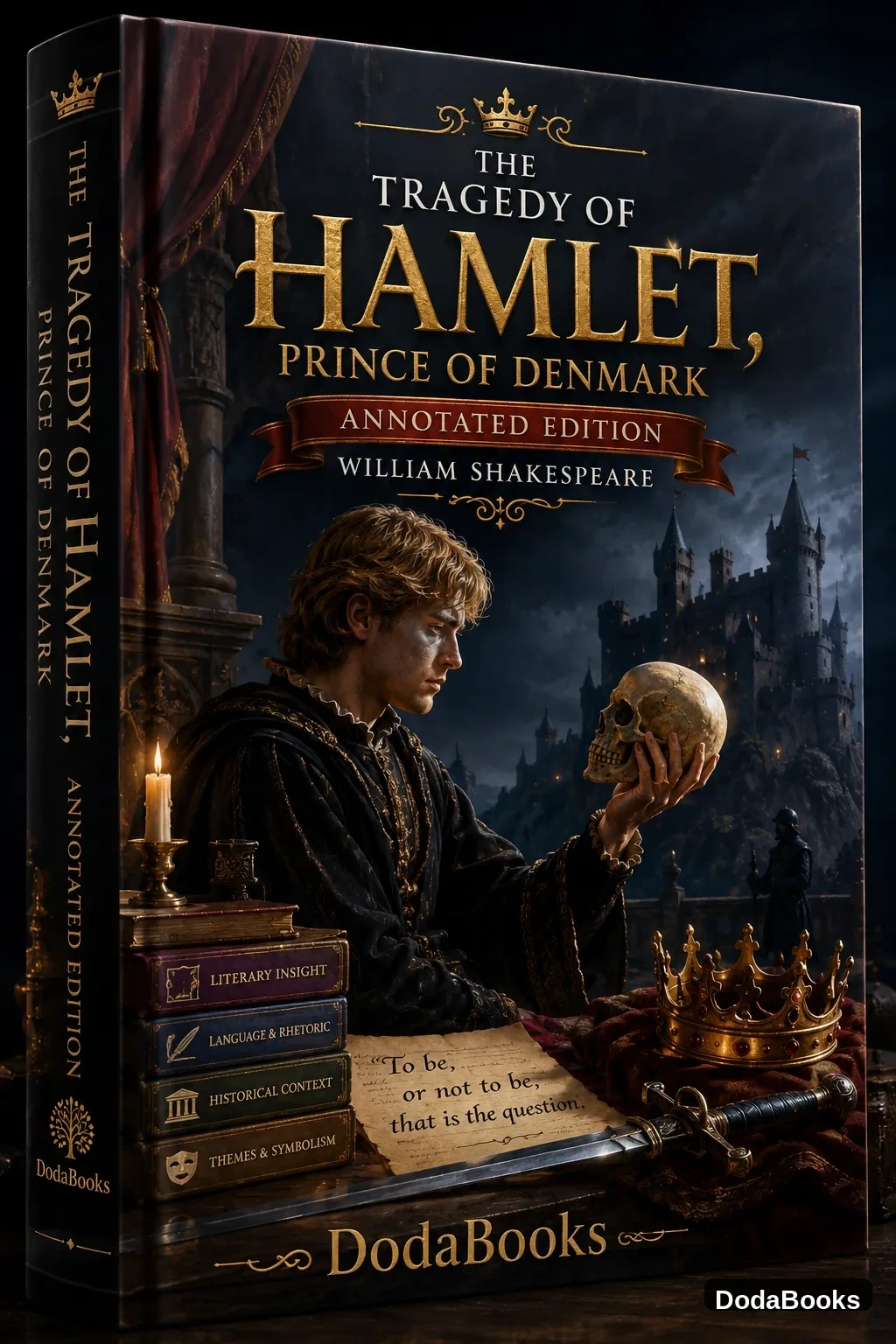
For theatre scholars, drama students, and actors seeking the definitive fully annotated text with First Folio and Second Quarto textual variations, theatrical staging histories, and historical notes on Renaissance demonology, we recommend the unabridged edition from DodaBooks:
Frequently Asked Questions
Why does Hamlet hesitate to kill Claudius when he finds him praying in Act III, Scene 3?
Hamlet refuses to kill Claudius during prayer because he fears that killing the king while he is in direct communion with God would send Claudius’ soul straight to heaven: “A villain kills my father, and for that, / I his sole son do this same villain send / To heaven. / O, this is hire and salary, not revenge.” Because Claudius murdered King Hamlet without giving him the opportunity to confess his sins—leaving the old king trapped in purgatorial fires—Hamlet desires a total revenge that destroys both Claudius’ mortal body and his immortal soul, seeking to strike him when he is drunk, enraged, or in incestuous pleasure.
Is Hamlet’s “antic disposition” (madness) genuine or feigned?
Hamlet explicitly announces to Horatio and the guards in Act I, Scene 5 that he intends to “put an antic disposition on” as a deliberate tactical deception. Feigning madness allows Hamlet to wander the palace freely, observe courtiers without exciting suspicion, speak subversive truths under the guise of nonsense, and mask his investigation into the King. However, Shakespeare portrays this performance as placing immense psychological strain upon Hamlet’s genuine mental stability; his intense grief, moral isolation, and visceral disgust with human nature frequently push his feigned madness to the brink of genuine manic-depressive breakdown.
What is the theological significance of King Hamlet’s Ghost?
The Ghost embodies the profound religious crisis of post-Reformation England. In Protestant doctrine (which Prince Hamlet studied at Wittenberg), Purgatory was dismissed as a Catholic fiction; supernatural apparitions were interpreted as either angels or demonic spirits disguised to lure mortals into sin. However, the Ghost describes purgatorial torments—being confined to fast in fires by day until the foul crimes of his days are burnt away. This doctrinal contradiction creates Hamlet’s deep hesitation: he cannot know with certainty whether the Ghost is his authentic father seeking justice or an emissary of Satan exploiting his melancholy to destroy his soul.
Related Masterwork Guides & Academic Analyses
Deepen your exploration of Shakespearean drama, tragic conflict, and Renaissance thought with our companion guides:
- Hamlet Study Guide: Tragedy, Characters & Themes: The foundational comprehensive study guide to Shakespeare’s masterpiece.
- Romeo and Juliet Themes & Symbolism: Key Motifs: Analyze the collision of tragic passion, generational feuding, and fate in Verona.
- Romeo and Juliet Characters: Analysis of Key Figures: Examine the archetypes, soliloquies, and character arcs of Shakespeare’s great early tragedy.
- The Brothers Karamazov Characters: The Karamazov Soul: Explore Dostoevsky’s philosophical drama of patricide, guilt, and moral rebellion.
- Dr. Jekyll and Mr. Hyde Themes: Victorian Dualism: Deconstruct the divided self, social hypocrisy, and psychological fragmentation.