Romeo and Juliet Themes & Symbolism: Key Motifs
Written in the mid-1590s, William Shakespeare’s The Tragedy of Romeo and Juliet is renowned worldwide as the supreme poetic expression of young romantic love. Yet beneath its lyric radiance lies a dark, relentless philosophical interrogation of violence, generational tyranny, cosmic fatalism, and the tragic limits of language. Shakespeare does not present the lovers in a romantic vacuum; their brief, incandescent passion is trapped within the claustrophobic, blood-soaked arena of Renaissance Verona—a city where ancient family vendettas poison civil order and where patriarchal authority commodifies children as dynastic property.
By subverting conventional Elizabethan imagery—inverting light and darkness, transforming wedding feasts into funeral dirges, and contrasting empty courtly Petrarchan rhetoric with genuine spiritual communion—Shakespeare creates a tragedy of breathless velocity and devastating emotional power.
While our companion Romeo and Juliet Study Guide provides the structural summary, character breakdowns, and historical theatrical context, this comprehensive critical analysis explores the play’s rich thematic tapestry, core symbolic motifs, and poetic architecture.
Thematic Architecture Overview
| Core Dimension | Critical Interpretation | Manifested Symbol or Motif |
|---|---|---|
| Inverted Optics | Night as sacred sanctuary for true love vs. day as violent public arena of street brawls. | Torches in darkness; the balcony scene; lark vs. nightingale; the dawn parting. |
| Cosmic Fate vs. Agency | Star-cross’d destinies colliding with reckless human impetuosity and family vendettas. | The celestial stars; the Chorus prologue; dreams of doom; the quarantined letter. |
| The Pharmacology of Hate | Botanical and chemical poison as a literal reality and metaphor for civic blood vendettas. | Friar Laurence’s herbal basket; the Mantuan apothecary’s gold; the tomb vial. |
| Linguistic Revolution | Moving from artificial Petrarchan posturing to mutual spiritual communion. | Rosaline’s hollow oxymorons vs. the shared 14-line sonnet at the Capulet ball. |
| Sterile Memorialization | The tragic commodification of sacrificed youth into cold metallic monuments. | The golden statues raised by Montague and Capulet; the Prince’s closing judgment. |
1. Inverted Light and Dark Symbolism: The Sanctuary of Night
In the Western literary tradition, light is almost universally equated with divine truth, reason, spiritual enlightenment, and safety, while darkness represents chaos, ignorance, sin, and physical peril. In Romeo and Juliet, Shakespeare performs a radical, continuous inversion of light and dark:
Daylight as the Arena of Violence and Surveillance
In Renaissance Verona, daylight brings danger, exposure, and death:
- The play’s bloody street brawls occur exclusively under the blistering heat of the daytime sun. In Act III, Scene 1, Benvolio warns Mercutio: “I pray thee, good Mercutio, let’s retire: / The day is hot, the Capulets abroad, / And if we meet we shall not scape a brawl; / For now, these hot days, is the mad blood stirring.”
- Daylight is the realm of patriarchal surveillance: Lord Capulet arranging business matches, Tybalt hunting for Montagues, and the Prince executing royal justice. Under the sun, individuals are defined strictly by tribal affiliation and factional duty.
Night as the Cloaking Temple of Love
In contrast, nighttime provides the sole sanctuary where Romeo and Juliet can transcend tribal hatred and unite as autonomous human souls:
This inversion culminates inside the Capulet charnel house in Act V, Scene 3. The tomb—the darkest, most terrifying place in Verona—is transformed by Juliet’s presence into a glowing lantern room: “For here lies Juliet, and her beauty makes / This vault a feasting presence full of light.”
2. “Star-Cross’d Lovers”: Fate, Free Will, and Temporal Velocity
The tragedy forces audiences to confront the eternal philosophical debate between cosmic predestination and human responsibility:
The Mechanism of Fate
From the opening sonnet, the Chorus announces that Romeo and Juliet are “star-cross’d lovers” whose path is dictated by astrological doom:
- Ominous Forebodings: Before entering the Capulet feast, Romeo experiences a chill of prophetic dread: “My mind misgives / Some consequence yet hanging in the stars / Shall bitterly begin his fearful date / With this night’s revels.”
- Defying the Cosmos: Upon hearing false news of Juliet’s death in Mantua, Romeo defies the heavens: “Is it even so? Then I defy you, stars!” Yet in defying the stars through suicide, he ironically fulfills the very doom prophesied for him.
- The Play of Incalculable Chance: Cosmic fate operates through improbable accidents: the servant who cannot read and inadvertently asks Romeo to read the guest list; the outbreak of bubonic plague that quarantines Friar John in a house, preventing the delivery of the letter; and Romeo drinking the poison mere seconds before Juliet awakens from her potion.
The Culpability of Human Impetuosity
However, Shakespeare makes clear that fate is abetted by reckless human choices:
This dynamic mirrors the philosophical tension between cosmic determinism and moral responsibility explored in our Hamlet Study Guide.
3. Poison as Reality and Metaphor: The Pharmacology of Hate
The motif of poison runs through Romeo and Juliet like a toxic current, bridging botany, medical science, social pathology, and moral corruption:
Friar Laurence’s Soliloquy: The Dual Nature of Creation
In Act II, Scene 3, Shakespeare introduces Friar Laurence holding an osier wicker basket filled with medicinal herbs and poisonous weeds. His opening speech is the moral philosophical core of the play:
“Within the infant rind of this small flower
Poison hath residence and medicine power:
For this, being smelt, with that part cheers each part;
Being tasted, slays all senses with the heart.
Two such opposed kings encamp them still
In man as well as herbs, grace and rude will.”
Friar Laurence outlines a fundamental Renaissance truth: nothing in nature is so good that it cannot be perverted into evil, and nothing is so evil that it cannot yield good when properly applied:
- Love as Medicine: Love has the potential to heal Verona’s ancient feud, uniting Montague and Capulet in peace.
- Love as Poison: When combined with reckless haste and unchecked passion, love curdles into a violent, suicidal obsession that slaughters six human beings (Mercutio, Tybalt, Lady Montague, Paris, Romeo, and Juliet).
The Mantuan Apothecary and the Corruption of Gold
In Act V, Scene 1, Romeo visits an impoverished apothecary in Mantua to purchase fast-acting poison. Shakespeare highlights the apothecary’s extreme destitution to critique the economic poison of the early modern world:
- The apothecary is starving, his shop filled with dusty alligators, empty bladders, and old cakes of roses. He sells the illegal chemical only because poverty compels him: “My poverty, but not my will, consents.”
- Romeo hands him gold, asserting that money is far more deadly than arsenic: “There is thy gold, worse poison to men’s souls, / Doing more murder in this loathsome world, / Than these poor compounds that thou forbid’st us sell.” Gold poisons social relationships, motivates the elder generation’s dynastic marriages, and drives men to murder.
4. The Linguistic Revolution: From Petrarchan Cliché to the Shared Sonnet
Shakespeare uses poetic form to mirror Romeo’s psychological awakening and transition from juvenile posturing to authentic tragic dignity:
The Artificiality of Rosaline
At the beginning of the play, Romeo is infatuated with Rosaline, a woman who never appears on stage. Romeo’s language is stiff, theatrical, and borrowed directly from sixteenth-century Italian courtly love manuals:
- He speaks in tired, mechanical oxymorons: “O brawling love, O loving hate… Feather of lead, bright smoke, cold fire, sick health!”
- Romeo does not love a real human being; he loves the performance of being an unrequited, melancholic lover. He locks himself in his darkened chamber, draws the curtains, and weeps for theatrical effect.
The Shared Sonnet at the Capulet Ball
When Romeo beholds Juliet in Act I, Scene 5, his artificial language collapses. Their first conversation forms a pristine, collaborative fourteen-line Shakespearean sonnet:
Quatrain 1 (Romeo):
“If I profane with my unworthiest hand
This holy shrine, the gentle fine is this:
My lips, two blushing pilgrims, ready stand
To smooth that rough touch with a tender kiss.”
Quatrain 2 (Juliet):
“Good pilgrim, you do wrong your hand too much,
Which mannerly devotion shows in this;
For saints have hands that pilgrims’ hands do touch,
And palm to palm is holy palmers’ kiss.”
Quatrain 3 (The Intertwined Dialogue):
Romeo: “Have not saints lips, and holy palmers too?”
Juliet: “Ay, pilgrim, lips that they must use in prayer.”
Romeo: “O, then, dear saint, let lips do what hands do;
They pray, grant thou, lest faith turn to despair.”
The Rhyming Couplet (The Culmination):
Juliet: “Saints do not move, though grant for prayers’ sake.”
Romeo: “Then move not, while my prayer’s effect I take.” (He kisses her)
This structural interweaving is revolutionary:
- Linguistic Reciprocity: Unlike Petrarchan sonnets—where an active male poet objectifies a silent, unattainable female statue—Romeo and Juliet speak to each other as intellectual equals. Juliet matches Romeo’s theological metaphors line for line.
- Sacred Eroticism: They frame physical attraction in the vocabulary of holy pilgrimage, elevating physical passion into spiritual transcendence.
- The Kiss as Punctuation: The sonnet culminates in a rhyming couplet and a physical kiss, sealing their linguistic union with physical reality.
5. The Golden Statues: The Tragic Commodification of Youth
The play concludes in Act V, Scene 3 with the arrival of the Prince, the Watch, and the warring patriarchs at the Capulet monument. Beholding their dead children lying entwined in sacrificial blood, Lord Montague and Lord Capulet finally end their vendetta:
The tragic irony of the golden statues is devastating. Throughout the play, the Capulets and Montagues measured worth through dynastic wealth, social prestige, and martial power. Even in their final act of reconciliation, they can only express honor through bullion: raising golden statues to replace the living, breathing children they sacrificed. The statues will endure, cold and lifeless, reminding Verona of the beauty it was too blind to cherish.
Recommended Critical Edition
For theater lovers, university students, and Shakespearean actors seeking the authoritative collated Quarto and First Folio text with comprehensive annotations on Elizabethan poetic rhetoric, Italianate dueling culture, and staging history, we recommend the definitive edition from DodaBooks:
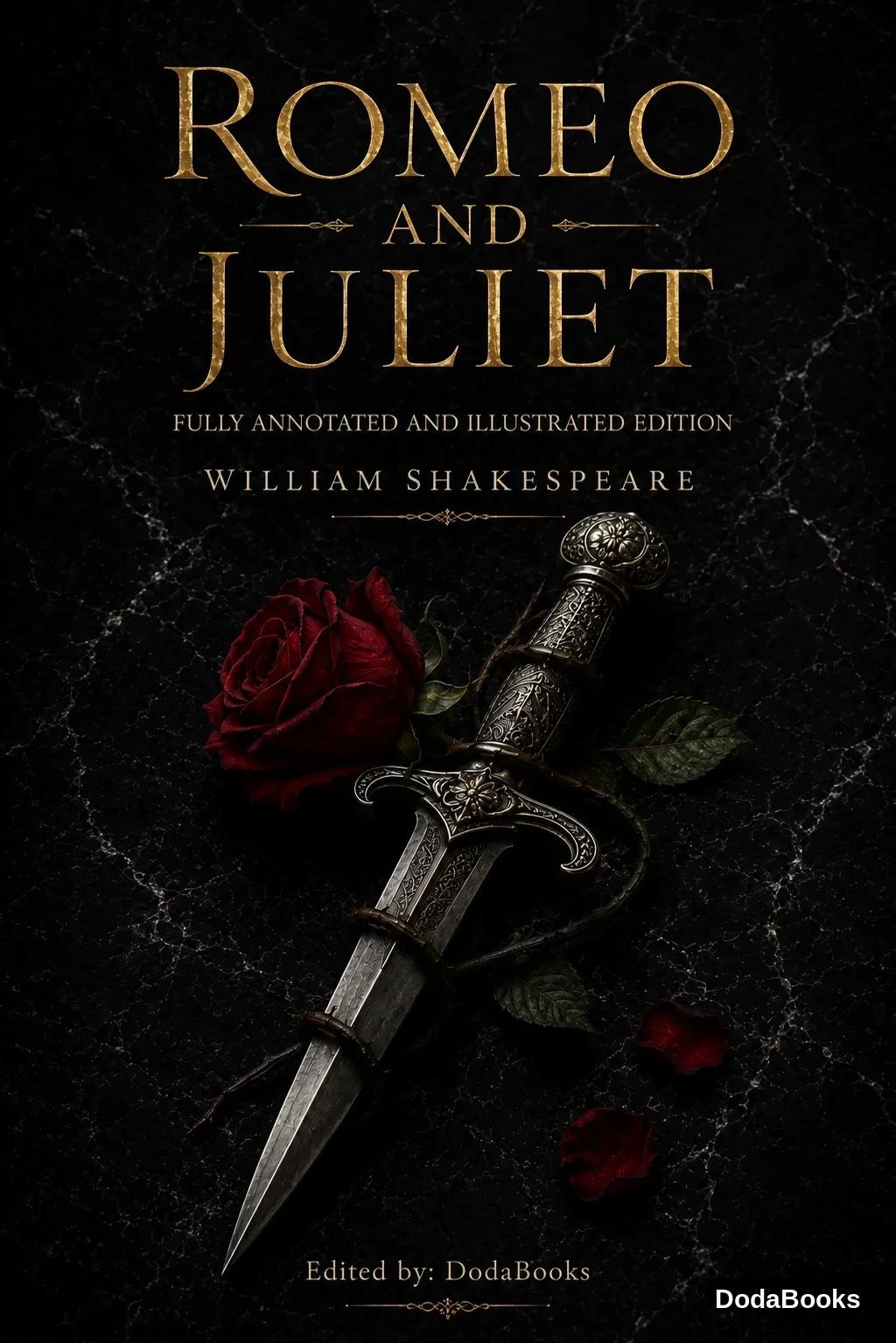
Romeo and Juliet: Fully Annotated Edition
Experience William Shakespeare’s immortal tragedy in a magnificent scholarly edition. Featuring the complete unabridged 5-act text collating the First and Second Quartos, extensive line-by-line annotations explaining archaic terms and Elizabethan wordplay, and essays on Renaissance poetic forms.
- Complete, authoritative unabridged 5-act dramatic text
- Comprehensive footnotes on Renaissance dueling manuals, herbal medicine, and sonnet structures
- Exquisite custom 3D typography and digital formatting optimized for modern e-readers
- Instant EPUB download compatible with Kindle, Apple Books, and Kobo
Frequently Asked Questions
Why does Shakespeare include the Queen Mab speech by Mercutio?
Mercutio’s Queen Mab speech in Act I, Scene 4 functions as a sharp, cynical antidote to romantic sentimentalism. While Romeo believes dreams are prophetic divine omens, Mercutio argues that dreams are merely the trivial, base illusions delivered by an insect-sized fairy riding across human bodies. The monologue exposes how human desires—courtly vanity, lawyer fees, soldiers’ slaughter, and lovers’ lust—are selfish and illusory, establishing Mercutio as the comic, subversive foil to Romeo’s emotional idealism.
What is the dramatic function of the Nurse in the play’s thematic architecture?
The Nurse embodies vulgar, practical domestic survival. While Juliet views love as a sacred, transcendent spiritual covenant, the Nurse views love strictly in terms of physical pleasure, social convenience, and economic security. When Romeo is banished and Capulet demands that Juliet marry Paris, the Nurse casually advises Juliet to commit bigamy and marry Paris because he is wealthy and handsome. This moral betrayal isolates Juliet, forcing her to abandon her childhood confidante and face mortal terror in the tomb as an independent, courageous adult.
How does the theme of time accelerate the catastrophe in Romeo and Juliet?
Shakespeare radically compresses the timeline of the play into four and a half breathless days (Sunday morning to Thursday night). Every action occurs with frantic haste: falling in love, marrying the next afternoon, fighting and killing an hour later, banishment at dawn, forced betrothal on Tuesday, potion on Wednesday night, and death on Thursday. Characters repeatedly describe events as lightning flashes—brilliant, incandescent, but immediately swallowed by darkness. This temporal acceleration leaves no room for cooling passions or rational deliberation, driving the youth into fatal precipitance.
Explore Related Literature Masterworks
Continue your exploration of classic world literature and Shakespearean drama with our companion analyses:
- Romeo and Juliet Study Guide: Themes & Tragedy: The foundational comprehensive study guide to Shakespeare’s early lyric masterpiece.
- Hamlet Study Guide: Tragedy, Characters & Themes: Deconstruct Shakespeare’s supreme tragedy of revenge ethics, philosophical skepticism, and mortality.
- The Picture of Dorian Gray Themes & Symbolism: Explore Oscar Wilde’s gothic examination of aestheticism, moral vanity, and the painted double.
- Pride and Prejudice Themes & Symbolism: Key Motifs: Discover Jane Austen’s witty dissection of Regency matrimonial economics, class pride, and self-knowledge.