Tom Sawyer Study Guide: Themes, Characters & Plot
Published in 1876, Samuel Langhorne Clemens’s The Adventures of Tom Sawyer (written under the celebrated pen name Mark Twain) stands as the quintessential masterwork of American boyhood, frontier nostalgia, and subversive social satire. Set in the fictionalized antebellum Mississippi River village of St. Petersburg, Missouri (closely modeled on Twain’s childhood home of Hannibal), the novel captures the exuberance, folklore, and psychological resourcefulness of youth while offering an incisive critique of small-town Victorian hypocrisy.
While Victorian children’s literature of the nineteenth century was dominated by moralizing tracts designed to lecture youth on pious obedience and solemn decorum, Twain fundamentally revolutionized the genre. Tom Sawyer is neither an angelic Victorian paragon nor a degenerate scoundrel; he is imaginative, self-dramatizing, superstitious, and fiercely resistant to the stifling constraints of respectable civilization.
While our companion analyses across Alice in Wonderland Study Guide and Jane Eyre Study Guide examine European childhood, Victorian educational absurdity, and class hierarchy, this comprehensive guide deconstructs Mark Twain’s frontier realism, narrative psychology, character foils, and enduring moral themes.
Fast Facts: Masterwork Overview
| Category | Detail |
|---|---|
| Author | Mark Twain (Samuel Langhorne Clemens, 1835–1910) |
| Publication Date | 1876 (First UK edition June 1876; First US edition December 1876) |
| Literary Genre | American Realism / Picaresque Novel / Bildungsroman / Satire |
| Setting | St. Petersburg, Missouri (along the Mississippi River), 1840s antebellum era |
| Narrative Form | Third-person omniscient narration with an ironic, affectionate adult retrospective voice |
| Central Conflict | Tom’s imaginative boyhood independence vs. town civilization, culminating in the terror of Injun Joe |
| Climax | Tom and Becky Thatcher trapped in the subterranean labyrinths of McDougal’s Cave |
| Key Motifs | Whitewashed fence, graveyard blood oaths, Jackson’s Island piracy, dead cats, cavern darkness |
1. Historical & Regional Context: The Antebellum Frontier
To appreciate The Adventures of Tom Sawyer, readers must situate the narrative within the cultural landscape of the 1840s American western borderland:
The Mississippi River as Frontier Highway and Boundary
In the decades preceding the American Civil War, the Mississippi River was not merely a geographic landmark; it was the dynamic economic spine and cultural artery of the United States. Steamboats connected remote agrarian hamlets to cosmopolitan trade hubs like St. Louis and New Orleans. Yet adjacent to this river trade lay the untamed wilderness: dense oak forests, limestone cavern systems, and uncharted sandbar islands.
For Twain, the river represents infinite possibility and primal freedom. When Tom Sawyer, Joe Harper, and Huckleberry Finn escape civilization to play pirates on Jackson’s Island, the river serves as a natural sanctuary isolating them from schoolmasters, Sunday school superintendents, and the domestic discipline of Aunt Polly.
The Contrast Between Respectable Town and the Outcast Margin
St. Petersburg is a deeply stratified frontier community where social respectability is measured by church attendance, starched collars, and property ownership:
- The Respectable Center: Guarded by matriarchs like Aunt Polly, schoolmaster Mr. Dobbins, Judge Thatcher, and the village clergy. Their existence is governed by formal rules, moral platitudes, and physical punishment (such as Mr. Dobbins’s brutal hickory switches).
- The Outcast Fringe: Populated by figures who operate outside social norms: Huckleberry Finn, the son of the town drunkard, who sleeps in empty hogshead barrels and wears discarded adult rags, and Injun Joe, a half-Native American outcast whose exclusion from white town society fuels violent vengeance.
Twain uses Tom Sawyer as the fluid mediator between these two worlds. Unlike Huck, Tom has a home, attends school, and craves community recognition; yet unlike his pious, tattle-tale half-brother Sid, Tom hungers for the wild freedom represented by Huck’s lawless existence.
2. Character Breakdown & Psychological Dynamics
Twain constructs a vibrant ensemble of frontier personalities whose interactions reveal the tensions between boyhood romance and adult reality:
3. Major Thematic Pillars
Boyhood Freedom vs. The Stifling Constraints of Civilization
The central struggle of the novel pits the untamed imagination of youth against the regimented machinery of adult civilization. To the boys of St. Petersburg, civilization is synonymous with confinement: shoes that pinch the feet, clean shirts that restrict movement, church pews that induce physical torment, and grammar books devoid of vitality.
When Tom escapes to Jackson’s Island with Huck and Joe, their communion with nature restores their spirits:
- Swimming in the warm morning river currents
- Cooking freshly caught channel catfish over campfire embers
- Sleeping beneath the canopy of stars without a roof or bedtime
Yet Twain reveals that complete isolation is impossible. The boys feel the magnetic tug of homesickness and community belonging. When they stage their dramatic return during their own funeral sermon—hiding in the gallery while the village mourns their supposed drowning—Tom achieves the ultimate boyish triumph: tasting the glory of public grief while remaining alive to relish the adulation.
The Evolution of Moral Conscience
One of Twain’s most brilliant achievements is charting Tom’s moral maturation without turning him into a boring adult. At the novel’s outset, Tom’s morality is governed by basic avoidance of Aunt Polly’s switch. When he and Huck witness the graveyard murder of Dr. Robinson, their initial response is pure animal self-preservation: they sign a solemn blood oath on a pine shingle promising eternal silence, terrified that Injun Joe will murder them if they speak.
However, as the trial of the wrongly accused Muff Potter nears, Tom experiences acute agony of conscience:
- He secretly sneaks tobacco and comfort to Muff Potter through the jailhouse window bars.
- He realizes that passive silence makes him complicit in an innocent man’s execution.
- In a climax of immense moral courage, Tom steps forward in court, breaks his oath, and testifies, exposing Injun Joe and vindicating Potter.
Tom’s moral growth mirrors the ethical awakenings explored across world literature, such as Raskolnikov’s spiritual reckoning in our Crime and Punishment Themes & Symbolism guide.
4. Key Plot Arcs & Narrative Architecture
Twain weaves four distinct narrative threads into a cohesive picaresque structure:
5. Folklore, Superstition, and Southern Frontier Realism
A profound dimension of Tom Sawyer is its meticulous preservation of nineteenth-century frontier folklore and supernatural rituals. For the youth of St. Petersburg, the universe is governed not by Newtonian physics or Christian theology, but by intricate folk magic:
- Wart Cures: Debating whether spunk-water (rainwater collected in a rotting tree stump) or a dead cat taken to a graveyard at midnight is the superior remedy for warts.
- Stray Marbles: Believing that burying a marble with incantations will summon all previously lost marbles to the same spot within a fortnight.
- Doodlebugs: Whispering incantations to burrowing antlion larvae to divine hidden secrets.
- Omens of Death: Interpreting the howling of a stray dog or the ticking of a death-watch beetle in the wallboard as infallible omens of mortal doom.
Twain does not mock these superstitions from an attitude of condescending superiority; rather, he documents how folk rituals provided frontier children with an imaginative framework for interpreting fear, illness, and the mysterious natural world.
6. The Terror of McDougal’s Cave: Ordeal and Rebirth
The climax of the novel in McDougal’s Cave represents the classical mythological descent into the underworld (katabasis):
When Tom and Becky wander away from the picnic party into the vast, unmapped limestone labyrinth, playful adventure transforms into life-or-death survival:
- Psychological Leadership: Facing total darkness, dwindling candle stubs, and bats, Tom discards his boyish theatrics. He comforts the terrified Becky, shares his last crust of wedding cake, and takes complete responsibility for their preservation.
- The Cord of Salvation: Using a kite string as an improvised Ariadne’s thread, Tom probes dangerous chasms and blind galleries while keeping anchored to Becky.
- The Glimpse of the Nemesis: In the pitch-black depths, Tom encounters Injun Joe. The proximity of genuine death strips away all romantic illusions.
- Resurrection: Spotting a pinpoint of daylight above the Mississippi River five miles downstream, Tom guides Becky out of the cave. When they return to the village at midnight, church bells ring, and the community celebrates their miraculous return.
When Judge Thatcher permanently seals the iron door of McDougal’s Cave, Injun Joe is inadvertently trapped inside and starves to death, scratching at the rock with his pocketknife. Twain captures the tragic poetry of the outcast’s demise with somber realism, closing the dark chapter of frontier violence.
Recommended Critical Edition
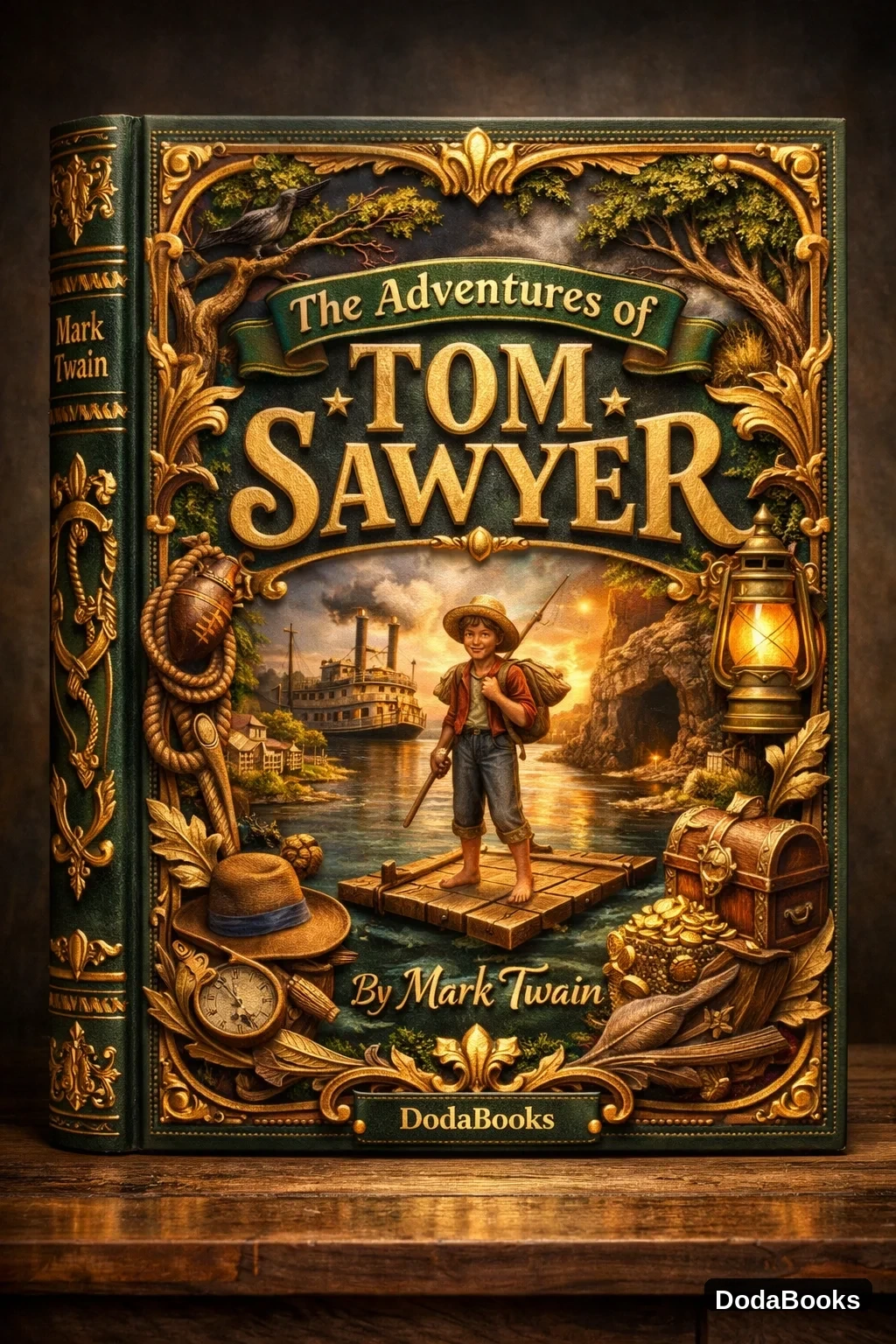
For literature students, teachers, and book collectors seeking the definitive text with authoritative historical commentary, nineteenth-century dialect glossaries, and original illustrations, we recommend the unabridged edition from DodaBooks:
The Adventures of Tom Sawyer
Experience Mark Twain’s immortal classic in a magnificent scholarly presentation. Featuring the complete, unabridged 1876 text, historical commentary on Mississippi steamboat culture, regional dialect notes, and essays on nineteenth-century folklore.
- Complete, authoritative unabridged 35-chapter novel text
- Comprehensive historical annotations on Missouri frontier culture and folklore
- Exquisite custom 3D typography and digital formatting optimized for modern e-readers
- Instant EPUB download compatible with Kindle, Apple Books, and Kobo
Frequently Asked Questions
Why did Mark Twain write Tom Sawyer as an adult novel rather than a children’s book?
In his preface, Mark Twain explicitly stated: “Although my book is intended mainly for the entertainment of boys and girls, I hope it will not be shunned by men and women on that account, for part of my plan has been to pleasantly remind adults of what they once were themselves, and of how they felt and thought and talked, and what queer enterprises they sometimes engaged in.” The novel operates on two distinct aesthetic levels: as an exciting picaresque adventure for young readers, and as a sophisticated, ironic critique of antebellum social mores, religious hypocrisy, and human nature for adults.
How does Tom Sawyer contrast with its sequel, The Adventures of Huckleberry Finn?
While The Adventures of Tom Sawyer is an affectionate, comic celebration of boyhood nestled safely within community structures, The Adventures of Huckleberry Finn (1884) is a darker, more subversive picaresque masterpiece. Huck Finn abandons the respectable village entirely to drift down the Mississippi River with the escaped enslaved man Jim, directly confronting the horrific institutional evil of American chattel slavery and the moral bankruptcy of Southern civilization.
What is the significance of the novel’s ending for Huck Finn?
At the conclusion of the novel, Widow Douglas adopts Huckleberry Finn to civilize him, forcing him to wear clean clothes, attend church, use cutlery, and sleep in a bed. Miserable and suffocating, Huck flees to his old hogshead barrel. Tom Sawyer only convinces Huck to return to the Widow by arguing that one must be respectable to join his new gang of robbers: “A gang of robbers is high-toned, Huck—much higher-toned than pirates.” The ending satirizes society’s concept of respectability, showing that boys will submit to civilization’s chains only if it enables their romantic criminal fantasies.
Explore Related Literature Masterworks
Continue your exploration of classic world literature and coming-of-age masterworks with our companion analyses:
- Alice in Wonderland Study Guide: Themes, Logic & Characters: Explore Lewis Carroll’s satirical Victorian masterpiece of linguistic nonsense and childhood curiosity.
- Jane Eyre Study Guide: Summary, Characters & Themes: Discover Charlotte Brontë’s gothic exploration of female autonomy, moral integrity, and social resilience.
- Hamlet Study Guide: Tragedy, Characters & Themes: Dive into Shakespeare’s immortal tragedy of philosophical reflection, moral paralysis, and political corruption.
- Frankenstein Study Guide: Summary, Characters & Analysis: Examine Mary Shelley’s Romantic investigation into scientific ambition, alienation, and social rejection.