Alice in Wonderland Themes & Symbolism: Key Motifs
When Charles Lutwidge Dodgson published Alice’s Adventures in Wonderland in 1865 under the pen name Lewis Carroll, English children’s literature was dominated by dour, heavy-handed moral tracts. For generations, young Victorian readers were fed pious fables intended to instill obedience, terror of divine retribution, and rigid social deference.
Carroll swept this solemn didacticism away with a stroke of linguistic and mathematical genius. Beneath Wonderland’s topsy-turvy surface lies an astonishingly sophisticated exploration of childhood psychology, epistemology, Oxford symbolic logic, and the arbitrary nature of adult social authority.
While our foundational Alice in Wonderland Study Guide provides complete chapter summaries and character overviews, this companion analysis examines the masterwork’s core philosophical themes, mathematical satires, and enduring symbolic motifs.
Fast Facts: Masterwork Thematic Profile
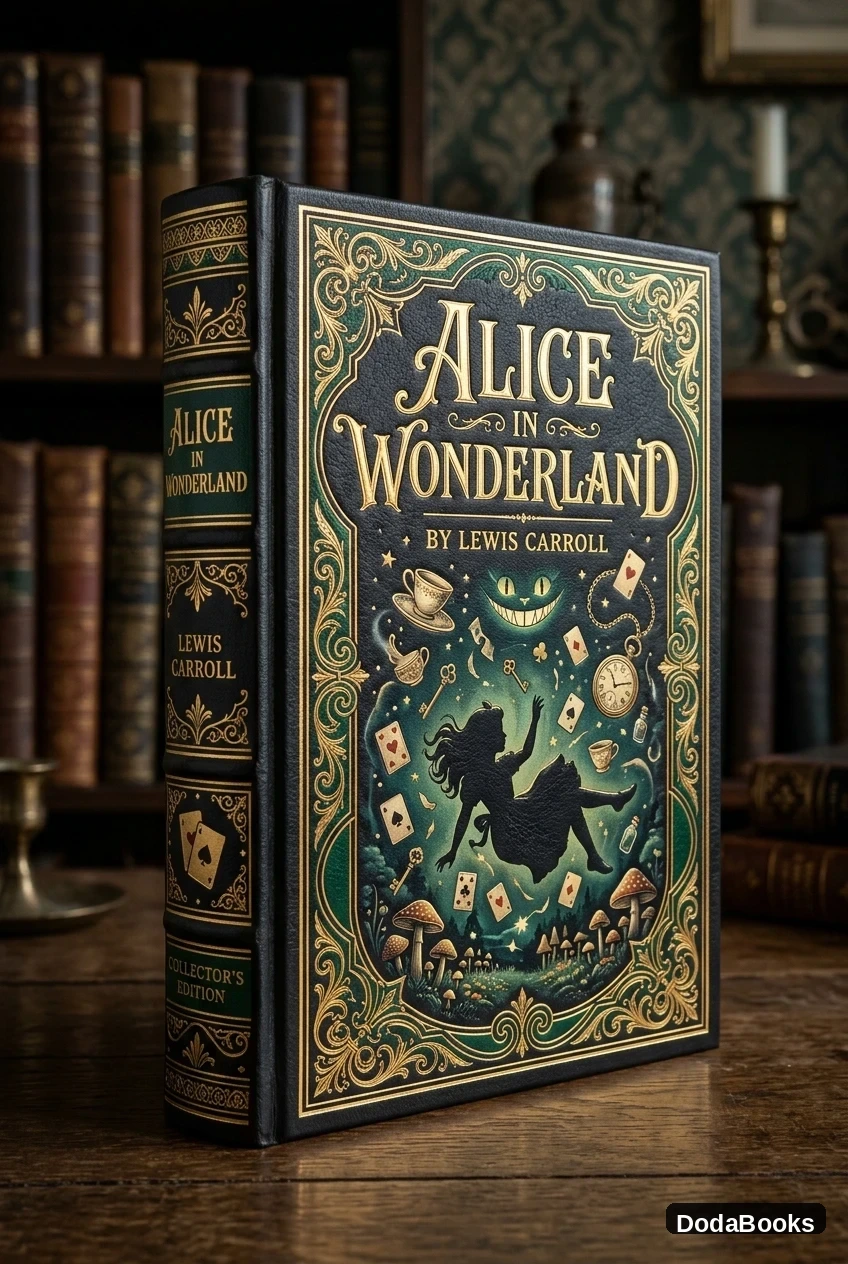
| Critical Dimension | Thematic Function in Wonderland |
|---|---|
| Existential Motif | Bodily Scale & Identity Crisis: The instability of the self during physical growth. |
| Intellectual Satire | Oxford Mathematics: Parodying quaternions, projective geometry, and symbolic logic. |
| Linguistic Theme | Semantic Subversion: Puns, literalized idioms, and the breakdown of communication. |
| Political Critique | Arbitrary Tyranny: Victorian governance and legal formalism exposed as absurd. |
| Educational Parody | Rote Verse Inversion: Moralistic schoolroom hymns twisted into predatory comedy. |
| Companion Analysis | Alice Study Guide • Pride & Prejudice Themes |
1. The Crisis of Childhood Identity and Bodily Scale
At the core of Alice’s Adventures in Wonderland is the terrifying instability of personal identity during the transition from early childhood to adulthood.
In Chapter 5 (“Advice from a Caterpillar”), the hookah-smoking insect bluntly interrogates Alice: “Who are YOU?” Alice can only reply in halting confusion:
“I—I hardly know, Sir, just at present—at least I know who I WAS when I got up this morning, but I think I must have been changed several times since then.”
The Psychological Horror of Somatic Instability
Alice’s physical body refuses to obey Newtonian physics or biological stability. By consuming potions labeled “DRINK ME,” cakes labeled “EAT ME,” and nibbling opposing sides of the Caterpillar’s mushroom, she experiences drastic physical fluctuations:
- Shrinking to Ten Inches: She is unable to reach the golden key left on the glass table, nearly drowning in a pool of her own giant tears.
- Growing to Nine Feet: Her neck elongates like a serpent through the canopy of the forest, causing an outraged Pigeon to attack her as an egg-stealing reptile despite Alice’s desperate protests that she is a little girl.
These wild scale shifts function as a brilliant psychological metaphor for the bewildering physical transformations of puberty. Children experience rapid bodily spurts and voice changes that alienate them from their own physical form. When adult authority figures demand that Alice define who she is, she discovers that her memory, size, and self-conception are completely fluid.
Like Dorian Gray’s supernatural portrait in The Picture of Dorian Gray Themes & Symbolism, which records inner spiritual alteration through altered matter, Alice’s changing physical stature mirrors her psychological alienation from the rigid domestic structures of Victorian society.
2. Oxford Mathematics and Non-Euclidean Satire
Charles Dodgson was not primarily an entertainer of children; he was a mathematical lecturer at Christ Church, Oxford, who published scholarly treatises on geometry, determinants, and formal logic. During the mid-nineteenth century, the world of mathematics was undergoing a revolutionary upheaval: traditional Euclidean geometry—which had grounded Western rationalism for two millennia—was being challenged by non-Euclidean geometries, symbolic algebra, and imaginary dimensions.
Dodgson was a conservative Euclidean who viewed many of these contemporary abstract innovations with skepticism and sharp satirical wit.
The Quaternions and the Mad Tea-Party
In Chapter 7 (“A Mad Tea-Party”), Carroll stages one of the most famous literary satires of higher mathematics in world literature:
| Historical / Mathematical Context | Wonderland Parody | Symbolic Interpretation |
|---|---|---|
| Hamilton’s Quaternions (1843) | The Hatter, March Hare, and Dormouse stuck in an eternal tea party. | Satirizing William Rowan Hamilton’s four-dimensional algebraic system ($i, j, k$, and scalar Time). |
| Quarreling with Time | The Hatter explains that he quarreled with Time last March at the Queen’s concert. | In quaternions, if Time ($t$) is held fixed, the spatial variables rotate endlessly without progressing. |
| Endless Clock Rotation | The hands remain frozen at 6:00 (tea-time); the trio constantly moves around the table. | When Time stops functioning as an active parameter, existence degenerates into circular repetition. |
| The Unanswerable Riddle | “Why is a raven like a writing-desk?” | Carroll satirizes pure formal logic detached from empirical reality; questions without answers. |
Similarly, Alice’s scaling dilemmas satirize projective geometry, where objects change proportions based on theoretical projection planes rather than fixed Euclidean ratios. When Alice tries to do mental arithmetic in Chapter 2—“Let me see: four times five is twelve, and four times six is thirteen, and four times seven is—oh dear! I shall never get to twenty at that rate!"—she is not speaking nonsense; she is performing base-arithmetic calculations using shifting number bases (base 18, base 21, base 24), demonstrating that Carroll’s apparent nonsense was governed by rigorous mathematical rules.
3. Linguistic Subversion and the Breakdown of Language
In Wonderland, human language ceases to function as a transparent medium of communication. Instead, words take on a stubborn, unruly physical existence of their own, constantly tripping up Alice’s rationalist Victorian education.
Literalizing Idioms and Parodying Verse
Carroll dismantles Victorian conversational conventions through three distinct linguistic techniques:
- Literalized Metaphors: When the Mock Turtle explains his education to Alice, he describes learning the regular branches of school: “Reeling and Writhing, of course, to begin with… and then the different branches of Arithmetic—Ambition, Distraction, Uglification, and Derision.” In Wonderland, figures of speech are taken literally: if you “beat time” in music, Time gets offended and refuses to move.
- Subversive Parody of Didactic Poetry: In Victorian classrooms, children were forced to memorize Isaac Watts’ pious moral hymns praising industriousness and warning against sinful idleness. In Wonderland, when Alice attempts to recite Watts’ solemn hymn “Against Idleness and Mischief”, her tongue recites an amoral, predatory ode to a smiling crocodile:
“How cheerfully he seems to grin,
How neatly spread his claws,
And welcome little fishes in
With gently smiling jaws!” - Semantic Anarchy: When Alice insists that saying what you mean is the same as meaning what you say, the March Hare, Hatter, and Dormouse mock her ruthlessly: “Not the same thing a bit! You might just as well say that ‘I see what I eat’ is the same thing as ‘I eat what I see’!” Carroll demonstrates that language is a fragile social contract; when its semantic conventions collapse, logic becomes an instrument of torment.
4. Alice’s Epistemological Progression through Wonderland
Alice’s journey down the rabbit hole is an intellectual and psychological pilgrimage through five distinct cognitive thresholds:
5. Arbitrary Tyranny: Jurisprudence and Political Parody
The final chapters of Alice’s Adventures in Wonderland present a devastating satire of political authoritarianism and legal bureaucracy.
The Queen of Hearts embodies unbridled monarchical despotism. She does not govern through constitutional law or reasoned debate; her sole response to every social awkwardness, dispute, or error is the hysterical shriek: “Off with his head!”
The Absurdities of the Royal Croquet Game
In Chapter 8, Alice participates in the Queen’s royal croquet game, which functions as an allegory of unfair, corrupt social systems:
- Live Animals as Instruments: The mallets are live flamingos that twist their necks upward to look into Alice’s face; the balls are live hedgehogs that unroll and crawl away; the wickets are playing-card soldiers bending over on their hands and feet.
- Absence of Rules: Players play all at once without waiting for turns, fighting violently over balls while the Queen storms about ordering executions.
- The King’s Secret Pardons: As soon as the Queen’s back is turned, the King quietly pardons all the condemned prisoners, exposing royal decrees as an empty, performative spectacle.
The Trial of the Knave of Hearts: Law Divorced from Reason
The climax of the novel—the trial of the Knave of Hearts for stealing tarts in Chapters 11 and 12—is a brilliant parody of the British legal system:
- Perversion of Due Process: The King acts simultaneously as judge, prosecutor, and jury coach, instructing the jury to consider their verdict before any witnesses have testified. When Alice objects, the Queen snaps her famous totalitarian rule: “Sentence first—verdict afterwards!”
- Fabricated Inculpation: An anonymous set of doggerel verses without signature or handwriting is introduced as decisive proof of the Knave’s guilt, with the King inventing tortured explanations for lines that mention neither tarts nor the Knave.
- The Dissolution of Tyranny: Alice’s growth throughout the trial is both physical and moral. When the King cites Rule Forty-Two (“All persons more than a mile high to leave the court”), Alice refuses to leave, pointing out that the King invented the rule on the spot. When the Queen screams for her execution, Alice shatters the illusion of authority forever:
“Who cares for you? You’re nothing but a pack of cards!”
With this declaration, Alice reclaims her empirical reason and autonomy. The playing cards fly into the air and cascade down upon her, dissolving the tyrannical nightmare and returning her to the sunlit riverbank of Victorian reality.
This confrontation with despotic authority links Alice’s intellectual defiance to the philosophical struggles against totalitarian obsession found in Moby-Dick Themes & Symbolism.
Recommended Critical Edition
For scholars, collectors, and readers seeking the definitive reading experience with historical annotations and restored Victorian artwork, we recommend the unabridged edition from DodaBooks:
Alice's Adventures in Wonderland (Annotated)
Rediscover Lewis Carroll's timeless masterpiece in an exquisite digital edition. Featuring complete historical annotations explaining Oxford mathematical satires, Victorian parodies, symbolic logic puzzles, and classic typographical layout optimized for modern e-readers.
- Complete, authoritative 1865 text with original typographical eccentricities
- Scholarly annotations explaining Victorian didactic verse parodies and quaternions
- Beautifully rendered custom 3D typography and digital formatting
- Instant EPUB download compatible with Kindle, tablets, and smartphones
Frequently Asked Questions
Why does the Cheshire Cat slowly disappear leaving only its grin?
The Cheshire Cat’s ability to vanish leaving only its grin represents a classic philosophical inquiry into substance versus attributes. In Western metaphysics, an attribute (such as a smile) cannot exist without the physical substance (the cat) that produces it. Carroll plays with symbolic abstraction, presenting a detached attribute existing independently in space, delighting readers while raising profound questions about the nature of physical reality.
What is the symbolic meaning of painting the white roses red in the Queen’s garden?
In Chapter 8, the three playing-card gardeners (Two, Five, and Seven) desperately paint white roses with red paint because they mistakenly planted a white rose tree instead of a red one demanded by the Queen, fearing beheading if discovered. This act symbolizes the artificial, deceitful cover-ups required to survive under despotic regimes, highlighting the pervasive hypocrisy forced upon subjects living in terror of arbitrary power.
Why is Alice’s sister included in the final scene of the novel?
The final scene on the riverbank shifts perspective to Alice’s older sister, who listens to Alice’s dream and pictures the little girl growing into a mature woman who will preserve the pure, loving heart of childhood. This frame narrative grounds Wonderland’s surreal anarchy in human tenderness, acknowledging that while adult life brings sober responsibilities, the wonder, curiosity, and imaginative freedom of youth remain a lifelong source of joy.
Explore Related Literature Masterworks
Continue your exploration of classic world literature and Victorian masterworks with our companion analyses:
- Alice in Wonderland Study Guide: Summary & Analysis: The foundational companion guide covering chapter breakdowns, character analysis, and historical context.
- Pride and Prejudice Themes & Symbolism: Explore Jane Austen’s masterful study of social class, marriage economics, and epistolary truth.
- The Picture of Dorian Gray Themes & Symbolism: Dive into Oscar Wilde’s gothic tragedy examining aestheticism, vanity, and the secret double life.
- Moby-Dick Themes & Symbolism: Analysis of Key Motifs: Discover Herman Melville’s monumental exploration of monomania, whiteness, and human hubris.