Tom Sawyer Characters: Analysis of Tom, Huck & Cast
When Mark Twain conceived The Adventures of Tom Sawyer in 1876, he created an ensemble of frontier personalities that permanently redefined American realism. Departing from the two-dimensional caricatures of nineteenth-century Sunday school tracts—which neatly segregated children into doomed juvenile delinquents and angelic, obedient prodigies—Twain crafted psychological portraits vibrating with authentic human vitality, moral ambiguity, and comedic brilliance.
At the psychological core of the novel lies the dynamic contrast between Tom Sawyer—the charming, book-intoxicated romantic rebel—and Huckleberry Finn—the unlettered, pragmatic outcast whose intuitive decency exposes the moral rot of antebellum society. Surrounding them is a vibrant frontier community: the guilt-ridden guardian Aunt Polly, the vengeful outcast Injun Joe, the chivalric catalyst Becky Thatcher, and the pious hypocrite Sid.
While our companion Tom Sawyer Study Guide and Tom Sawyer Themes & Symbolism deconstruct plot arcs and cultural motifs, this comprehensive study provides an academic character analysis of Mark Twain’s cast, examining their psychological motivations, social archetypes, and developmental trajectories.
Master Character Roster & Archetypal Matrix
| Character | Societal Role | Psychological Archetype | Central Conflict |
|---|---|---|---|
| Tom Sawyer | Middle-class orphan | The Romantic Rebel / Social Magician | Boyish independence and fantasy vs. civic duty and moral conscience. |
| Huckleberry Finn | Pariah son of town drunk | The Noble Savage / Natural Pragmatist | Absolute physical freedom vs. the stifling confinement of civilization. |
| Injun Joe | Mixed-race frontier criminal | The Avenging Shadow / Cultural Pariah | Bitter social alienation and vengeful malice vs. the rule of law. |
| Aunt Polly | Elderly maternal guardian | The Loving Disciplinarian | Calvinist spiritual duty (“spare the rod”) vs. tender maternal devotion. |
| Becky Thatcher | County Judge’s daughter | The Chivalric Ideal & Catalyst | Aristocratic vanity and coquetry vs. shared survival and emotional depth. |
| Sid Sawyer | Pious half-brother | The Malicious Conformist | Surface moral rectitude masking spiteful opportunism and jealousy. |
| Muff Potter | Gentle town drunkard | The Vulnerable Scapegoat | Naive alcoholism and helplessness vs. false murder allegations. |
1. Tom Sawyer: The Romantic Rebel and the Cult of Style
Tom Sawyer is one of the most complex creations in American literature: a mischievous, self-dramatizing boy whose actions are governed by an intricate chivalric aesthetic:
The Dominance of Literary Romanticism
Unlike Huck Finn, who responds to raw natural phenomena, Tom views reality through the prism of European romantic literature. He has voraciously read Walter Scott, Alexandre Dumas, Robin Hood ballads, and pirate yarns, absorbing their conventions as absolute dogma:
- The Compulsion of Ritual: For Tom, an adventure has no validity unless conducted strictly “by the book.” When playing Robin Hood with Joe Harper in Sherwood Forest, Tom refuses to fight out of turn, insisting that Robin Hood cannot fall until the ballad specifies that he is shot from behind.
- The Aesthetic of Transgression: Tom does not break rules out of malice; he breaks them to create theatrical drama. Stealing sugar from Aunt Polly’s closet, escaping through bedroom windows at midnight, and sneaking back to town to witness his own funeral are stage plays engineered to maximize personal glory.
- The Social Magician: In the legendary whitewashed fence episode (Chapter 2), Tom demonstrates uncanny insight into human psychology. By reframing arduous labor as an exclusive privilege, he reveals that human desire is driven by artificial scarcity, manipulating his peers into paying for the privilege of working.
The Moral Awakening: Conscience vs. Peer Loyalty
Tom’s critical character transformation occurs when childish make-believe collides with genuine mortal horror:
Tom emerges from the cave not merely as an audacious rascal, but as a legitimate civic hero whose internal moral compass has superseded childish fear. This psychological trajectory mirrors the ethical awakenings explored across world literature, such as Fitzwilliam Darcy’s cognitive maturation in our Pride and Prejudice Characters Analysis.
2. Huckleberry Finn: The Natural Pragmatist on the Margins
Huckleberry Finn stands as Tom Sawyer’s indispensable dramatic and philosophical foil. Where Tom is middle-class, literate, and theatrical, Huck is an outcast, illiterate, and rigorously pragmatic:
The Freedom of the Pariah
Huck is the son of the town drunkard, Pap Finn, who has completely abandoned him:
- Huck sleeps in empty wooden hogshead barrels, wears cast-off adult trousers held up by a single suspender, and eats when he can forage or fish.
- Every respectable mother in St. Petersburg cordially hates and dreads Huck because he is lawless, vulgar, and irreligious.
- Simultaneously, every boy in town secretly envies Huck with boundless passion because he enjoys absolute liberty: he goes barefoot from spring to frost, never washes, never attends church, and never has to obey a schoolmaster’s switch.
Comparative Analysis: Tom vs. Huck
The intellectual tension between Tom and Huck illustrates the division between European romantic convention and American frontier realism:
| Dimension | Tom Sawyer | Huckleberry Finn |
|---|---|---|
| Social Standing | Middle-class orphan with a home and family | Homeless outcast son of the town drunkard |
| Inspiration Source | Walter Scott romance novels and pirate books | Lived empirical experience and frontier nature |
| Attitude to Society | Craves community adulation and social respectability | Seeks total avoidance of institutional surveillance |
| Concept of Adventure | An elaborate theatrical performance “by the book” | A direct, practical confrontation with survival |
| Attitude to Wealth | Delighted by treasure; dreams of robber prestige | Indifferent to cash; finds wealth a burdensome cage |
Twain uses Huck to expose the artificiality of Tom’s games. In the novel’s final scene, when Huck refuses to live with Widow Douglas because civilized life is unbearable torture, Tom manipulates him into returning by insisting that one must be respectable to join his new gang of robbers. Huck submits to civilization’s chains only because his love for Tom’s imaginative companionship outweighs his longing for solitude.
3. Injun Joe: The Avenging Shadow of Frontier Hypocrisy
Injun Joe is the undisputed villain of Tom Sawyer, yet he is far more than a stock melodramatic monster; he is a terrifying manifestation of frontier racial trauma and social exclusion:
The Psychology of Grievance
Injun Joe’s deadly malice is fueled by lifelong humiliation at the hands of the white establishment:
- In Chapter 9, while extorting money from Dr. Robinson in the midnight graveyard, Joe reveals the deep historical roots of his grudge: “Five years ago you drove me away from your father’s kitchen one night, when I come to ask for something to eat, and you said I warn’t there for any good; and when I swore I’d get even with you if it took a hundred years, your father had me jailed for a vagrant. Did you think I’d forget? The Injun blood ain’t in me for nothing!”
- Later, Joe plots to mutilate the gentle Widow Douglas—slitting her nostrils and notching her ears like an animal—because her late husband, the county justice of the peace, once had him publicly horsewhipped for vagrancy.
The Shadow Double
Injun Joe functions as Tom Sawyer’s psychological shadow. Where Tom plays at being a bloodthirsty pirate and bandit for harmless romantic glory, Injun Joe is the genuine outlaw whose violent crimes bring real terror, blood, and death into the village. When Tom glimpses Injun Joe in the pitch-black depths of McDougal’s Cave, boyish romanticism dies: Tom realizes that real outlaws are not dashing Robin Hoods, but desperate, cornered predators.
Injun Joe’s death—starving behind the bolted iron door of McDougal’s Cave, desperately carving a drip-stone with his pocketknife—is treated by Twain with solemn, tragic gravity. Twain emphasizes the town’s swift transition from terror to hypocritical sentimentality: citizens petition the Governor for a posthumous pardon, flocking to weep at the monster’s funeral, proving that society loves villains only once they are safely dead.
4. Aunt Polly: The Crucible of Calvinist Love
Aunt Polly represents the domestic, maternal heart of St. Petersburg. An elderly, God-fearing Christian woman, her daily existence is consumed by the exhausting challenge of raising her spirited orphaned nephew:
The War Between Duty and Tenderness
Aunt Polly’s parenting is torn between two opposing philosophies:
- Calvinist Moral Rigor: She genuinely believes that children are born with sinful natures that must be purged through rigorous physical correction: “Spare the rod and spoil the child, as the Good Book says. I’m a-laying up sin and suffering for us both, I know. He’s full of the Old Scratch, but laws-a-me! he’s my own dead sister’s boy, and I ain’t got the heart to lash him, somehow.”
- Maternal Vulnerability: Whenever she whips Tom, her conscience burns with remorse; yet whenever she lets him off, her conscience accuses her of neglecting his spiritual salvation.
5. Becky Thatcher and Sid Sawyer: Foils of Youth
Twain rounds out his portrait of frontier youth through two contrasting figures representing courtship and domestic obedience:
Becky Thatcher: The Catalyst of Chivalry
Judge Thatcher’s daughter Becky is the romantic ideal of St. Petersburg: golden hair braided in two long tails, spotless white pinafore, and aristocratic poise:
- The Playground Coquette: Becky is spirited and proud. She matches Tom’s emotional games, breaking their engagement over his confession of prior love for Amy Lawrence, and flirting with Alfred Temple to provoke his jealousy.
- The Crucible of McDougal’s Cave: In the subterranean darkness, Becky’s decorative exterior falls away. Facing starvation and eternal night, she demonstrates profound emotional trust in Tom, while Tom proves his manhood by protecting her, sharing his last crumb of wedding cake, and braving the abyss to lead her to safety.
Sid Sawyer: The Hypocrisy of the Model Child
Tom’s younger half-brother Sid is the antithesis of boyish vitality:
- Sid is quiet, obedient, well-mannered, and attentive in Sunday School—the dream child of Victorian parenting literature.
- Yet Twain reveals that Sid’s good behavior is completely devoid of authentic virtue. He does not obey out of love; he conforms to gain adult favor and take malicious delight in seeing Tom whipped.
- In Chapter 1, it is Sid who maliciously exposes Tom’s swim by pointing out that Tom re-stitched his shirt collar with black thread instead of white. Sid embodies the petty, vindictive conformist whose surface piety conceals a cold, envious heart.
6. Muff Potter: The Vulnerable Scapegoat
The gentle, simple-minded town drunkard Muff Potter plays a crucial catalytic role in Tom’s moral development:
- The Exploited Victim: Having blacked out from alcohol during the graveyard brawl, Potter genuinely believes Injun Joe’s lie that he murdered Dr. Robinson with his own pocketknife.
- The Unconditional Kindness: Chained in the town jail, Potter holds no bitterness against the village. When Tom and Huck bring him tobacco, he weeps with gratitude, praising them as the only souls in town who have not forgotten an old friend.
- The Catalyst for Redemption: Potter’s innocence forces Tom to choose between selfish cowardice and heroic truth. By taking the witness stand, Tom saves Potter from the gallows, restoring him to dignity and humanity.
Recommended Critical Edition
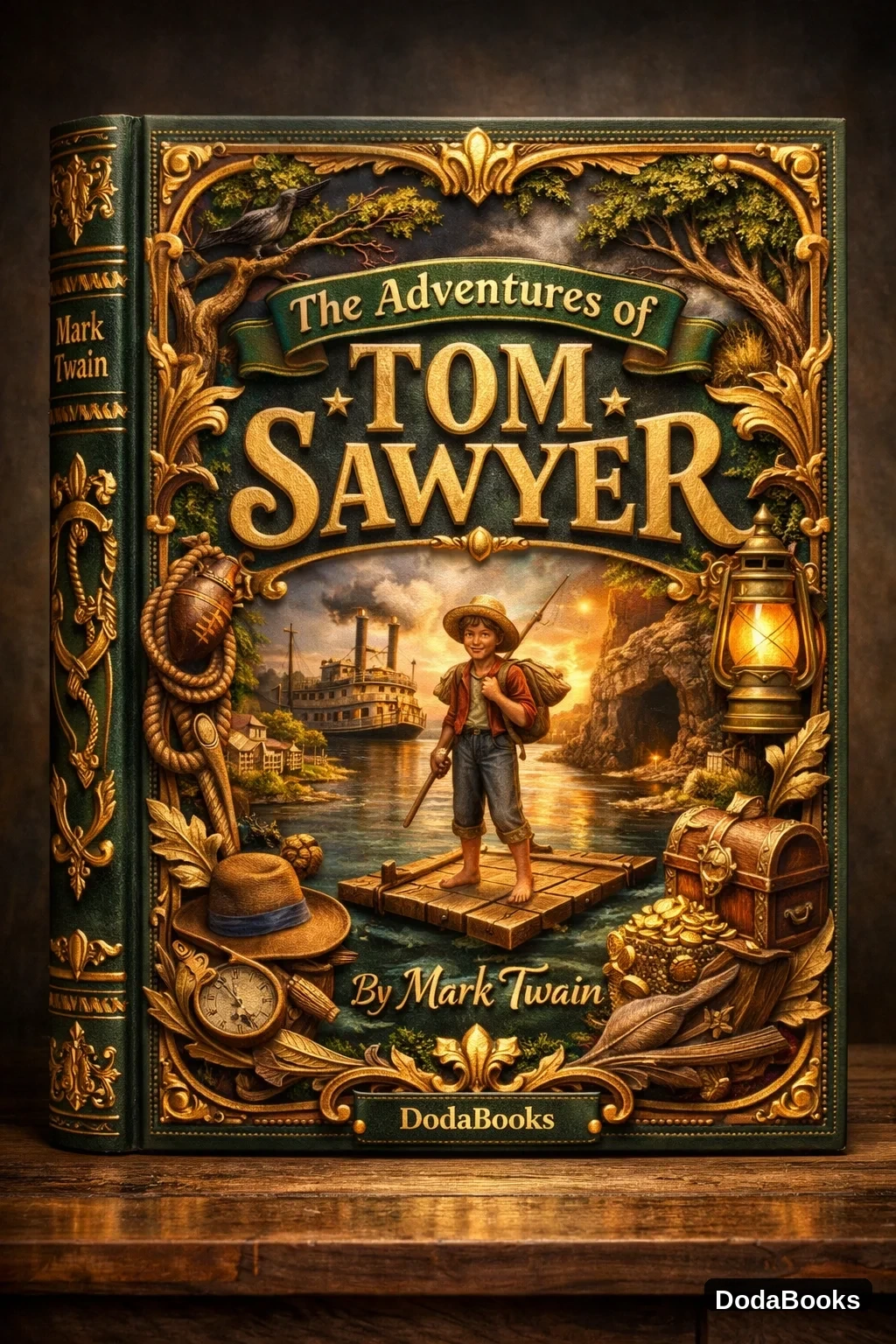
For literature teachers, university students, and collectors seeking the authoritative text with comprehensive character breakdowns, historical context on Missouri borderland culture, and dialect notes, we recommend the unabridged edition from DodaBooks:
The Adventures of Tom Sawyer: Complete Edition
Discover Mark Twain’s immortal classic in a magnificent scholarly presentation. Featuring the complete unabridged 35-chapter novel text, exhaustive historical footnotes on nineteenth-century Mississippi frontier life, character analyses, and critical essays on American realism.
- Complete, authoritative unabridged 35-chapter novel text
- Comprehensive character profiles and historical dialect glossaries
- Exquisite custom 3D typography and digital formatting optimized for modern e-readers
- Instant EPUB download compatible with Kindle, Apple Books, and Kobo
Frequently Asked Questions
Why does Tom Sawyer choose to take Becky Thatcher’s whipping in school?
In Chapter 20, Becky accidentally tears a page of schoolmaster Mr. Dobbins’s secret medical anatomy book. When Mr. Dobbins demands to know who committed the crime, Tom leaps to his feet and shouts, “I done it!” taking the savage whipping on his own back. This act of chivalric self-sacrifice marks a major milestone in Tom’s emotional maturity: he willingly endures intense physical agony and public humiliation to shield the girl he loves from shame, earning Becky’s permanent devotion.
How does Mark Twain use Sid to satirize the “Good Boy” genre of Victorian literature?
During the nineteenth century, popular Sunday school books constantly featured saintly “good boys” who never got dirty, always memorized Bible verses, and died young with angelic smiles. Twain despised this artificial genre. Through Sid, Twain exposes the dark psychological reality behind such paragons: Sid’s spotless obedience is motivated entirely by selfish opportunism, lack of imagination, and spiteful jealousy toward his more charismatic brother.
What is the thematic significance of Widow Douglas adopting Huck Finn at the end of the novel?
Widow Douglas’s adoption of Huck Finn represents civilization’s attempt to domesticate the wild American frontier spirit. The Widow provides Huck with clean clothes, education, bedsheets, and regular meals, but demands that he surrender his autonomy, attend church, and conform to social decorum. Huck’s absolute misery under her roof demonstrates that bourgeois respectability can be more suffocating and spiritually destructive than material poverty.
Explore Related Literature Masterworks
Continue your exploration of classic world literature and character psychology with our companion analyses:
- Tom Sawyer Study Guide: Themes, Characters & Plot: The foundational comprehensive study guide to Mark Twain’s frontier masterpiece.
- Tom Sawyer Themes & Symbolism: Key Motifs Analysis: Deconstruct the whitewashed fence, the cave katabasis, and Mississippi folklore.
- Pride and Prejudice Characters: Elizabeth, Darcy & Cast: Explore Jane Austen’s psychological breakdown of pride, prejudice, and Regency character arcs.
- Moby-Dick Characters Analysis: Ahab, Ishmael & Crew: Examine Herman Melville’s deconstruction of totalitarian obsession, corporate morality, and the Pequod crew.