The Metamorphosis Study Guide: Summary & Analysis
First published in Leipzig in late 1915 by Kurt Wolff Verlag, Franz Kafka’s The Metamorphosis (Die Verwandlung) stands as the defining masterwork of twentieth-century modernist literature and existential dread. Written in a feverish three-week burst in late 1912 while Kafka was employed as a daytime legal clerk at the Workers’ Accident Insurance Institute in Prague, the novella translates the anonymous bureaucratic pressures, economic exhaustion, and patriarchal terror of modern industrial life into an indelible surrealist parable.
Unlike traditional mythological metamorphoses in Ovid or fairy tales where transformations are magical, retributive, or redemptive, Kafka’s narrative begins with the catastrophe already completed. In the famous opening sentence—one of the most scrutinized in world literature—there is no prologue, no metaphysical explanation, and no moral justification:
“Als Gregor Samsa eines Morgens aus unruhigen Träumen erwachte, fand er sich in seinem Bett zu einem ungeheuren Ungeziefer verwandelt.”
(“One morning, when Gregor Samsa woke from troubled dreams, he found himself transformed in his bed into a monstrous vermin.”)
Rather than panicking about his physical monstrosity, Gregor’s immediate cognitive anxiety concerns missing the 5:00 AM train to work and facing the wrath of his employer. This monstrous dissonance between biological horror and commercial triviality encapsulates the Kafkaesque: a world in which the economic apparatus has so thoroughly colonized the human soul that losing one’s livelihood is experienced as a catastrophe far more terrifying than losing one’s humanity.
While our companion guides deconstruct philosophical allegories in The Metamorphosis Themes & Symbolism and map familial psychodynamics in The Metamorphosis Characters Analysis, this foundational study guide provides students, educators, and critical scholars with an exhaustive academic deconstruction of Kafka’s novella.
Fast Facts: Masterwork Overview
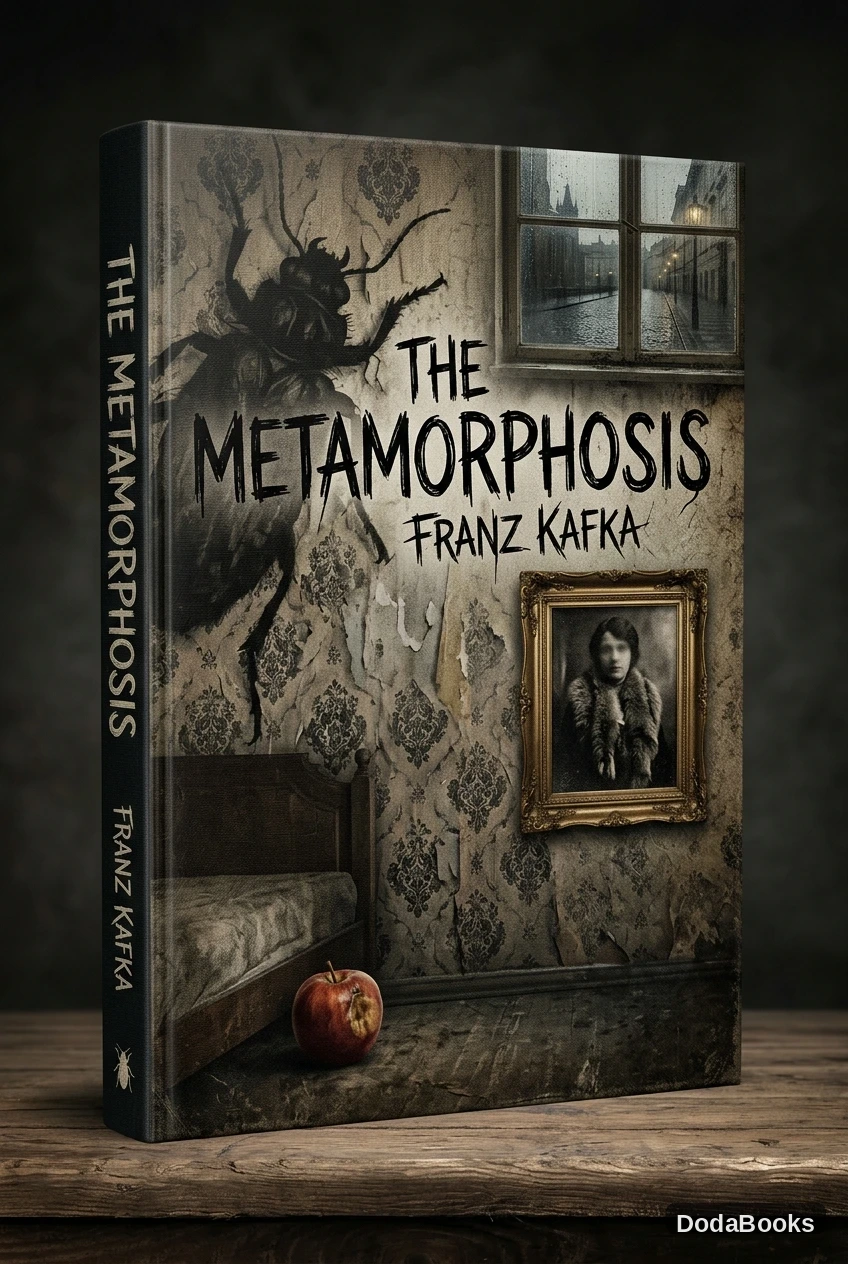
| Category | Detail |
|---|---|
| Author | Franz Kafka (1883–1924) |
| Publication Date | November 1915 (Die Weißen Blätter), December 1915 (Kurt Wolff Verlag) |
| Original Language | German (Die Verwandlung) |
| Literary Genre | Modernist Fiction / Absurdist Fiction / Psychological Novella |
| Setting | The Samsa family apartment, Prague, Bohemia (Austro-Hungarian Empire), early 20th century |
| Narrative Form | Third-person limited focalized primarily through Gregor Samsa’s perspective |
| Central Conflict | Gregor’s struggle to maintain human consciousness, familial dignity, and love while physically reduced to repulsive vermin |
| Climax | Grete’s violin recital in Section III, leading to her public renunciation of Gregor (“We must get rid of it”) |
| Key Concepts | Ungeziefer, Alienation, The Father’s Debt, The Embedded Apple, Exploitative Family Dynamics, The Clean Sweep |
Historical, Biographical & Linguistic Context
To comprehend the psychological depths of The Metamorphosis, one must examine three intersecting dimensions of Kafka’s life and historical era:
Biographical: Hermann Kafka
Kafka lived under the crushing psychological shadow of his tyrannical father, Hermann Kafka, a self-made dry-goods merchant whose booming voice, physical vitality, and bourgeois materialism terrorized his sickly, sensitive son. In his famous 1919 Letter to His Father, Franz explicitly linked his feelings of worthlessness and bodily inadequacy to his father's suffocating judgment—a dynamic mirrored directly in Mr. Samsa's violent assault upon Gregor.
Socioeconomic: The Bureaucratic Grind
Employed by the semi-nationalized Workers' Accident Insurance Institute, Kafka spent his days calculating disability indemnities for industrial workers whose fingers and limbs had been mangled in factory machinery. Kafka saw firsthand how modern industrial capitalism reduces human beings to disposable physical components, discarding workers the instant their bodies fail to generate profit.
Linguistic: The Meaning of Ungeziefer
Kafka chose the Middle High German term Ungeziefer, derived from roots meaning 'an animal unsuitable for sacrificial offering'—an unclean, reviled beast that pollutes the sacred precinct. By leaving the creature's exact species ambiguous, Kafka ensured that Gregor represents not a specific bug, but the universal human experience of social abjection, contamination, and spiritual disqualification.
The Tripartite Structural Architecture
Kafka divided The Metamorphosis into three distinct, symmetrically balanced sections, each culminating in a violent confrontation between Gregor and his father that forces Gregor back into his quarantined bedroom:
          SECTION I                           SECTION II                          SECTION III
[The Morning of Awakening]            [Quarantine & Division]                [Starvation & Rebirth]
           │                                    │                                      │
• Gregor wakes as vermin              • Grete feeds rotting scraps          • Three lodgers occupy flat
• Chief Clerk arrives                 • Furniture stripped away             • Grete's violin recital
• Gregor opens bedroom door           • Picture of lady in fur              • Grete renounces "it"
• Father drives him back with         • Father bombards with apples;        • Gregor dies in peace;
  cane and newspaper rolled.            Apple rots in Gregor's flesh.         Family rides tram into spring.
Detailed Plot Breakdown & Narrative Analysis
Section I: The Morning of Awakening
The narrative begins inside Gregor Samsa’s modest bedroom. Gregor, a traveling textile salesman, awakes to find his body radically altered: his back has hardened into a curved, brown, armor-plated carapace; his pale, segmented belly is arched in stiff sections; and numerous fragile, spindly legs wave helplessly before his eyes.
Remarkably, Gregor’s initial thoughts are entirely mundane:
- He inspects the dreary weather: rain dripping against the windowpane;
- He complains about his exhausting profession: irregular meals, constant travel, temporary acquaintances who never become true friends;
- He agonizes over the family debt: five years earlier, his father’s business collapsed, forcing Gregor to take a grueling sales job to repay his father’s debts to his tyrannical boss.
                  THE TRAP OF ECONOMIC DEBT
     [Father's Failed Business] ──► Massive Debt to Employer
                 │
                 ▼
     [Gregor's Five-Year Contract]
     • Wakes at 4:00 AM daily
     • Never misses a day of work
     • Pays apartment rent, bills, Grete's violin lessons
                 │
                 ▼
     [Metamorphosis as Biological Strike]
     The body physically refuses to get on the 5:00 AM train.
When Gregor fails to catch the 5:00 AM or 7:00 AM trains, his mother, father, and seventeen-year-old sister Grete knock anxiously on the three doors that surround his bedroom. Soon, the Chief Clerk (Prokurist) arrives in person from the firm, demanding an explanation for Gregor’s uncharacteristic tardiness and immediately insinuating that Gregor has been stealing company funds.
Summoning superhuman effort, Gregor maneuvers his cumbersome bulk to the door, using his toothless jaws to turn the key in the lock. The door swings open.
The reaction is instantaneous and catastrophic:
- The Chief Clerk covers his mouth with his hand, backing slowly down the hallway with an expression of paralyzed horror before fleeing down the marble staircase;
- Mrs. Samsa sinks into her skirts, her hair coming undone, staring blankly before crying: “Help, for God’s sake, help!”;
- Mr. Samsa clenches his fists with a hostile grimace, seizes the Chief Clerk’s abandoned walking stick in his right hand and a heavy newspaper in his left, and stamps his feet, hissing like a wild beast to drive Gregor back into his room.
As Gregor struggles to turn his wide, clumsy body through the narrow doorway, he becomes wedged in the opening. His father delivers a merciless blow from behind, sending Gregor flying into the dark room, bleeding profusely from his injured flank, before slamming and bolting the door shut.
Section II: Domestic Quarantine & The Apple Bombardment
Gregor awakens from a deep, comatose slumber in the evening twilight. Attracted by the smell of food, he finds that someone has placed a bowl of fresh sweet milk with floating slices of white bread by the door—his favorite meal as a human. However, when he tastes it, he is repulsed: his new physiology cannot tolerate fresh human food.
The following morning, Grete notices the untouched milk. Sensing that her brother’s tastes have altered, she brings an assortment of decaying food scraps on an old newspaper:
“There were old, half-decayed vegetables; bones from the evening meal covered in a white sauce that had solidified; a few raisins and almonds; a piece of cheese that Gregor had declared inedible two days before; a dry crust of bread; a crust smeared with butter and salt.”
Gregor devours the rotting cheese and rotten vegetables with ravenous delight. Thus begins a routine of domestic quarantine: twice a day, Grete cleans Gregor’s room and provides food while their parents wait outside in fearful silence. Gregor discovers that his eyesight is deteriorating—the street across the way now appears as an indistinct gray desert—while his physical agility increases. He takes pleasure in scuttling across the walls and hanging from the floral ceiling.
The Stripping of the Room & The Lady in Furs
Noticing Gregor's habit of crawling on the ceiling, Grete decides to remove his heavy furniture—the writing desk, the chest of drawers—to give him open space. Gregor initially welcomes the idea, but as his mother and sister drag the furniture away, he experiences a sudden panic: they are stripping away every tactile trace of his human identity. Desperate to salvage a single artifact of his humanity, Gregor scuttles up the wall and presses his warm, sticky belly against the framed print of the lady wrapped in a massive fur boa—a picture he had cut from an illustrated magazine and framed in gold. When his mother enters and sees the enormous brown beast clinging to the wall, she collapses unconscious on the sofa.
Grete rushes out to fetch smelling salts; Gregor follows her into the hallway to help, but Grete screams in terror. At that moment, Mr. Samsa returns home from his new job as a bank messenger, dressed in a sharp blue uniform with gold buttons.
Misunderstanding the situation, the father assumes Gregor has mounted a violent assault upon his mother. Refusing to listen, the father stalks Gregor around the dining room table, his heavy boots thumping, unbuckling his fury. Reaching into a bowl on the sideboard, the father begins pelting Gregor with red apples:
“An apple thrown without much force grazed Gregor’s back and slid off harmlessly. But another that followed immediately afterward embedded itself deeply in his back; Gregor wanted to drag himself onward, as if the shocking, unbelievable pain might pass with a change of position; but he felt as though he were nailed to the spot and stretched out in the complete confusion of all his senses.”
The rotting apple remains wedged in Gregor’s flesh for the remainder of his life, an incurable wound that impairs his mobility and marks the beginning of his physical decline.
Section III: Decline, Death, and the Family’s Rebirth
For more than a month, Gregor suffers from the festering wound caused by the apple. Yet the family feels a lingering pang of guilt; as compensation, they begin leaving the living room door slightly ajar in the evenings, allowing Gregor to lie in the darkness of his room and watch his family through the crack.
The domestic landscape has altered drastically:
- The family dismissed the servant girl, hiring a crude, bony old charwoman (Bedienerin) with white hair who visits morning and evening;
- The mother sews fine lingerie for a fashion house;
- Grete studies French and stenography in the evenings, working as a salesgirl;
- The father refuses to take off his bank messenger uniform even when resting, sleeping in his armchair while the gold buttons grow tarnished with grease;
- To generate income, the family rents three rooms to three bearded lodgers, serious gentlemen who demand immaculate cleanliness and order.
Gregor’s room becomes the household junk depository: unwanted furniture, broken boxes, ash cans, and kitchen refuse are shoved into his sanctuary. Covered in dust, cobwebs, and remnants of old food, Gregor lies neglected in the filth.
       [GREGOR'S DECLINE]                          [FAMILY'S REVITALIZATION]
Wounded by rotting apple                    Mr. Samsa working as bank messenger
Starving; Refuses food                      Mrs. Samsa sewing fine lingerie
Room turned into garbage dump               Grete working as salesgirl & studying
Filthy, neglected, covered in dust          Family rents rooms to three lodgers
The climax occurs one evening when Grete plays her violin in the kitchen for the lodgers. The lodgers invite her into the living room, but quickly grow bored, standing by the window smoking cigars. Drawn irresistibly by the beauty of the music, Gregor creeps out of his room into the light of the living room, mesmerized:
“Was he an animal, that music could move him so? He felt as if the way were opening before him to the unknown nourishment he had so longed for.”
Gregor dreams of confessing to Grete that he had intended to send her to the Music Conservatory before his metamorphosis, vowing to defend her violin playing with his life.
However, one of the lodgers spots the dust-covered vermin crawling on the rug. The lodgers are outraged by the unsanitary conditions, announcing that they are terminating their lease immediately without paying rent.
Once the lodgers retreat to their bedrooms, Grete breaks down in tears. Banging her fist on the table, she delivers the fatal verdict:
“My dear parents,” said his sister, slapping her hand on the table by way of an introduction, “things cannot go on like this. Perhaps you don’t realize it, but I do. I won’t pronounce the name of my brother in front of this monster, and so all I say is: we must try to get rid of it. We’ve done everything humanly possible to take care of it and put up with it; I don’t think anyone can blame us in the least… It has to go… If it were Gregor, he would have realized long ago that human beings can’t live with such a beast, and he would have gone away of his own free will.”
Gregor listens in the darkness. Turning his agonizingly painful body around, he crawls back into his bedroom. He harbors no hatred or bitterness toward his family:
“He remembered his family with tenderness and love. His opinion that he must disappear was if anything even firmer than his sister’s.”
At three o’clock in the morning, watching the faint gray light of dawn illuminate his window, Gregor’s chin drops to the floorboards, and his final breath leaves his nostrils.
The Aftermath: The Clean Sweep
The following morning, the old charwoman discovers Gregor’s flat, desiccated corpse. She pokes him with her broom handle:
“Just look at this, it’s kicked the bucket; it’s lying there, completely dead!”
The family enters the room. Mr. Samsa crosses himself: “Well, now we can thank God.” He immediately evicts the three arrogant lodgers from the apartment, ordering them to leave on the spot. The charwoman reports that she has already disposed of Gregor’s corpse (“You don’t need to worry about how to get rid of that stuff in there. It’s already been taken care of”).
The Samsa family takes the day off from work—a luxury they have not permitted themselves in months. Boarding an electric tramcar, they ride out into the warm, sunlit open countryside on the outskirts of Prague. Discussing their finances, they realize that despite their hardships, their prospects are remarkably bright: all three have secure, promising jobs, and they resolve to move to a smaller, cheaper, and more pleasant apartment.
In the novella’s closing image, Mr. and Mrs. Samsa notice their daughter’s physical transformation:
“As they watched their increasingly lively daughter, it struck both Mr. and Mrs. Samsa almost at the same moment that in spite of all the sorrow that had made her cheeks pale, she had blossomed recently into a pretty, shapely young woman… And it was like a confirmation of their new dreams and good intentions when at the end of their ride their daughter was the first to spring to her feet and stretch her young body.”
The physical blossoming of Grete’s young body is purchased directly with Gregor’s death. Having extracted all economic and emotional life from their son, the bourgeois family discards his empty husk, turning with predatory vitality to their daughter to secure their next social investment on the marriage market.
The Concept of the “Ungeziefer” and Entomological Realism
A persistent debate in Kafka scholarship concerns the physical nature of Gregor’s form:
- The Myth of the Cockroach: The English translation of Ungeziefer as “giant cockroach” (popularized by Willa and Edwin Muir’s 1933 translation) is technically inaccurate. In German, a cockroach is a Küchenschabe.
- Nabokov’s Entomological Analysis: In his celebrated Lectures on Literature at Cornell University, novelist and lepidopterist Vladimir Nabokov analyzed the anatomical details in Kafka’s text:
- Gregor has a domed, convex back (gewölbten braunen Rücken);
- A hard, segmented belly divided into arched calluses;
- Many thin, jointed legs with tiny suction pads (Klammerbeinen);
- Strong mandibles capable of turning a brass key;
- Most significantly, Nabokov pointed out that beneath the hard carapace on his back, Gregor possesses wings—an anatomical feature Gregor never discovers because he is so psychologically constrained by his human habits that he never attempts to fly. Nabokov classified Gregor as a giant beetle (Coleoptera).
- Kafka’s Insistence on Non-Representation: When Kurt Wolff prepared the first edition of Die Verwandlung in 1915 with an illustration by Ottomar Starke, Kafka sent an urgent letter forbidding any depiction of the insect:
“The insect itself is not to be drawn. It is not even to be seen from a distance… If I may make a suggestion, I should choose scenes like the following: the parents and the head clerk in front of the locked door, or even better, the parents and the sister in the lighted room, while the door to the completely darkened adjoining room stands open.”
Kafka recognized that the horror of the metamorphosis is strictly subjective and psychological. To draw the bug is to reduce an existential crisis of being to a cheap carnival spectacle.
Frequently Asked Questions
What exact creature does Gregor Samsa turn into in The Metamorphosis?
Kafka deliberately avoided specifying a concrete biological species, using the German phrase ‘ungeheuren Ungeziefer’—meaning a monstrous vermin or unclean beast unfit for sacrificial offering. While popular culture often depicts Gregor as a giant cockroach, Vladimir Nabokov famously argued from textual evidence (domed armored back, segmented belly, little legs, hidden wings) that Gregor is an enormous beetle. Crucially, Kafka instructed his publisher Kurt Wolff never to draw the insect on the cover, emphasizing that the transformation is an internal existential condition rather than an entomological curiosity.
Why does Gregor’s father throw apples at him, and what is their significance?
In Section II, when Gregor inadvertently alarms his mother during the removal of his bedroom furniture, Mr. Samsa retaliates by pelting Gregor with red apples from the dining sideboard. One apple wedges deeply into Gregor’s soft armored back, where it remains embedded and slowly rots for months, causing an incurable festering infection. Symbolically, the apple evokes the biblical Fall of Man and original sin, representing the father’s lethal patriarchal judgment, guilt, and the physical sentence of death imposed upon a son who has failed his economic obligations.
How does Grete’s attitude toward Gregor change across the three sections?
In Section I and II, Grete acts as Gregor’s sole protector and nurse, bringing him various foods to discover his new palate, opening his window, and cleaning his room. However, as she takes a job as a salesgirl and Gregor’s presence threatens the family’s lodger revenue, her sympathy transforms into exhausted resentment. In Section III, after Gregor disrupts her violin recital, Grete explicitly renounces his humanity, referring to him as ‘it’ and declaring: ‘We must try to get rid of it… it is killing you both, I see it coming.’
Related Masterwork Guides & Deconstructions
Continue your exploration of modernist literature, existential psychological crises, and psychological alienation across our canon:
- The Metamorphosis Themes & Symbolism: Deconstruct the Ungeziefer, the father’s uniform, the lady in furs, and the violin.
- The Metamorphosis Characters Analysis: Analyze Gregor’s sacrifice, Mr. Samsa’s wrath, Grete’s transformation, and the lodgers.
- The Picture of Dorian Gray Study Guide: Full Text Analysis: Compare Kafka’s psychological alienation with Oscar Wilde’s portrait of aesthetic decadence.
- Crime and Punishment Study Guide: Full Text Analysis: Examine psychological alienation and moral redemption in Dostoevsky’s Petersburg.
- Dr. Jekyll and Mr. Hyde Study Guide: Full Analysis: Contrast Gregor’s involuntary bodily metamorphosis with Dr. Jekyll’s chemical transformation into Edward Hyde.