Gulliver’s Travels Study Guide: Summary & Analysis
Published anonymously in Dublin and London in late October 1726 by publisher Benjamin Motte under the full title Travels into Several Remote Nations of the World. In Four Parts. By Lemuel Gulliver, First a Surgeon, and then a Captain of Several Ships, Jonathan Swift’s masterwork stands as the most corrosive, multifaceted prose satire in the history of the English language. Disguised brilliantly within the popular eighteenth-century genre of the authentic maritime travelogue—complete with meticulously engraved fictional cartography, nautical terminology, latitude measurements, and deadpan documentary verisimilitude—the text operates as a devastating multi-layered assault against political corruption, scientific hubris, colonial conquest, religious intolerance, and the profound moral vanity of humanity.
Rather than offering a gentle didactic moral comedy in the vein of Joseph Addison or Richard Steele, Swift famously declared in a letter to Alexander Pope in September 1725 that his governing artistic purpose was “to vex the world rather than divert it.” Over nearly three centuries, Gulliver’s Travels has maintained an extraordinary double life: frequently bowdlerized, abridged, and illustrated as an innocent children’s fantasy of miniature men and flying islands, while remaining in its unabridged four-part totality one of the darkest philosophical inquiries ever mounted against the humanist conviction that man is a rational animal (animal rationale). In Swift’s uncompromising redefinition, man is at best merely rationis capax—an animal occasionally capable of reason, who almost invariably employs that faculty to multiply, systematize, and disguise his innate animal brutality.
While our companion analyses explore psychological character foil dynamics in Gulliver’s Travels Characters Analysis and deconstruct symbolic allegories in Gulliver’s Travels Themes & Symbolism, this comprehensive study guide provides educators, university scholars, and literary researchers with an exhaustive textual, historical, and structural deconstruction of Swift’s foundational narrative.
Fast Facts: Masterwork Overview
| Category | Detail |
|---|---|
| Author | Jonathan Swift (1667–1745) |
| Publication Date | October 28, 1726 (Benjamin Motte, London) |
| Original Language | English |
| Literary Genre | Menippean Satire / Philosophical Travelogue / Parodic Allegory |
| Narrative Form | First-person epistolary pseudo-autobiographical travel memoir |
| Structure | Four distinct voyage books (39 total chapters) with prefatory publisher letters |
| Central Conflict | The collision between European self-righteous exceptionalism and objective moral depravity across alien civilizations |
| Key Milestones | Immediate sensation selling out within a week; praised by Alexander Pope, Voltaire, and John Gay |
Historical & Political Context: Augustan Satire and the Scriblerus Club
To understand the ferocious satirical bite of Gulliver’s Travels, readers must locate the work within the turbulent political, economic, and scientific landscape of early Georgian Britain (1714–1726). The accession of King George I of the House of Hanover in 1714 marked the total collapse of the Tory ministry led by Robert Harley, Earl of Oxford, and Henry St. John, Viscount Bolingbroke, with whom Jonathan Swift had served as chief political propagandist and editor of The Examiner.
Following the Tory downfall, the Whig party established an entrenched parliamentary oligarchy orchestrated by Sir Robert Walpole—Britain’s first de facto Prime Minister. Swift, exiled to Dublin as Dean of St. Patrick’s Cathedral, watched with bitter dismay as Walpole consolidated political authority through an unprecedented system of royal patronage, Treasury bribery, financial speculation, and aggressive censorship.
       ┌─────────────────────────────────────────────────────────────┐
       │                The Augustan Satirical Matrix                 │
       └──────────────────────────────┬──────────────────────────────┘
                                      │
         ┌────────────────────────────┼────────────────────────────┐
         ▼                            ▼                            ▼
  Court Oligarchy             Colonial Conquest           The New Science
(Walpole's Whig Hegemony)    (Maritime Mercantilism)    (Royal Society Hubris)
         │                            │                            │
   Parodied as:                 Parodied as:                 Parodied as:
• Lilliputian Tightropes     • Plunder of Indigenous     • Academy of Lagado
• Low-Heels vs. High-Heels     Territories (Part IV)     • Extracting Sunbeams
• Big-Endians vs. Little     • Exploitation of Ireland     from Cucumbers
The Scriblerus Club and the Mock-Travel Genre
The intellectual origins of Gulliver’s Travels stem from the Scriblerus Club, an informal literary circle formed in London around 1714 comprising Swift, Alexander Pope, John Gay, Dr. John Arbuthnot, and Thomas Parnell. Their shared mission was to satirize the pedantry, bad taste, and pseudo-intellectualism of the age under the persona of a pedantic German scholar named “Martinus Scriblerus.” Swift assumed the assignment of parodying contemporary travel memoirs—particularly popular bestsellers like William Dampier’s A New Voyage Round the World (1697) and Daniel Defoe’s Robinson Crusoe (1719).
Defoe’s Crusoe had celebrated the triumph of middle-class English ingenuity, practical Protestant piety, and benevolent imperial ownership over virgin wilderness. Swift weaponized Defoe’s own documentary realism to invert this myth: instead of civilizing the wilderness, Gulliver discovers that European civilization is itself the most monstrous savagery on earth.
The Financial Revolution and Colonial Mercantilism
The early 1720s were characterized by runaway financial speculation, culminating in the catastrophic collapse of the South Sea Bubble in 1720. Thousands of British investors, including members of parliament and royal ministers, were ruined in a fraudulent speculative scheme predicated on projected slave trade monopolies in Spanish America. Swift observed firsthand how intangible paper wealth, speculative joint-stock companies, and imperial expansion dismantled traditional agrarian ethics and legal integrity. In Part III, Swift directly satirizes this financial fever through the “Projectors” of Balnibarbi, whose speculative schemes ruin fertile lands in pursuit of impossible innovations.
Complete Four-Part Plot Architecture & Narrative Deconstruction
Swift organizes Lemuel Gulliver’s twenty-six years of wandering into an architectural progression that systematically dismantles European self-complacency. Each voyage operates on a precise mathematical scale, shifting the protagonist from giant among pygmies to insect among giants, from pragmatic observer among detached academics to a traumatized beast kneeling before virtuous equines.
Voyage Progression & Epistemological Collapse:
┌─────────────────┐     ┌──────────────────┐     ┌──────────────────┐     ┌──────────────────┐
│ Part I: Lilliput│ ──> │Part II:Brobdingnag│ ──> │ Part III: Laputa │ ──> │ Part IV: Equines │
│ Scale: 1 to 12  │     │ Scale: 12 to 1   │     │ Scale: Abstract  │     │ Scale: Species   │
│ Physical Giant  │     │ Physical Vermin  │     │ Grounded vs Air  │     │ Yahoo vs Equine  │
│ Political Pride │     │ Moral Dissection │     │ Science Failure  │     │ Total Misanthropy│
└─────────────────┘     └──────────────────┘     └──────────────────┘     └──────────────────┘
Part I: A Voyage to Lilliput (The Satire of Court Politics & Petty Ambition)
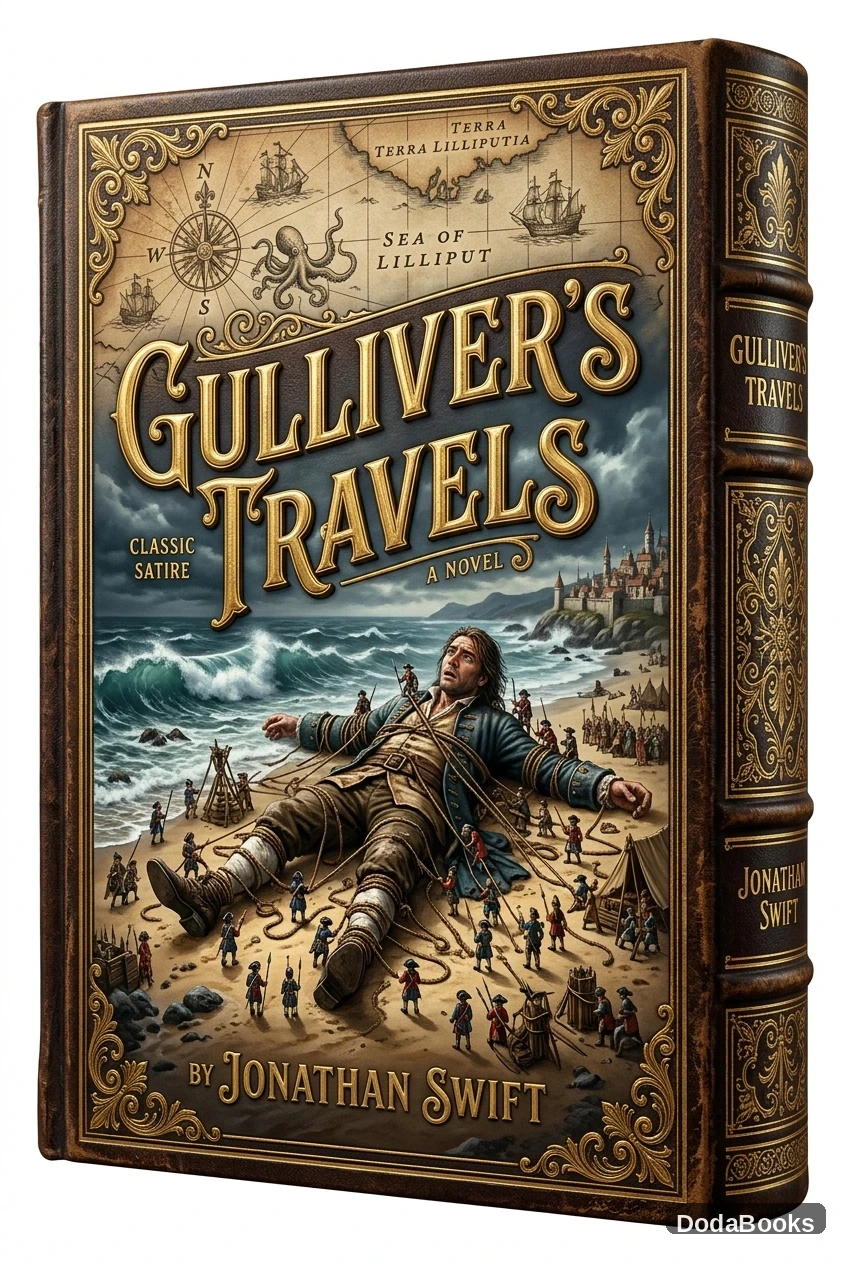
Following a disastrous shipwreck in November 1699, Lemuel Gulliver awakens on the shore of Lilliput to discover himself securely bound to the earth by thousands of slender cords, surrounded by six-inch-tall humanoid inhabitants armed with miniature bows and arrows. The Lilliputians construct a massive wheeled engine propelled by hundreds of miniature horses to transport the “Man-Mountain” (Quinbus Flestrin) to their imperial metropolis of Mildendo, chaining him inside an ancient desecrated temple.
       Scale Contrast: Lilliput (1:12)
       ┌────────────────────────────────────────────────────────┐
       │ Gulliver (Man-Mountain): Consumes 1,728 rations daily  │
       │ Emperor: 6 inches tall, claimed "delight of universe" │
       │ High Offices: Awarded by tightrope dancing proficiency │
       └────────────────────────────────────────────────────────┘
Swift rapidly strips the initial fairy-tale charm of Lilliput to reveal a venomous caricature of George I’s court:
- The Tightrope Performers: Ministerial appointments, cabinet seats, and royal honors (represented by blue, red, and green silk threads) are not earned through administrative wisdom or legal scholarship, but by who can leap highest on a suspended rope without breaking their neck—a direct lampoon of Sir Robert Walpole’s political balancing acts.
- The Tramecksan vs. Slamecksan: Lilliputian politics is fractured into two vicious factions distinguished solely by the height of their shoe heels: the High-Heels (Tories) and the Low-Heels (Whigs). The reigning Emperor wears only low heels, but his heir displays a grotesque political vacillation by walking with one high heel and one low heel, causing him to hobble absurdly through the corridors of power.
- The Big-Endian vs. Little-Endian War: Lilliput is locked in an existential conflict with the neighboring empire of Blefuscu over whether soft-boiled eggs should be cracked at the larger or smaller end. This theological dispute has cost forty ships of the line, hundreds of smaller vessels, and thirty thousand lives, directly mirroring England’s sectarian wars between Protestantism and Catholicism.
Gulliver initially assists the Emperor by wading across the channel, cutting the anchor cables of Blefuscu’s imperial fleet, and dragging fifty enemy warships back to Lilliput. However, when the megalomaniacal Emperor demands that Gulliver help him completely subjugate Blefuscu and execute all Big-Endian exiles, Gulliver flatly refuses to be an instrument of tyranny.
His doom is sealed when he extinguishes a catastrophic fire in the Empress’s palace apartments by urinating directly upon the imperial chambers—saving the palace but committing high treason under Lilliputian sumptuary law. Orchestrated by his jealous rivals Flimnap and Skyresh Bolgolam, articles of impeachment are drawn up against Gulliver, condemning him to have his eyes put out while being starved slowly to death. Warned by a friendly courtier, Gulliver flees to Blefuscu, repairs an abandoned full-sized boat, and escapes back to England with miniature livestock hidden in his pockets.
Part II: A Voyage to Brobdingnag (The Moral Microscope of Physical Magnification)
Two months after returning home, Gulliver’s insatiable maritime wanderlust drives him back to sea aboard the Adventure. Blown off course by violent gales in June 1702, the crew makes landfall on an unknown peninsula to forage for fresh water. When a gigantic humanoid pursues the longboat back to the ship, the crew abandons Gulliver in a field of sixty-foot-tall barley. Captured by a native farmer who stands seventy feet high, Gulliver experiences an absolute, terrifying inversion of Part I: he who was a demigod among the Lilliputians is now treated as a miniature plaything, equivalent to a weasel, frog, or wind-up toy.
       Scale Inversion: Brobdingnag (12:1)
       ┌────────────────────────────────────────────────────────┐
       │ Gulliver: 6 feet tall (treated as a vulnerable insect)  │
       │ Brobdingnagians: 72 feet tall; pores like craters      │
       │ King's Verdict: "Most pernicious race of little vermin"│
       └────────────────────────────────────────────────────────┘
The farmer exploits Gulliver as a commercial freak show, exhibiting him across market towns until Gulliver nearly collapses from physical exhaustion. Hearing of the phenomenon, the Queen purchases Gulliver for a thousand pieces of gold. The farmer’s gentle nine-year-old daughter, Glumdalclitch (“little nurse”), is retained at court to care for him, sewing him clothes and constructing a padded carrying box (travelling box) to protect him from palace hazards—including giant rats, predatory dwarf pranks, falling apples, and a pet monkey who kidnaps him to the palace roof.
In Brobdingnag, Swift employs physical magnification as a moral microscope:
- The Repulsiveness of the Human Flesh: Gulliver is sickened by the Brobdingnagian women’s skin, where magnified pores resemble open craters, hairs appear like stout bristles, and blemishes look like mountainous tumors. When the palace maids-of-honor undress before him, treating him as an inanimate creature incapable of sexual consciousness, Gulliver feels immense nausea rather than titillation, illustrating Swift’s theme of the grotesque frailty of the biological body.
- The King’s Political Interrogation: In Chapters VI and VII, the wise, humane King of Brobdingnag summons Gulliver to explain the constitution, laws, military apparatus, and religious structure of Great Britain. Gulliver proudly describes the British Parliament, the courts of equity, the standing army, and the global empire. With forensic Socratic cross-examination, the King deconstructs Gulliver’s claims, asking why a nation of peaceful islanders requires a vast standing mercenary army, why justice is so expensive that only the wealthy can afford it, and why gamblers and bankrupts are elevated to the House of Lords.
The philosophical climax of Part II occurs when Gulliver, hoping to win royal favor, offers to teach the King the secret recipe for gunpowder—describing how brass and iron cannons can blow up entire battalions, smash walls to dust, and tear human bodies limb from limb. The King is struck with sheer horror, condemning Gulliver as an unnatural monster:
“He was amazed how so impotent and groveling an insect as I… could entertain such inhuman ideas, and in so familiar a manner appear wholly unmoved at all the scenes of blood and desolation I had painted as the common effects of those destructive machines; whereof, he said, some evil genius, enemy to mankind, must have been the first contriver.”
The King concludes his examination with the novel’s most famous and devastating political assessment: that European humanity is “the most pernicious race of little odious vermin that nature ever suffered to crawl upon the surface of the earth.”
Gulliver’s captivity terminates when an eagle mistakes his travel box for a tortoise shell, carries it out over the open ocean, and drops it into the sea, where an English merchant vessel rescues him.
Part III: Laputa, Balnibarbi, Glubbdubdrib, Luggnagg & Japan (The Critique of Scientific Hubris)
Departing once again on the Hopewell in August 1706, Gulliver’s vessel is seized by Dutch and Japanese pirates in the East Indies, and Gulliver is set adrift in a small canoe. He reaches a cluster of barren rocky islands where he spots a gigantic, circular flying island hovering in the sky: Laputa.
                The Floating Citadel of Laputa
                    ┌─────────────────────┐
                    │    Floating Island  │  <-- Controlled by Lodestone
                    └──────────┬──────────┘      (Magnetic Levitation)
                               │
            Drops Rocks / Taxes│Starves Sun & Rain
                               ▼
                    ┌─────────────────────┐
                    │ Balnibarbi (Colony) │  <-- Ruined by Academic
                    │  City of Lagado     │      "Projectors" & Theorists
                    └─────────────────────┘
Laputa represents Swift’s satire of the Enlightenment Royal Society (whose president was Sir Isaac Newton) and imperial colonial oppression:
- The Laputan Intellectuals: The ruling aristocrats have heads tilted perpetually to the right or left, with one eye turned inward and the other directly upward toward the zenith. They are so profoundly absorbed in abstract speculative mathematics, geometry, and celestial mechanics that they are incapable of noticing physical obstacles, requiring servant “Flappers” armed with blown bladders filled with dried peas to strike them gently on the mouth and ears to hold a conversation. Their houses are crooked and falling down because their architects despise practical measurements, and their wives routinely cuckold them with mainlanders because the philosophers notice nothing outside abstract theorems.
- The Oppressive Floating Lodestone: The island is propelled magnetically by a massive lodestone mounted inside an astronomical chasm. Swift transforms this technological marvel into an instrument of imperial terror: when continental subjects in the subordinate territory of Balnibarbi revolt against crushing taxes, the King hovers Laputa directly over the rebelling city, cutting off all sunlight and rain until the population starves, or crushing their buildings directly under the island’s stone bottom—an allegory for England’s brutal economic strangulation of Ireland.
- The Grand Academy of Lagado: Gulliver visits the mainland metropolis of Lagado, where the entire agrarian economy lies in ruins because the “Projectors” have abandoned traditional farming methods in favor of absurd scientific experiments. Inside the Academy, Gulliver witnesses:
- A philosopher attempting to extract sunbeams from cucumbers to warm the air during inclement summers.
- An architect attempting to build houses from the roof downward.
- A projector attempting to soften marble into pincushions.
- A linguist trying to abolish spoken words entirely, forcing citizens to carry heavy sacks of physical objects on their backs to communicate through silent display.
- Glubbdubdrib and the Deconstruction of History: On the island of magicians, the Governor allows Gulliver to conjure the spirits of the dead. Gulliver interrogates Alexander the Great, Hannibal, Caesar, and Brutus. To his horror, Gulliver discovers that classical historians lied systematically: glorious military victories were won through cowardly accidents or poison; noble senators were corrupt sycophants; and illustrious aristocratic lineages originated from liaisons between noble ladies and stable boys, coachmen, and footmen.
- The Struldbruggs of Luggnagg (The Curse of Immortality): In Luggnagg, Gulliver learns of the Struldbruggs—rare individuals born with a red circular mark on their forehead who are physically incapable of dying. Gulliver enthusiastically imagines living forever as an immortal philosopher accumulating universal knowledge and wealth. However, the King reveals the nightmarish reality: the Struldbruggs possess immortality without eternal youth. Upon reaching eighty, they lose their memories, teeth, hair, and taste; at ninety, they forget the names of their children; by a hundred, their language changes so rapidly that they can no longer communicate with living generations. Declared legally dead at eighty, they wander the kingdom as wretched, envious, parasitic ghosts—an indelible demonstration of the folly of human desire.
Part IV: A Voyage to the Country of the Houyhnhnms (The Philosophical Climax)
Appointed Captain of the merchantman Adventure in 1710, Gulliver suffers mutiny when his replacement crew consists of recruited buccaneers who chain him in his cabin and maroon him on an unfamiliar, tranquil shore. Venturing inland, Gulliver encounters a herd of hideous, hairy, quadrumanous beasts with flat faces, hooked claws, and coarse brown skin, who climb trees and discharge excrement upon his head: the Yahoos.
                The Great Anthropological Divide
       ┌─────────────────────────────────────────────────────────┐
       │             The Master Houyhnhnm (Horse)                │
       │ • Pure Reason (*animal rationale*)                      │
       │ • No words for Lie, Falsehood, War, or Deceit           │
       │ • Calm, Benevolent, Stoic, Free from Passion            │
       └────────────────────────────┬────────────────────────────┘
                                    │ Evaluates
                                    ▼
       ┌─────────────────────────────────────────────────────────┐
       │                 Lemuel Gulliver (Human)                 │
       │ • Endowed with reason, but uses it to multiply vices    │
       │ • Despises Yahoos, yet shares their identical anatomy   │
       └────────────────────────────┬────────────────────────────┘
                                    │ Terrified of
                                    ▼
       ┌─────────────────────────────────────────────────────────┐
       │                  The Yahoos (Human Beast)               │
       │ • Pure Animal Instinct, Filth, Greed, and Gluttony      │
       │ • Hoard shiny stones, gorge on carrion, attack kin      │
       └─────────────────────────────────────────────────────────┘
Suddenly, a dapple gray horse approaches, scattering the savage beasts with serene authority. Accompanied by a brown bay horse, the animal conducts a forensic inspection of Gulliver’s shoes, coat, and hands, speaking a melodious, guttural language. Gulliver is escorted to a clean, timber-framed dwelling where he expects to meet the human master of the estate, only to realize that the horses are the masters: they are the Houyhnhnms (pronounced “whin-hims”, imitating a horse’s whinny), meaning in their tongue “the perfection of nature.”
Swift constructs Houyhnhnm society as a radical utopian embodiment of pure, unadulterated Stoic reason:
- The Absence of Falsehood: Their vocabulary has no word for lying, deceit, or hypocrisy; to communicate an untruth is expressed periphrastically as saying “the thing which was not,” since the sole purpose of speech is to communicate understanding.
- The Elimination of Vices: They have no crime, no money, no class envy, no standing armies, and no concept of speculative philosophy. They govern their community through an annual Representative Council based on universal benevolence and friendship.
- The Nature of the Yahoos: The Houyhnhnms employ the wild, degenerate Yahoos as beasts of burden. When Gulliver removes his clothing to sleep, his Houyhnhnm host inspects his naked body and is horrified to discover that Gulliver is anatomically identical to the filthy, despised Yahoos, distinguished only by a whiter skin, hairless body, and a thin capacity for rational speech.
Over three years, Gulliver acquires the Houyhnhnm tongue and explains the architecture of European civilization to his master: the religious wars that slaughtered millions over whether bread is flesh or wine is blood; the legal system where lawyers spend their careers proving that white is black and black is white; the medical profession that poisons healthy bodies to generate fees; and the money system where ninety-nine percent of the population starves in labor so that one percent may gorge on luxury.
The Master Houyhnhnm delivers Swift’s crushing indictment:
“When a creature pretending to reason could be capable of such enormities, he dreaded lest the corruption of that faculty might be worse than brutality itself… that nature had given us only a small spark of reason, which we used solely to aggravate our natural corruptions, and to acquire others which nature had never given us.”
When Gulliver is bathing in a river, a young female Yahoo is enflamed with sexual desire and plunges into the water to embrace him, confirming beyond all denial his biological identity as a Yahoo. Gulliver embraces his submission completely: he adopts the trot, gestures, and tone of the horses, desiring nothing more than to spend the remainder of his days in a quiet cottage serving the Houyhnhnms.
However, the General Assembly of Houyhnhnms rules that it is unnatural to keep a Yahoo with reasoning capacity inside a domestic household, fearing he might lead a rebellion among the wild Yahoos. Heartbroken, Gulliver constructs a wooden canoe caulked with Yahoo tallow, bids an agonizing farewell to his master, kisses the hoof of his benefactor, and casts off into the Pacific.
Rescued against his will by the benevolent Portuguese maritime captain Don Pedro de Mendes, Gulliver shrinks from human touch in horror, plugging his nose with rue and lavender to block the stench of European flesh. Returned to Redriff in England, he cannot bear to look upon or be touched by his wife and children. He purchases two young horses, stables them beside his garden, and spends four hours every morning conversing with them, concluding his memoirs with an impassioned plea: that any human being afflicted with the monstrous sin of Pride should never dare appear in his sight.
The Four Voyages: Comparative Analytical Matrix
| Dimension | Part I: Lilliput | Part II: Brobdingnag | Part III: Laputa & Academy | Part IV: Houyhnhnmland |
|---|---|---|---|---|
| Geographic Scale | 1:12 (Gulliver is 12× larger) | 12:1 (Brobdingnagians are 12× larger) | Disconnected / Floating / Subterranean | Species Inversion (Horse rules Human) |
| Primary Satirical Target | Court intrigue, party politics, Whig corruption | Physical vanity, military violence, imperial hubris | Scientific hubris, theoretical detachment, bad historiography | The humanist myth of man as a rational animal |
| Gulliver’s Role | Benevolent protector / imperial weapon | Helpless court curiosity / vulnerable insect | Observant traveler / skeptical tourist | Convert / Traumatized misanthropic disciple |
| Key Symbol | Tightrope leaps & silk threads | The King’s laughter & gunpowder rejection | Academy Projectors extracting sunbeams | The Yahoo carcass & the Horse’s hoof |
| Moral Epiphany | Petty ambition makes men smaller than insects | Magnified physical detail reveals moral deformity | Knowledge divorced from human utility breeds devastation | Reason weaponized without virtue is demonic malice |
Pedagogical Application: Seminar Discussion & Examination Prompts
For literature seminars, college educators, and AP English classrooms, Swift’s Gulliver’s Travels offers rich terrain for dialectical interrogation:
- The “Hard” vs. “Soft” School of Swift Criticism: Is Swift speaking directly through Gulliver at the end of Part IV, demanding that humanity embrace total misanthropic self-abnegation? Or does the heroic, selfless benevolence of Captain Don Pedro de Mendes operate as a deliberate authorial foil to demonstrate that Gulliver’s fanatical obsession with equine rationality is itself an absurd, prideful form of madness?
- The Politics of Scale in Political Philosophy: How does Swift use the mathematical shift between Part I and Part II to deconstruct Thomas Hobbes’s concept of the Leviathan? Does absolute physical superiority naturally confer moral authority, or does power inevitably degenerate into paranoia?
- The Academy of Lagado and Modern Technocracy: Compare Swift’s parody of the Grand Academy Projectors with 21st-century technological utopianism (e.g., artificial intelligence, geoengineering, transhumanism). Where does Swift draw the boundary between legitimate scientific inquiry and dangerous intellectual hubris?
Frequently Asked Questions
What are the four voyages in Gulliver’s Travels, and what does each satirize?
Jonathan Swift structures Gulliver’s Travels into four distinct voyages, each targeting specific dimensions of human depravity and institutional folly. Part I (Lilliput) satirizes European court politics, religious factionalism, and petty ambition through six-inch miniatures. Part II (Brobdingnag) reverses perspective to expose the physical grossness and moral inadequacy of European civilization when scrutinized by enlightened giants. Part III (Laputa, Balnibarbi, Glubbdubdrib, and Luggnagg) parodies speculative science, Enlightenment rationalism detached from practical utility, corrupt historiography, and the horrifying vanity of immortality through the Struldbruggs. Part IV (The Country of the Houyhnhnms) delivers Swift’s devastating philosophical climax, contrasting rational equine nobility with the bestial, avaricious nature of human Yahoos.
Why do the Big-Endians and Little-Endians go to war in Lilliput?
The war between Lilliput (Little-Endians) and Blefuscu (Big-Endians) satirizes the bitter, centuries-long religious and political conflicts between Protestant England and Catholic France, particularly sparked by King Henry VIII’s break from Rome. The dispute originates from an imperial decree mandating that all subjects break their boiled eggs at the smaller end after an emperor’s son cut his finger breaking an egg at the traditional larger end. Swift uses this absurd culinary schism to illustrate how institutional authorities wage catastrophic wars, persecute citizens, and distort holy doctrine over completely trivial sectarian pretexts.
Why does Gulliver reject human society and prefer horses at the end of the novel?
Upon returning to England after living among the Houyhnhnms, Gulliver suffers profound psychological alienation and misanthropy. Having witnessed the serene rationality, honesty, and benevolence of the horses—and having recognized that human beings are merely Yahoos endowed with enough reason to magnify their vices—he cannot endure the smell, sight, or conversation of his wife and children. He purchases two horses, spends four hours daily conversing with them in the stables, and views human pride as an unforgivable absurdity in a creature so biologically and morally corrupt.
Read the Complete Unabridged Masterwork on DodaBooks
Experience Jonathan Swift’s Gulliver’s Travels in its full, unabridged four-part glory. The DodaBooks annotated digital edition features clean typography, complete chapter footnotes, historical maps of Lilliput and Brobdingnag, and deep critical commentary formatted for e-readers, tablets, and phones.
Get the DodaBooks Edition — $5.99